An elliptical junction and a 23-patient preliminary study.
Reading Library · Anesthesia Epochs · 中文版
Watch the companion film
1981: Archie Brain — The Laryngeal Mask · Watch on YouTube
Historical anchor: 1981. Date details and source qualifications are explained below.
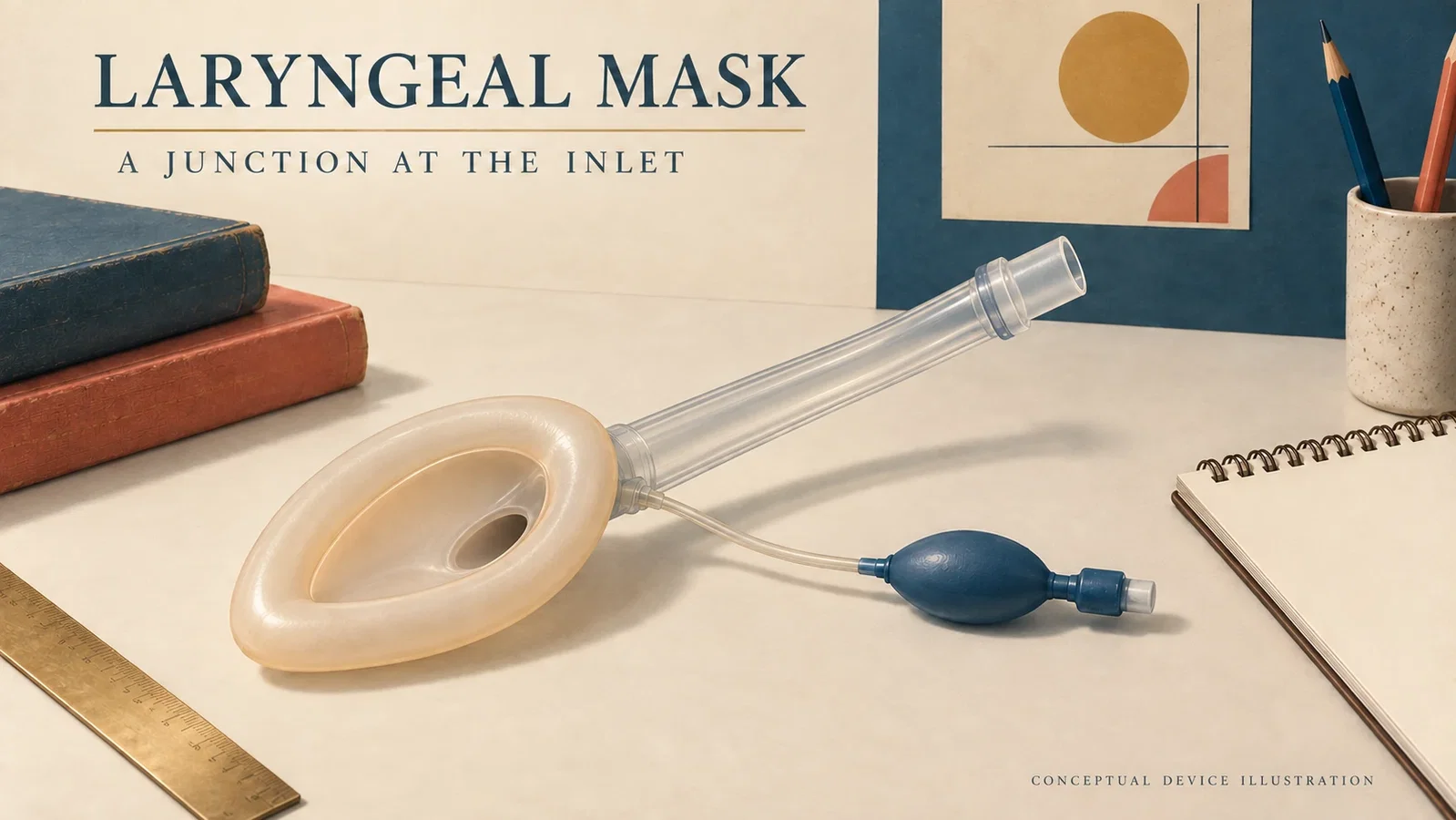
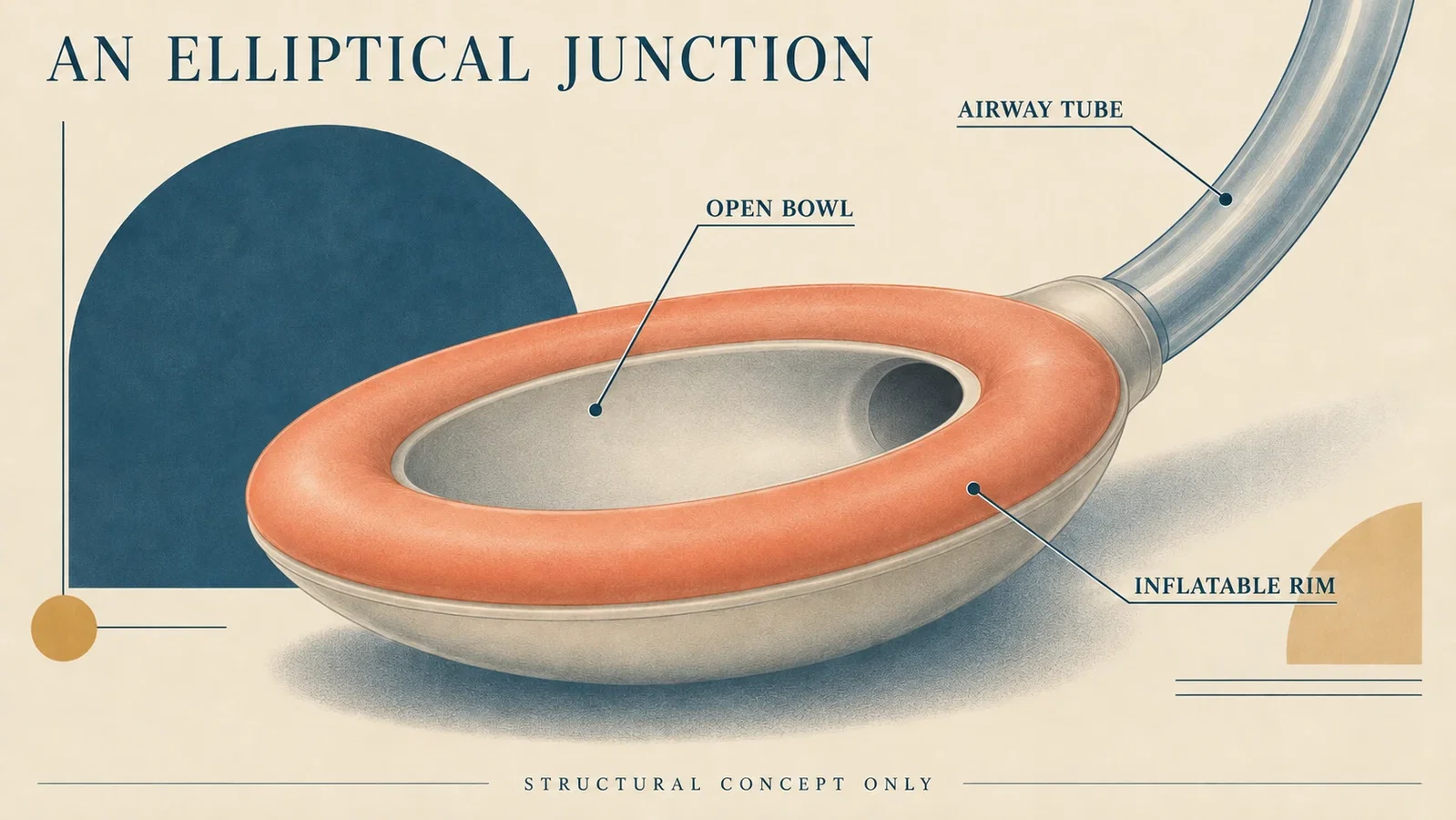
Brain opened his 1983 paper with a mechanical description of tracheal intubation: one tube placed inside another. He considered whether a gas-tight junction could instead meet the airway at the laryngeal inlet. Examination of postmortem specimens suggested that an elliptical inflatable cuff in the hypopharynx could make such a junction.[1, p. 801]
The prototype combined parts already at hand: the rubber cuff of a Goldman paediatric dental mask and clear Portex tubing, with a separate inflation line. The original illustration shows a shallow, spoon-like device.[1, pp. 801–802] Its junction surrounds the laryngeal inlet; the airway tube itself does not pass through the vocal cords. This account describes a historical design, rather than instructions for making or inserting a device.
The article's 1981 date comes from the Wood Library-Museum's account of when Brain began development. The original paper followed in 1983. The museum separately places commercial availability for clinical use in the United Kingdom in 1988, and availability in the United States in 1992.[2] Development, publication and commercial supply therefore belong to different dates. These sources do not establish an exact day of first clinical use in 1981.
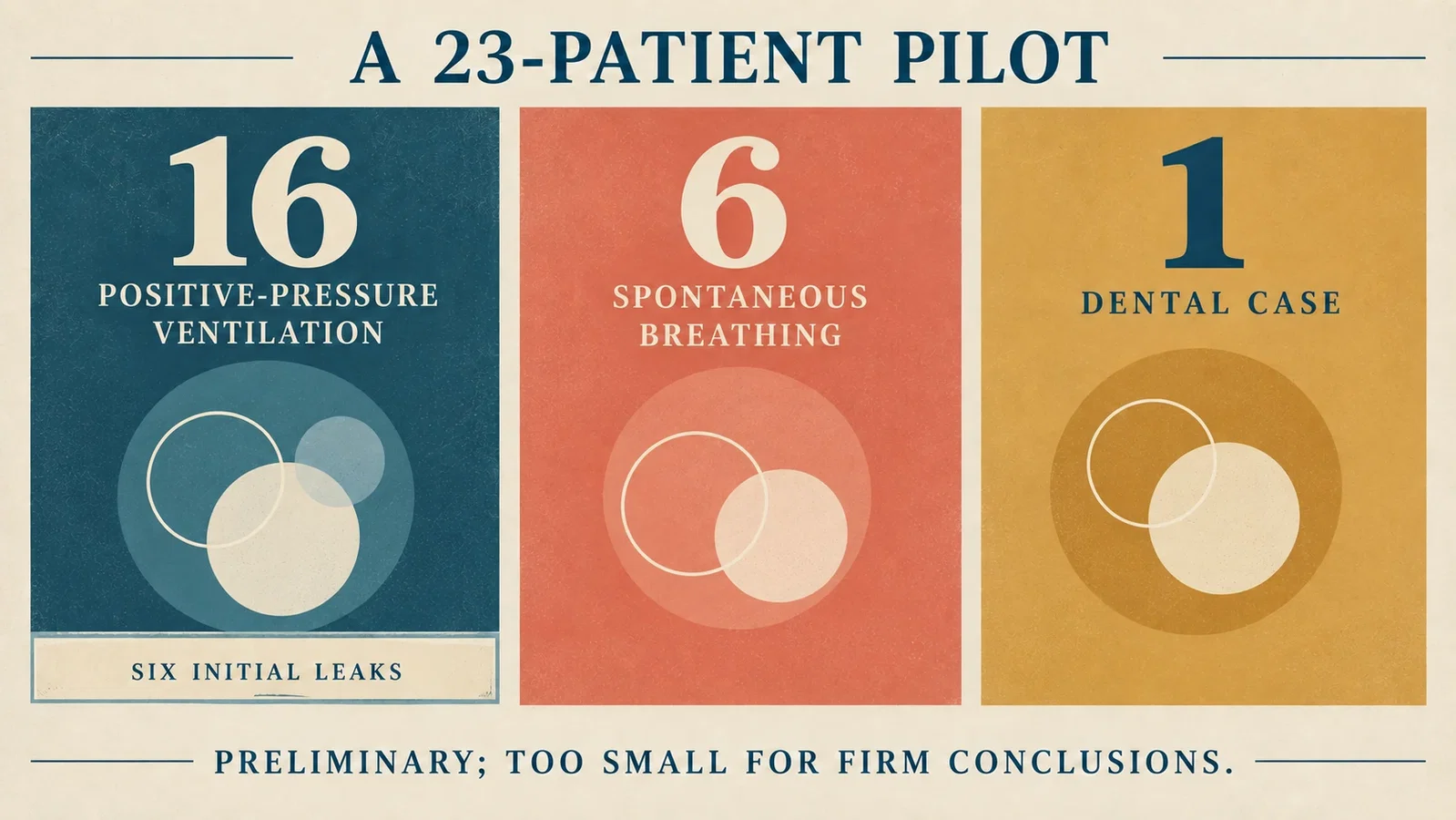
The reported pilot study involved 23 patients: 16 women undergoing laparoscopic procedures for assessment of positive-pressure ventilation, six patients breathing spontaneously and one dental patient.[1, pp. 801–803] Ventilation was achieved in all 16 patients in the first group, but six initially had leaks. Five resolved after adjustments or changes of prototype; one stopped spontaneously. Three patients in that group reported a mild sore throat. These observations show both what worked and what still needed refinement.

Brain repeatedly described the study as preliminary and too small for firm conclusions. The discussion mentioned experience in another 108 patients without reporting them in the same detail as the pilot. Adding the two numbers would misrepresent the paper as a fully reported 131-patient study.[1, pp. 803–804] The observation in one dental patient likewise does not establish general protection from aspiration of gastric contents. The later silicone and disposable devices pictured by the museum should not be mistaken for photographs of the 1981 prototype.[2]
Later difficult-airway documents provide useful comparisons. The 2013 ASA guideline distinguishes supraglottic devices used for ventilation from those used to assist intubation, and discusses LMA evidence and complications.[3, Section III] A 2016 editorial by Jagannathan, Sohn and Fiadjoe describes supraglottic airway roles while leaving some device comparisons as questions for future PeDI analyses.[4, p. i4] The related reading below connects a prototype, later clinical strategies and subsequent research questions. They do not assert that the later documents were directly caused by this single 1981 event.
Image note: all four images are modern editorial illustrations. The device is conceptual, not a replica of a branded model or original prototype. The structural illustration is neither anatomy nor an insertion guide. The dates distinguish development, publication and commercial availability. The cohort diagram contains only the 23-patient pilot; it does not absorb the later 108 patients or imply established safety.
Sources and reading limits
- Brain AIJ. The laryngeal mask—a new concept in airway management. Br J Anaesth. 1983;55:801–805. Original publisher paper. DOI:10.1093/bja/55.8.801. PMID 6349667. Complete five-page original PDF read. Its printed last page is 805; the publisher landing page instead lists 806.
- Wood Library-Museum of Anesthesiology. Laryngeal Mask Airway · Archived copy. Collection identifiers akfg/akff. Official collection description read for development and commercial chronology; its broad clinical benefit statements are not used as trial evidence.
- Apfelbaum JL, Hagberg CA, Caplan RA, et al. Practice Guidelines for Management of the Difficult Airway: An Updated Report by the American Society of Anesthesiologists Task Force on Management of the Difficult Airway. Anesthesiology. 2013;118:251–270. Original guideline. PMID 23364566. Section III and SGAs for Ventilation were read; the whole guideline was not read.
- Jagannathan N, Sohn L, Fiadjoe JE. Paediatric difficult airway management: what every anaesthetist should know! Br J Anaesth. 2016;117(Suppl 1):i3–i5. Contemporary editorial. PMID 27095241. Page i4 read for the role of supraglottic airways and questions for future PeDI analyses. This is an editorial, not the PeDI main research article.
Continue exploring
Related reading connects shared questions and contexts; it does not by itself establish historical influence.
- 2012: Maya Suresh Leads Two Societies in One Year
- 2013: An Old Airway Algorithm Makes Room for Video Laryngoscopy
- 2016: 1,018 Difficult Intubations Make 'Try Again' a Measurable Risk
The Source Room · About & Editorial Method
Sources and reading limits are stated above. Illustrations are labelled as original source images or AI-made. Historical accounts are educational; they are not current treatment instructions.