Shared definitions across 13 children's hospitals turned scattered events into a visible attempt-risk gradient while preserving the causal limits of registry evidence.
Reading Library · Anesthesia Epochs · 中文版
Watch the companion film
2016: PeDI — The Pediatric Difficult Intubation Registry · Watch on YouTube
Historical anchor: 2016. Date details and source qualifications are explained below.
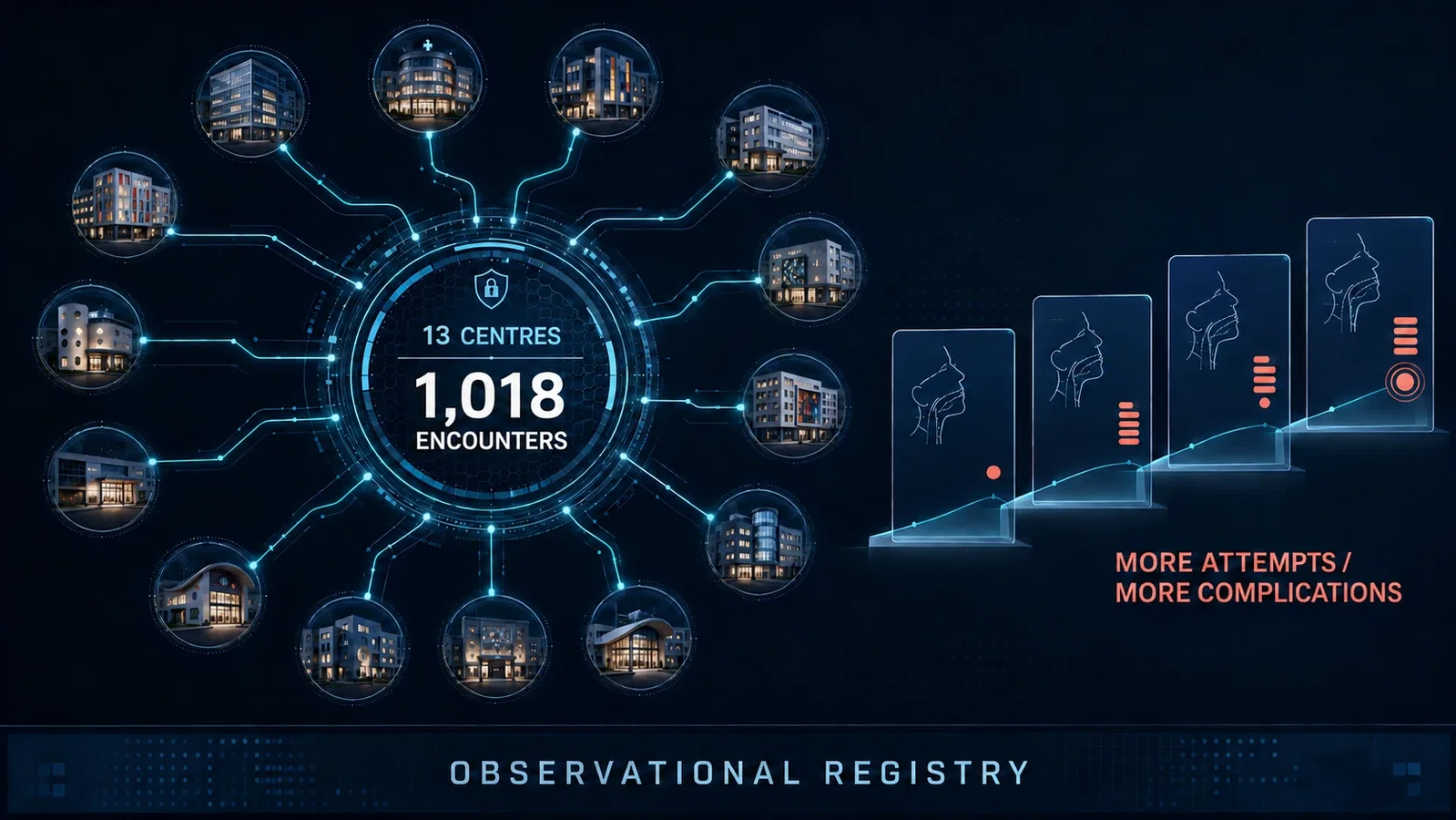
One of the most useful numbers in the surviving supplement to the first PeDI report is 1,010.
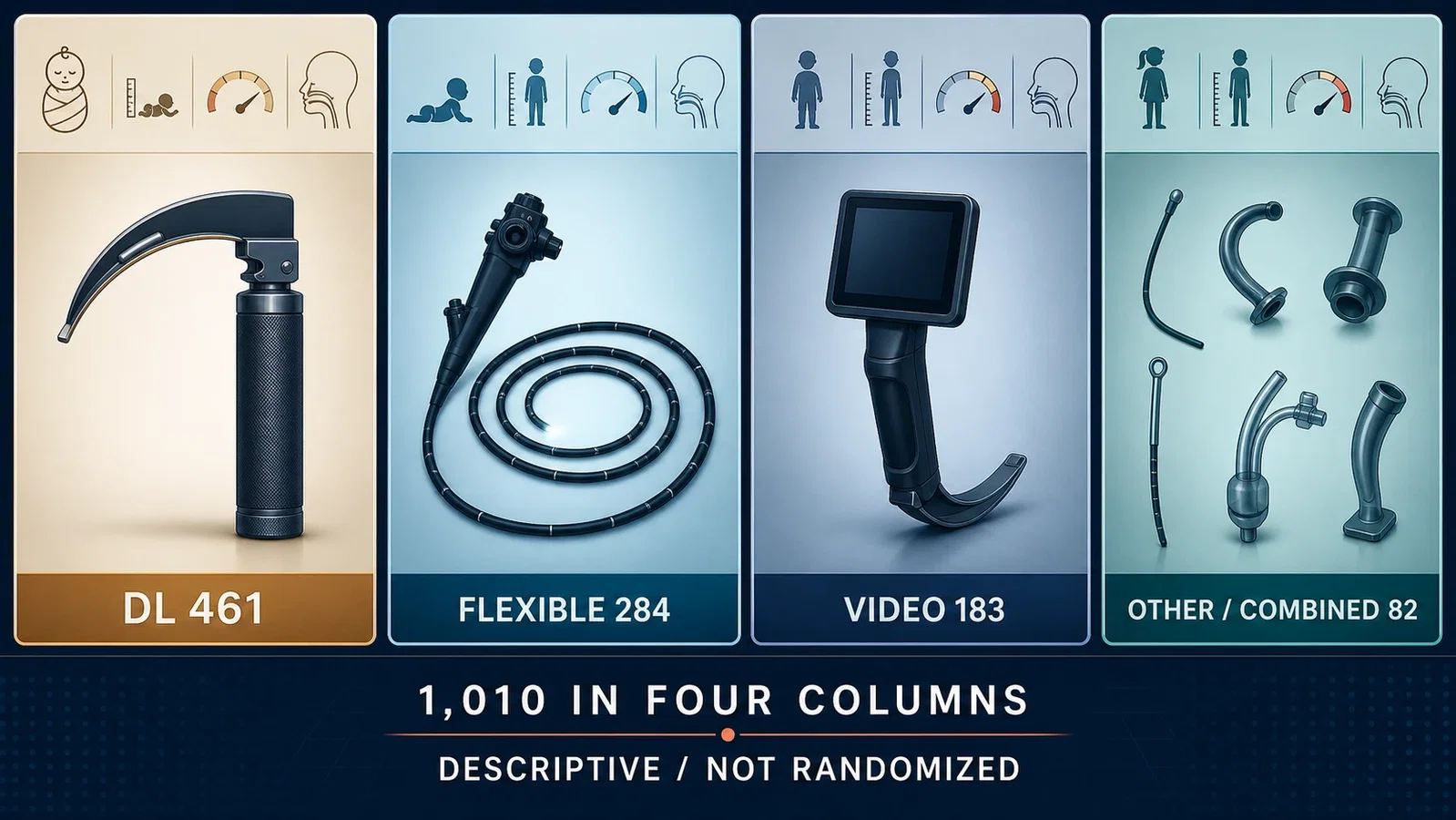
It is not the size of the published cohort. That number was 1,018 difficult tracheal-intubation encounters. The supplement instead divides primary devices into four columns: 461 for direct laryngoscopy, 284 for flexible fibre-optic bronchoscopy, 183 for GlideScope, and 82 for other or combined techniques. Together they make 1,010.
The appendix does not explain the remaining eight encounters.
That small gap is a good entrance to the history of the Pediatric Difficult Intubation Registry. PeDI made scattered, high-risk events countable across hospitals, but it did not make clinical reality perfectly tidy. Its value came from preserving enough structure to reveal a pattern while leaving the limits of the record visible.
The pattern that mattered most concerned persistence. As attempts accumulated, complications became more common. A decision that could feel like a local judgment after one failed view became an exposure that could be measured across more than a thousand encounters.
The registry began with agreement, not data entry
The official PeDI history places the collaborative's formation under the Society for Pediatric Anesthesia in 2010. Participants then spent roughly two years agreeing on definitions before data collection began in 2012.
That preparatory work was not administrative decoration. A multicentre registry cannot compare events if one hospital records a difficult laryngoscopy, another records a difficult intubation, and a third records only complete failure. The group first had to decide which encounters belonged to the same research object.
The later complete PeDI methods describe four routes into the registry. A consultant or attending could obtain a Cormack-Lehane grade 3 or 4 view with direct laryngoscopy. Direct laryngoscopy could be physically impossible because of anatomy. It could have failed within the preceding six months. Or the responsible consultant or attending could defer it because success seemed unlikely or harm seemed more likely.
A patient could satisfy more than one route. The criteria were not four mutually exclusive bins, and their percentages should not be summed as if they were.
By the time the initial report appeared in the January 2016 issue of The Lancet Respiratory Medicine, the shared framework had assembled encounters from 13 children's hospitals. Collection covered August 2012 through January 2015.
An encounter is not necessarily a unique child
The published denominator was 1,018 difficult tracheal-intubation encounters.
The word encounters matters. The accessible evidence does not establish that every record represents a different child. Rewriting the denominator as 1,018 unique patients would silently change the unit of analysis and suggest an independence that the source chain does not prove.
Registries often become historically memorable through their largest number. Their scientific meaning, however, depends on the noun attached to it. PeDI counted qualifying airway encounters across centres. It did not offer a census of 1,018 distinct children.
The publication date also resists false precision. The publisher supplement says the article appeared online on 16 December 2015. PubMed records an electronic date of 17 December, and Crossref deposited its record on 18 December. January 2016 is the stable issue anchor. “Published online in December 2015” is safer than selecting one disputed day.
The supplement does not contain four comparable device groups
It is tempting to read the four device columns as a contest. The table itself argues against that interpretation.
The groups differed in age, weight, airway examination, anticipated difficulty, qualifying criteria, and the role of the first provider. Direct laryngoscopy was used much more often when difficulty had not been anticipated. Flexible bronchoscopy and GlideScope were used in groups enriched for abnormal airway examinations and anticipated difficulty.
Those differences existed before the outcome was known. Clinicians selected techniques in response to anatomy, expectation, experience, and circumstance. The devices were not randomly assigned to exchangeable children.
This is why the exact first-attempt success percentages available only in the inaccessible main-article abstract do not belong in this account. Even if repeated correctly, they would invite a causal ranking that the study design and the visible baseline imbalance cannot support. The supplement is more informative as a map of confounding by indication than as a league table.
Its unexplained subtotal matters for the same reason. This article preserves 1,018 as the report denominator and 1,010 as the four-column supplement denominator. It does not invent a missing-device category for the eight encounters that the appendix does not classify.
Harm became visible across a sequence of attempts
A complete peer-reviewed editorial published in 2016 by Narasimhan Jagannathan, L. Sohn, and John Fiadjoe independently restates the central outcomes from the PeDI analysis.
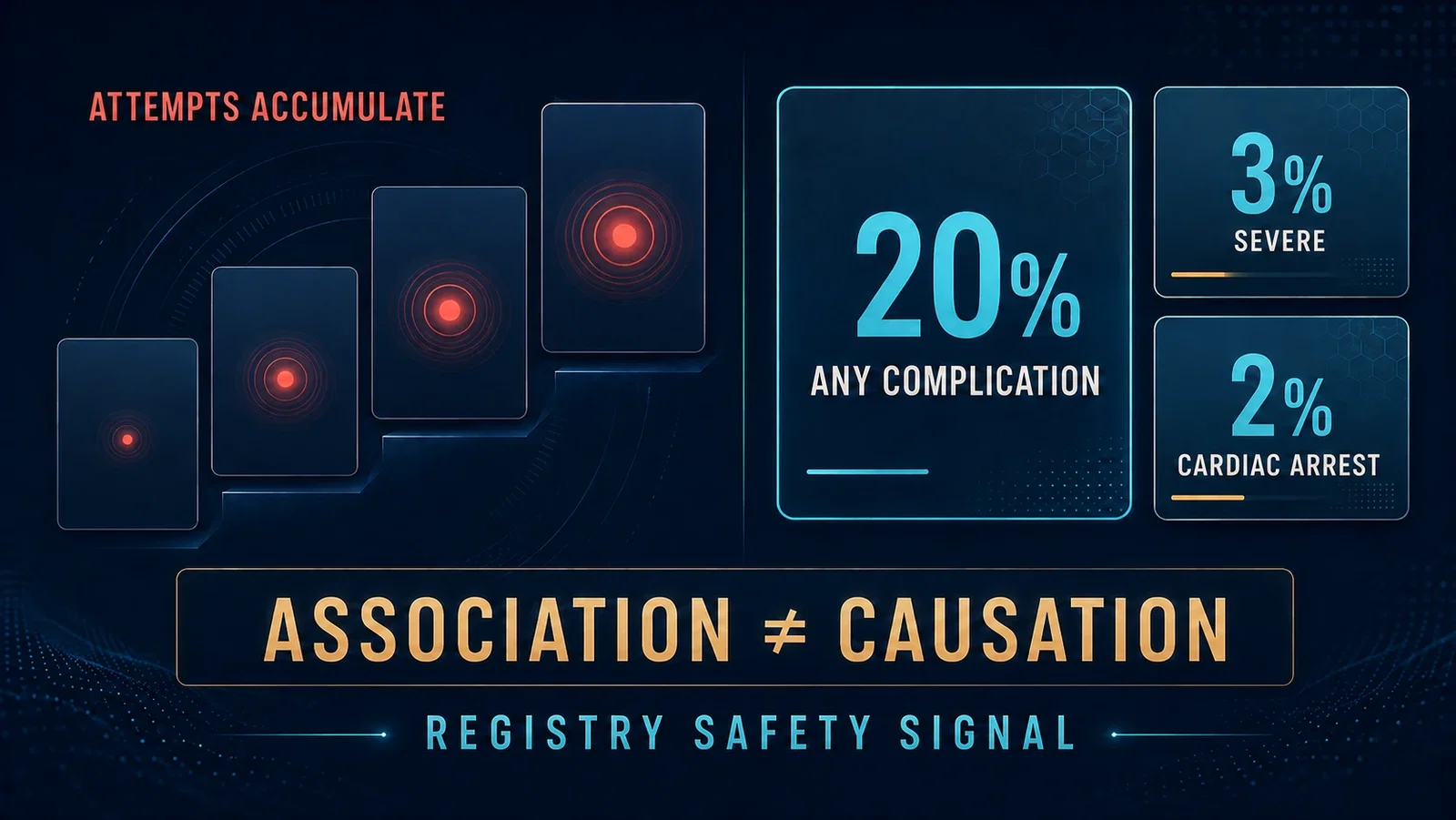
Tracheal intubation failed in 19 encounters, about 2%. At least one complication occurred in 204, or 20%. Severe complications occurred in about 3%, and cardiac arrest in about 2%. Transient hypoxaemia was the most frequent complication overall.
The study's most consequential observation was a gradient. The proportion of encounters with complications rose with each additional attempt. More than two attempts was associated with complications, as were weight below 10 kg, a short thyromental distance or micrognathia, and three direct-laryngoscopy attempts before moving to an indirect technique.
This did not mean that every extra attempt had been isolated as the cause of the next injury. A more anatomically difficult airway may generate both more attempts and more complications. Size, physiology, urgency, operator choice, and available equipment may influence both sides of the association.
PeDI nevertheless changed the question. Instead of treating a failed attempt as an isolated technical setback, the registry placed it inside a sequence. The sequence could then be examined against outcomes across centres.
An observational signal can support action without proving mechanism
The contemporary editorial translated the pattern into recommendations. Its authors argued for limiting repeated direct-laryngoscopy attempts, moving to an indirect technique when direct laryngoscopy failed, and considering a means of maintaining oxygenation during attempts.
Those statements belong to the authors' interpretation of observational evidence. They are not randomized estimates of device superiority, and they are not reproduced here as a current bedside protocol.
The distinction is more than a disclaimer. Safety research often has to act before a perfect experiment is possible. A registry can identify a recurrent, potentially modifiable pattern and justify scrutiny of that pattern. It cannot erase the differences between patients or reconstruct every clinician's reason for continuing.
PeDI made persistence legible as a safety exposure. Later trials, device studies, implementation work, and updated guidelines would have to address the questions that a registry could not settle.
Publication turned the registry into a feedback system
The collaborative did more than publish its founding cohort.
A fully accessible 2024 PeDI analysis describes national lectures about the initial findings, monthly reports to registry members with benchmarked institutional and aggregate data, and a difficult-airway bundle checklist. The database was no longer only a place where encounters accumulated. It became part of a cycle in which centres defined events, recorded them, saw a shared pattern, received feedback, and generated another period of observation.
That cycle is one of the registry's most important historical contributions. A rare complication may be too uncommon for one institution to interpret confidently. A network can aggregate it, return the comparison to members, and ask whether practice changes alongside the next set of outcomes.
The network also expanded. The later analysis drew from a much larger registry and constructed matched early and current cohorts of 785 and 3,925 encounters. These are analytic denominators for a later comparison. They are not corrections to the 1,018 encounters in the initial publication.
Later improvement had more than one plausible cause
In the matched comparison, the incidence of any complication was similar across periods. Severe complications fell from 3.2% in the early cohort to 1.8% in the current cohort, while cardiac arrest fell from 1.8% to 0.8%. The later cohort also had fewer total attempts, fewer direct-laryngoscopy attempts, and less persistence with direct laryngoscopy.
The findings are compatible with a successful learning system. They do not prove that the registry's educational work alone caused the change.
The authors explicitly place PeDI activity in a broader environment. Video-laryngoscopy systems became more available. New society guidance emphasized limiting attempts. Awareness of the consequences of repeated direct laryngoscopy increased. Propensity matching and multivariable modelling could address measured differences, but not every unmeasured factor. Some complications might have arisen from conditions other than airway management, and the registry could not know exactly why a clinician chose a particular technique.
The 2024 paper therefore supplies both a hopeful result and its restraint. Practice and severe outcomes changed in participating centres. Several technical, educational, and cultural changes occurred at the same time.
The unavailable main article sets a boundary, not an invitation to guess
The complete 12-page version of the 2016 article remains behind publisher entitlement. Its official landing page, ScienceDirect routes, Elsevier metadata service, repository indexes, and known archive paths were checked. No lawful open copy of the full body was found.
The peer-reviewed publisher supplement was fully read, as were the contemporary three-page editorial and the complete 13-page 2024 PeDI study. The official collaborative history and structured bibliographic records were also read.
The missing body changes what can be claimed. Exact device success rates and detailed severe versus non-severe subcounts that appear only in the abstract are excluded. No unseen methods passage is reconstructed from later papers. The access failure is recorded instead of being hidden behind a citation.
PeDI changed the shape of paediatric airway knowledge
The initial report did not identify a universal winning device. It did not turn every complication into the consequence of one decision, and it did not produce a timeless algorithm.
It changed something more fundamental.
Common definitions allowed rare events from 13 hospitals to become comparable. Encounter-level records placed attempts and outcomes in the same sequence. The shared denominator made persistence visible as a pattern rather than a private impression. Later feedback turned that pattern back toward participating centres, where another period of data could test whether practice and outcomes moved together.
The history of PeDI is therefore not a simple story of technology replacing technology. It is a change in scale and accountability. “Try again” ceased to be only a moment inside one difficult airway. Across 1,018 encounters, it became a measurable question about accumulating risk.
The registry could not answer that question with randomized certainty. Its lasting contribution was to make the question too visible to ignore.
Sources and reading limits
Sources: Fiadjoe JE et al. Lancet Respir Med. 2016;4(1):37-48. PMID 26705976. DOI 10.1016/S2213-2600(15)00508-1, with complete peer-reviewed publisher supplement and original publisher figures; Jagannathan N, Sohn L, Fiadjoe JE. Br J Anaesth. 2016;117(Suppl 1):i3-i5. PMID 27095241. DOI 10.1093/bja/aew054; Stein ML et al. eClinicalMedicine. 2024;69:102461. PMID 38374968. PMCID PMC10875248. DOI 10.1016/j.eclinm.2024.102461; official Pediatric Difficult Intubation Collaborative website. All cited sources were read for this article. The 2016 main article body was not available; abstract-only details carry no unique claim.
Visual interpretations
These illustrations explore the setting and ideas. Depicted people, actions, instruments and documents are reconstructions, not evidence of their exact historical appearance.

Continue exploring
Related reading connects shared questions and contexts; it does not by itself establish historical influence.
Historical connections
- Earlier connection: 2013: An Old Airway Algorithm Makes Room for Video Laryngoscopy
Related reading
- 1981: Archie Brain Begins Developing the Laryngeal Mask
- 2001: GlideScope Moves the Glottis onto a Screen
- 1945–2009: Cuffed Pediatric Tracheal Tubes Rethink Size, Position and Evidence
- 2016–2019: GAS, PANDA and MASK Narrow the Pediatric Neurotoxicity Question
The Source Room · About & Editorial Method
Sources and reading limits are stated above. Illustrations are labelled as original source images or AI-made. Historical accounts are educational; they are not current treatment instructions.