Only GAS randomized anesthesia; PANDA used sibling matching to reduce shared-family confounding, and MASK used population and propensity-guided sampling across zero, single, and multiple exposure—yielding bounded reassurance rather than a universal safety verdict.
Reading Library · Anesthesia Epochs · 中文版
Watch the companion film
2016–2019: GAS, PANDA and MASK — Anesthesia and the Developing Brain · Watch on YouTube
Historical anchor: 2019. Date details and source qualifications are explained below.
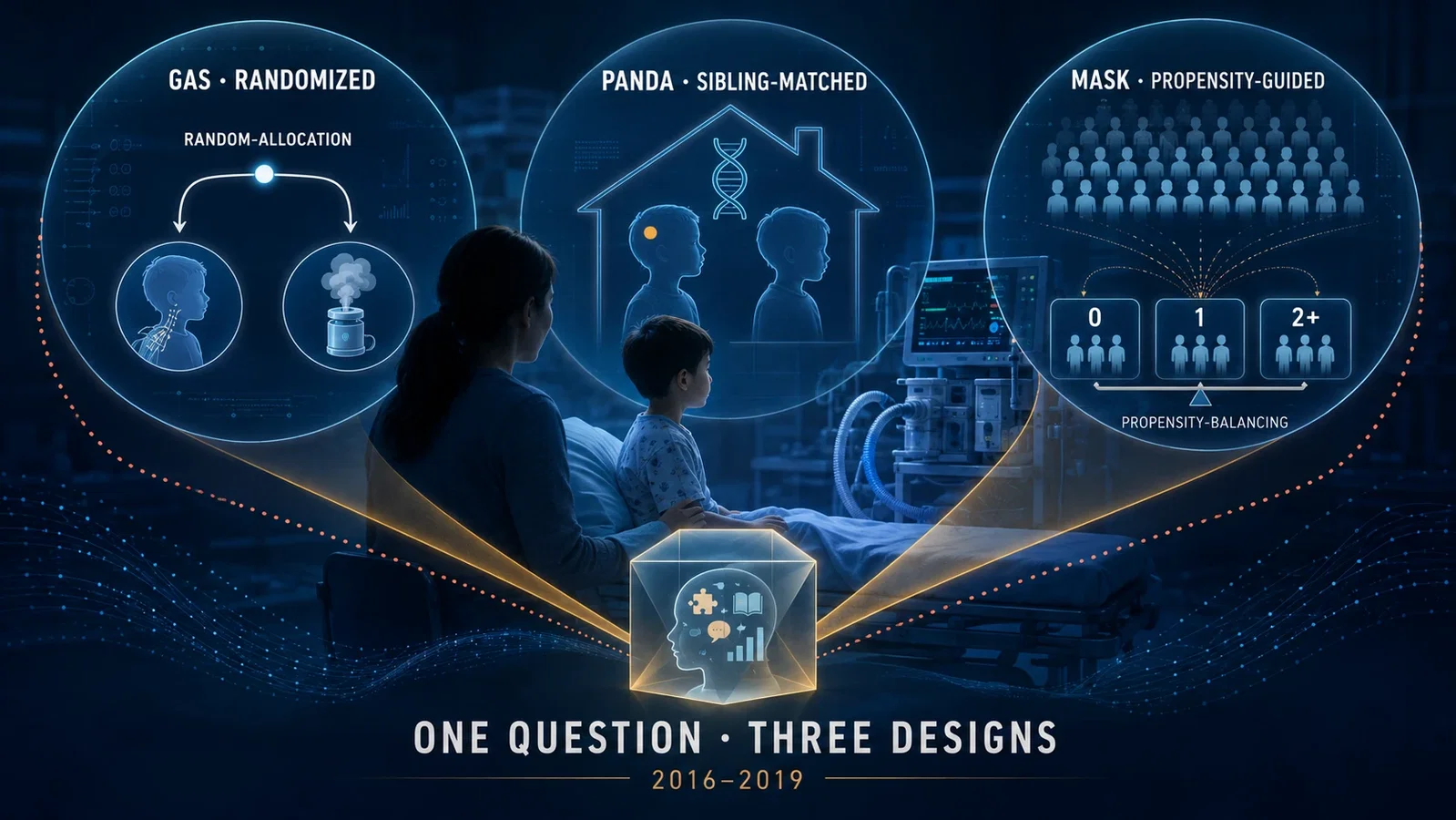
Three studies reached the same question through three different doors.
One door opened into a randomized trial. Another led to pairs of brothers and sisters. The third opened onto a population record in which some children had never been exposed to anesthesia, some once, and some several times.
The doors were labeled GAS, PANDA, and MASK.
Between 2016 and 2019, these studies supplied complementary human evidence in a controversy that had begun elsewhere. Experiments in young animals showed neuronal injury and later changes in learning or behavior after exposure to commonly used anesthetic agents. Clinical databases then produced mixed associations between early surgery with anesthesia and later developmental outcomes. Yet a child's need for surgery is not randomly assigned. Prematurity, congenital disease, repeated hospitalization, and the procedure itself can all travel with anesthesia exposure.
The hard question was therefore not merely whether exposed and unexposed children scored differently years later. It was whether a study design could separate anesthesia from the many reasons a child received it.
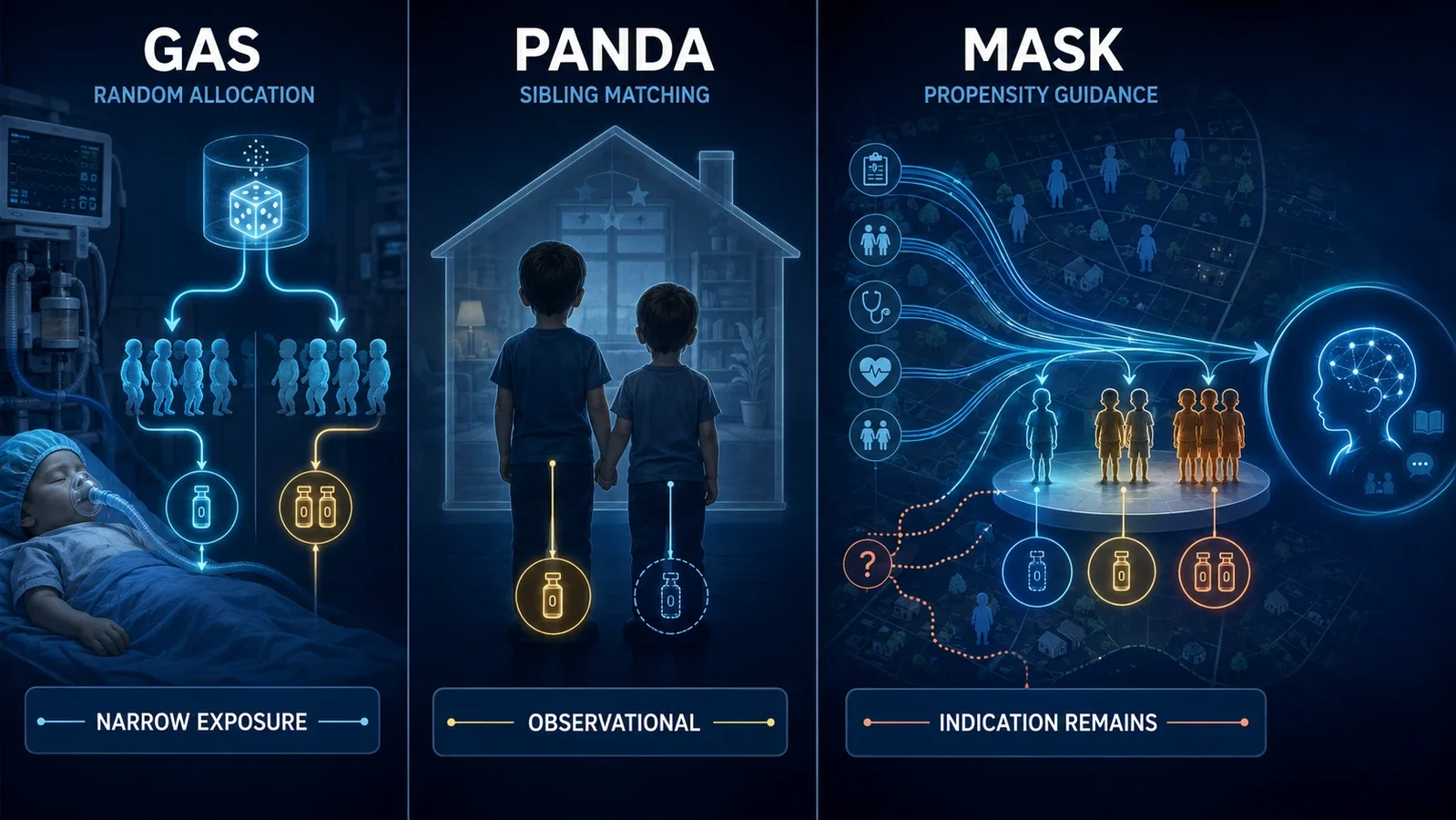
GAS, PANDA, and MASK did not solve that problem in the same way. Only GAS randomized exposure. PANDA and MASK were observational cohorts. Calling all three randomized trials would erase the very reason the series became informative.
GAS changed the anesthetic by random allocation
GAS asked the narrowest and most experimentally powerful question.
At 28 hospitals in seven countries, infants undergoing inguinal hernia repair were randomly assigned to awake-regional anesthesia or sevoflurane general anesthesia. Neurodevelopmental assessors were masked to allocation. The clinicians delivering anesthesia, and often the parents, could not be fully masked because the two techniques left visible clues.
The five-year statistical analysis plan made the primary question unusually explicit. Investigators would measure Full Scale IQ with the WPPSI-III at age 5. They defined two groups as clinically equivalent if the entire 95% confidence interval for the mean difference stayed between minus 5 and plus 5 IQ points. Because equivalence trials can be biased toward similarity when treatment changes or protocol violations are diluted in an intention-to-treat analysis, the prespecified primary analysis was per protocol. Intention-to-treat, imputed, and complete-case analyses were also planned.
Of 722 randomized infants, 363 entered the awake-regional group and 359 the general-anesthesia group. The median general-anesthesia duration was 54 minutes. In the per-protocol primary analysis, outcome data were available for 205 awake-regional and 242 general-anesthesia children.
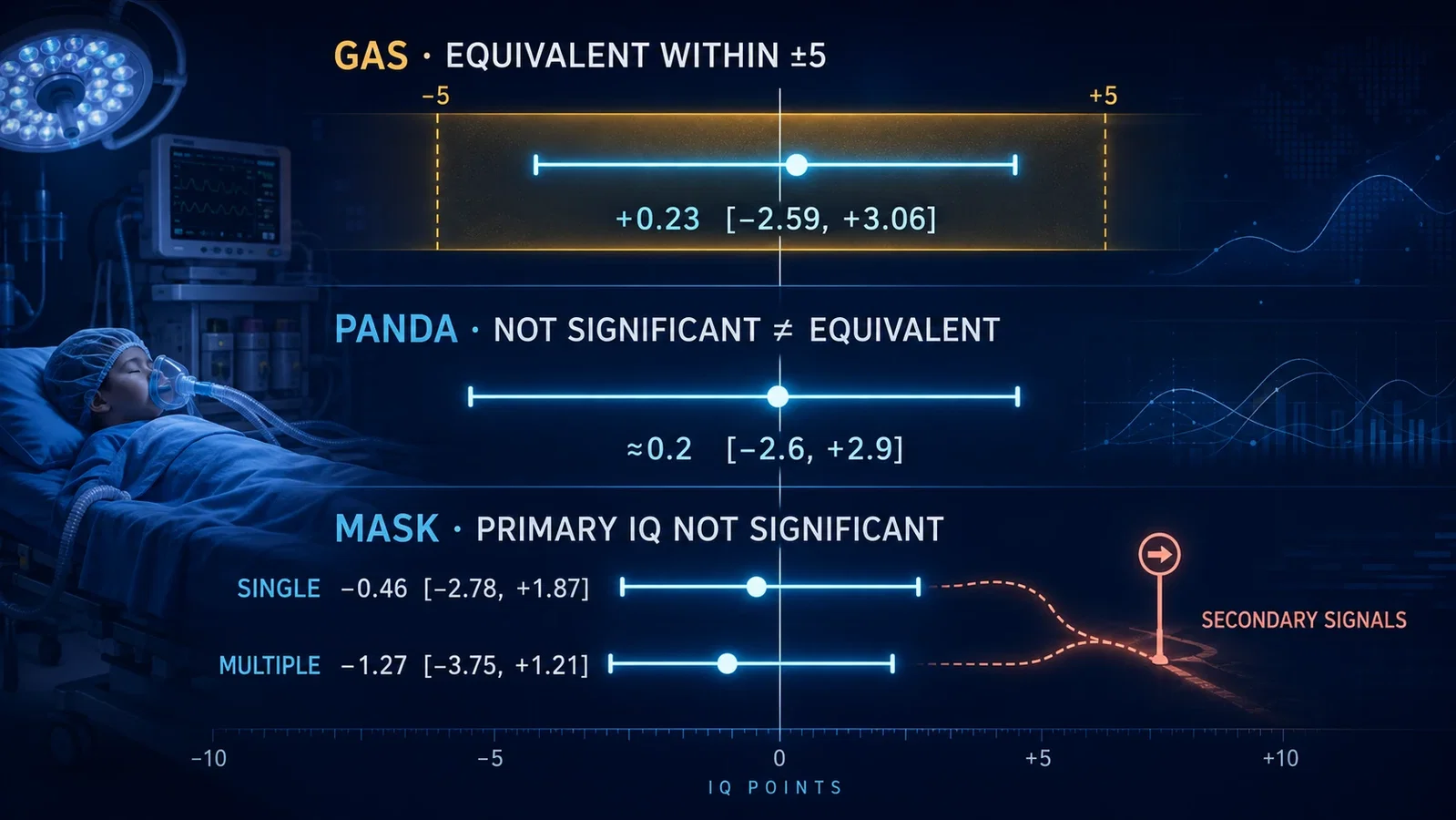
Mean Full Scale IQ was 99.08 after awake-regional anesthesia and 98.97 after general anesthesia. The adjusted difference, awake-regional minus general anesthesia, was 0.23 points. Its 95% confidence interval ran from -2.59 to 3.06.
That interval did more than cross zero. It remained completely inside the prespecified -5 to +5 equivalence zone. For this outcome, population, comparison, and exposure, GAS could therefore support the word equivalent.
The qualifying phrase matters as much as the result. GAS studied one sevoflurane anesthetic of median 54 minutes in infants selected for hernia repair. The population was predominantly male, and the paper reports that no exposure lasted longer than 120 minutes, so it could not analyze a longer-exposure subgroup. The trial did not randomize children to repeated anesthetics, long operations, combinations of several general anesthetic agents, or every medically vulnerable state.
Follow-up also narrowed certainty. Loss to follow-up was greater than anticipated, and children with poorer two-year performance were more likely to be missing at five years. Multiple imputation addressed missing outcomes under stated assumptions; it could not make selective follow-up disappear. The confidence interval still stayed within the equivalence margin across the reported analyses, but the attrition belongs beside the conclusion rather than in a footnote outside it.
PANDA held family background closer
Randomizing a child to an unnecessary anesthetic would be unethical, so many clinically important questions cannot use the GAS design. PANDA chose a different control: a biological sibling.
At four United States pediatric centers, investigators identified healthy children who had received one general anesthetic for inguinal hernia surgery before 36 months. Each exposed child was paired with a biological sibling, within three years of age, who had not received general anesthesia before 36 months. Exposure was reconstructed from old records; neuropsychological testing was performed prospectively when the siblings were 8 to 15 years old.
Siblings share much that ordinary controls do not. Genes, household conditions, parental education, and socioeconomic circumstances overlap. Matching them does not create randomization, but it can reduce important sources of familial confounding.
The primary analysis included 105 sibling pairs. All exposed children had received inhaled anesthetics. Median anesthetic duration was 80 minutes, with a range from 20 to 240 minutes. Mean Full Scale IQ was 111 in both groups.
In the full Results section and Table 2, the estimated difference defined as exposed minus unexposed was +0.2 points, with a 95% confidence interval from -2.6 to 2.9. The abstract prints the same magnitude and interval with a negative sign. Because the substantive conclusion is unchanged but the direction is internally inconsistent, the most faithful public description is that the estimated mean difference was essentially zero.
PANDA did not detect statistically significant mean differences in Full Scale IQ, verbal or performance IQ, or most other tested neurocognitive domains. Some unadjusted secondary behavior and adaptive-function differences weakened after adjustment for sex. A categorical internalizing-behavior result remained, but the number of same-sex pairs was limited.
This is reassuring, but it is not an equivalence result. PANDA specified no clinical equivalence margin. A confidence interval that includes zero can still include small positive and negative effects, and a non-significant test does not prove that the true effect is exactly zero.
The family design also left boundaries of its own. Ninety percent of the exposed children were boys, and only 42 sibling pairs were the same sex. Participating families had high mean IQ, recruitment could select families willing to return for extensive testing, and many older anesthesia records were on paper. The sample was healthy and tied to one operation. PANDA could not settle repeated exposure, prolonged exposure, prematurity, serious comorbidity, or every developmental domain.
MASK widened the exposure pattern
MASK moved from a selected operation to a defined community.
Using the Rochester Epidemiology Project, investigators reconstructed procedures requiring general anesthesia among children born in Olmsted County, Minnesota, from 1994 through 2007. Propensity information guided sampling so that children with no exposure, one exposure, and multiple exposures before age 3 could undergo a detailed neuropsychological battery at ages 8–12 or 15–20.
Propensity methods are sometimes described as making an observational study “like a trial.” That shorthand goes too far. They can balance characteristics that were measured and modeled. They cannot randomize the need for surgery or erase an unmeasured illness, family circumstance, or developmental vulnerability.
Of 998 enrolled participants, one multiply exposed child declined all testing. The analysis therefore included 997: 411 unexposed, 380 singly exposed, and 206 multiply exposed. Median cumulative anesthetic duration was 45 minutes in the single-exposure group and 187 minutes in the multiple-exposure group. About two-thirds of the multiply exposed group accumulated more than two hours.
The primary outcome was Full Scale IQ. Compared with unexposed children, the adjusted estimate was -0.46 points after a single exposure, with a 95% confidence interval from -2.78 to 1.87. After multiple exposure, it was -1.27 points, with a 95% confidence interval from -3.75 to 1.21. Neither primary comparison was statistically significant.
MASK did not, however, find a featureless field of null results. Among prespecified secondary composites, multiply exposed children scored 3.5 points lower in processing speed and automaticity and 5.5 points lower in fine-motor coordination; the corresponding confidence intervals excluded zero. These differences were not detected in singly exposed children. Parents of multiply exposed children also reported more concerns in several executive, behavioral, and reading areas, while selected parent-report differences appeared after single exposure as well.
Those signals deserve neither concealment nor promotion into a causal verdict. The study measured many secondary outcomes, and the authors called for cautious interpretation. Children who undergo several procedures differ from children who undergo none. The complete supplement shows heterogeneous operations and medical histories, later exposures after age 3, and estimates that were often larger before adjustment. Propensity weighting reduced measured imbalance; it could not identify anesthesia, rather than illness, surgery, hospitalization, or another factor, as the cause.
MASK's contribution was therefore two-sided. It did not detect a statistically significant primary IQ difference after either single or multiple exposure. At the same time, it preserved a specific multiple-exposure hypothesis in processing speed, fine motor coordination, and some parent-reported outcomes for future study.
Three designs are not three votes
It is tempting to line up the papers and count conclusions. That misses what each design contributed.
GAS used random allocation to make the exposed and comparison groups exchangeable at baseline, then asked a prespecified equivalence question. Its internal validity was strongest, while its exposure and patient range were narrow.
PANDA placed a sibling on each side of the comparison. It reduced confounding from shared family background and followed outcomes into later childhood, but exposure remained observational and the recruited sample was selective.
MASK broadened the population and included a multiple-exposure group. It used detailed testing and extensive sensitivity analyses, but procedure and illness traveled with exposure count, leaving causation unresolved.
The studies therefore triangulate rather than replicate. If three differently biased instruments point away from a large average IQ effect after one relatively brief exposure in healthy children, that convergence is meaningful. It is more informative than three analyses built from the same database and assumptions.
But triangulation does not remove every blind spot. All three measured average group outcomes. A small effect can lie inside a confidence interval. A susceptible subgroup can disappear inside a mean. IQ can remain stable while a narrower domain changes. A result after one short anesthetic cannot be copied onto several long anesthetics. Healthy hernia patients cannot stand in for premature infants, children with congenital disease, or those requiring repeated major surgery.
The question became better, not simply closed
By February 2019, the blunt question “Does anesthesia damage a child's brain?” had become scientifically inadequate.
For GAS, the answer concerned a randomized comparison, one short sevoflurane exposure, and age-five Full Scale IQ within a predefined margin. For PANDA, it concerned a single exposure, healthy siblings, and the absence of a detected mean difference without an equivalence test. For MASK, it concerned population associations, a non-significant primary IQ result, and cautious secondary patterns after multiple exposure.
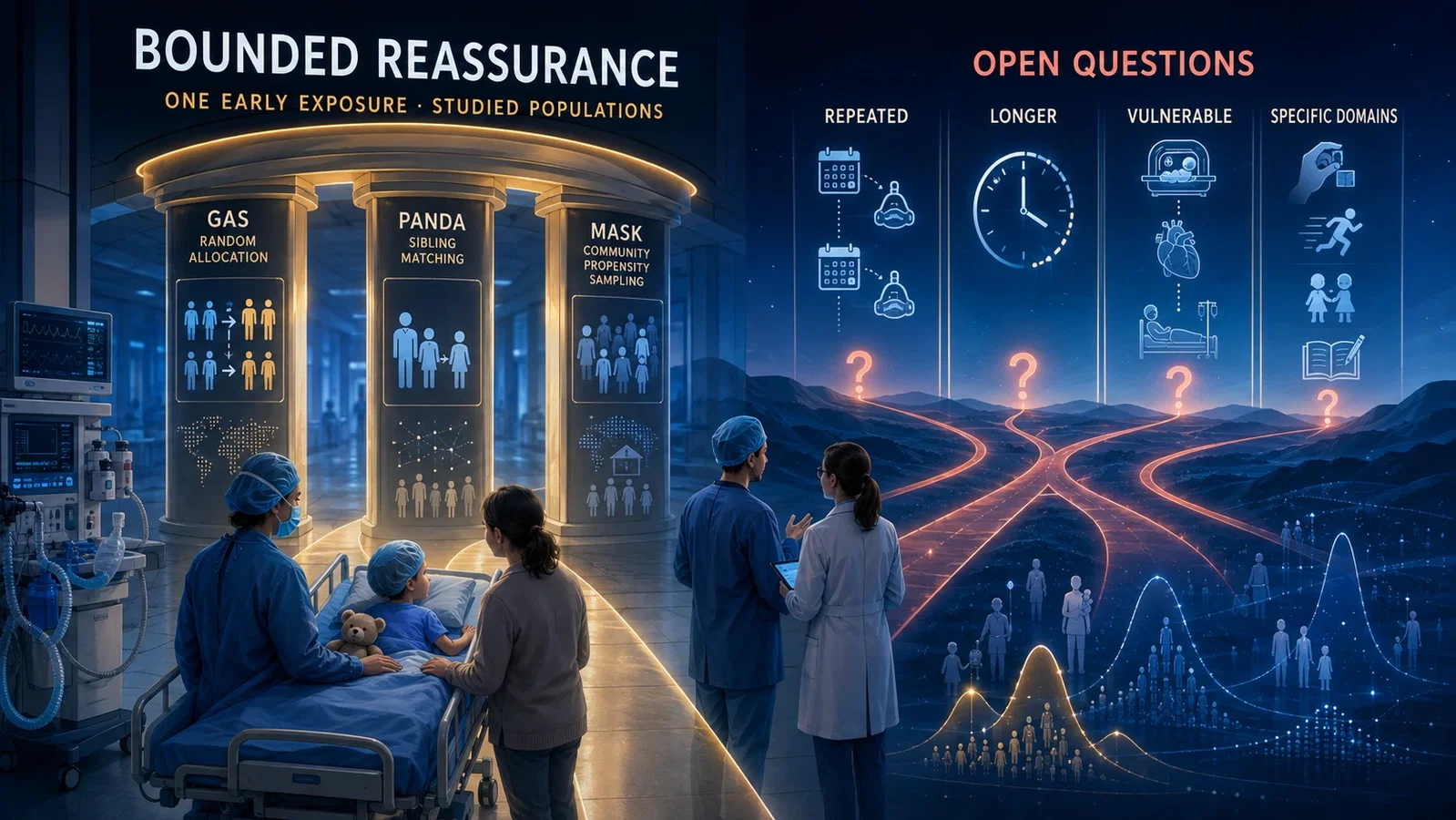
The strongest shared message was bounded reassurance: these studies did not reveal a large average intelligence deficit after one early exposure within the populations and duration distributions they examined. That is not the same sentence as “anesthesia is harmless.”
The remaining questions became more specific. What happens after repeated or substantially longer exposure? Which children are biologically or medically more vulnerable? Are processing speed, fine motor coordination, behavior, and school performance more sensitive than a global IQ score? How much of an observed association belongs to anesthesia, and how much to the operation and condition that made anesthesia necessary?
Good evidence does not always end a controversy by choosing one side. Sometimes it improves the nouns, the denominators, and the uncertainty.
GAS supplied randomization. PANDA supplied family matching. MASK supplied population breadth and an exposure gradient.
Together, they did not stamp the word safe across childhood anesthesia. They replaced a frighteningly broad question with several narrower ones that could finally be answered honestly.
Sources and reading limits
This is a history of evidence, not individualized advice about whether a child should undergo or defer a needed procedure.
Sources: McCann ME et al. Lancet. 2019;393:664-677. PMID 30782342. DOI 10.1016/S0140-6736(18)32485-1; Sun LS et al. JAMA. 2016;315:2312-2320. PMID 27272582. DOI 10.1001/jama.2016.6967; Warner DO et al. Anesthesiology. 2018;129:89-105. PMID 29672337. DOI 10.1097/ALN.0000000000002232; Sun LS et al. J Neurosurg Anesthesiol. 2012;24:382-388. PMID 23076226; Gleich SJ et al. Contemp Clin Trials. 2015;41:45-54. PMID 25555440; ACTRN12606000441516; NCT00756600.
Visual interpretations
These illustrations explore the setting and ideas. Depicted people, actions, instruments and documents are reconstructions, not evidence of their exact historical appearance.
Continue exploring
Related reading connects shared questions and contexts; it does not by itself establish historical influence.
- 1953: Virginia Apgar Gives the Newborn a Common Language
- 1945–2009: Cuffed Pediatric Tracheal Tubes Rethink Size, Position and Evidence
- 2016: 1,018 Difficult Intubations Make 'Try Again' a Measurable Risk
- 2018: Beverley Orser and the α5-GABA_A Brake After Anesthesia
- 2018: The PND Consensus Separates Postoperative Time from Cause
- 2019: ENGAGES Cuts Anesthetic Exposure but Not Delirium
The Source Room · About & Editorial Method
Sources and reading limits are stated above. Illustrations are labelled as original source images or AI-made. Historical accounts are educational; they are not current treatment instructions.