The 2018 recognition of Beverley Orser illuminated a preclinical chain from anesthetic exposure to extrasynaptic tonic inhibition and delayed memory effects.
Reading Library · Anesthesia Epochs · 中文版
Watch the companion film
2018: Beverley Orser — Alpha5 GABA-A Receptors and Memory · Watch on YouTube
Historical anchor: 2018. Date details and source qualifications are explained below.
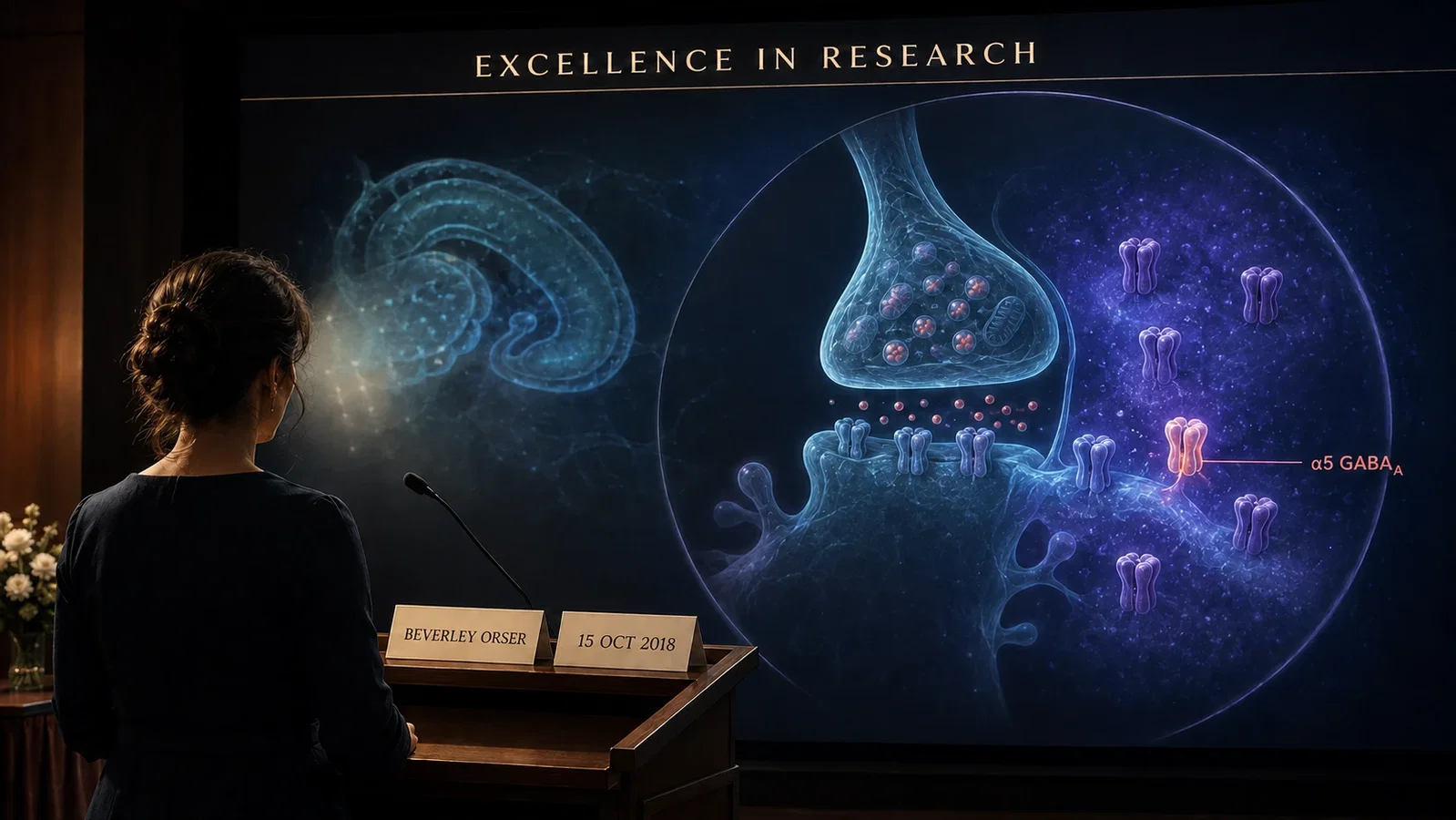
On October 15, 2018, a 90-minute Celebration of Research appeared on the program for the Moscone Center's South Building, Room 206. Under that session, the American Society of Anesthesiologists' official meeting guide listed the 2018 ASA Excellence in Research Award and its recipient, Beverley Orser.
On the same date, the National Academy of Medicine announced its new members. Its citation for Orser was unusually specific: discovery of the unique pharmacological properties of extrasynaptic GABA-A receptors, their mechanistic role in anesthetic- and inflammation-induced memory impairment, and leadership in academic anesthesiology.
The two recognitions shared a date but not a ceremony. Nor did they identify a single “2018 award paper.” They pointed toward a longer line of work organized around a deceptively simple question: once an anesthetic is gone, has the nervous system necessarily returned to its previous state?
A 2014 study by Orser's team in the Journal of Clinical Investigation offers a fully accessible mechanistic cross-section of that research program.
An award is not one paper
The University of Toronto had congratulated Orser on the ASA Excellence in Research Award in September 2018. In December, the Canadian Anesthesiologists' Society reported that the award recognized her fundamental-science research and its important impact on anesthesiology practice.
Neither record says that the award was bestowed for the 2014 JCI article alone.
The abstract of Orser's later award lecture describes a wider program: extrasynaptic GABA(_A) receptors in the anesthetic state, in neuronal and nonneuronal cells, in several disorders, and as possible drug targets. The 2014 article is therefore best read as a window into the recognized work, not as the complete reason for the recognition.
That distinction fixes the chronology. The year 2018 is the historical anchor for recognition, not the beginning of the α5-GABA(_A) research.
The real question began after anesthesia
While a GABAergic general anesthetic is present, it can enhance inhibition mediated by GABA(_A) receptors. Its direct allosteric effect fades rapidly after the drug is eliminated. It was natural to infer that receptor function returned to baseline at the same time and no longer contributed to later memory problems.
The 2014 study tested that inference. It did not attempt to show that one receptor explains every form of postoperative cognitive change.
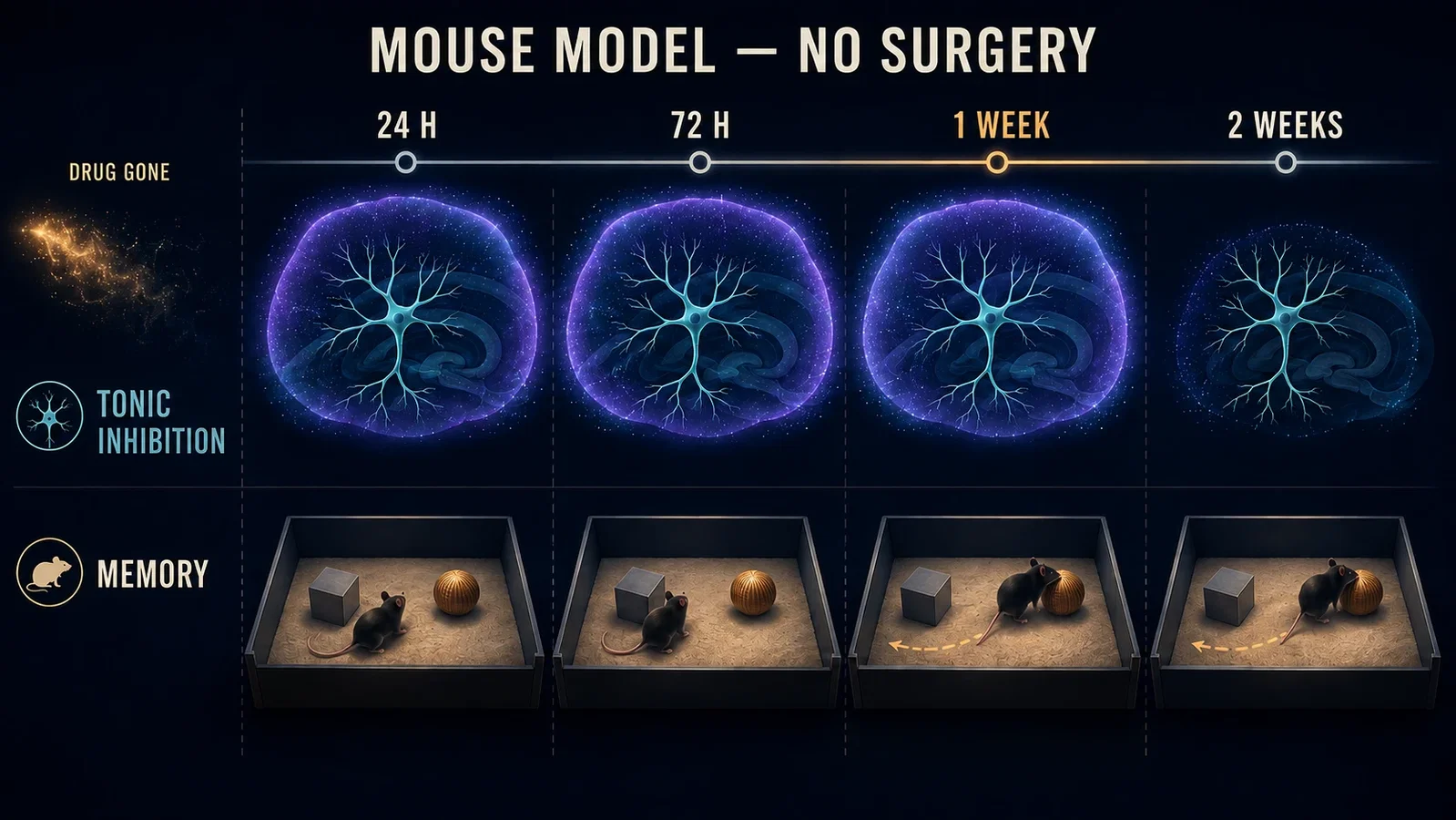
The experiment used male mice and did not include surgery. Researchers administered 8 mg/kg of etomidate, a dose selected to approximate the ED50 for loss of the righting reflex, and later tested novel-object recognition.
Recognition memory was impaired at 24 and 72 hours, but performance had recovered by one week. Dexmedetomidine, an active comparator that did not target GABA(_A) receptors, did not produce the same memory finding. Total time spent interacting with the objects was similar, making residual sedation or reduced exploration an unlikely simple explanation.
This was an assay of object recognition after anesthetic exposure in mice. It was not a study of human postoperative delirium or of a modern clinical perioperative neurocognitive disorder.
Behavior recovered before the receptor system did
The investigators then moved from behavior to the hippocampal CA1 circuit. Twenty-four hours after etomidate, potentiation at Schaffer collateral-CA1 synapses was reduced. By one week it had partly recovered.
The more revealing distinction appeared in inhibitory currents.
Miniature inhibitory postsynaptic currents, which sample discrete synaptic events, were not detectably changed at 24 hours. The background tonic inhibitory current, however, rose to 174% of control. It remained elevated at 72 hours and one week, but not at two weeks.
Cell-surface expression of the α5 subunit followed a related, though not identical, course: 128% of control at 24 hours, 130% at one week, and back near baseline at two weeks. Total α5 expression did not increase.
This was not simply a story of cells making more α5 protein. The result pointed toward a sustained change in surface availability of extrasynaptic receptors and the tonic inhibition they generated.
The one-week point is essential. Memory behavior had recovered even though tonic current and surface α5 remained elevated. The paper proposed homeostatic compensation as a possibility but did not establish the compensatory mechanism. Receptor physiology and behavior were not permanently locked to one curve.
Why the causal argument centered on α5-GABA(_A)
Correlation alone would not identify the receptor subtype. The team approached causality from two directions.
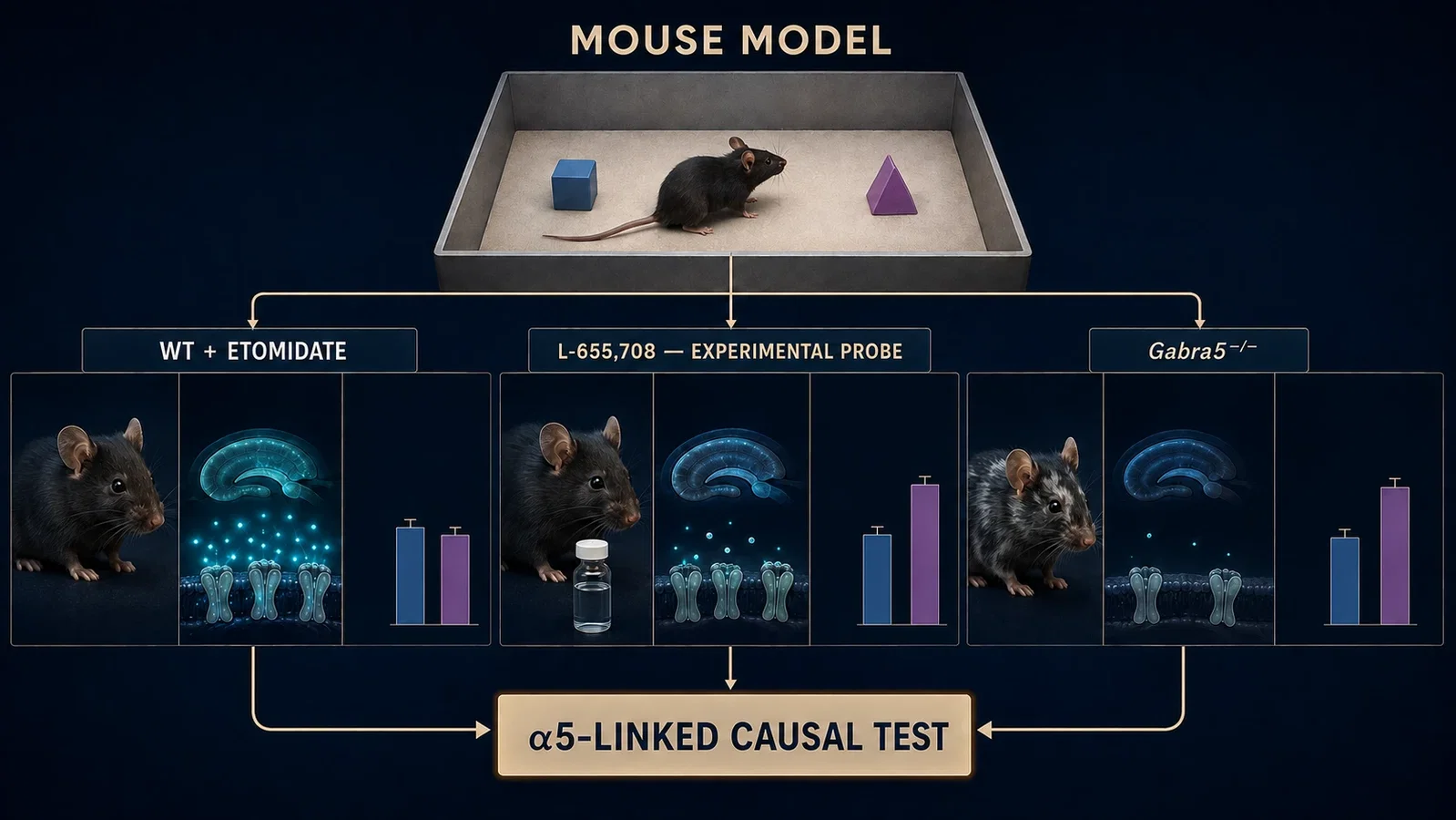
First, the component of tonic current sensitive to the α5-selective inverse agonist L-655,708 was larger after etomidate. In the behavioral experiment, 0.5 mg/kg of L-655,708 given before memory training reversed the recognition deficit measured after etomidate.
Second, mice lacking Gabra5 did not show the same delayed rise in tonic current or the same recognition-memory deficit after etomidate.
Pharmacologic inhibition and genetic deletion converged on the same receptor subtype. Within the model, that made the causal case stronger than a simple association between two rising measurements.
L-655,708 was nevertheless an experimental probe in mice. The paper did not establish it as safe or effective treatment for postoperative memory problems in people, and it did not create a clinical recommendation.
Astrocytes moved the story between cells
The investigators next asked whether etomidate acted directly on neurons to produce the delayed rise in tonic current.
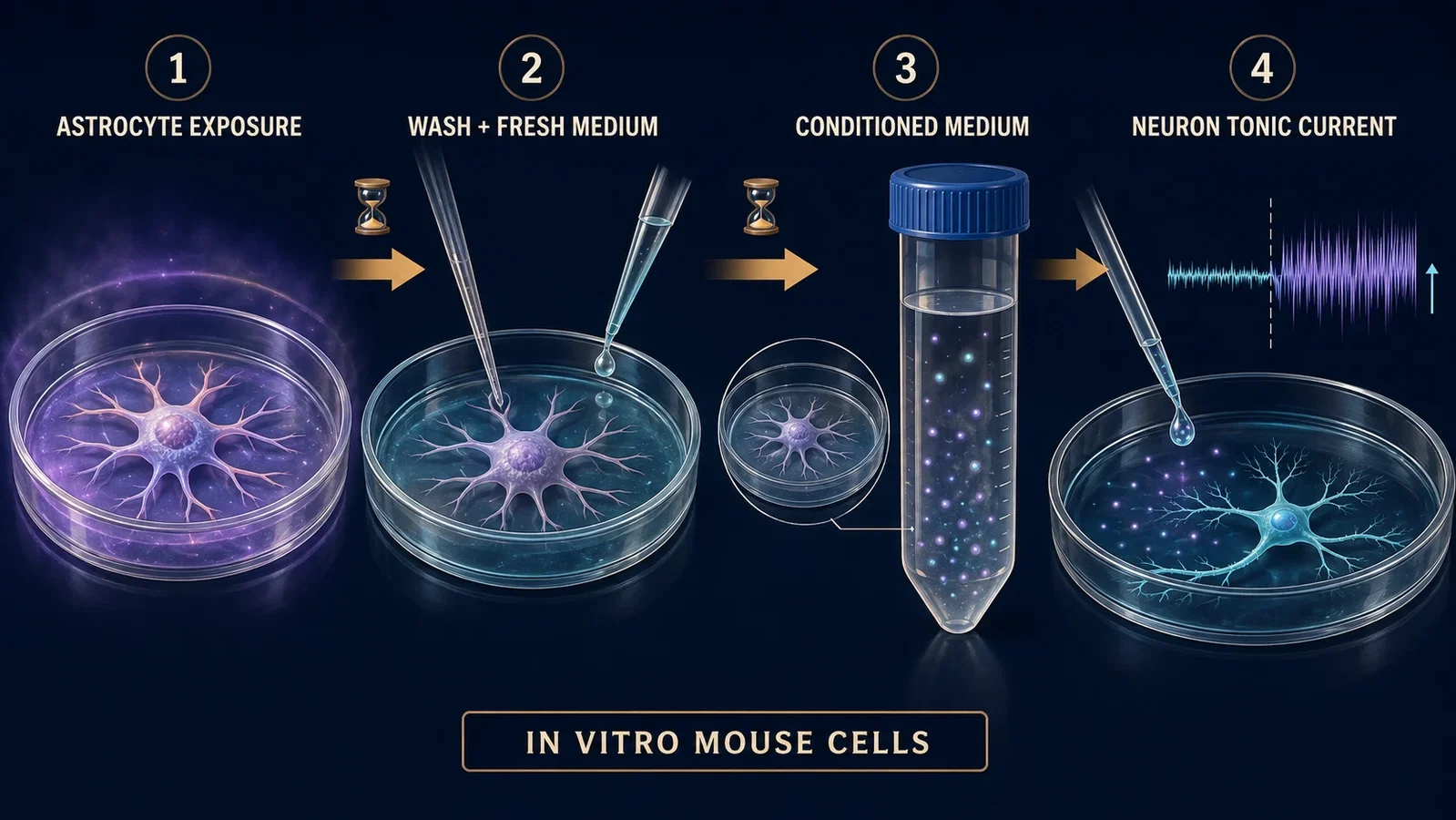
Neuron-only cultures did not show the change. Neither did microglia-neuron cocultures. Astrocyte-neuron cocultures did.
They then exposed astrocytes alone to etomidate for one hour, replaced the medium, waited two hours, collected the conditioned medium, and applied it to neurons for 24 hours. Neuronal tonic current rose to 136% of control.
Under this in-vitro design, exposing astrocytes to etomidate was necessary and sufficient to trigger the measured current increase in neurons.
The experiment did not identify the released signal. It also did not prove that human postoperative memory changes travel through the same pathway. What it changed was the shape of the question: an anesthetic no longer had to be physically present if its exposure had initiated a later signal between cells.
Dose and agent did not draw one universal curve
A higher etomidate dose, 20 mg/kg and selected to approximate the ED100 for loss of righting reflex, impaired recognition memory through one week; performance recovered by two weeks. Tonic current and surface α5 were elevated at 24 hours.
Isoflurane supplied a second control. A lower exposure, 0.7% for 20 minutes, did not increase surface α5 or δ at 24 hours. An anesthetizing exposure, 1.3% for one hour, increased tonic current to 237% of control and surface α5 to 134%, while δ remained unchanged.
These contrasts suggest dependence on dose, exposure duration, and pharmacokinetics. They do not support the blanket claim that every dose of every GABAergic anesthetic leaves the same week-long receptor effect.
The outline of the program was visible by 2012
The 2014 paper was not the first signal. The complete PubMed abstract for a 2012 study by Zurek, Bridgwater, and Orser records an earlier proof of concept. In mice, short-term recognition memory was impaired 24 hours after isoflurane while working memory was not. The recognition deficit resolved by 72 hours. L-655,708, administered only after the anesthetic exposure and before training, reversed the 24-hour deficit, while Gabra5-null mice did not develop it.
A lawful complete body of that article is not covered here, so these statements remain inside the abstract boundary. The record is used to show that the research question predates both the 2014 mechanism paper and the 2018 recognition. It is not used to invent unseen methodological or discussion details.
The history changed the question, not the prescription
A conventional pharmacology narrative often ends at concentration: the drug arrives, the receptor is modulated, the drug leaves, and the effect ends.
Orser's research moved the boundary farther downstream. In this mouse model, direct drug exposure had ended while surface receptor distribution and tonic inhibition could still be altered. A postanesthetic biological state could not be defined solely by how much anesthetic remained in blood or brain.
The 2018 ASA award and NAM election brought that line of work into a historical spotlight. The spotlight does not erase the experimental limits. The JCI study contained no surgery, no patients, and no clinical treatment trial. The astrocyte mediator was not identified. At one week, behavior and receptor physiology had already separated.
What the work left behind was not a ready prescription. It was a more durable question: when the anesthetic is gone, is the neural circuit still processing what the exposure set in motion?
Sources and reading limits
Sources: ASA 2018 Meeting & Exhibit Guide, Celebration of Research program, internal p.73; Zurek AA, Yu J, Wang DS, et al. J Clin Invest. 2014;124(12):5437-5441. PMID 25365226. PMCID PMC4348961. DOI 10.1172/JCI76669, complete article and supplement; Zurek AA, Bridgwater EM, Orser BA. Anesth Analg. 2012;114(4):845-855. PMID 22383672, abstract-level use only; Orser BA. Anesthesiology. 2019;131(4):795-800. PMID 31335546, abstract-level use only; University of Toronto PhysioLINK, September 11, 2018; Canadian Anesthesiologists' Society Anesthesia News, December 2018; National Academy of Medicine new-member announcement, October 15, 2018. All cited sources were read for this article.
Visual interpretations
These illustrations explore the setting and ideas. Depicted people, actions, instruments and documents are reconstructions, not evidence of their exact historical appearance.
Continue exploring
Related reading connects shared questions and contexts; it does not by itself establish historical influence.
- 2010: NICE CG103 Turns 'Think Delirium' into a Care Pathway
- 2018: The PND Consensus Separates Postoperative Time from Cause
- 2019: Seven Summit Actions Map the Work Against Perioperative Neurocognitive Disorders
- 2019: ENGAGES Cuts Anesthetic Exposure but Not Delirium
- 2016–2019: GAS, PANDA and MASK Narrow the Pediatric Neurotoxicity Question
- 2020: Japan Approves Remimazolam for General Anesthesia
The Source Room · About & Editorial Method
Sources and reading limits are stated above. Illustrations are labelled as original source images or AI-made. Historical accounts are educational; they are not current treatment instructions.