In 2010, a national guideline connected risk recognition, daily observation, tailored prevention, diagnosis, and care.
Reading Library · Anesthesia Epochs · 中文版
Watch the companion film
2010: NICE CG103 — Think Delirium · Watch on YouTube
Historical anchor: 2010. Date details and source qualifications are explained below.
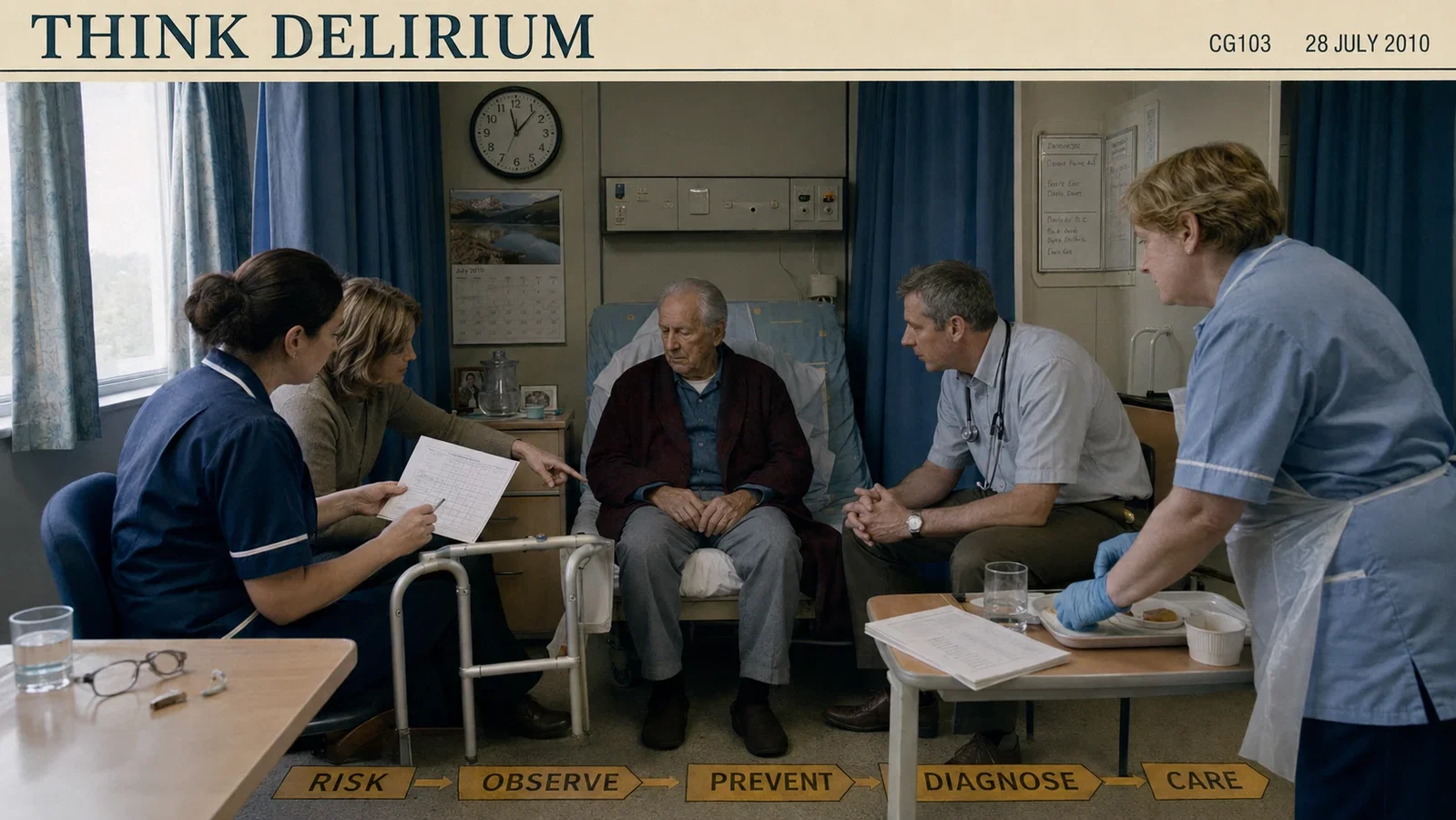
The patient who attracts the least attention may be the one whose attention has changed the most.
Delirium can arrive with agitation, but it can also make a person quiet, withdrawn, sleepy, or slow to respond. In a busy ward, that presentation creates no alarm. Unless someone knows the person's usual behavior, notices a change, and tells the next caregiver, hypoactive delirium can remain almost invisible.
On 28 July 2010, the National Institute for Health and Clinical Excellence published Clinical Guideline 103, originally titled Delirium: diagnosis, prevention and management. It did not discover delirium or introduce a test that replaced clinical judgment. It divided recognition, prevention, diagnosis, and care into actions that could be performed, documented, and handed over.
That distinction made “Think delirium” more than an appeal for awareness. It became a safety pathway.
Attention had to begin before diagnosis
CG103 identified four entry points to the prevention pathway: age 65 years or older, cognitive impairment or dementia, a current hip fracture, and severe illness that was deteriorating or at risk of doing so. The presence of any one factor placed a person in the at-risk group.
Risk was not a diagnosis. At presentation, staff were to look for recent changes or fluctuations in cognition, perception, physical function, or social behavior. A relative or caregiver might supply the crucial comparison. A daughter who said that her father was answering much more slowly than yesterday was not offering background color. She was contributing evidence that a one-time examination could not recover.
The guideline extended that work through the admission or residential stay. Everyone in hospital or long-term care was to be observed at least daily for changes or fluctuations occurring within hours or days. Staff were asked to be particularly alert to behavior suggesting hypoactive delirium.
A physician may relate altered behavior to illness and medication. A nurse sees change across a shift. A care assistant notices drinking, mobility, sleep, and engagement. Family members know the baseline. The pathway works only if those partial views meet.
Prevention was built from ordinary actions
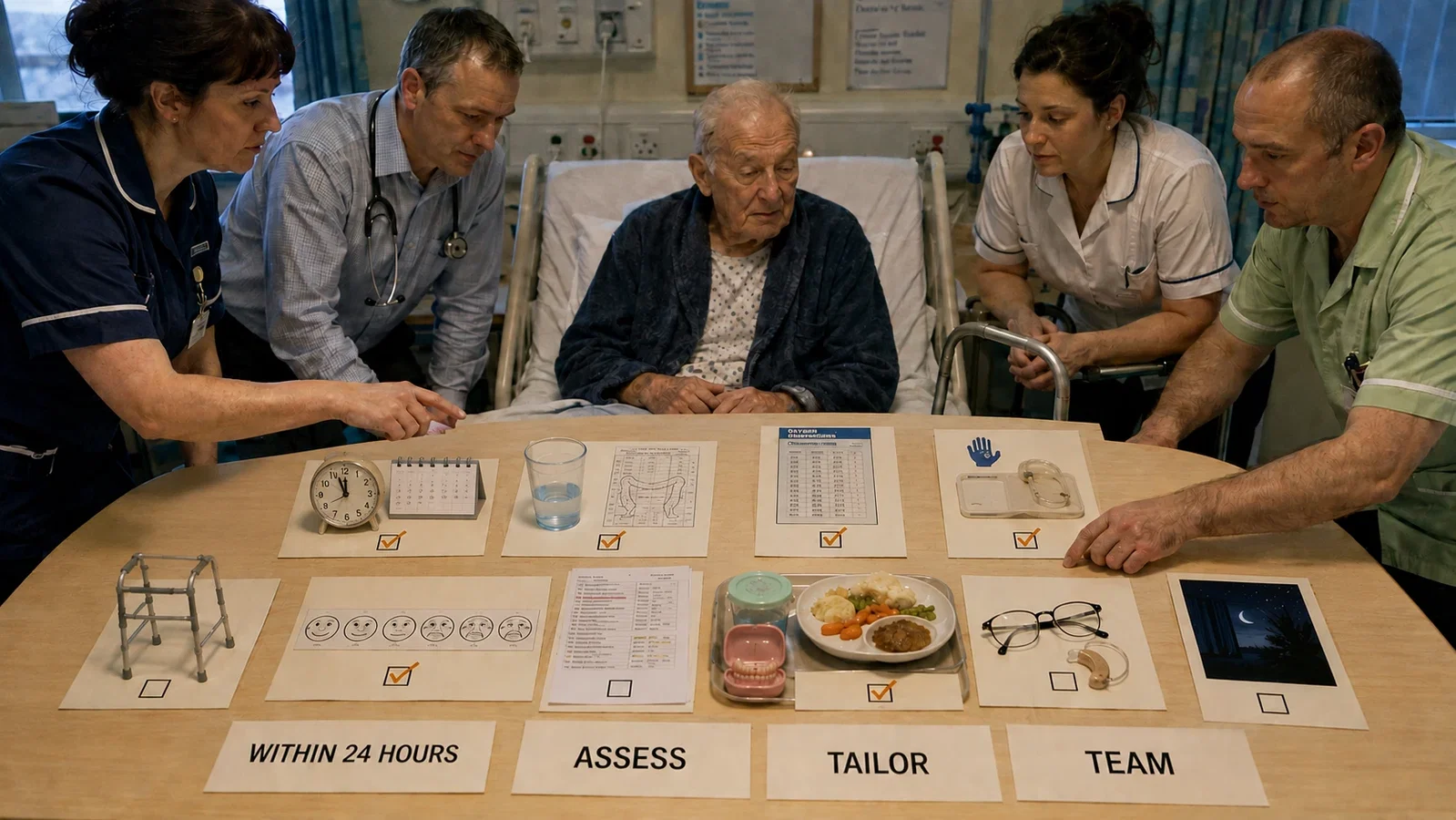
For a person at risk, CG103 called for assessment of contributing clinical factors within 24 hours of admission. The result was not a standard package delivered identically to every patient. It was a multicomponent intervention tailored to the person's needs and care setting, delivered by a multidisciplinary team trained and competent in delirium prevention.
The ten domains were strikingly practical. They included cognitive impairment or disorientation, dehydration or constipation, hypoxia, infection and unnecessary catheterization, immobility, pain, multiple medications, poor nutrition and dentures, sensory impairment, and sleep disturbance.
Each domain translated into observable work: make clocks, calendars, spectacles, and hearing aids usable; explain place and roles; review medications and pain; treat infection; support hydration, nutrition, and movement; reduce avoidable nighttime disturbance and room changes.
These ordinary actions expose why prevention is difficult. Responsibility crosses professions, rooms, and shifts. A printed list cannot make the work coherent unless a team assesses which factors matter for this person and revisits them as circumstances change.
“Multicomponent” therefore did not mean that all ten boxes had to be checked for everyone. The sequence was assess, tailor, act, and observe again.
The original diagnostic route was not 4AT
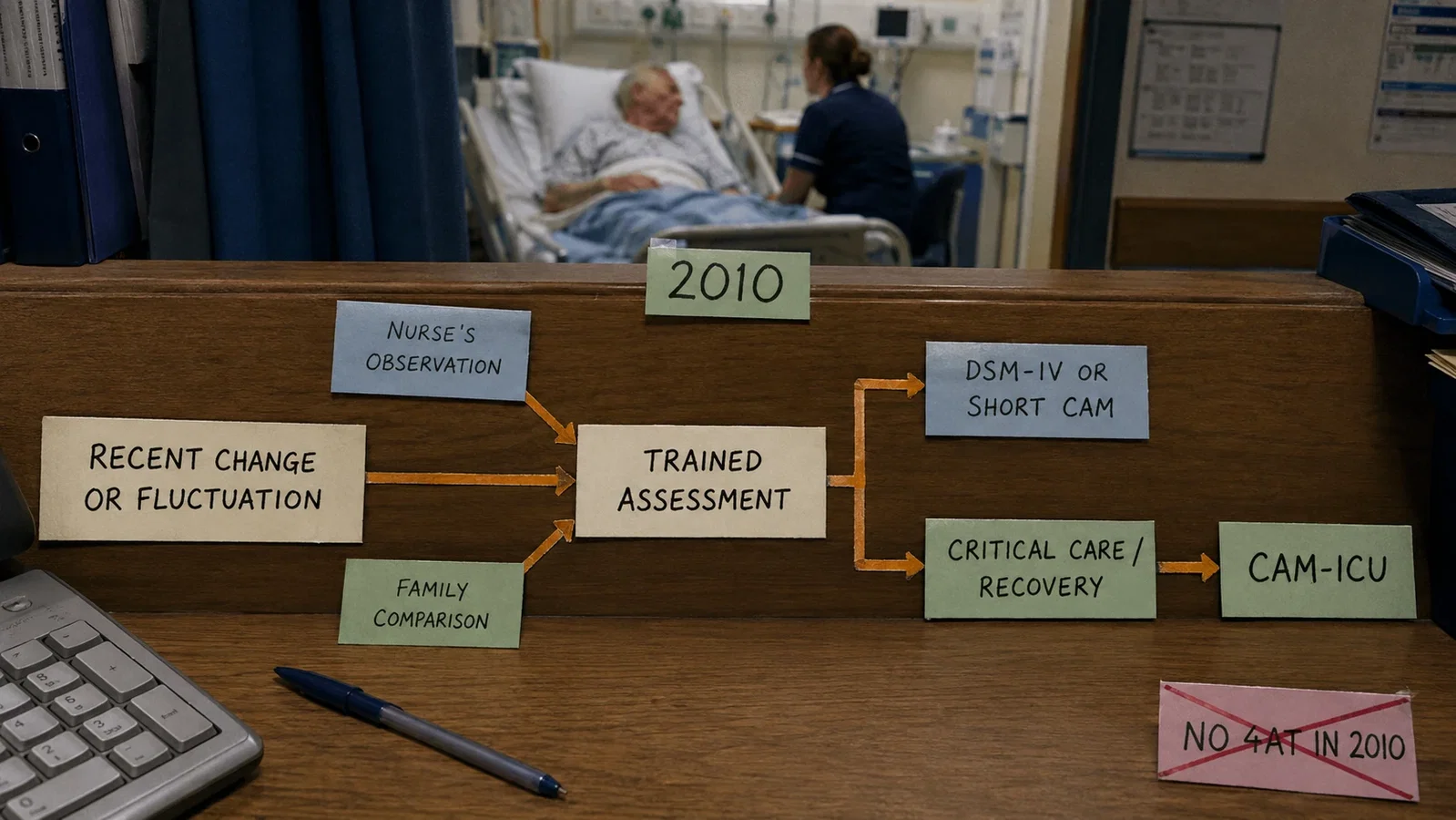
The current NICE webpage can easily mislead a historical reader. It now recommends 4AT for assessment in most settings, with CAM-ICU or the Intensive Care Delirium Screening Checklist in critical care and the postoperative recovery room. Those are 2023 recommendations.
The 2010 full guideline described a two-stage process. First came the recognition of recent changes and fluctuations. If indicators were present, a trained and competent healthcare professional performed a clinical assessment using DSM-IV criteria or the short Confusion Assessment Method. In critical care or the recovery room after surgery, the guideline recommended CAM-ICU.
The setting-specific branch rested on a concrete limitation. In the recovery-room study reviewed by the committee, the short CAM had a sensitivity of only 43 percent. The group judged it inappropriate for that population and selected CAM-ICU instead. A tool was not treated as universally reliable simply because it worked elsewhere.
The version record closes the chronology. During its 2018 surveillance review, NICE described 4AT as an area of increasing interest raised by a stakeholder and said it was awaiting publication of an NIHR validation study before considering whether the recommendations should change. In January 2023, NICE replaced the assessment and diagnosis recommendations with the current 4AT, CAM-ICU, and ICDSC pathway and a final diagnosis by a professional with relevant expertise.
This 2010 article can explain that later evolution. It cannot lend 4AT backward to a guideline written before the evidence review that supported it.
Treatment began with causes and connection
Once delirium was diagnosed, the first instruction was to identify and manage the possible underlying cause or combination of causes. The guideline then emphasized communication, reorientation, reassurance, involvement of family and caregivers, and a suitable care environment.
Medication came much later in the sequence. If a person was distressed or considered a risk to themselves or others, verbal and nonverbal de-escalation came first. Only when those measures were ineffective or inappropriate did the original 2010 wording suggest considering short-term haloperidol or olanzapine, usually for one week or less, starting at the lowest clinically appropriate dose and titrating cautiously. The text also warned about use in people with Parkinson's disease or dementia with Lewy bodies.
That history is not current prescribing advice. NICE removed olanzapine from the recommendation in March 2019. In April 2022, it strengthened the warning about cardiac and neurological risks of haloperidol for acute treatment in older people. A reader deciding what to do now needs the live guideline, the current product and safety information, and patient-specific clinical judgment.
The prevention chapter drew an equally important line. Evidence for pharmacological prevention was limited, often imprecise, and derived from populations or interventions that were not representative. The Guideline Development Group made no recommendation for routine preventive medication. Uncertainty was left visible as a research question rather than converted into an authoritative-looking prescription.
The evidence supported action, not certainty
The multicomponent recommendation was broader than either of the studies that most influenced it. The committee regarded the Inouye 1999 and Marcantonio 2001 studies as relatively reliable proof of concept. Each produced a relative-risk estimate of about 0.66 for delirium incidence, but the confidence intervals were too imprecise to distinguish securely between an important clinical difference and no important difference.
Inouye's study reported 105 total days of delirium in the intervention group and 161 with usual care. It did not find a difference in delirium severity or hospital length of stay. Marcantonio's study reported a relative risk of 0.65, with a 95 percent confidence interval from 0.42 to 1.00, and found no significant difference in episode duration or hospital stay.
The committee did not simply copy either intervention. It combined those studies with risk-factor reviews, evidence from other clinical questions, and expert judgment to construct the ten-domain package. That is a defensible guideline process, but it changes the kind of claim that can be made. The package was an evidence-informed recommendation. It was not proof that each component independently produced a benefit in every setting.
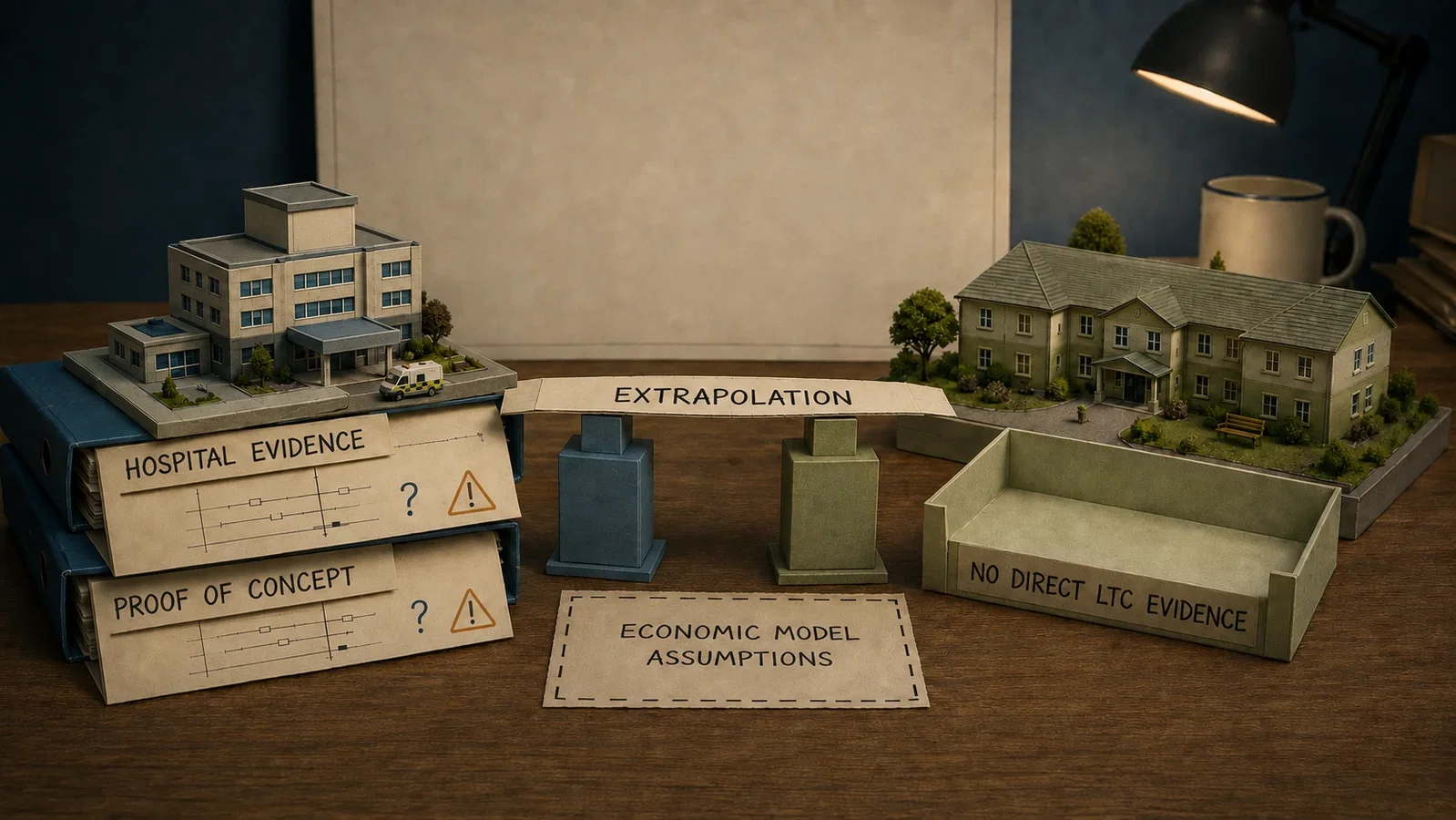
The long-term-care recommendation makes the distinction especially clear. The full guideline stated that there was no direct clinical evidence for multicomponent prevention in long-term care and no health-economic model for that setting. The committee extrapolated from hospital evidence and its experience, judged that a tailored approach could be adapted without major additional cost, and called for dedicated research.
Extrapolation is not the same as fabrication. It is a bridge built from a stated analogy and professional judgment. Its strength can be evaluated only when the bridge remains visible.
A model was not a promise of savings
CG103 also contained an economic model. Under its assumptions, targeted multicomponent prevention was judged cost-effective for older general-medical patients at intermediate or high risk and for older patients admitted for emergency repair of a hip fracture.
The model depended on assumptions about baseline risk, long-term care, dementia, institutional admission, quality of life, and cost. Some inputs came from non-UK studies. Sensitivity analyses did not turn the model into an observed national result.
It would therefore be inaccurate to say that publishing CG103 saved every hospital money, just as it would be inaccurate to credit the document with reducing mortality, dementia, or length of stay. Delirium was associated with serious outcomes, and selected preventive strategies were modeled as cost-effective. The act of issuing a guideline was not randomized to patients and has no independent effect size.
The durable change was a shared sequence
CG103 covered adults in hospital and long-term residential care. It included acute, critical, and surgical wards, but it was not solely a perioperative guideline. It excluded people under 18, those receiving end-of-life care, intoxication or withdrawal from drugs or alcohol, and delirium associated with those states.
Its relevance to perioperative medicine is still direct. A person may enter with cognitive impairment or a hip fracture, pass through anaesthesia and a recovery room, and then encounter pain, hypoxia, medications, catheters, interrupted sleep, immobility, infection, and unfamiliar rooms. No single professional sees that whole journey. A safety pathway has to travel with the patient.
The historical achievement of 2010 was not one diagnostic instrument or one treatment. It was the ordering of shared work. Risk had an entry point. Change had to be observed and documented. Prevention had to be tailored. Diagnostic tools had to fit the setting. Causes came before reflex medication. Information returned to patients and families. Unresolved delirium prompted another search for causes and possible dementia.
“Think delirium” became consequential when it stopped being only a reminder and became work that different people could see, perform, hand over, and review.
Sources and reading limits
Sources: National Clinical Guideline Centre. Delirium: diagnosis, prevention and management. Clinical Guideline 103. July 2010; NICE official launch release, 28 July 2010; NICE CG103 overview, current recommendations, update information, 2018 surveillance, and evidence index; NCBI Bookshelf NBK553009 current-version mirror. All pages of the official 447-page guideline were visually inspected, and the title, scope, methods, complete original summary recommendations, and all claim-bearing evidence-to-recommendation sections were read. Current pages are used only to control later versions.
Visual interpretations
These illustrations explore the setting and ideas. Depicted people, actions, instruments and documents are reconstructions, not evidence of their exact historical appearance.
Continue exploring
Related reading connects shared questions and contexts; it does not by itself establish historical influence.
Historical connections
These links follow specific development, adoption or citation connections recorded in the underlying research. They do not imply that history had one inevitable path.
- Later connection: 2015: Care for the Older Surgical Patient Becomes a Perioperative Pathway
- Later connection: 2019: ENGAGES Cuts Anesthetic Exposure but Not Delirium
Related reading
- 1990: CAM Makes Delirium Assessment Testable
- 2018: The PND Consensus Separates Postoperative Time from Cause
- 2018: Beverley Orser and the α5-GABA_A Brake After Anesthesia
- 2019: ENGAGES Cuts Anesthetic Exposure but Not Delirium
- 2019: Seven Summit Actions Map the Work Against Perioperative Neurocognitive Disorders
The Source Room · About & Editorial Method
Sources and reading limits are stated above. Illustrations are labelled as original source images or AI-made. Historical accounts are educational; they are not current treatment instructions.