Nine observed features, four algorithm features and the assessment behind them.
Reading Library · Anesthesia Epochs · 中文版
Watch the companion film
1990: Inouye — The Confusion Assessment Method · Watch on YouTube
Historical anchor: 1990. Date details and source qualifications are explained below.
On December 15, 1990, Sharon Inouye and colleagues published the Confusion Assessment Method (CAM) in the Annals of Internal Medicine. Their aim was to help clinicians outside psychiatry recognize delirium through a defined method. The paper presented an observational instrument and a diagnostic algorithm, then compared CAM assessments with psychiatric evaluations.[1, pp 941–943] Publication anchors this article; the validation work took place in 1988–1989.
The two study sites, Yale and Chicago, contributed 56 participants aged 65–98. Yale enrolled 30, including 11 from a geriatric assessment clinic and 19 from medical wards; Chicago enrolled 26 general medical patients. Both sites selected samples to challenge the assessment. Yale included suspected delirium, dementia and depression; Chicago excluded suspected depression.[1, pp 941–942] This was neither an exclusively postoperative cohort nor a representative hospital screening sample.
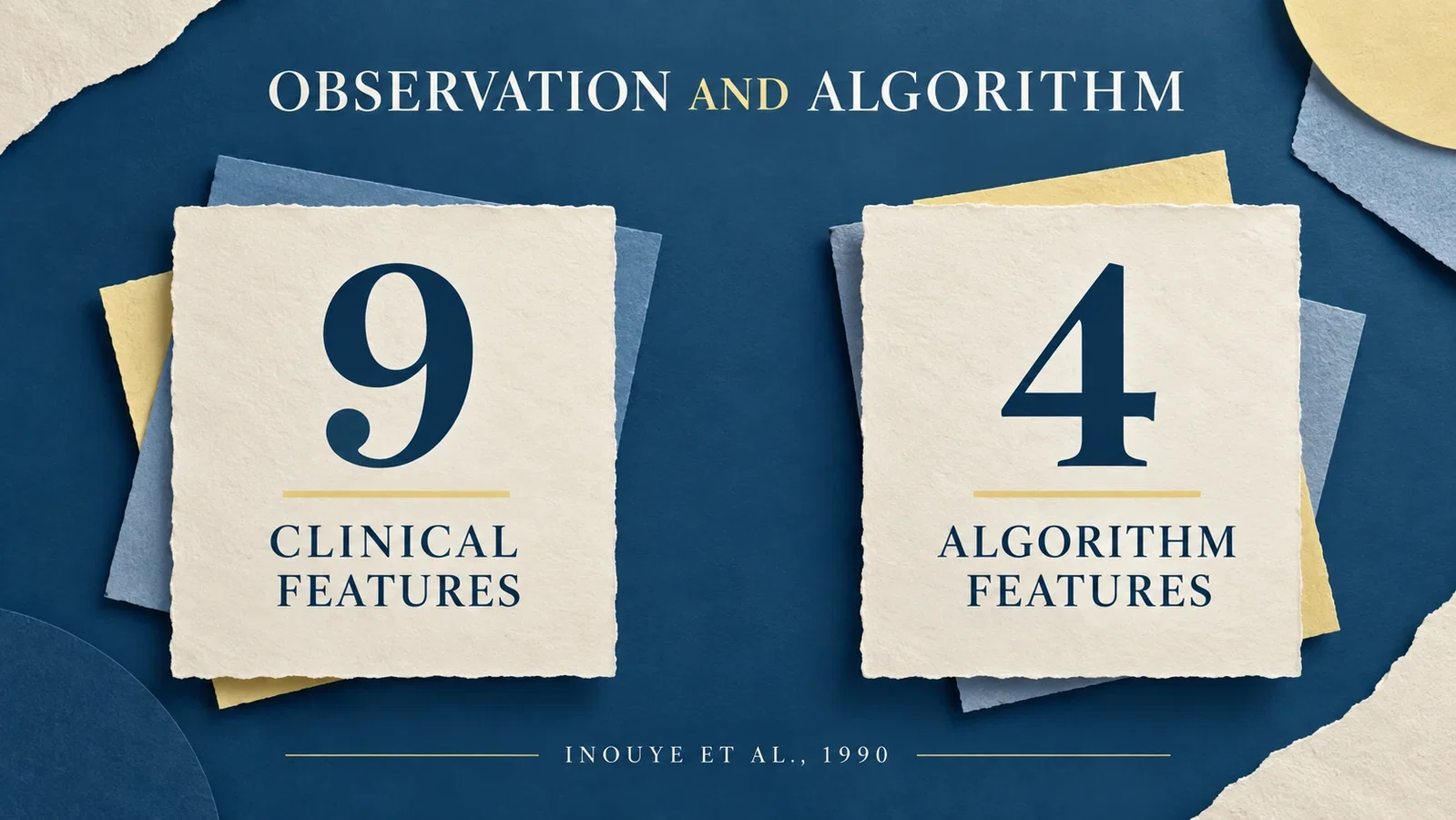
The instrument recorded nine clinical features. Its prespecified algorithm used four: acute onset with fluctuation, inattention, disorganized thinking and altered consciousness. The first two were required, together with at least one of the latter two.[1, pp 942–943, 946–947] The rule combined features rather than adding a score. An etiological requirement was omitted because the underlying cause might not be directly observable or known at the initial assessment.
The comparison depended on a defined procedure. Geriatricians completed CAM after a standardized interview with cognitive testing. Psychiatrists assessed delirium using DSM-III-R and could draw on additional history and records. Assessors were unaware of each other’s results; examinations occurred within six hours, with the order varied.[1, pp 942–943] The study evaluated this procedure. Its intended use beyond psychiatry did not establish performance for every profession or setting.
The results need their denominators. CAM identified 10 of 10 and 15 of 16 participants classified as delirious by the psychiatric reference, giving sensitivities of 100% and 94%. It correctly excluded delirium in 19 of 20 and 9 of 10 others, giving specificities of 95% and 90%. The sensitivity estimates had broad 95% confidence intervals: 66%–100% and 68%–100%, respectively.[1, Tables 2–3] These were observations in small selected samples, not fixed properties across populations.
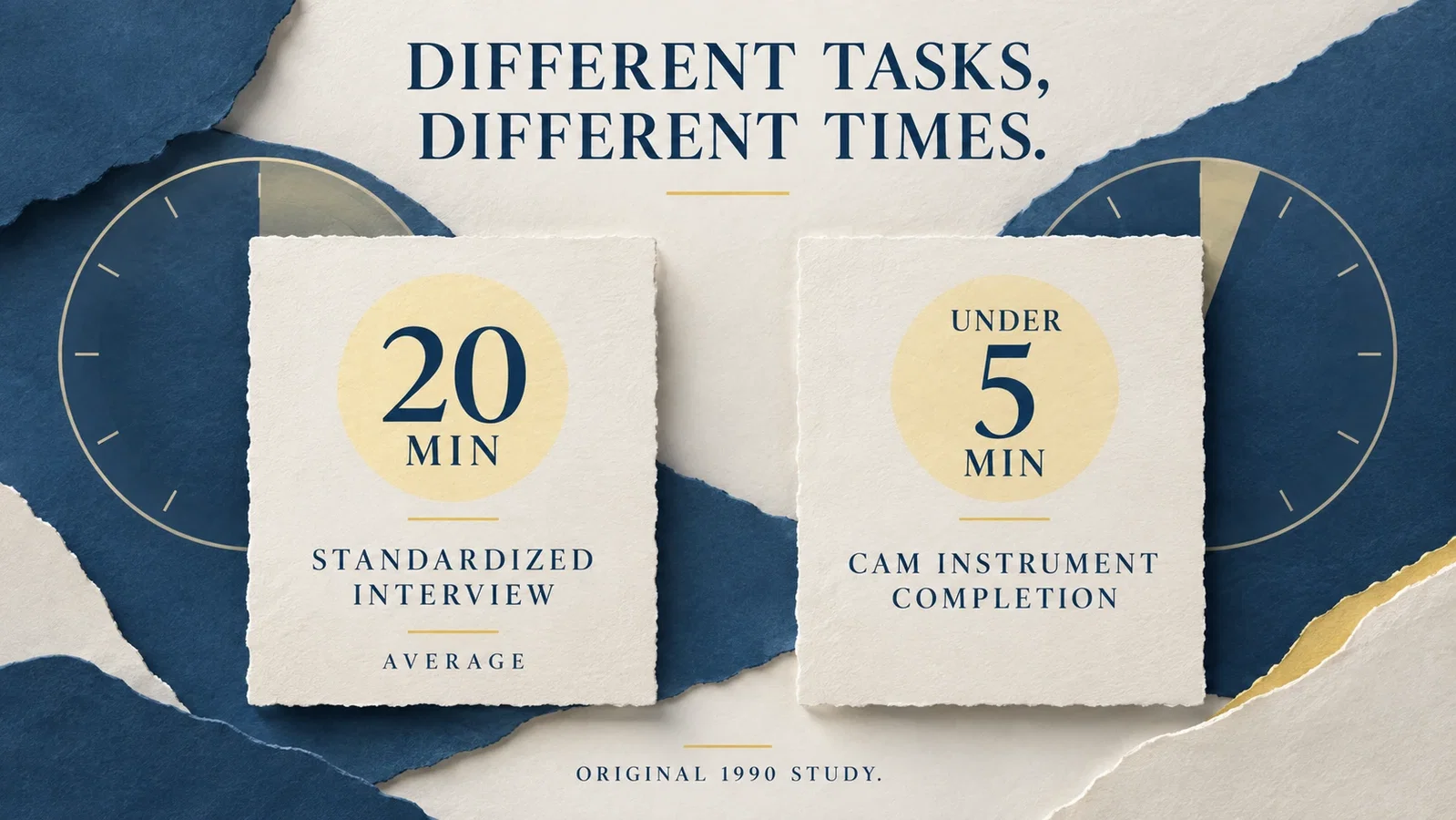
The timing claim also needs its context. Standardized interviews, including cognitive testing, averaged 20 minutes; completing the CAM instrument took less than five minutes. The authors emphasized training and the quality and completeness of the observations supporting the ratings.[1, pp 944–945] All three misclassified participants had severe dementia. Differences in assessment time and information could also affect agreement. A brief recording instrument still depended on the assessment behind it.
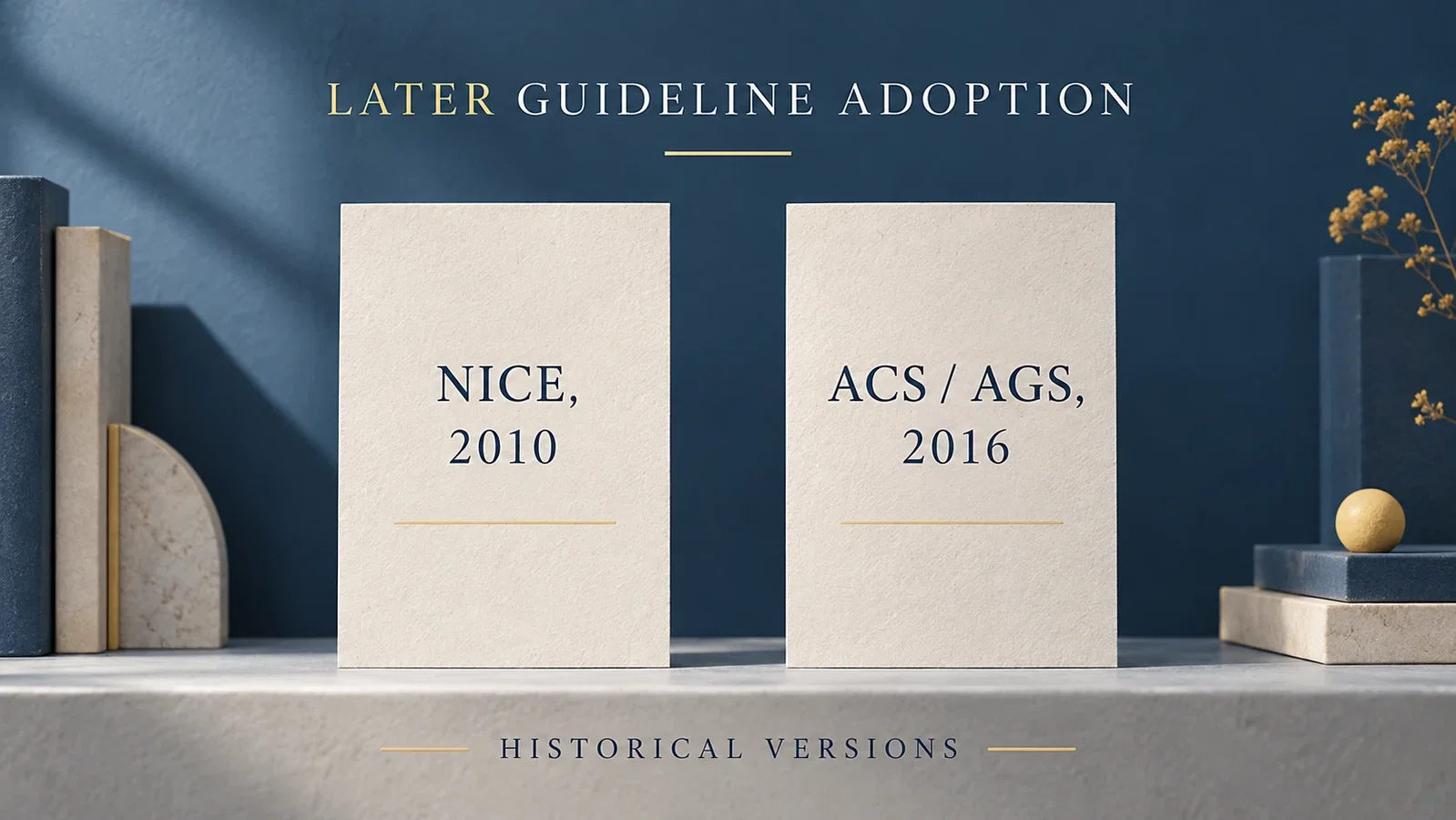
In its 2010 CG103 guideline, NICE included clinical assessment using DSM-IV or short CAM, performed by a trained and competent professional. That version specified CAM-ICU for critical care and postoperative recovery rooms.[2, pp 58, 67, 120–121] This documents later adoption in a dated guideline; it does not extend the original 1990 validation to those settings.
The 2016 ACS NSQIP/American Geriatrics Society perioperative guideline directly cited the 1990 paper and included an adapted short-CAM table. It also discussed conflicting evidence around routine screening and distinguished CAM from the CAM-ICU adaptation for nonverbal, mechanically ventilated patients.[3, pp 21–22, 58, reference 119] These specific uses and citations support the site’s existing links between CAM and the two guideline articles.
Across the original study and later guidelines, CAM provided a way to organize clinical observations. Acute change, attention, thinking and consciousness could be recorded and compared as defined features.[1, pp 945–947] The 1990 paper supported a method of recognition. It did not show that using CAM itself reduced mortality or determine the cause of delirium.
Images are modern editorial concepts, not scenes from the 1990 study, original assessment forms or clinical instructions.
Sources and reading limits
- Inouye SK, van Dyck CH, Alessi CA, Balkin S, Siegal AP, Horwitz RI. Clarifying confusion: the confusion assessment method. A new method for detection of delirium. Ann Intern Med. 1990;113(12):941–948. PMID 2240918. All eight original pages read from the institutional-hosted scan. Small selected validation samples; references are not additional studies read.
- National Clinical Guideline Centre. Delirium: diagnosis, prevention and management, CG103 full guideline. July 2010. Cover and pp 58, 67, 117, 120–121 individually reread from the 447-page PDF. Historical recommendation 1.5.1; neither the whole guideline nor its underlying studies newly read here.
- ACS NSQIP/American Geriatrics Society. Optimal perioperative management of the geriatric surgical patient: best practices guideline. 2016. Cover and printed pp 21–22, 58 individually reread from the 65-page PDF. Later guideline adoption and explicit citation of the 1990 article, not independent replication of its results.
Source limits: the 1990 paper states that 38 people were eligible, nine were excluded and 30 enrolled at the first site, an internal arithmetic discrepancy. This account retains the site totals consistent with its abstract and tables without reconstructing that flow. Full text of Wei et al.’s 2008 review (PMID 18384586) is not covered and supplies no unique claim here. The later guidelines are discussed as historical versions, not current clinical advice.
Continue exploring
Related reading connects shared questions and contexts; it does not by itself establish historical influence.
- 2010: NICE CG103 Turns 'Think Delirium' into a Care Pathway
- 2015: Care for the Older Surgical Patient Becomes a Perioperative Pathway
The Source Room · About & Editorial Method
Sources and reading limits are stated above. Illustrations are labelled as original source images or AI-made. Historical accounts are educational; they are not current treatment instructions.