Between 2012 and 2016, an ACS/AGS-related guideline family carried cognition, frailty, delirium, function, and patient goals across the surgical journey while keeping uncertainty visible.
Reading Library · Anesthesia Epochs · 中文版
Watch the companion film
2012: The Older Surgical Patient — A Best-Practice Pathway · Watch on YouTube
Historical anchor: 2015. Approximate placement; see the essay for the date range and evidence.
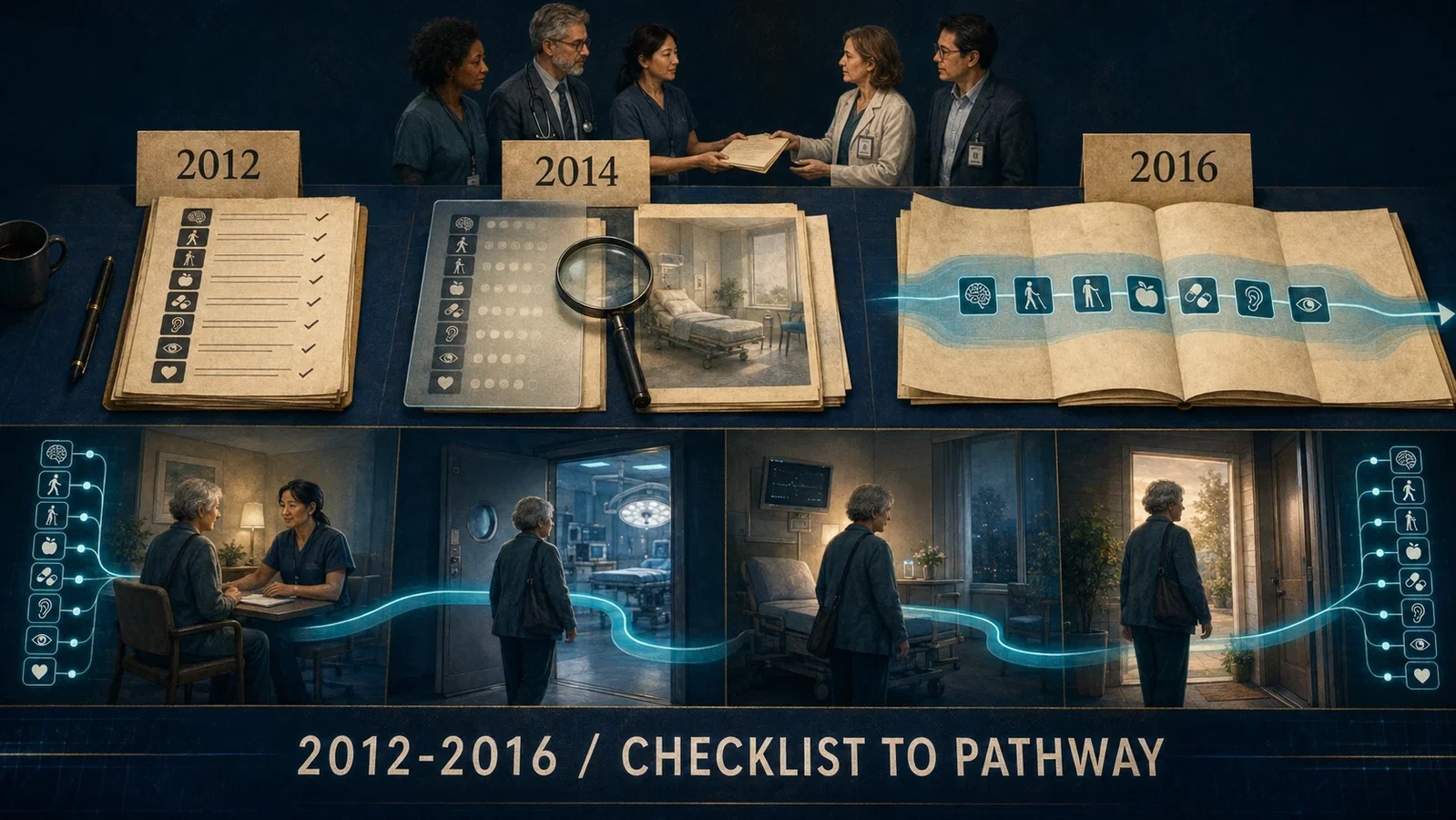
The family contains strong recommendations without pretending that all of its evidence was strong.
That tension is more than a feature of guideline methodology. It is the key to why a set of documents published between 2012 and 2016 belongs in a history of anesthesia and perioperative care.
No new drug entered the operating room. No monitor illuminated a previously invisible variable. Instead, a coalition of surgeons, geriatricians, anesthesiologists, nurses, and other specialists widened the perimeter of what counted as perioperative work.
Cognition, function, frailty, nutrition, medications, delirium, patient goals, and social support began to travel with the older patient. They no longer had to remain preoperative-clinic observations that vanished at the next doorway.
The documents organized that continuity. They did not prove that one universal bundle improved every outcome.
This is a document family, not a 2014-2019 guideline edition
A 2014-2019 date range would be misleading if read as a historical claim. The source-backed chronology begins in 2012 and ends in 2016.
The first constituent is the joint ACS NSQIP/AGS best-practices guideline on optimal preoperative assessment of the geriatric surgical patient, published electronically in August 2012 and in the October issue of the Journal of the American College of Surgeons.
The second is the American Geriatrics Society's complete clinical practice guideline for postoperative delirium in older adults, dated October 10, 2014. Two journal articles followed: a JACS Best Practice Statement that appeared online in November 2014 and in print in February 2015, and a JAGS abstracted guideline published online in December 2014 and in print in January 2015. They are companion forms of the 2014 work, not two additional guideline events.
The third is the 2016 ACS NSQIP/AGS best-practices guideline on optimal perioperative management, released online on January 4 and printed in May.
The apparent 2019 endpoint came from a different sentence in an organizational release. It referred to a planned launch target for a later Coalition for Quality in Geriatric Surgery program, not to a new guideline edition. The official AGS page dates the delirium guideline to 2014 and records a 2021 reaffirmation.
The historical span is 2012-2016.
Before an older patient reaches the operating-room door
Imagine an older person preparing for surgery. This is a composite figure used to make the documents' architecture visible, not a patient reported in the sources.
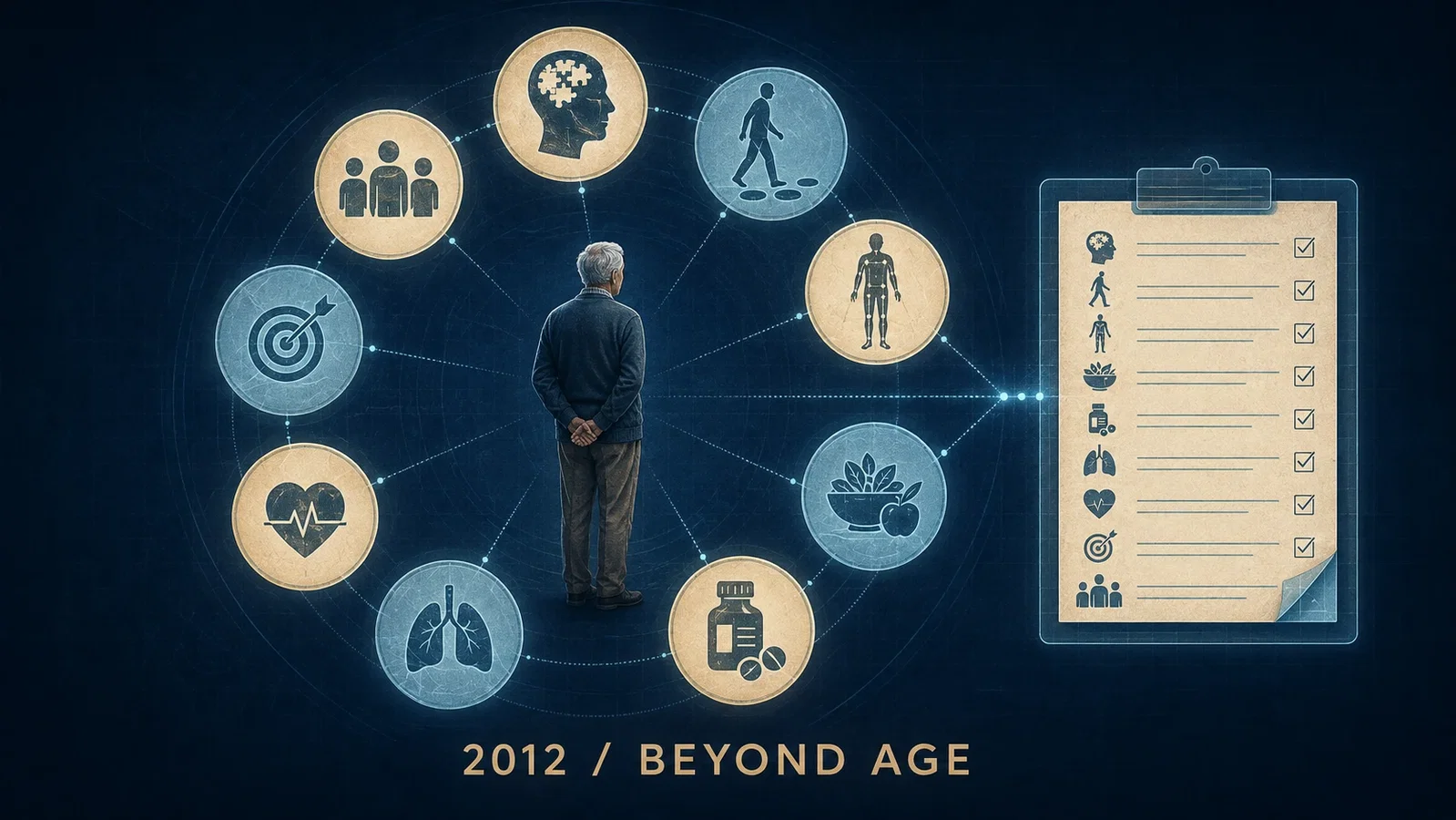
Age and a cardiac risk estimate might once have dominated the first glance. The 2012 guideline asked clinicians to hold a much wider picture at the same time. Its framework included cognition and decision-making capacity, depression, delirium risk, alcohol and other substance use, cardiac and pulmonary evaluation, functional status and falls, frailty, nutrition, medications, goals of treatment, social support, and selective preoperative testing.
Each domain could change the meaning of the others.
A cognitive baseline matters to consent before surgery and to recognizing change afterward. Slower walking or recent falls may reveal vulnerability that a diagnosis list misses. Weight loss and poor intake can narrow the margin available for recovery. Medication review may expose avoidable burdens. A clear account of goals and available support can determine whether a technically possible operation fits the life the person wants to regain.
The checklist did not discover all of these domains. Its historical move was to place them inside one preoperative frame and make their omission harder to treat as someone else's problem.
It was also a best-practices guideline, not a randomized trial of the entire checklist. The sources support the existence and breadth of the framework. They do not show that deploying it as a single package reduced mortality, complications, length of stay, or loss of independence.
Cardiac evaluation became one tile in a larger mosaic
The distinction matters because a 2014 ACC/AHA cardiovascular guideline is easily folded into an ACC/AHA-AGS family.
The 2012 geriatric document did use ACC/AHA cardiac algorithms. That made cardiovascular evaluation one external module within the broader assessment. It did not turn the ACC/AHA Task Force guideline into an AGS publication.
More importantly, placing cardiac clearance at the center would reverse the intellectual direction of the geriatric framework. Cardiac and pulmonary risks remained important, but they sat beside cognition, function, frailty, nutrition, medications, goals, and support. No single physiologic system served as a summary of the whole person.
That shift can look modest on paper. Clinically, it changes what information must be present before a plan can be called complete.
The patient approaching the operating-room door is not merely an age attached to an operation, or a heart attached to a risk score. The person brings a baseline mind, a way of moving, a reserve of strength, a set of priorities, and a network that may or may not be able to support recovery.
The delirium panel made its evidence funnel visible
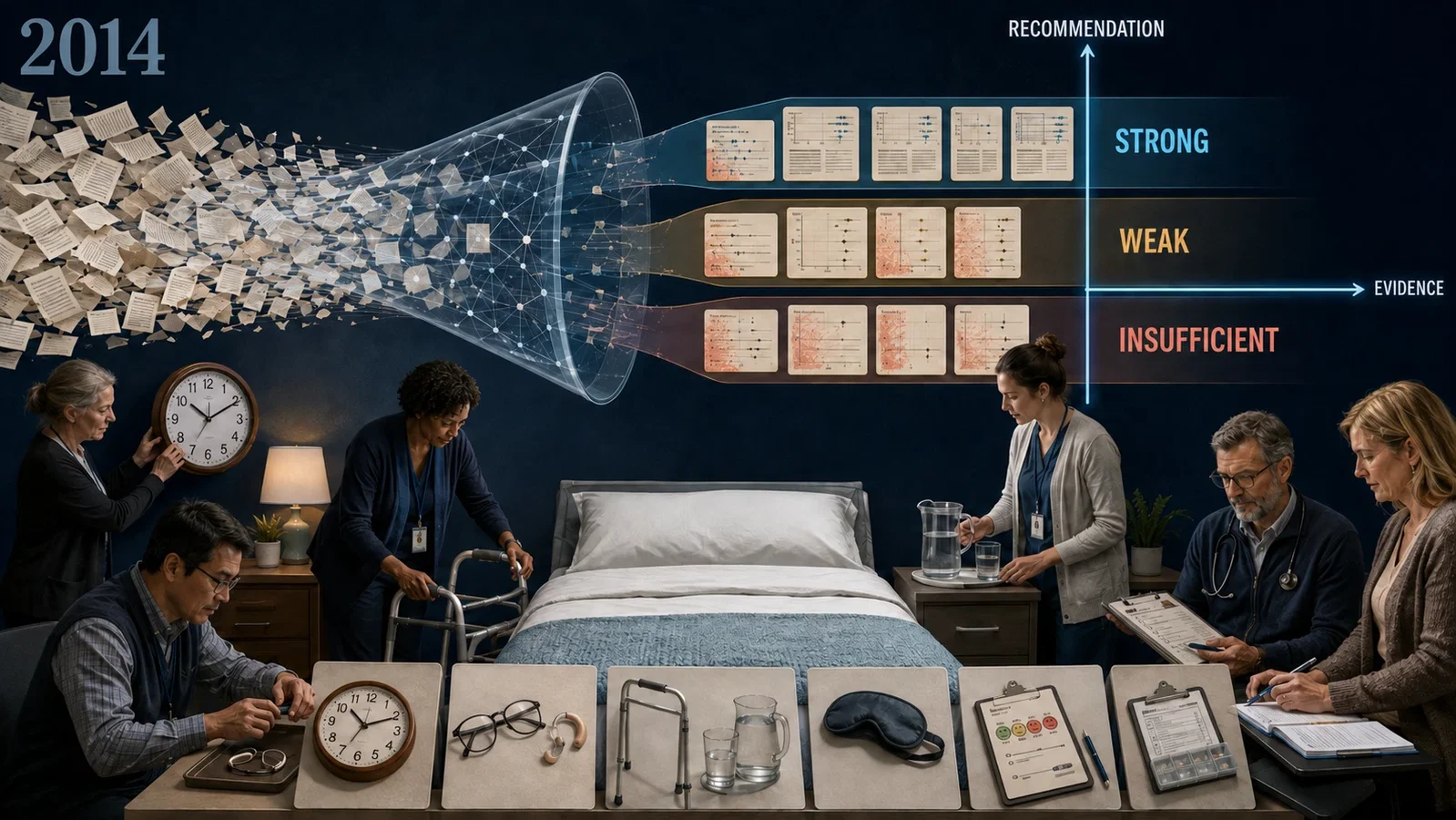
The 2014 AGS guideline concentrated on preventing and treating postoperative delirium in surgical patients aged 65 and older. Its study-flow diagram showed how a very large search narrowed into a much smaller body capable of supporting recommendation ratings.
The full search identified 10,877 records. Of those, 3,512 reached co-chair screening and 223 reached full-panel screening. The process produced 199 evidence tables, and 68 studies were used to rate recommendations.
These are review-flow numbers. They are not 10,877 patients, and the 68 studies were not 68 trials all demonstrating one treatment effect.
The guideline also documented the uneven reach of its evidence. Some material came from nonsurgical populations or required extrapolation. Several questions about diagnosis, screening, intensive care, palliative care, and other settings were not all captured by the same main search. The panel did not erase those limitations simply because a recommendation had to be written.
One result stood out. A multicomponent nonpharmacologic program for at-risk older surgical patients, delivered throughout hospitalization by an interdisciplinary team, received a strong recommendation supported by moderate-quality evidence. Components included orientation and cognitive support, sleep, mobility, visual and hearing assistance, hydration, nutrition, pain management, medication review, and prevention of avoidable complications.
The center of gravity was not a single rescue treatment. It was the environment and continuity of care.
Recommendation and evidence run on different axes
The delirium guideline becomes particularly revealing when its two rating systems are held apart.
Recommendation strength expresses how firmly a panel advises an action after considering likely benefits, harms, feasibility, values, and the available evidence. Evidence quality describes confidence in the underlying studies: their directness, consistency, precision, and risk of bias.
The summary contained eight strong recommendations. Only the multicomponent nonpharmacologic prevention recommendation carried moderate-quality evidence. The other seven were supported by low-quality evidence.
That does not make a strong recommendation fraudulent. A panel may need to advise against a plausibly harmful medication or insist on evaluation for underlying causes even when ideal trials do not exist. But the label strong cannot be translated into proved with high-quality evidence.
The same discipline defines what the guideline left unsettled. It did not establish processed electroencephalography as a proven way to prevent delirium. Evidence for regional anesthesia was weak and low quality rather than a demonstration of universal superiority. Results for prophylactic antipsychotics were inconsistent, so the panel made no general recommendation for or against their use. Antipsychotic treatment was reserved for severe agitation or distress threatening substantial harm after behavioral measures had failed, and benzodiazepines were not first-line therapy except for specific indications such as withdrawal.
Authority and certainty were allowed to remain different things.
One underlying guideline acquired two journal lives
Publication history can make a single evidence project look like several discoveries.
The complete AGS guideline was dated October 10, 2014. The JACS Best Practice Statement went online on November 14, 2014, then appeared in a February 2015 issue. The JAGS abstracted clinical practice guideline went online on December 12, 2014, then appeared in the January 2015 issue.
The JACS article offered a practical presentation that included risk, diagnosis, screening, prevention, treatment, and implementation. It explicitly described itself as accompanying the clinical practice guideline. The JAGS article said that it was an abstracted version based on the 2014 AGS guideline.
The two publication routes mattered. They placed the work before overlapping but different clinical audiences and packaged its content for different uses. They did not create separate search processes or three independent rounds of guideline authorship.
This is why the combined article can retain 2015 as its display midpoint while using 2012-2016 as its factual range. A timeline anchor is a navigational device. It is not a license to turn print dates into new historical events.
In 2016, the patient's information crossed the threshold
The title of the 2016 document announced the change: from preoperative assessment to perioperative management.
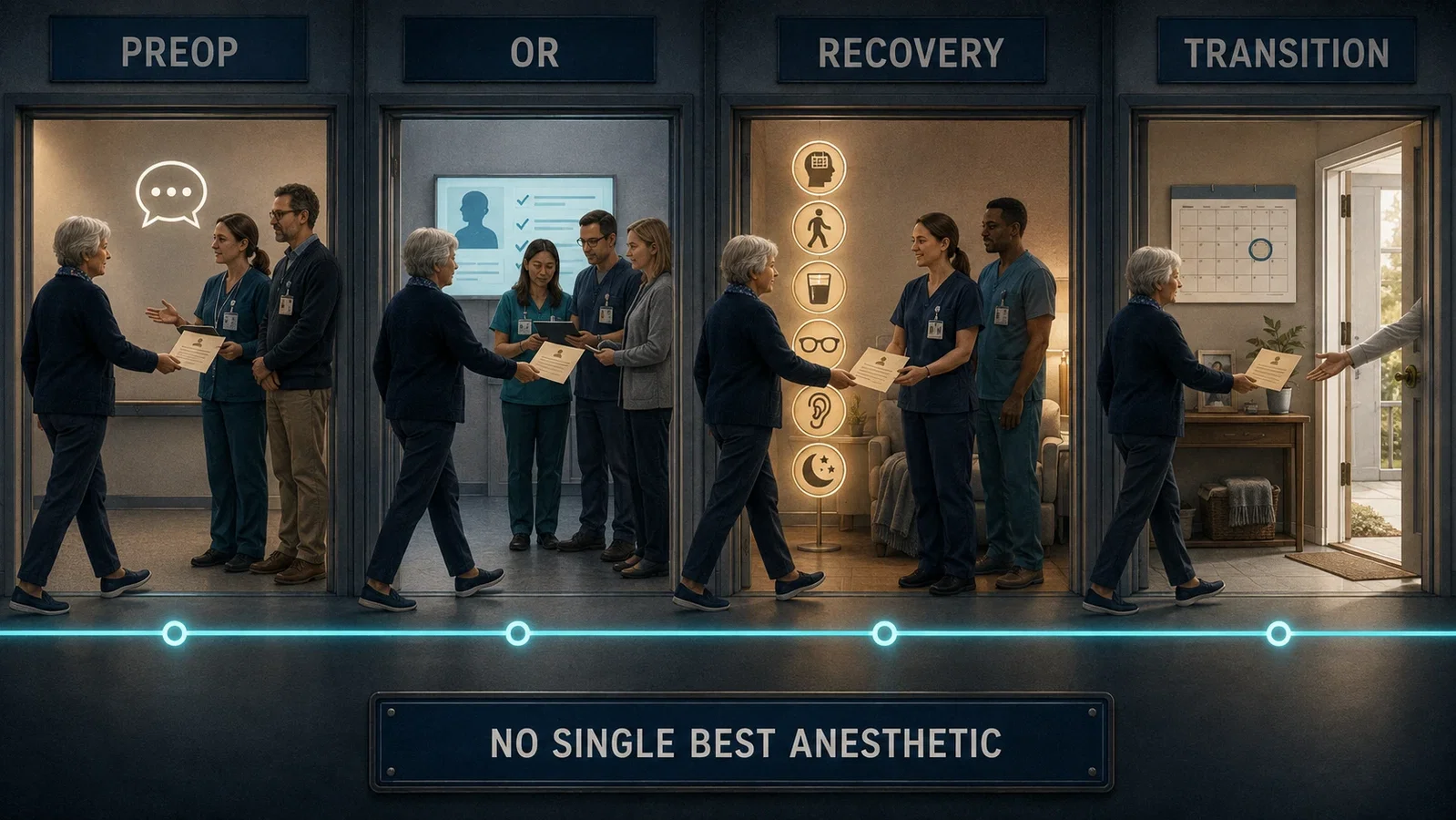
It explicitly built on the 2012 collaboration. The domains identified before surgery now had to persist through four phases: immediate preoperative care, intraoperative care, postoperative care, and care transition.
Return to the composite patient.
At the first threshold, cognition, decision-making, medications, function, nutrition, goals, advance directives, and support remain active planning information. A conversation about what matters to the patient is not complete if its result disappears when the schedule advances.
At the operating-room threshold, the plan becomes individualized rather than doctrinaire. The 2016 document did not identify one anesthetic technique as best for every older adult. It did not establish definitive superiority of regional over general anesthesia. Surgical requirements, patient condition, risks, and preferences still shape the choice.
In recovery, the preoperative baseline becomes a reference rather than an archived form. Orientation, sensory aids, mobility, hydration, nutrition, sleep, pain management, and medication review can work together. Delirium, functional decline, falls, urinary problems, pressure injury, and other vulnerabilities belong to ongoing perioperative work rather than to an isolated postoperative service.
At transition, the plan must acquire a receiver. Functional needs, medication changes, events during hospitalization, follow-up responsibilities, and available support have to survive the move to another team or home.
The four phases are not four new patients. They are four institutional views of the same person.
Continuity was something the documents could organize
The family did not provide one device that could be switched on. Its intervention target was closer to organizational memory.
Who knows the patient's cognitive and functional baseline? Who sees the hearing aid as part of delirium prevention rather than a personal accessory? Who notices that a medication list changed? Who carries the patient's goals into a new setting? Who receives the plan when the patient leaves?
Those questions are less visually dramatic than a new monitor, but they expose a recurrent hazard in complex care: every doorway can reset attention.
The documents tried to prevent that reset. A preoperative observation had to become an intraoperative constraint, a recovery-room reference, or a transition responsibility when relevant. The same vulnerability could require different action at different phases, but it should not have to be rediscovered from zero.
This is also why multicomponent nonpharmacologic delirium prevention fits the larger historical arc. Orientation, mobility, hydration, sleep, sensory support, pain review, and medication review do not belong to a single profession or a single moment. They become coherent only when responsibility persists across people and time.
Continuity became the architecture the guideline family was capable of designing.
A complete-looking pathway did not become complete evidence
The elegance of a pathway can create retrospective overconfidence. Once every phase has a box, the diagram appears to contain a solution.
The source documents resist that reading.
The 2012 and 2016 guidelines combined research, existing guidance, and expert judgment. The delirium work conducted a structured review and rated its evidence, yet many recommendations remained low quality, weak, or insufficient. None of the documents tested the entire 2012-2016 family as one intervention against a control group.
They therefore do not, by themselves, prove lower mortality, fewer complications, shorter hospitalization, preserved independence, or universal adoption. Specific components may have their own supporting studies, but those outcomes cannot be assigned wholesale to the family.
Nor can the historical documents be presented as a current bedside protocol. Guidance changes, evidence accumulates, and individual decisions require contemporary clinical context. This article explains how a framework developed; it does not issue patient-specific instructions.
The same boundary excludes a convenient but false 2019 finale. A later quality-program target may show that organizations wanted to operationalize geriatric surgical standards more broadly. It cannot be used as a guideline revision date.
An honest history can describe a more complete map while preserving the blank spaces on it.
What changed was the duration of clinical attention
The 2012 checklist made a broad set of vulnerabilities visible before surgery. The 2014 delirium guideline showed how to make recommendations without disguising the uneven quality of their evidence. The 2016 perioperative document carried those concerns through preparation, the operating room, recovery, and transition.
None of the three steps invented frailty, cognition, delirium, nutrition, function, or patient preference. Their collective contribution was positional. These concerns moved from the margins of an operation into the architecture of perioperative care.
That movement altered responsibility. A baseline could no longer be considered useful only to the clinician who measured it. A patient goal could not end at consent. A delirium risk could not become visible only after confusion appeared. A transition could not be treated as the administrative moment after the clinical work was over.
The family left uncertainty intact. It did not nominate one best anesthetic or certify a universal outcome-improving bundle. It did something quieter: it made it harder for institutions to treat an older person's vulnerabilities as disconnected observations.
From checklist to pathway, the paper trail grew longer because the required attention grew longer.
Continuity became the intervention the documents could organize, even when outcomes remained uncertain.
Sources and reading limits
Sources: Chow WB et al. J Am Coll Surg. 2012;215(4):453-466. PMID 22917646. DOI 10.1016/j.jamcollsurg.2012.06.017; American Geriatrics Society Expert Panel on Postoperative Delirium in Older Adults. Clinical Practice Guideline for Postoperative Delirium in Older Adults. 2014; American Geriatrics Society Expert Panel. J Am Coll Surg. 2015;220(2):136-148.e1. PMID 25535170. DOI 10.1016/j.jamcollsurg.2014.10.019; American Geriatrics Society Expert Panel. J Am Geriatr Soc. 2015;63(1):142-150. PMID 25495432. PMCID PMC5901697. DOI 10.1111/jgs.13281; Mohanty S et al. J Am Coll Surg. 2016;222(5):930-947. PMID 27049783. DOI 10.1016/j.jamcollsurg.2015.12.026. All cited sources were read for this article. The 2014 ACC/AHA record is used only as exclusion control.
Visual interpretations
These illustrations explore the setting and ideas. Depicted people, actions, instruments and documents are reconstructions, not evidence of their exact historical appearance.
Continue exploring
Related reading connects shared questions and contexts; it does not by itself establish historical influence.
Historical connections
- Earlier connection: 2010: NICE CG103 Turns 'Think Delirium' into a Care Pathway
- Later connection: 2018: The PND Consensus Separates Postoperative Time from Cause
- Later connection: 2019: ENGAGES Cuts Anesthetic Exposure but Not Delirium
- Later connection: 2019: Seven Summit Actions Map the Work Against Perioperative Neurocognitive Disorders
Related reading
- 1990: CAM Makes Delirium Assessment Testable
- 2001: Fried's Frailty Phenotype Makes a Clinical Concept Measurable
- 2010: Makary's Five-Item Study Brings Frailty into Preoperative Assessment
- 2018: The PND Consensus Separates Postoperative Time from Cause
- 2019: Seven Summit Actions Map the Work Against Perioperative Neurocognitive Disorders
- 2019: ENGAGES Cuts Anesthetic Exposure but Not Delirium
- 2024: Nine Organizations Turn Preoperative Cardiac Clearance into a Continuous Pathway
The Source Room · About & Editorial Method
Sources and reading limits are stated above. Illustrations are labelled as original source images or AI-made. Historical accounts are educational; they are not current treatment instructions.