ENGAGES reduced volatile-anesthetic exposure and EEG suppression in 1,232 older surgical patients without demonstrating fewer delirium cases on postoperative days 1-5.
Reading Library · Anesthesia Epochs · 中文版
Watch the companion film
2019: ENGAGES — EEG-Guided Anesthesia and Delirium · Watch on YouTube
Historical anchor: 2019. Date details and source qualifications are explained below.
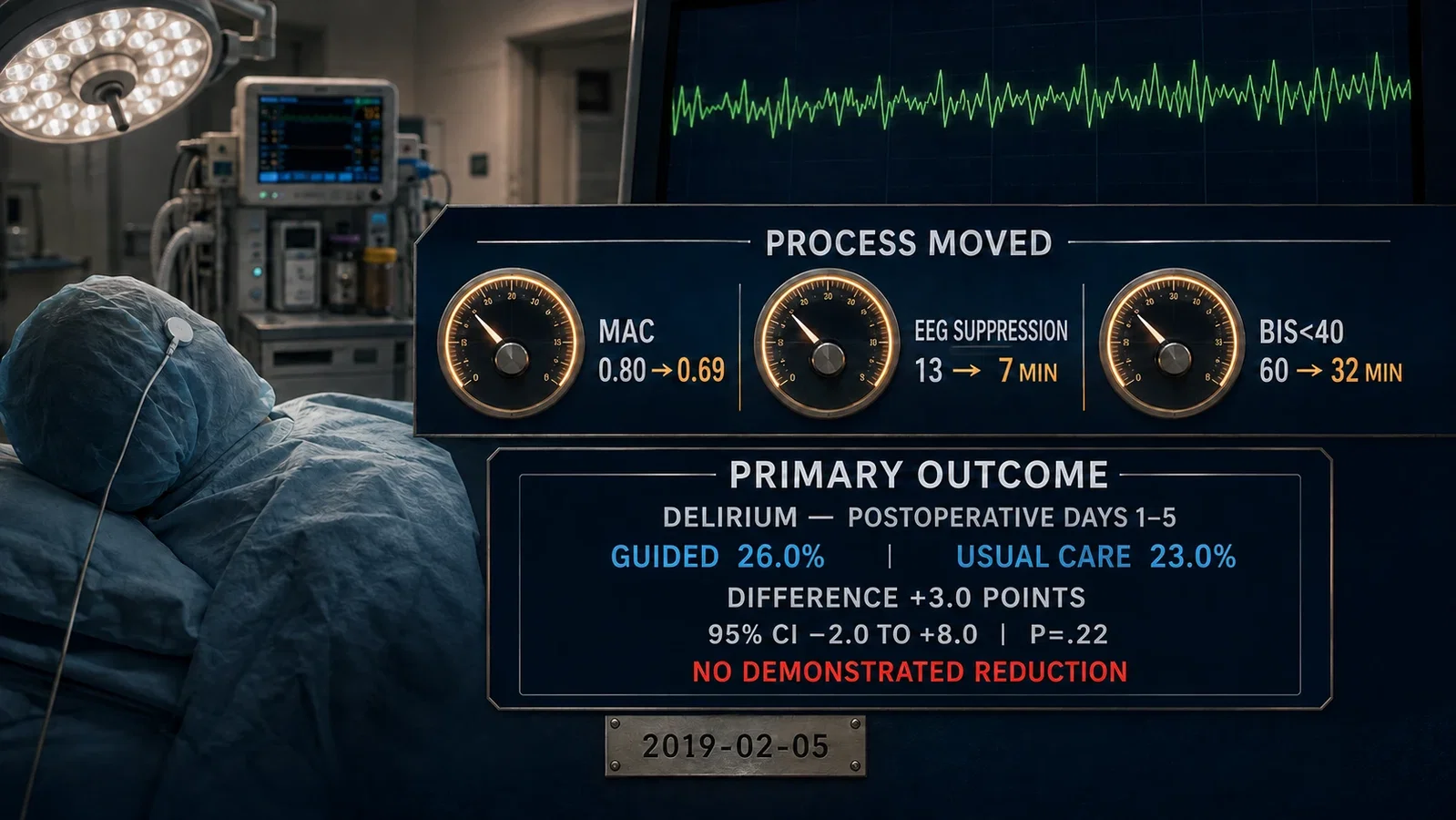
The electroencephalogram changed. The anesthetic changed. The outcome that mattered most did not change in the hoped-for direction.
That is what made ENGAGES more than an ordinary “negative trial.” Its intervention reached the operating room and moved the physiological measures it was meant to move. The unanswered question was whether those changes would travel far enough downstream to prevent postoperative delirium.
They did not—at least not as a demonstrated reduction in this trial.
Before the result, three denominators
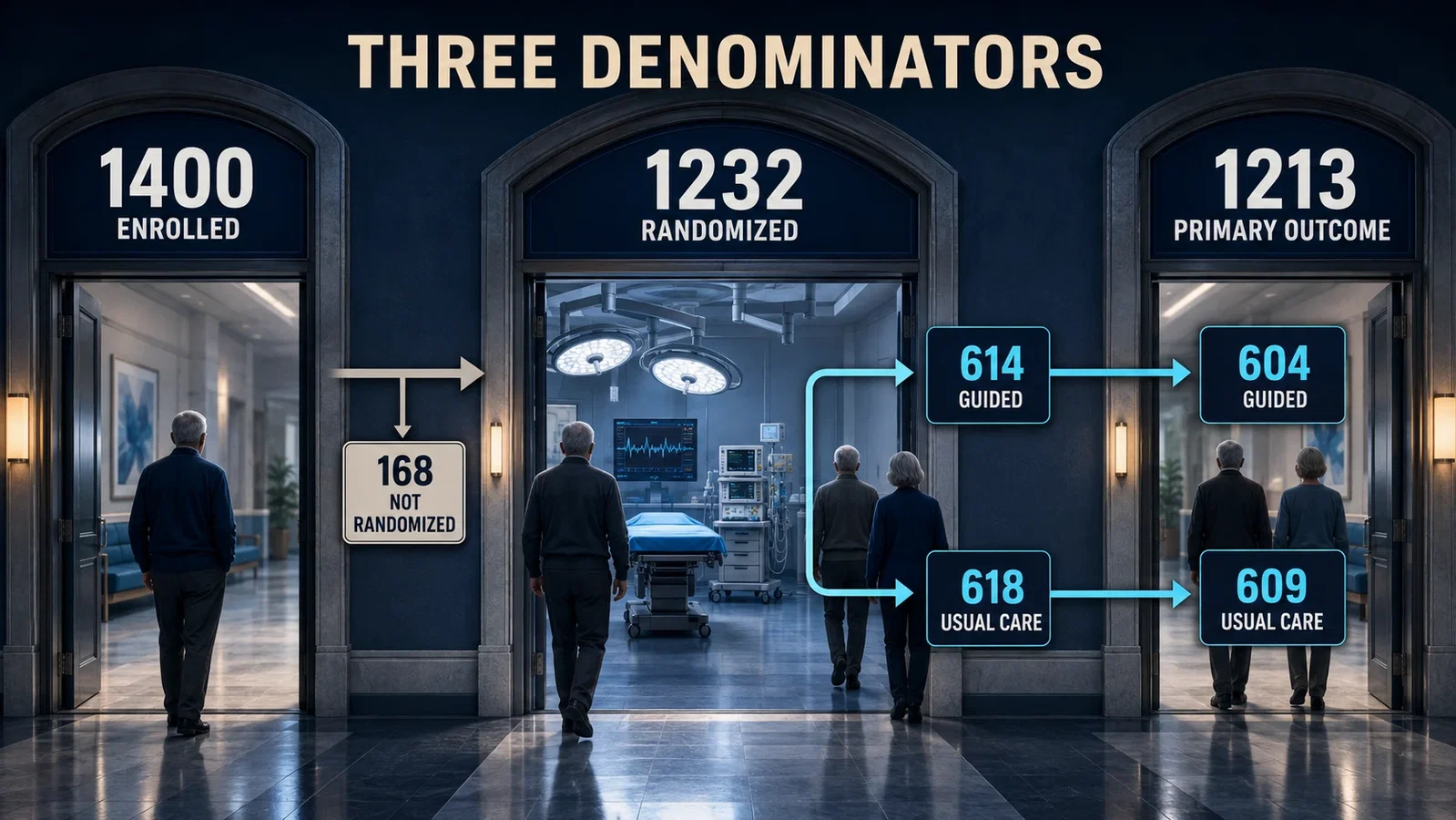
From January 2015 to May 2018, the team screened 39,144 patients at Barnes-Jewish Hospital in St Louis. They consented or enrolled 1,400. But enrollment was not randomization.
Before assignment, 168 people did not enter a treatment arm: two died, 49 were found ineligible after enrollment, 49 had surgery canceled, the research team missed 31 operations, and 37 withdrew. That left 1,232 randomized patients—614 assigned to EEG-guided anesthetic administration and 618 to usual care.
The participants were at least 60 years old and undergoing major surgery with volatile-agent general anesthesia. The trial was conducted across three hospital facilities and 48 operating rooms, but it remained one institutional center. Calling it multicenter would turn geographical spread inside a hospital system into a different study design.
Nineteen randomized patients did not yield the primary delirium outcome. One died during surgery, three withdrew that day, eleven remained too heavily sedated throughout the assessment window, and four left the hospital before the first scheduled assessment. The primary analysis therefore contained 1,213 people: 604 guided and 609 usual care.
Those three numbers—1,400, 1,232, and 1,213—describe different doors in the trial. Blending them would make every percentage that follows less trustworthy.
Everyone wore the sensor; only one group could read the story
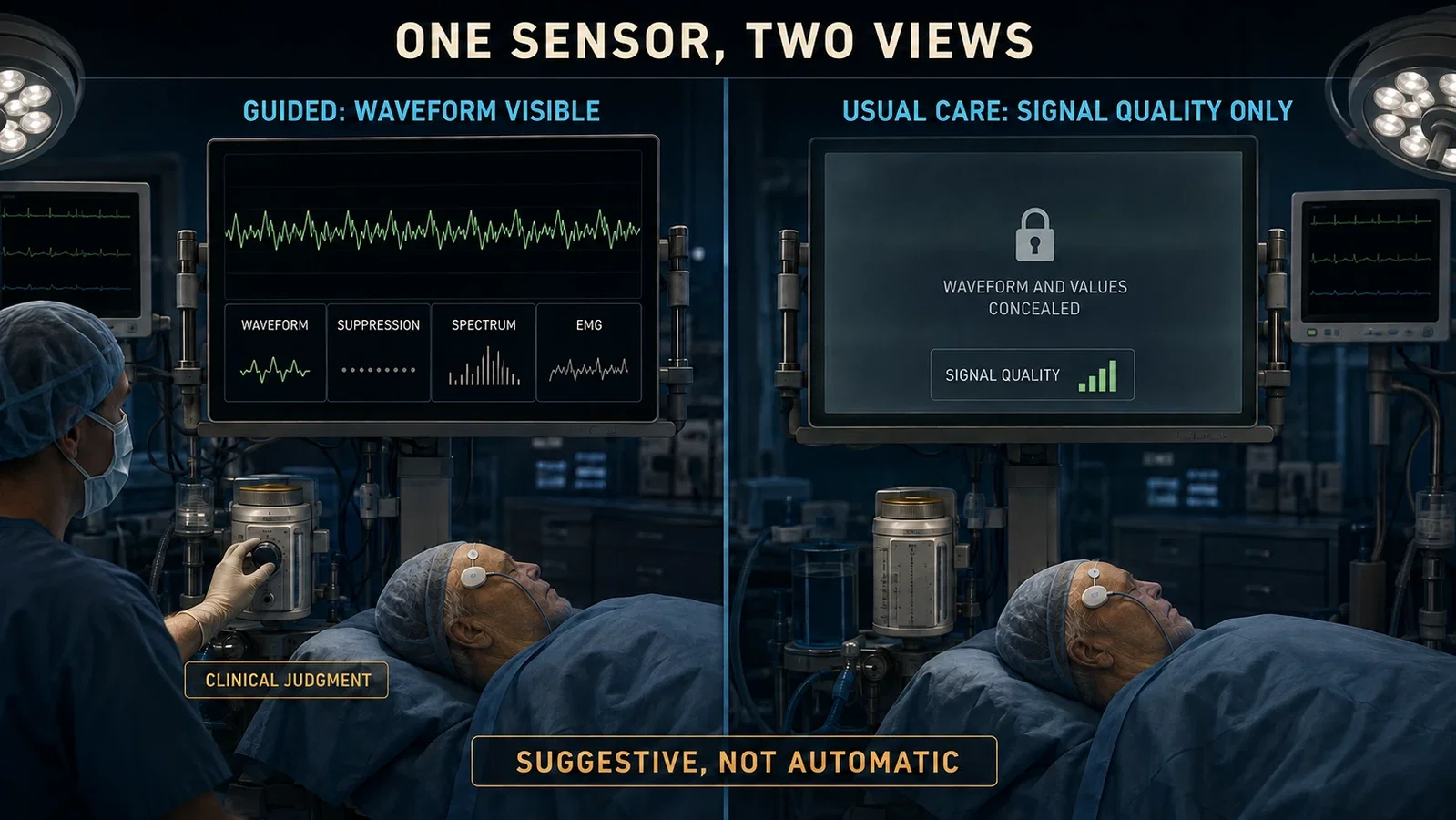
Every participant received a frontal EEG sensor. In usual care, the anesthesia clinician could see a signal-quality indicator but not the waveform or the other derived values. In the guided group, the waveform, suppression ratio, spectral-edge frequency, electromyography, and bispectral index were visible.
The clinicians in the guided group were trained to recognize EEG patterns and were encouraged to reduce volatile anesthetic when suppression appeared. Suppression was the chief trigger; a BIS value below 40 was secondary. Clinical judgment remained in the loop.
This was not an automatic depth controller, and it was not simply an order to chase one BIS number. The protocol itself called the guidance suggestive rather than prescriptive. A clinician could see a reason to reduce anesthetic and still decide that movement, hemodynamics, or surgical conditions made reduction inappropriate.
Patients and outcome assessors could be blinded. The anesthesia professionals delivering a visible-waveform intervention could not. ClinicalTrials.gov’s compact label of “triple masking” therefore has to be read together with the main paper’s operational description.
Both groups were also discouraged from using nitrous oxide and intravenous hypnotics during maintenance, and all participants received a multicomponent safety intervention. Those common elements belonged to the trial environment, not uniquely to the randomized EEG contrast.
The intervention worked inside the operating room
The guided protocol did not remain a training slide. It changed anesthetic practice.
Median end-tidal volatile-anesthetic exposure was 0.69 MAC in the guided group and 0.80 MAC in usual care, a difference of −0.11. Median EEG-suppression time was 7 rather than 13 minutes, a reduction of 6 minutes. Median time with BIS below 40 was 32 rather than 60 minutes, a reduction of 28 minutes. The two EEG differences had P values below .001.
There was no corresponding separation in median time with mean arterial pressure below 60 mm Hg: 7 minutes in each group.
The EEG records were extensive but not literally complete. Suppression data were available for 595 of 604 guided and 594 of 609 usual-care patients in the primary-outcome set; BIS-below-40 data were available for 594 and 575. Five guided cases had technical problems that prevented display, while ten usual-care clinicians judged that they needed to view the EEG.
Those deviations did not erase the contrast. The intervention successfully reduced the exposure and suppression measures that motivated it. That makes the clinical result harder—not easier—to dismiss.
The primary outcome stayed put
The prespecified primary outcome was incident delirium on postoperative days 1 through 5. Trained, blinded researchers assessed patients daily with the CAM or CAM-ICU. Because delirium fluctuates and can escape an afternoon interview, an independent structured chart review supplemented the bedside assessments, with adjudication for uncertainty.
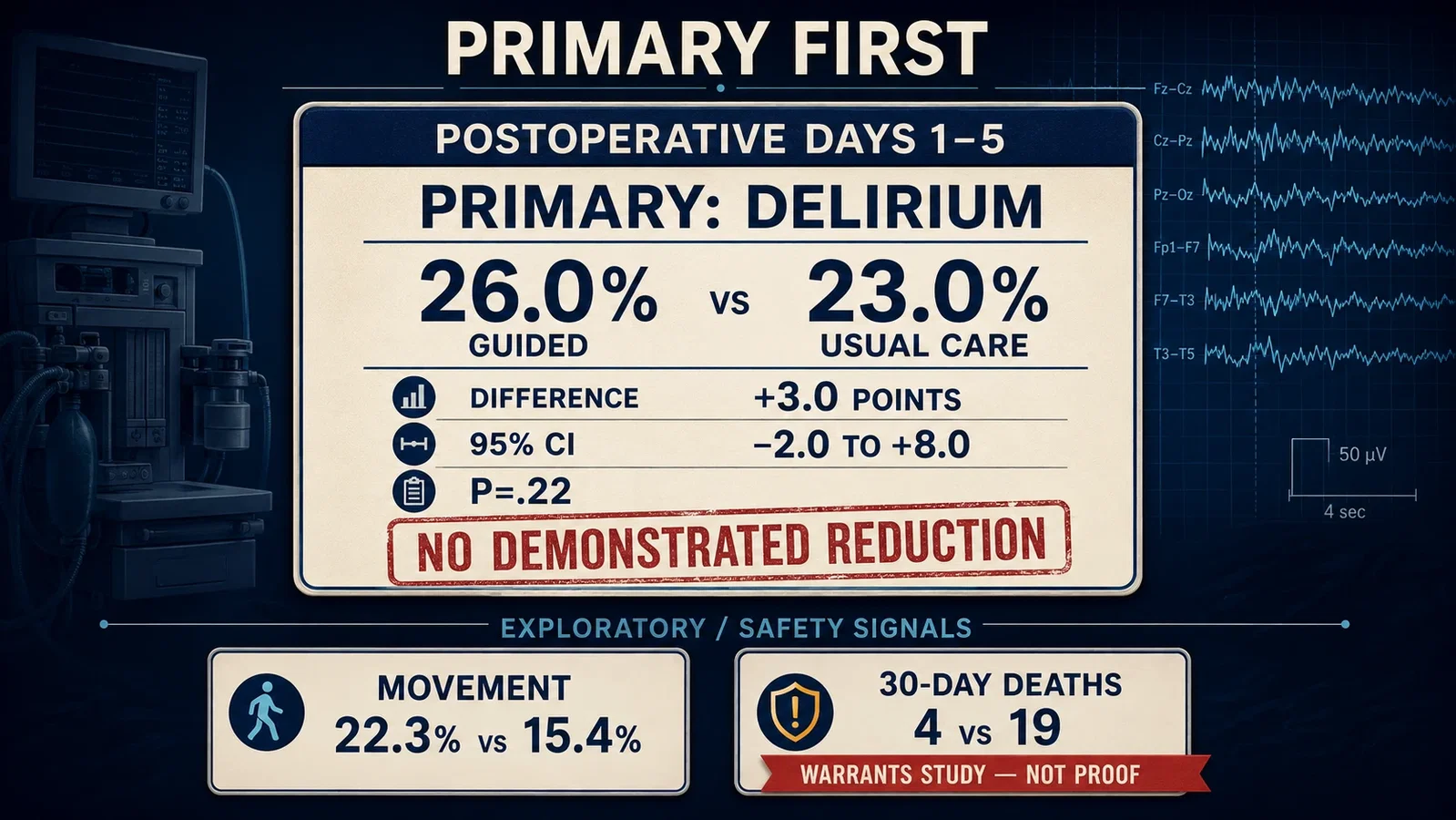
Delirium occurred in 157 of 604 guided patients, or 26.0%, and 140 of 609 usual-care patients, or 23.0%.
The absolute difference was +3.0 percentage points. Its 95% confidence interval ran from −2.0 to +8.0 points, and P=.22.
The trial therefore did not demonstrate the expected decrease. It did not establish that the strategies were equivalent, and it did not establish that guidance increased delirium. A nonsignificant superiority test does neither of those jobs.
The study had been designed with more than 90% power to detect an 8-point absolute reduction under its assumptions. That gave it a meaningful test of the large benefit it expected. It did not rule out every smaller benefit or harm in every future population.
Post hoc exercises did not rescue the hypothesis. Treating missing outcomes as all positive or all negative, adjusting for prognostic variables, excluding guided cases with the weakest protocol fidelity, and reassigning the small number of treatment crossovers did not produce a significant delirium reduction. These analyses supported the direction of the primary result; they did not become a new primary outcome.
Two striking side signals, neither a new verdict
Undesirable intraoperative movement was reported in 137 of 614 guided patients and 95 of 618 usual-care patients: 22.3% versus 15.4%, a difference of +6.9 points with P=.002. Trying to use less anesthetic could carry a tradeoff.
But movement was not the same as awareness or injury. No assessed patient in either group reported intraoperative awareness. Postoperative nausea and vomiting and the proportion experiencing at least one serious adverse event did not differ significantly.
Then came the result most likely to steal the story: 4 guided patients and 19 usual-care patients died within 30 days in the JAMA report.
That difference was large enough to demand attention and unexpected enough to demand restraint. Mortality was an exploratory safety outcome among many comparisons, not the prespecified primary endpoint. The authors wrote that it warranted further investigation. The trial did not establish that EEG guidance, reduced anesthetic exposure, or reduced suppression saved lives.
The same discipline applies in the other direction. More movement cannot turn the primary delirium result into a general warning against EEG guidance. Fewer deaths cannot turn it into a mortality trial. Outcome hierarchy protects a study from whichever secondary result happens to be more dramatic.
A null result can still contain a successful experiment
ENGAGES had important strengths. It generated a measurable treatment contrast. Delirium incidence was high enough to test a clinically meaningful reduction. Assessment training, blinding, chart review, and adjudication made missing delirium determinations uncommon.
It also had boundaries. One center’s practice patterns may not travel to another. Daily interval assessments can miss a fluctuating syndrome even when chart review is added. A common multicomponent intervention may have influenced some outcomes in both arms. The findings do not automatically extend to total intravenous anesthesia. A derived suppression ratio can underestimate visually recognizable EEG suppression.
Most importantly, the trial tested a strategy and an indication—not the existence of the EEG, and not every reason an anesthesiologist might look at it.
The monitor made a proposed target visible. Training and feedback changed clinician behavior. Anesthetic exposure and suppression fell. Postoperative delirium did not fall with them in a statistically demonstrated way.
That sequence is not a failure to learn. It is the trial doing the difficult work that an association, a mechanism, and a monitor cannot do alone.
It asks whether changing what we can see also changes what the patient experiences.
And it permits the answer to be no.
Sources and reading limits
Sources: Wildes TS, Mickle AM, Ben Abdallah A, et al. JAMA. 2019;321(5):473-483. PMID 30721296. PMCID PMC6439616. DOI 10.1001/jama.2018.22005; Wildes TS, Winter AC, Maybrier HR, et al. BMJ Open. 2016;6:e011505. PMID 27311914. PMCID PMC4916605. DOI 10.1136/bmjopen-2016-011505; JAMA Supplements 1-4; ClinicalTrials.gov NCT02241655; archived PubMed, PMC, Europe PMC, and Crossref records. All cited sources were read for this article.
Visual interpretations
These illustrations explore the setting and ideas. Depicted people, actions, instruments and documents are reconstructions, not evidence of their exact historical appearance.
Continue exploring
Related reading connects shared questions and contexts; it does not by itself establish historical influence.
Historical connections
- Earlier connection: 2010: NICE CG103 Turns 'Think Delirium' into a Care Pathway
- Earlier connection: 2015: Care for the Older Surgical Patient Becomes a Perioperative Pathway
- Later connection: 2019: Seven Summit Actions Map the Work Against Perioperative Neurocognitive Disorders
Related reading
- 2010: NICE CG103 Turns 'Think Delirium' into a Care Pathway
- 2015: Care for the Older Surgical Patient Becomes a Perioperative Pathway
- 2018: Beverley Orser and the α5-GABA_A Brake After Anesthesia
- 2018: The PND Consensus Separates Postoperative Time from Cause
- 2019: Seven Summit Actions Map the Work Against Perioperative Neurocognitive Disorders
- 2016–2019: GAS, PANDA and MASK Narrow the Pediatric Neurotoxicity Question
- 2024: GPT-4 Turbo Classifies Preoperative Text but Struggles to Predict Duration
The Source Room · About & Editorial Method
Sources and reading limits are stated above. Illustrations are labelled as original source images or AI-made. Historical accounts are educational; they are not current treatment instructions.