The 2018 PND consensus did more than rename POCD: it separated pre-existing disease, delirium, recovery, later NCD, and the evidence required for each.
Reading Library · Anesthesia Epochs · 中文版
Watch the companion film
2018: Naming Perioperative Neurocognitive Disorders · Watch on YouTube
Historical anchor: 2018. Date details and source qualifications are explained below.
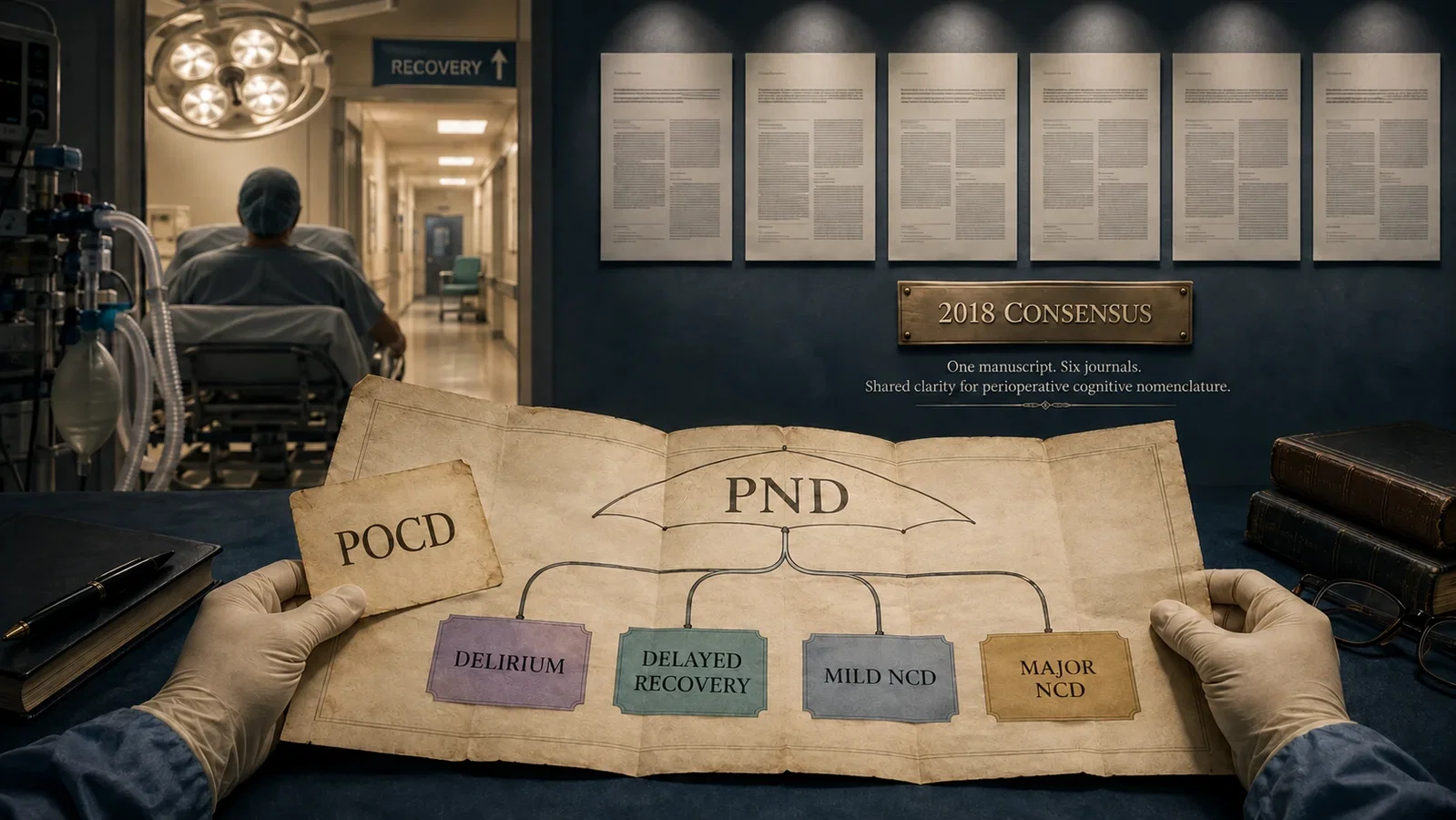
The word postoperative looks innocent. It places an event after an operation.
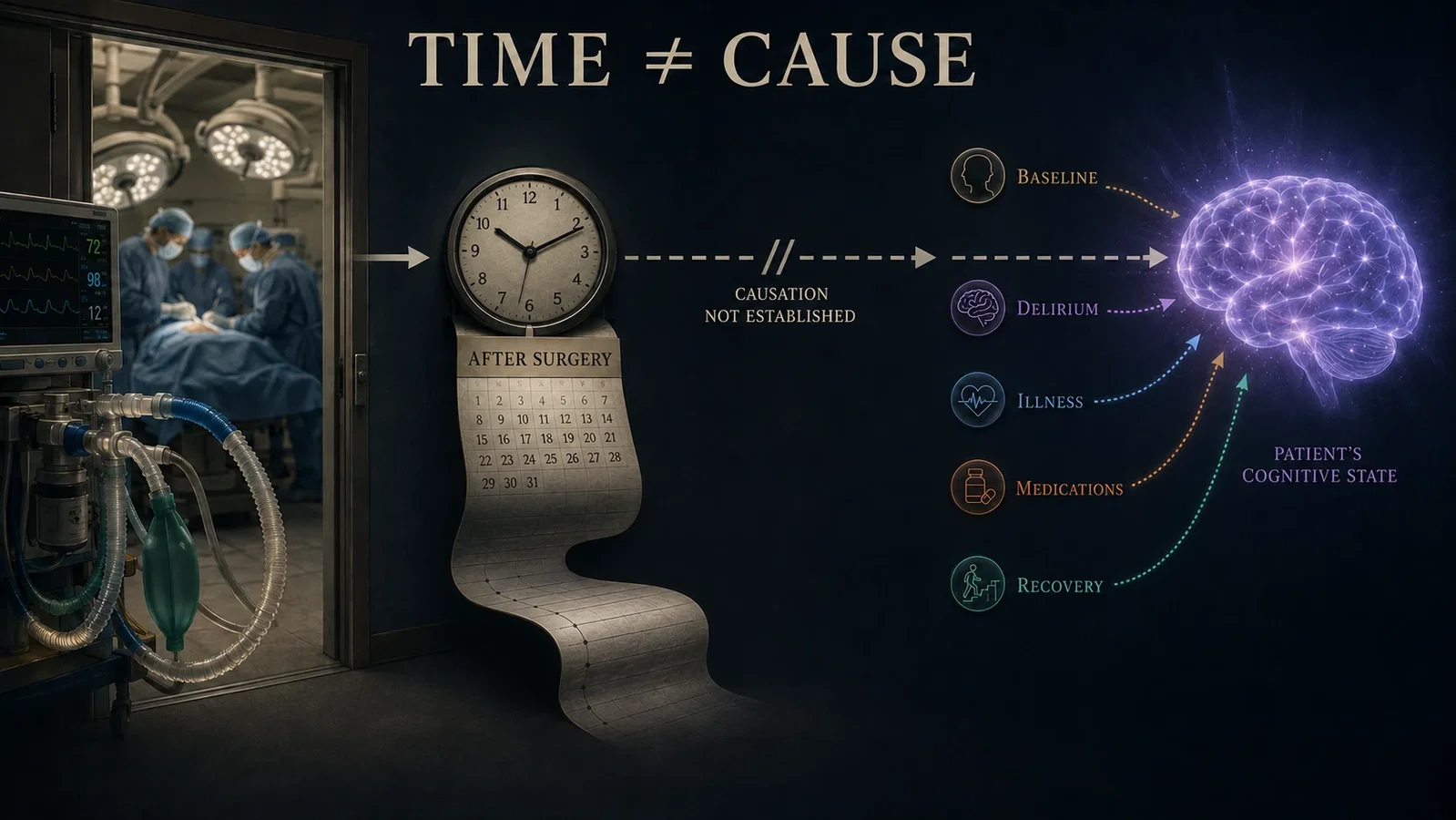
Yet when it precedes cognitive dysfunction, chronology easily acquires a causal shadow. A lower test score appears after surgery; the label seems to name a clinical disorder; and anesthesia or surgery quietly becomes the explanation even when the evidence has not established one.
In 2018, a multispecialty working group led by Lis Evered and colleagues tried to make that hidden reasoning visible. Its recommendations appeared under the same title in six journals. The project is often summarized as a change from POCD to PND. The actual proposal was more exacting: it divided one loose research vocabulary into distinct periods, diagnoses, and evidentiary requirements.
One consensus crossed six journal boundaries
The group broadly followed a modified Delphi process without specifying in advance how many rounds it would take. Members met in Copenhagen in 2014, Honolulu in March 2015, and Washington, DC, in July 2015, then continued by email.
Twenty-five of 44 members responded to the second questionnaire in December 2015, a 57% response; 21 of 41 responded to the third in September 2016, 51%. One remaining disagreement was resolved by majority in October 2016 before final support and publication.
Those details matter because this was a negotiated professional recommendation, not a trial in which patients validated every boundary. Consensus did not mean that every participant had held an identical view from the beginning.
The same text entered the Journal of Alzheimer's Disease, British Journal of Anaesthesia, Anesthesiology, Anesthesia & Analgesia, Acta Anaesthesiologica Scandinavica, and Canadian Journal of Anesthesia. Six bibliographic records therefore mark a deliberate cross-specialty publication strategy. They are not six independent replications.
PND was designed as an umbrella
The working group recommended perioperative neurocognitive disorders as an overarching term. It did not offer PND as one new DSM-5 diagnosis, a billing code, or a result generated by a single test.
Under the umbrella sit different states: impairment already present before surgery, acute emergence phenomena, postoperative delirium, cognitive decline during recovery, and later mild or major neurocognitive disorder. The umbrella organizes them without making them interchangeable.
That distinction prevents the most tempting but inaccurate summary of the paper. The authors did not simply cross out POCD and write PND above it. They asked a claimant to say when a problem was identified, what sort of evidence supported it, whether everyday independence had changed, and what causal meaning—if any—the name could bear.
The clock begins before the operation
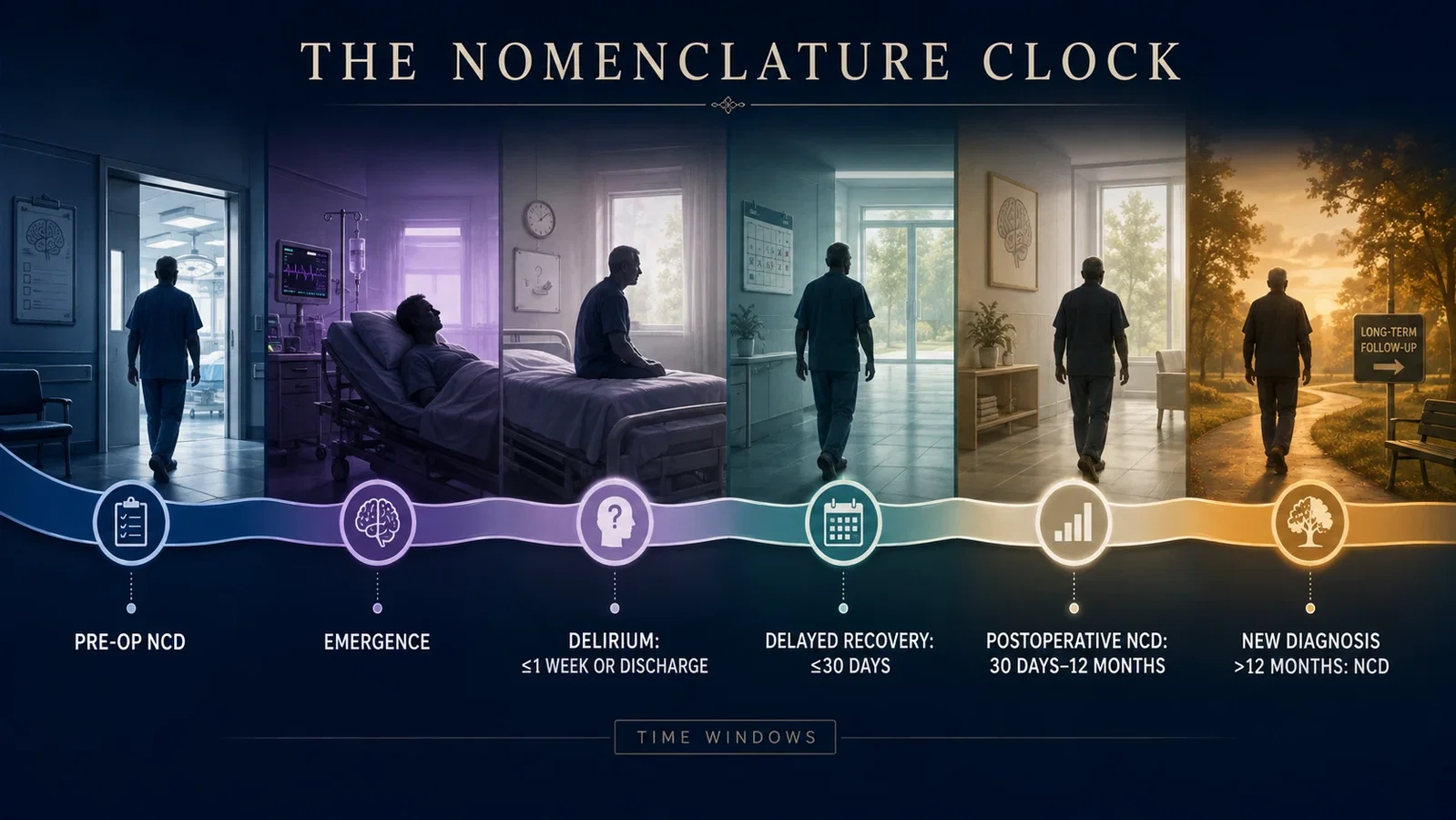
A perioperative account starts with baseline. Cognitive impairment recognized before surgery should use the same mild or major NCD terminology used in the community. An existing condition cannot be assigned retrospectively to an anesthetic that has not yet occurred.
The recommendation also separated excitation or delirium during immediate emergence from postoperative delirium. The phenomena may be adjacent or continuous in an individual patient, but proximity does not erase the distinction.
For postoperative delirium, the proposed window extended through one week after the procedure or until hospital discharge, whichever came first. The patient still had to meet an appropriate delirium framework, with medication, withdrawal, medical illness, and multiple etiologies considered. Delirium that began inside the window could persist with the postoperative description; a new delirium beginning only after discharge did not acquire that specifier merely because surgery had occurred earlier.
This was already more precise than using postoperative to mean any time after an operation.
Thirty days described recovery; twelve months limited the specifier
For cognitive decline through 30 days, the group proposed delayed neurocognitive recovery. The wording acknowledged that the immediate effects of drugs, pain, disturbed sleep, acute illness, complications, and hospitalization may still be resolving. Assessments made before a patient was medically ready for discharge could be reported, but the recovery environment had to remain part of their interpretation.
From 30 days through 12 months, a new diagnosis could be called postoperative mild NCD or postoperative major NCD. The familiar term POCD could remain in parentheses during a transition period, allowing older research to be mapped to the new language without pretending that the two systems were identical.
Beyond 12 months, the rule had an easily lost qualification. A disorder first diagnosed after that point should use ordinary mild or major NCD terminology, without a postoperative specifier. A diagnosis established within 12 months could retain the temporal specifier if it persisted beyond the anniversary.
None of these cut points was presented as a midnight change in neurobiology. They were pragmatic boundaries for communication and comparison.
A clinical disorder required more than a changed score
Earlier POCD research commonly classified decline by comparing neuropsychological test performance with baseline. Studies varied in their batteries, number of tests, thresholds, aggregation rules, control groups, and follow-up times. Such methods could answer a research question, but a group-derived psychometric classification was not automatically an individual clinical diagnosis.
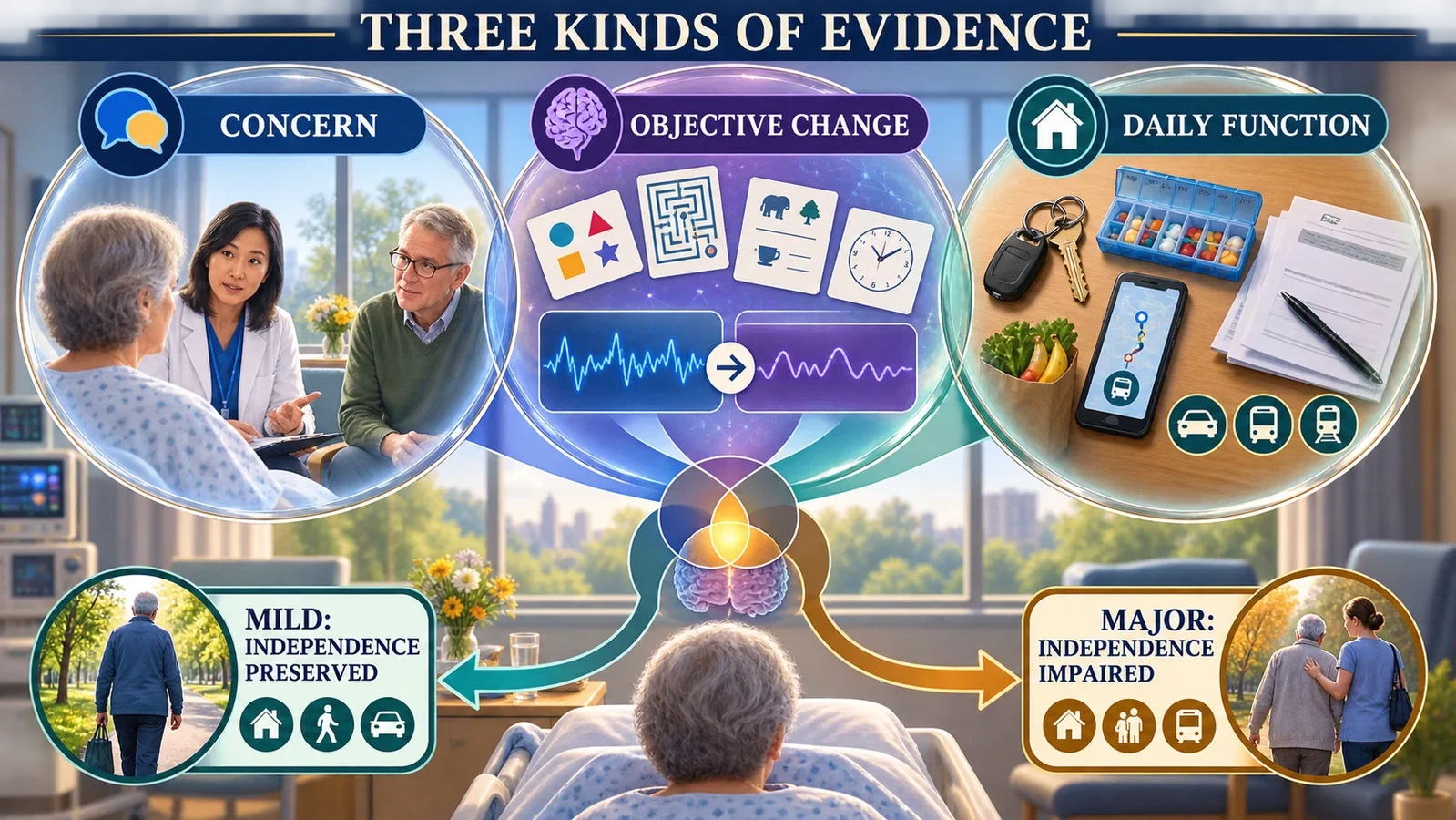
The 2018 framework joined three kinds of evidence:
- concern about cognitive decline from the individual, a knowledgeable informant, or a clinician;
- objective evidence of decline or impairment on an appropriate assessment; and
- the effect on instrumental activities of daily living and independence.
Mild NCD was typically associated with performance about one to two standard deviations below appropriate norms or controls, or roughly the 3rd to 16th percentile when scores were not normally distributed. Independence remained intact, although tasks might require more effort, time, or compensatory strategies.
Major NCD was typically associated with performance more than two standard deviations below appropriate norms, or at or below the 3rd percentile, together with interference in independent everyday activity.
The numerical ranges were guides, not self-executing diagnoses. Function helped distinguish mild from major disease, and concern, objective evidence, and independence had to be interpreted in the same person.
Screening and assessment were not synonyms
An appropriate cognitive assessment also had to account for baseline ability, serial change, age, education, language, cultural context, available norms or controls, and practice effects. A high-functioning person can decline materially while remaining within a broad population range; an isolated “normal” score can therefore conceal change.
The Mini-Mental State Examination and Montreal Cognitive Assessment remained useful screening instruments. They were not substitutes for a domain-specific neuropsychological evaluation when a clinical diagnosis was being asserted.
The consensus did not impose one universal battery or a required number of tests. Its standard concerned the structure and interpretation of evidence, not allegiance to a particular instrument.
The decisive restraint was causal
The proposal treated postoperative as a temporal specifier. It did not establish that anesthesia or surgery caused the cognitive change.
Pre-existing disease, previously unrecognized impairment, delirium, infection, organ dysfunction, medication, hospitalization, and the natural course of neurocognitive illness can all occupy the same interval. DSM-5 had not itself endorsed postoperative as a specifier; the working group offered it as a practical perioperative extension.
It would therefore be wrong to present the consensus as official proof that surgery causes neurocognitive disorder. It would be equally wrong to make the nomenclature prove that anesthesia never contributes to later change. A naming document can discipline a causal claim; it cannot settle the causal question by itself.
The achievement was grammatical
The recommendations did not make postoperative cognition simple. They made simple statements harder to defend.
After 2018, “the patient had postoperative cognitive decline” invited a series of missing questions. What was the baseline? Was the event emergence delirium, postoperative delirium, delayed recovery, or later mild or major NCD? Who perceived the change? How was it measured? Did it impair independence? Did postoperative mark time, or was it being asked to smuggle in a cause?
The historical change was not merely one acronym replacing another. A label that had carried too many assumptions was unfolded into a timeline, a clinical structure, and an explicit limit on inference.
Postoperative could tell the clock. It could not, by itself, tell the cause.
Sources and reading limits
Supplement 1 has repeated, material reference-list mismatches, so no numerical, etiologic, or named-study claim relies on it alone; Supplement 2 is an excerpt and does not mean that the complete DSM-5 was obtained or read.
Sources: Evered L, Silbert B, Knopman DS, et al. Br J Anaesth. 2018;121(5):1005-1012. PMID 30336844. PMCID PMC7069032. DOI 10.1016/j.bja.2017.11.087, complete article and two publisher supplements; joint-publication identities in Journal of Alzheimer's Disease (PMID 30347621), Anesthesiology (PMID 30325806), Anesthesia & Analgesia (PMID 30325748), Acta Anaesthesiologica Scandinavica (PMID 30325016), and Canadian Journal of Anesthesia (PMID 30324338). All cited sources were read for this article.
Visual interpretations
These illustrations explore the setting and ideas. Depicted people, actions, instruments and documents are reconstructions, not evidence of their exact historical appearance.
Continue exploring
Related reading connects shared questions and contexts; it does not by itself establish historical influence.
Historical connections
These links follow specific development, adoption or citation connections recorded in the underlying research. They do not imply that history had one inevitable path.
- Earlier connection: 2015: Care for the Older Surgical Patient Becomes a Perioperative Pathway
Related reading
- 1998: ISPOCD1 Follows Cognitive Change Beyond Discharge
- 2010: NICE CG103 Turns 'Think Delirium' into a Care Pathway
- 2015: Care for the Older Surgical Patient Becomes a Perioperative Pathway
- 2018: Beverley Orser and the α5-GABA_A Brake After Anesthesia
- 2016–2019: GAS, PANDA and MASK Narrow the Pediatric Neurotoxicity Question
- 2019: ENGAGES Cuts Anesthetic Exposure but Not Delirium
- 2019: Seven Summit Actions Map the Work Against Perioperative Neurocognitive Disorders
The Source Room · About & Editorial Method
Sources and reading limits are stated above. Illustrations are labelled as original source images or AI-made. Historical accounts are educational; they are not current treatment instructions.