The same rapidly hydrolyzed benzodiazepine entered different indications in Japan and the United States; reversible never meant risk-free, and approval did not end surveillance.
Reading Library · Anesthesia Epochs · 中文版
Watch the companion film
2020: Remimazolam — First Approval in Japan · Watch on YouTube
Historical anchor: 2020. Date details and source qualifications are explained below.
When a new drug enters the operating room, speed tends to capture the headline.
How quickly does it take effect? How soon does a patient wake after the infusion stops? Can it be reversed? Does it produce less hypotension? Those questions matter. Yet remimazolam's 2020 approval history shows why a drug cannot be understood from kinetics alone. The same molecule crossed two regulatory thresholds as two different clinical objects: first a general anesthetic in Japan, then a narrower procedural sedative in the United States, where even the legal approval date came in two steps.
This is therefore not a story of a fast new drug defeating its predecessors.
It is the story of a deliberately engineered benzodiazepine acquiring boundaries around speed, reversibility, and uncertainty in two regulatory systems.
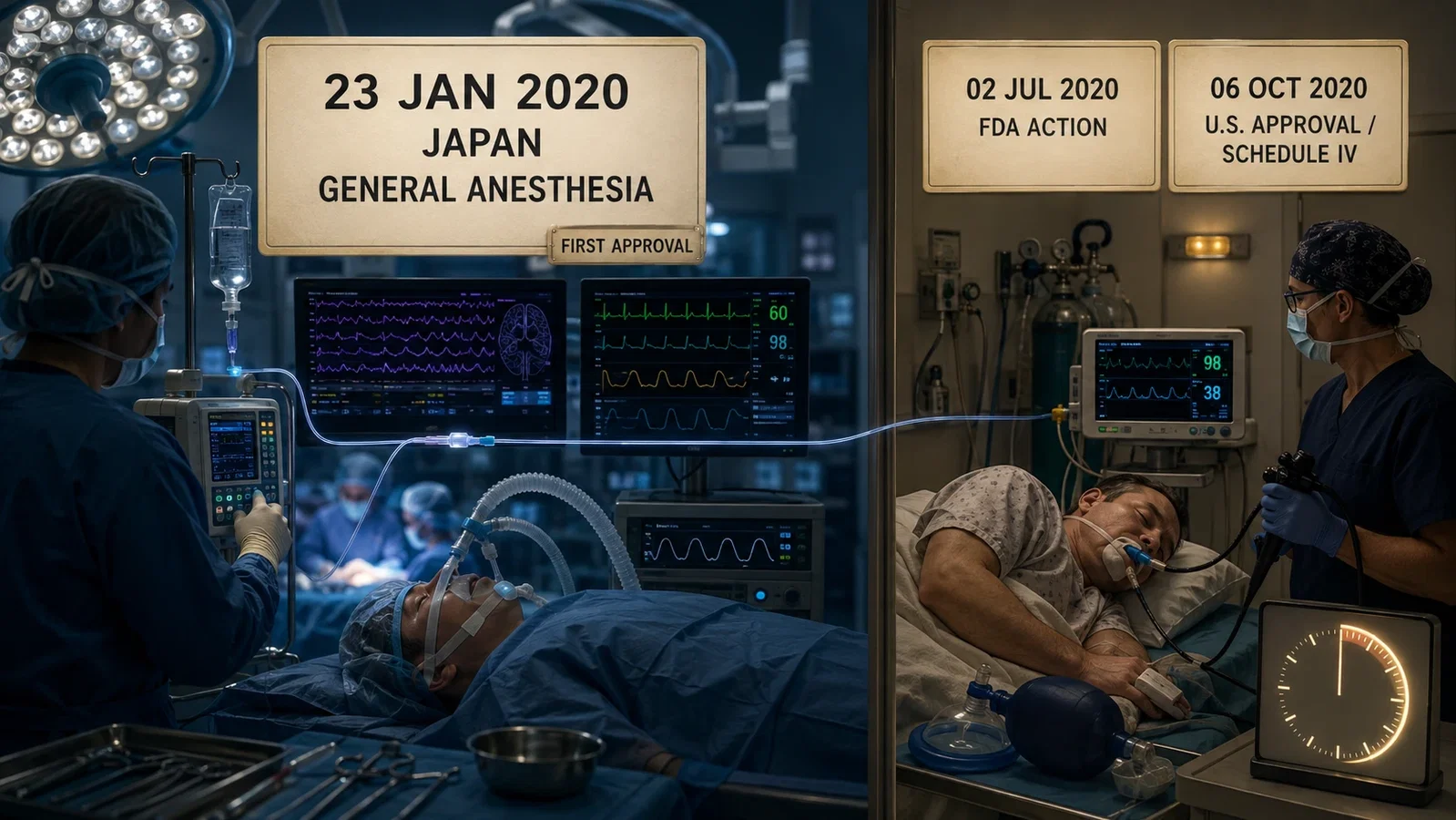
23 January: the first approval happened in Japan
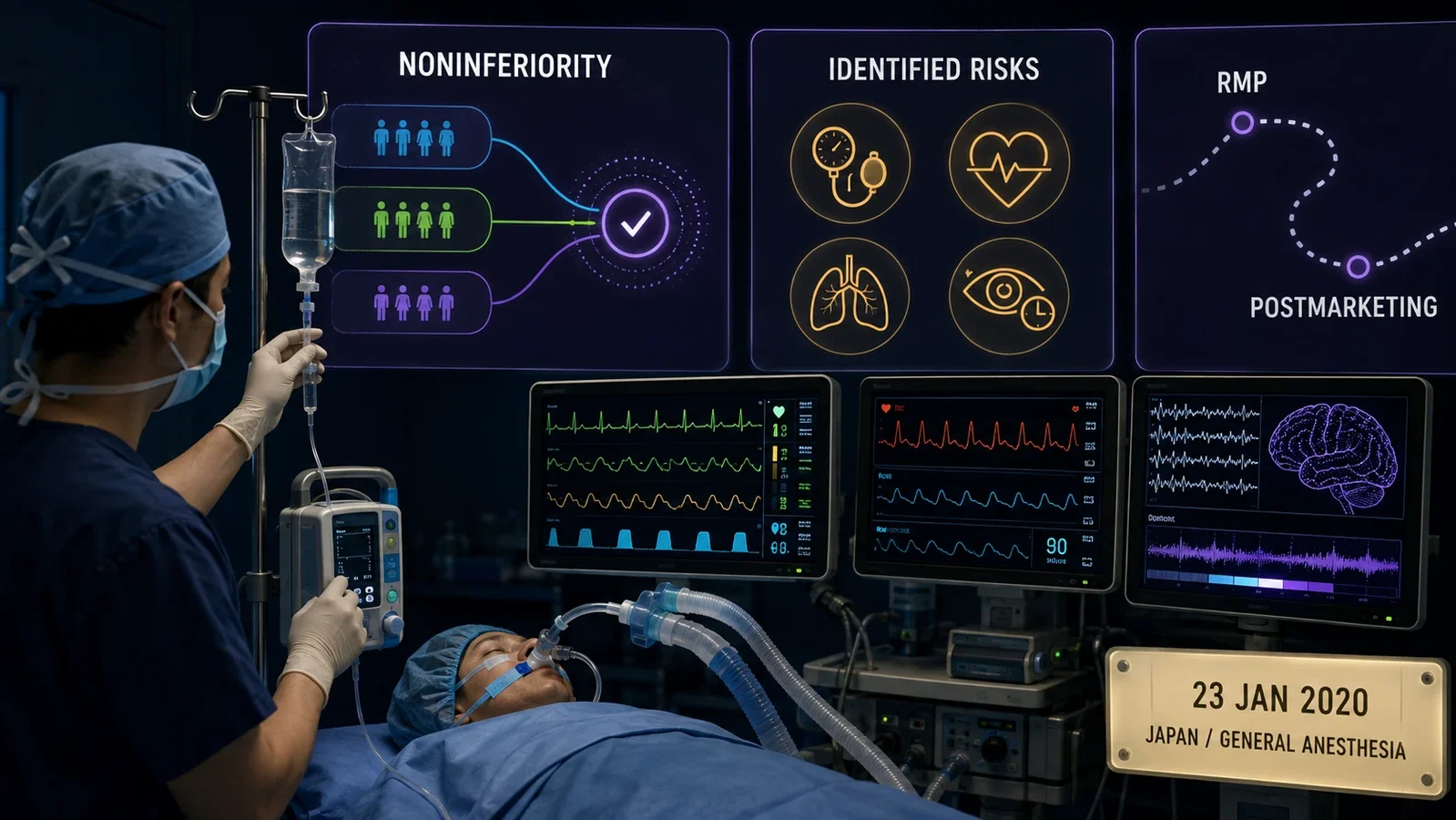
Japan approved remimazolam on 23 January 2020 for the induction and maintenance of general anesthesia in adults. It was the first approval of the drug anywhere.
The date needs care. PMDA's preserved 73-page review file also contains a review report dated 11 November 2019 and a review-result document dated 4 December. Those dates belong to the internal path toward authorization; they do not replace the 23 January approval event. In April 2020, Susan J. Keam published a review titled “Remimazolam: First Approval.” Its PubMed abstract also identifies 23 January as the Japanese first approval.
The Japanese product was Anerem, containing remimazolam besylate. Its indication covered both induction and maintenance—the interval from loss of consciousness through the intraoperative control of anesthetic depth.
That scope became crucial to the later comparison. One drug did not mean one approval.
It was designed to make a benzodiazepine more controllable
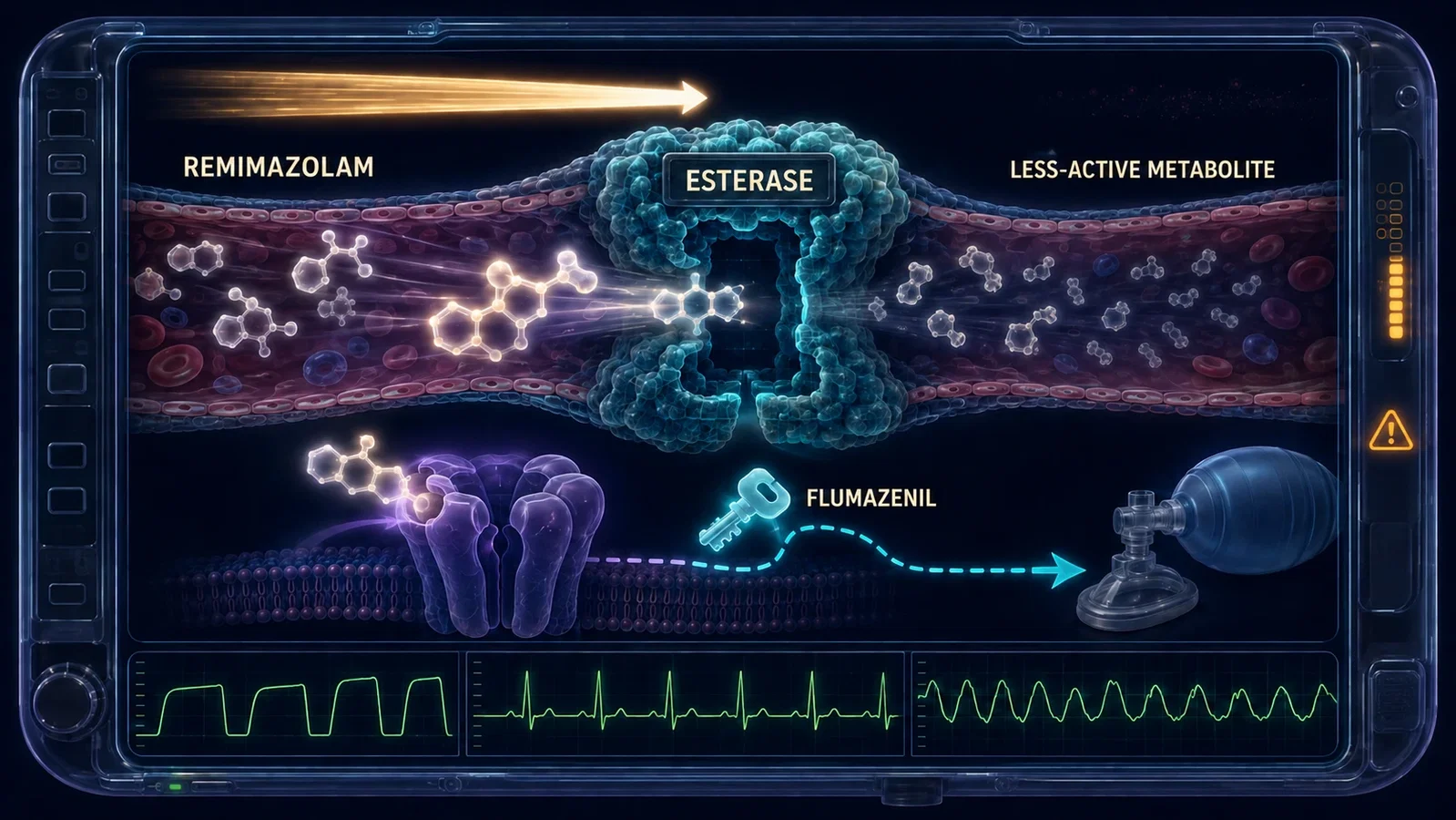
Remimazolam remained a benzodiazepine. It acts at the benzodiazepine site of the GABA-A receptor and enhances inhibitory neurotransmission. The molecule did not escape its pharmacologic family; it added a different time design.
Tissue carboxylesterases rapidly hydrolyze it, predominantly to a substantially less active metabolite. The initial U.S. label reported a terminal half-life of roughly 37 to 53 minutes. Its sedative effect could also be antagonized with flumazenil.
Together, these features created an attractive proposition: retain benzodiazepine sedation and reversibility while reducing the prolonged recovery associated with sustained midazolam exposure, and avoid propofol's lipid emulsion formulation.
But a design proposition is not a promise that every patient will awaken on schedule. Regulatory review had to ask whether the molecule could deliver anesthesia in trials and which risks remained.
A 375-patient trial answered a limited, explicit question
Japan's pivotal ONO-2745-05 study assigned 375 treated patients to three groups: 150 at each of two remimazolam induction rates and 75 to propofol.
The study was randomized and single-blind. Remimazolam was transparent and propofol a white emulsion, so the anesthesiologist administering and assessing the study drug could not realistically remain unaware of the assignment. The blinding had a practical limit.
Investigators defined “function as a general anesthetic” through a composite: no intraoperative awareness or memory, no rescue sedative, and no body movement. All three groups reached 100%, and both remimazolam regimens met the prespecified noninferiority framework relative to propofol.
That was an important result, but not proof of comprehensive superiority. It showed that remimazolam could provide general anesthesia for these patients under this endpoint. It did not demonstrate lower mortality, faster recovery in every setting, or a reason to replace propofol.
Treatment-related adverse events occurred in 39.3% and 42.7% of the two remimazolam groups and 61.3% of the propofol group. Treatment-related decreased blood pressure was reported in 20.0%, 24.0%, and 49.3%; injection-site pain in 0%, 0%, and 18.7%, respectively. Those observations helped establish the new drug's appeal. They were trial-specific findings, not permission to say that remimazolam never lowers blood pressure or is safer for everyone.
Reversible did not mean risk-free
PMDA's risk-management plan retained four important identified risks: hypotension, bradycardia, respiratory depression, and delayed emergence. QT prolongation and dependence remained important potential risks.
Across 362 remimazolam recipients pooled from two Japanese studies, decreased blood pressure was recorded in 38.1%, and 39.0% received treatment such as a vasopressor. Most events were mild or moderate in the development program, but that did not make them negligible. PMDA noted that delayed intervention could allow a serious state to develop, so hemodynamic management and warning language remained necessary.
Respiration followed the same logic. The absence of a drug-related serious respiratory-depression event in the Japanese trials did not establish the absence of risk. General-anesthetic induction begins before controlled ventilation, and a drug effect can persist after respiratory support ends. PMDA therefore retained respiratory depression as a serious adverse reaction and a postmarketing concern.
Emergence was not automatic either. Twenty-nine of 362 patients had not opened their eyes 30 minutes after the infusion ended; 19 received flumazenil. Two delayed-emergence adverse events were reported, one severe. Flumazenil supplied a pharmacologic route of reversal, not a push-button guarantee.
Dependence was likewise not deleted because surgical exposure was brief. The surgical trials recorded no event meeting the drug-abuse, dependence, or withdrawal query, but human abuse-potential evidence and benzodiazepine class biology still supported warning and surveillance. Japan required continued information collection; the United States later placed the drug in Schedule IV.
Older patients, those with higher ASA status, people with severe hepatic impairment, and cardiac-surgery populations carried their own exposure or evidence limitations. The review did not allow “rapid metabolism” to erase those differences. It required adjustment to patient condition, continuous observation, and further postmarketing evidence.
2 July and 6 October: the United States cannot be reduced to one date
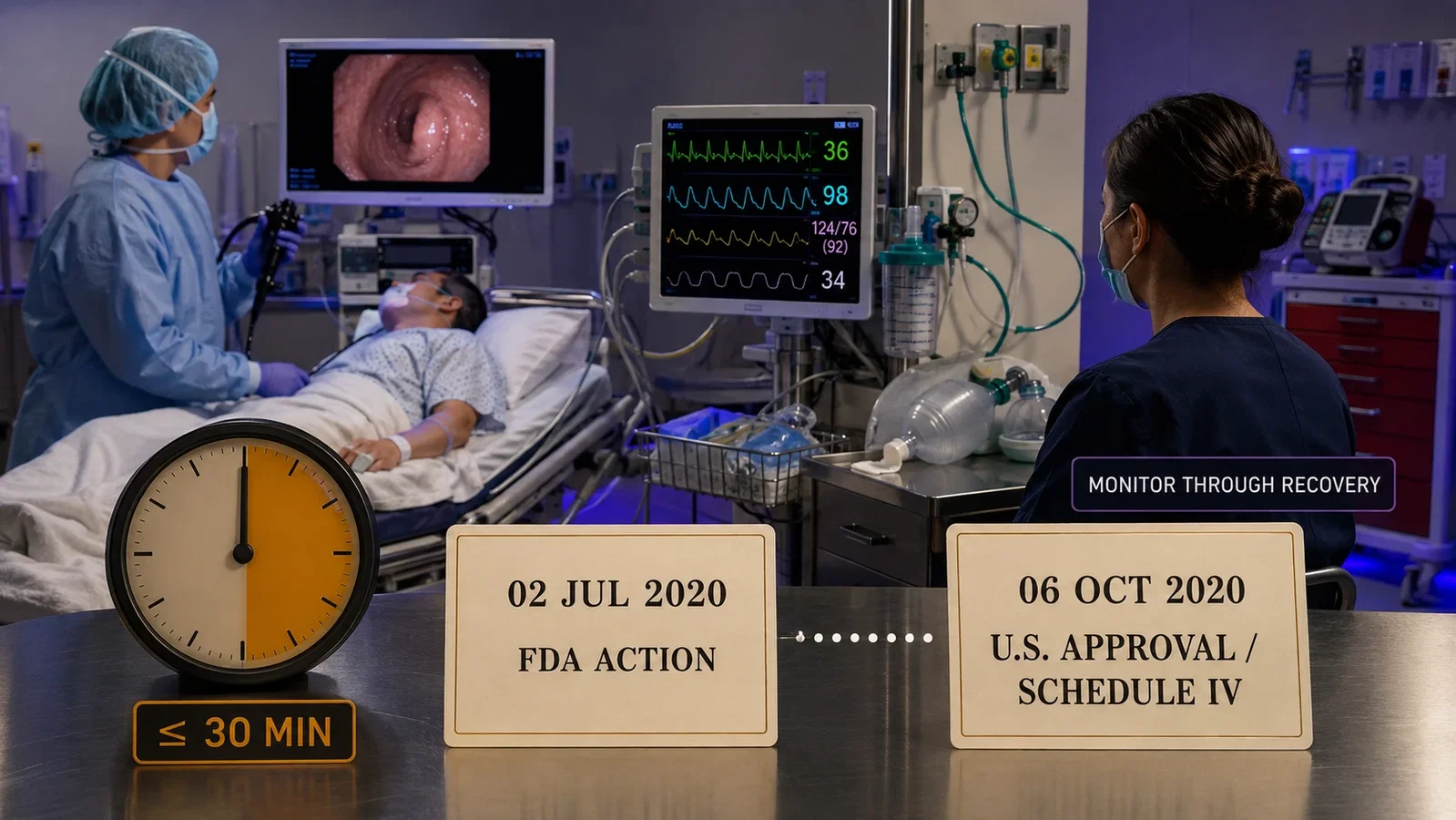
FDA took an approval action on the Byfavo application on 2 July 2020. The indication was not general anesthesia. It was procedural sedation in adults undergoing procedures lasting 30 minutes or less.
The approval letter contains a structure that can look contradictory but is legally important. It first states that the application is approved effective on the date of the letter. Under “Controlled Substance Scheduling,” it then explains that DEA scheduling remained incomplete and that, under U.S. law, the approval date for Byfavo would be the day DEA published its interim final scheduling notice. Marketing also required that notice and a labeling supplement reflecting the schedule.
DEA placed remimazolam in Schedule IV on 6 October, with drug code 2846, and made the rule effective that day. The current Drugs@FDA record still preserves both layers: an action date of 2 July and a note naming 6 October as the date of approval.
The accurate account does not choose one date and hide the other. July was FDA's regulatory decision; October completed the scheduling condition and supplied the statutory approval and effective-marketing point.
Schedule IV was not a low-risk badge. DEA placed remimazolam there because it had accepted medical use and abuse, psychic-dependence, and some physical-dependence liability comparable to other benzodiazepines, but lower abuse potential than Schedule III substances.
The U.S. evidence concerned short procedures, not Japanese-style general anesthesia
The U.S. approval relied chiefly on two adequate and well-controlled studies: one in colonoscopy and one in bronchoscopy. A third colonoscopy study enrolled patients with ASA III or IV status, but its primary purpose was safety and it did not conduct formal inferential efficacy testing.
FDA's summary review reported procedure-success rates of 91.3% versus 1.7% in colonoscopy and 80.6% versus 4.8% in bronchoscopy, comparing remimazolam with placebo. The numbers were striking, but the comparator must remain visible.
Midazolam was primarily investigator-administered rescue medication in these trials, not an unbiased randomized active comparator. The program therefore cannot be rewritten as proof that remimazolam was superior to midazolam.
The procedures averaged only about 12 to 13 minutes. Few lasted more than 30 minutes, and success appeared to fall as procedures grew longer. The U.S. label's “30 minutes or less” language was not decoration; it was the boundary left by the evidence actually studied.
The initial label added another boundary in a boxed warning. A trained sedation professional who was not simultaneously conducting the diagnostic or therapeutic procedure had to administer the drug. Monitoring extended through recovery. Skills and equipment for maintaining an airway, assisting ventilation, and performing cardiovascular resuscitation had to be immediately available, along with oxygen, emergency drugs, and bag-mask ventilation. Monitoring included capnography, pulse oximetry, and clinical assessment.
Those requirements did not contradict “rapid” or “reversible.” They showed that regulators never understood those words to mean “no airway plan required.” Opioids and other sedative-hypnotics could still deepen sedation and respiratory depression. Flumazenil could not reverse opioid effects, and re-sedation remained possible after antagonism.
A new option did not abolish anesthetic discipline
Remimazolam's first approval did mark the clinical arrival of a pharmacologic idea: use rapid esterase hydrolysis to improve controllability while preserving a benzodiazepine antagonist as an exit route.
Yet the most revealing parts of the approval files are not the onset and recovery curves alone. Japan admitted the drug to general anesthesia while building a risk-management plan around it. The United States confined it to short procedural sedation, wrote the narrow procedure evidence into the indication, and joined legal scheduling to requirements for trained personnel, monitoring, and rescue.
A drug can be easier to titrate and still lower blood pressure, depress respiration, delay emergence, or be misused. A trial can establish noninferiority without making an older agent obsolete. One country can approve general anesthesia while another approves only short sedation.
The 2020 milestone was not the arrival of an automatically safe anesthetic.
It was the formal addition of a new option to the drug cabinet, placed back inside the disciplines that no kinetic innovation can remove: titrate, monitor, prepare to rescue, and keep asking questions after launch.
Sources and reading limits
Only the abstract and bibliographic record of the Keam review were available.
Sources: PMDA, Anerem IV 50 mg review report and product record, 2020; FDA NDA 212295 approval package, initial label, and Division Director Summary/Cross-Discipline Team Leader Review, 2020; DEA, Federal Register 2020;85(194):63014-63019; Keam SJ. Drugs. 2020;80(6):625-633. PMID 32274703. DOI 10.1007/s40265-020-01299-8 (abstract/metadata only). This is a history of the 2020 approvals, not current prescribing guidance.
Visual interpretations
These illustrations explore the setting and ideas. Depicted people, actions, instruments and documents are reconstructions, not evidence of their exact historical appearance.
Continue exploring
Related reading connects shared questions and contexts; it does not by itself establish historical influence.
Related reading
- 1942: Griffith and Johnson Use Curare in Twenty-Five Patients
- 2002: The Sugammadex Concept Builds a Molecular Pocket for Rocuronium
- 2008: Bridion Enters the European Union
- 2015: The FDA Approves Sugammadex After Seven Years
- 2018: Beverley Orser and the α5-GABA_A Brake After Anesthesia
- 2022: POISE-3 Finds Tranexamic Acid Cuts Bleeding Without Proven Cardiovascular Noninferiority
The Source Room · About & Editorial Method
Sources and reading limits are stated above. Illustrations are labelled as original source images or AI-made. Historical accounts are educational; they are not current treatment instructions.