In 9,535 patients, two intravenous 1-g doses answered two questions that cannot be merged: bleeding fell from 11.7% to 9.1%, while cardiovascular noninferiority was not established.
Reading Library · Anesthesia Epochs · 中文版
Watch the companion film
2022: POISE-3 — Tranexamic Acid in Noncardiac Surgery · Watch on YouTube
Historical anchor: 2022. Date details and source qualifications are explained below.

Some trials are easiest to misrepresent in a single sentence.
“The drug worked, and cardiovascular events were not significantly increased.”
That sounds concise and reassuring. It also erases almost everything that makes POISE-3 important.
On 2 April 2022, the tranexamic-acid findings from POISE-3 were presented at the American College of Cardiology meeting and published online simultaneously in the New England Journal of Medicine. The trial supplied one clear answer: in higher-risk inpatients undergoing noncardiac surgery, perioperative tranexamic acid reduced the composite of life-threatening, major, or critical-organ bleeding.
The same trial preserved a second answer that cannot be translated into “no problem”: it did not meet its prespecified noninferiority standard for the cardiovascular composite.
POISE-3 belongs in the history of anaesthesia because both answers have to remain true at once.
One trial deliberately asked two different questions
Tranexamic acid inhibits fibrinolysis. That gives it a persuasive mechanism for reducing bleeding and transfusion, while naturally raising another question: if clots are less readily broken down, could myocardial injury, stroke, arterial thrombosis, or venous thromboembolism become more common?
POISE-3 did not bury benefit and risk inside a vague “overall outcome.” Its investigators specified two primary questions and gave them different statistical structures.
The first was a superiority question: could tranexamic acid reduce the time to first life-threatening, major, or critical-organ bleeding within 30 days? This efficacy outcome was analysed according to randomized assignment—the intention-to-treat principle.
The second was a noninferiority question: for a 30-day composite of myocardial injury after noncardiac surgery, nonhaemorrhagic stroke, peripheral arterial thrombosis, or symptomatic proximal venous thromboembolism, could the trial exclude a disadvantage larger than a margin chosen in advance? The conservative primary analysis required receipt of both planned doses. The upper limit of the one-sided 97.5% confidence interval for the hazard ratio had to be below 1.125, and the one-sided P value had to be below .025.
Those questions cannot both be answered by asking whether there was a conventional statistically significant difference.
Superiority asks whether the evidence demonstrates something better.
Noninferiority asks whether the evidence is precise enough to rule out something unacceptably worse.
9,535 patients connected the moments before incision and at closure
Between June 2018 and July 2021, POISE-3 recruited at 114 hospitals in 22 countries. Participants were at least 45 years old, were scheduled for inpatient noncardiac surgery, and had risk factors for both bleeding and cardiovascular complications.
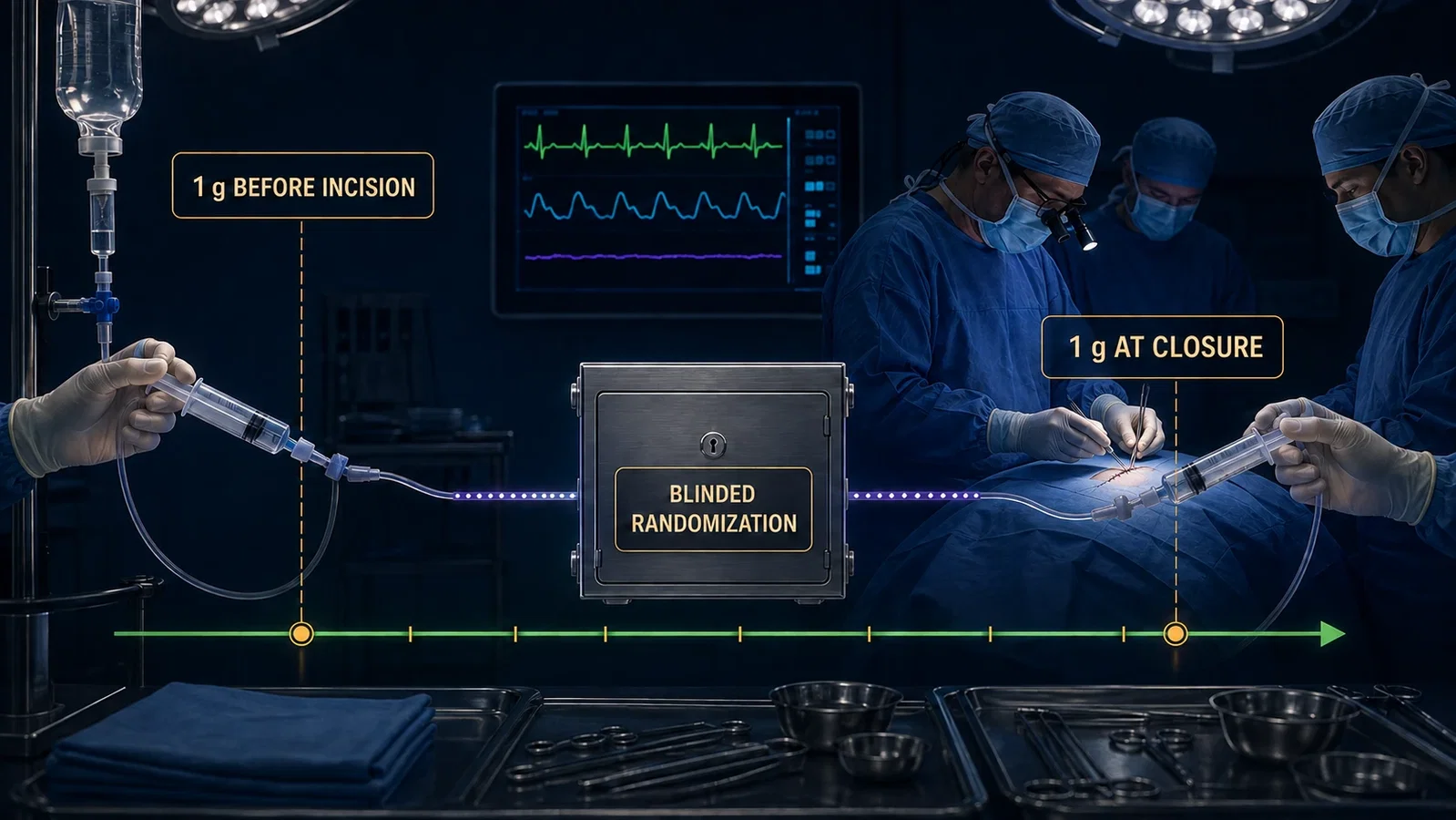
Investigators screened 193,450 patients and randomized 9,535: 4,757 to tranexamic acid and 4,778 to placebo. Patients, clinicians, data collectors, outcome adjudicators, and investigators were unaware of the assignment.
The regimen was simple. One gram was given intravenously within 20 minutes before the anticipated skin incision. A second gram was given at the end of surgery or wound closure. In each group, 96.3% received both planned doses, and 30-day follow-up was 99.9% complete.
Simple did not mean universal. The trial excluded important populations, including patients undergoing cardiac or intracranial surgery, those with severe renal impairment or dialysis, a seizure disorder, or recent arterial or venous thrombosis. It studied selected higher-risk inpatients, not every person having a minor ambulatory procedure.
POISE-3 also used a partial factorial design. Eligible participants could be randomized simultaneously between two perioperative blood-pressure strategies, but the 2022 article reported the tranexamic-acid comparison. Pulling the other randomization into this story would blur a deliberately focused question.
The bleeding outcome fell from 11.7% to 9.1%
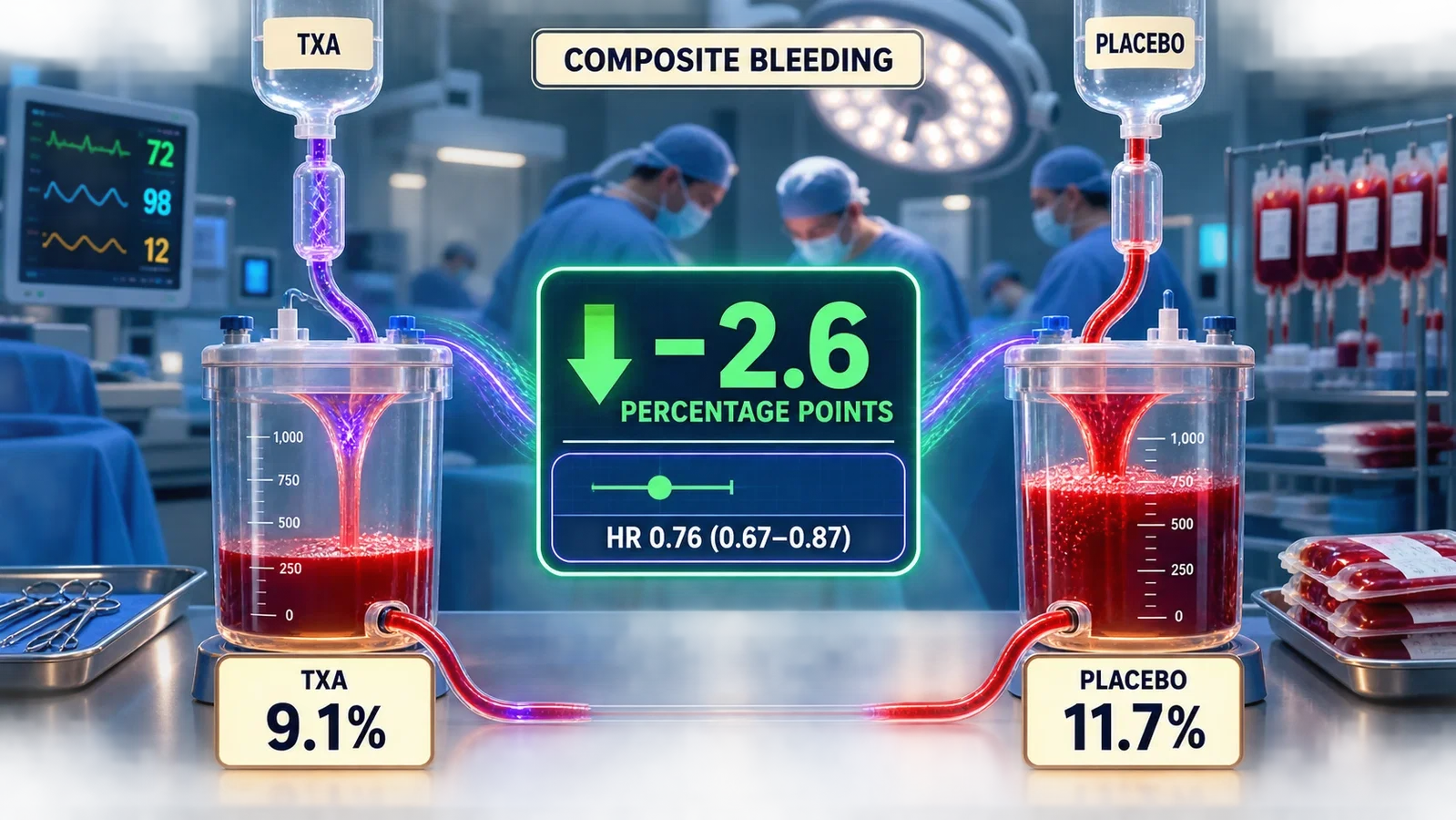
Among all randomized participants, the primary bleeding composite occurred in 433 of 4,757 patients assigned to tranexamic acid, 9.1%, and 561 of 4,778 assigned to placebo, 11.7%.
The hazard ratio was 0.76, with a 95% confidence interval from 0.67 to 0.87. The absolute difference was -2.6 percentage points, with a 95% interval from -3.8 to -1.4; the superiority P value was below .001.
This was a clear positive result. It did not need a post hoc subgroup or a secondary endpoint promoted after the fact.
The components also show where the signal lived. Life-threatening bleeding occurred in 78 versus 79 patients, almost identical numbers. Trial-defined major bleeding occurred in 363 versus 496, and critical-organ bleeding in 12 versus 21. The categories could overlap and cannot be added mechanically, but the pattern is plain: the composite changed primarily through the major-bleeding component, not through a separately established reduction in life-threatening bleeding.
Other bleeding measures supported the same mechanism. Bleeding independently associated with mortality after noncardiac surgery occurred in 8.7% versus 11.3%, and International Society on Thrombosis and Haemostasis major bleeding in 6.6% versus 8.7%. At least one unit of packed red cells was transfused in 9.4% versus 12.0%, and at least two units in 6.2% versus 8.3%.
Those findings make the haemostatic benefit more credible. They should not be separated into a row of independently “proven” victories. The article explicitly states that intervals for secondary and tertiary outcomes were not adjusted for multiplicity.
The cardiovascular result missed a narrow line that could not be moved
The primary cardiovascular analysis used participants who received both planned doses.
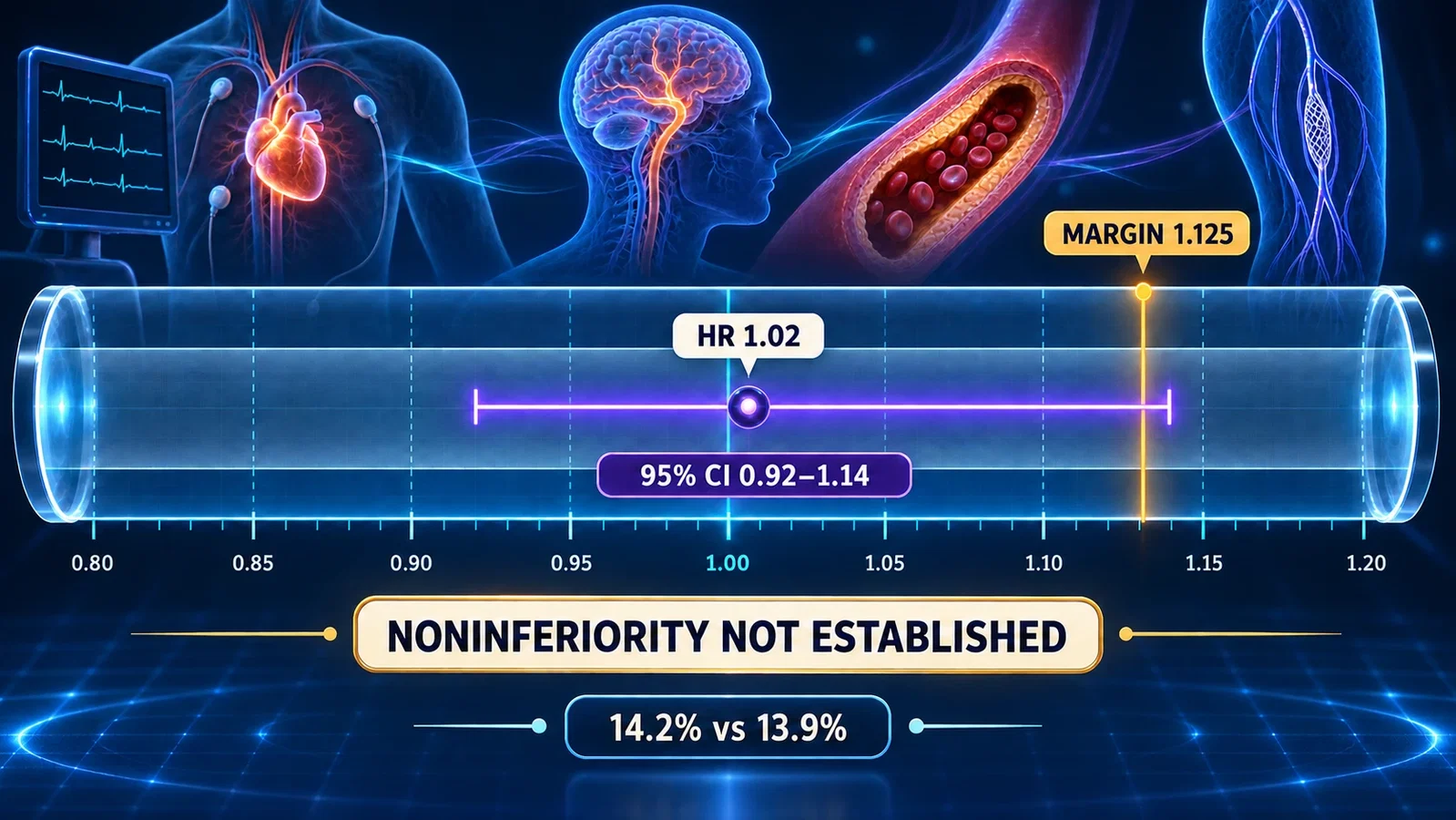
An event occurred in 649 of 4,581 patients given tranexamic acid, 14.2%, and 639 of 4,601 given placebo, 13.9%. The hazard ratio was 1.02, with a 95% confidence interval from 0.92 to 1.14. The absolute difference was an increase of 0.3 percentage points, with an interval from a 1.1-point decrease to a 1.7-point increase.
The point estimates look close.
But noninferiority is not established because two numbers look close.
The prespecified upper boundary had to be below 1.125. It reached 1.14. The one-sided P value had to be below .025. It was .04.
Noninferiority was therefore not established.
The difference between 1.14 and 1.125 is only 0.015. That is exactly why the result is so vulnerable to rhetorical repair. It can be described as “almost met,” converted into “similar event rates,” or displaced by a post hoc probability displayed in the conference presentation.
The boundary matters because it was drawn before the comparative data were revealed. A result approaching that boundary does not cause the boundary to move.
Failure to establish noninferiority is not proof of harm
There is an equal and opposite error: translating the missed noninferiority criterion into proof that tranexamic acid increased cardiovascular events.
The data did not establish that conclusion either.
The composite point estimate was near 1, the observed absolute difference was small, and the interval included both a modest reduction and a modest increase. The intention-to-treat sensitivity analysis was similar, with a hazard ratio of 1.03 and a 95% confidence interval from 0.92 to 1.14.
The individual outcomes did not form a decisive harm pattern. Myocardial injury after noncardiac surgery occurred in 12.8% versus 12.6%. Myocardial infarction occurred in 67 versus 53 patients, stroke in 24 versus 16, symptomatic pulmonary embolism in 24 versus 17, and proximal deep-vein thrombosis in 11 versus 13. The intervals around these less frequent events were broad. Selecting one cell cannot turn the trial into proof of a specific thrombotic injury.
Seizures occurred in 10 versus 3 patients, with a hazard ratio of 3.35 but a 95% confidence interval from 0.92 to 12.20. That possible signal deserves visibility together with its scarcity and imprecision.
The careful conclusion has two halves: POISE-3 did not establish cardiovascular noninferiority, and POISE-3 did not establish that tranexamic acid caused cardiovascular harm.
A net-benefit number could not close two primary questions
The investigators also constructed a net risk-benefit composite containing vascular death, nonfatal severe bleeding, myocardial injury, stroke, peripheral arterial thrombosis, and symptomatic proximal venous thromboembolism.
It occurred in 20.7% of the tranexamic-acid group and 21.9% of the placebo group, with a hazard ratio of 0.94 and a 95% confidence interval from 0.86 to 1.02.
That composite provides a useful overview. It was also secondary, and its interval crossed 1. It cannot become confirmatory evidence that benefits “outweighed” risks, and it cannot retroactively establish cardiovascular noninferiority.
This is why the two primary questions were kept separate. Once events of different frequency, severity, and mechanism are compressed into a single total, a common reduction in bleeding can obscure an uncommon but incompletely excluded vascular risk. POISE-3 allowed readers to inspect the combined picture without letting it delete the original evidence streams.
The protocol history gave prespecification its own timeline
The official POISE-3 supplementary package preserves 217 pages of protocols, change documents, and the statistical analysis plan.
Protocol version 1.0 is dated 16 March 2018, before the first participant was randomized on 27 June. The protocol then evolved through multiple versions. Final version 7.0 is dated 22 July 2021, near the end of recruitment. Changes involved exclusions, outcome classification, sample-size assumptions, and subgroup definitions.
The file even retains two distinct change-document paths converging on version 6.0. That is not duplication to be scrubbed from the record. It is part of the governance trace left by a large international trial.
The tranexamic-acid statistical analysis plan is dated 26 November 2021, and its three responsible signatories completed approval on 26 and 27 November. The publication states that it was finalized before investigators knew the treatment results and before database freeze.
Recruitment had originally targeted 10,000. The COVID-19 pandemic slowed enrolment and created a financial deficit, so the steering committee stopped recruitment on 15 July 2021 after at least 9,500 patients had been randomized. It did not know the comparative results, although it knew that aggregate event rates were higher than initially estimated.
That history cannot be reduced to “nothing ever changed after day one.” Nor does it support a claim that the rules were rewritten after the answer was seen. The more useful reality is that protocols evolve as evidence and operations evolve, while decisive analysis rules can still be fixed before unblinding and preserved in an auditable version chain.
POISE-3 left a boundary that convenience could not move
POISE-3 did not give clinicians the easiest slogan.
It gave them something more useful.
For selected patients aged 45 years or older undergoing inpatient noncardiac surgery, two intravenous 1-g doses of tranexamic acid clearly reduced the 30-day composite bleeding outcome. That benefit was supported by randomization, high adherence, and almost complete follow-up.
At the same time, the trial did not exclude a cardiovascular disadvantage beyond the prespecified noninferiority boundary with the required precision. The observed difference was small and harm was not established, but uncertainty was not erased.
Good clinical evidence does not always divide the world into green and red.
Sometimes it illuminates one side while telling us that the light on the other remains insufficient.
The epochal significance of POISE-3 is not only that it made the haemostatic value of tranexamic acid visible across noncardiac surgery. It also reminded readers that a statistical boundary is not decorative. When the result misses by 0.015, the most difficult—and most important—act is to leave the line where it was drawn.
Sources and reading limits
Sources: Devereaux PJ et al.; POISE-3 Investigators. N Engl J Med. 2022;386(21):1986-1997. PMID 35363452. DOI 10.1056/NEJMoa2201171; official supplementary appendix and protocol/statistical-analysis-plan package; Marcucci M et al. Trials. 2022;23:101. PMID 35101083. PMCID PMC8805242. DOI 10.1186/s13063-021-05992-1; official PHRI ACC22 presentation; archived PubMed, Crossref, ClinicalTrials.gov, Europe PMC, and PHRI records. This is a history of the 2022 trial result, not an individualized treatment recommendation.
Visual interpretations
These illustrations explore the setting and ideas. Depicted people, actions, instruments and documents are reconstructions, not evidence of their exact historical appearance.
Continue exploring
Related reading connects shared questions and contexts; it does not by itself establish historical influence.
Related reading
- 2010: Makary's Five-Item Study Brings Frailty into Preoperative Assessment
- 2015: Thirteen Actions Make Hemorrhage a System Responsibility
- 2018: A 25-Country Network Finds Fewer Complications but Harder Rescue
- 2020: Japan Approves Remimazolam for General Anesthesia
- 2020: COVIDSurg Turns 1,128 Patients into an International Surgical Warning
- 2024: Nine Organizations Turn Preoperative Cardiac Clearance into a Continuous Pathway
The Source Room · About & Editorial Method
Sources and reading limits are stated above. Illustrations are labelled as original source images or AI-made. Historical accounts are educational; they are not current treatment instructions.