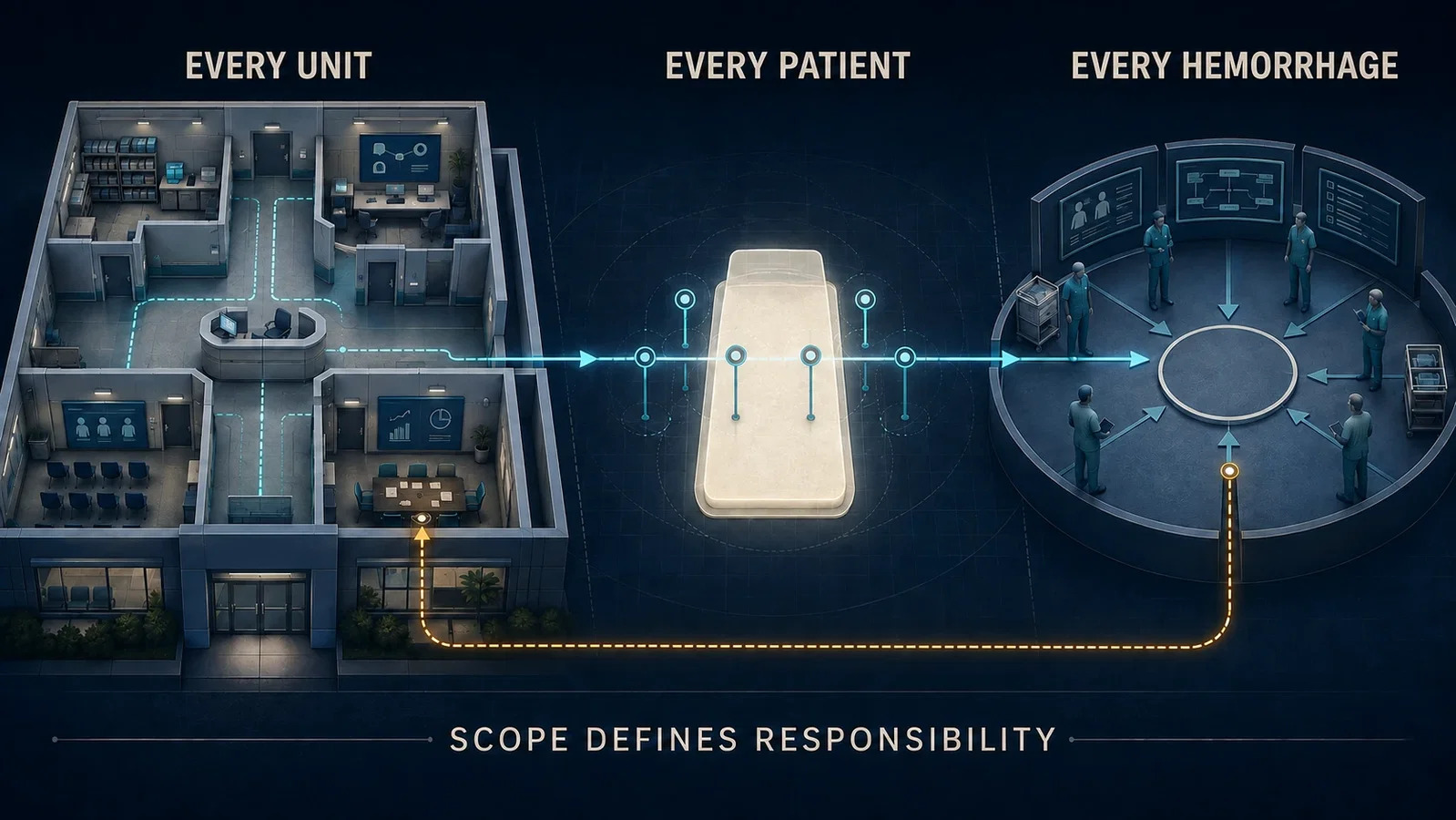
It invented no new hemostatic technique; it asked every unit to prepare, every patient to be recognized, every hemorrhage to receive a staged response, and every event to return as learning.
Reading Library · Anesthesia Epochs · 中文版
Watch the companion film
2015: The Obstetric Hemorrhage Safety Bundle · Watch on YouTube
Historical anchor: 2015. Date details and source qualifications are explained below.

The public object was only one page long.
Across it ran thirteen actions: a hemorrhage cart, immediate access to medication, a response team, transfusion protocols, drills, risk assessment, cumulative measurement, a stage-based plan, support, review, and metrics.
None was presented as a new drug or operation. None could stop obstetric hemorrhage merely by appearing on paper. Yet together they changed the scale of the problem.
The 2015 National Partnership for Maternal Safety consensus bundle asked whether a birthing facility had connected the people, supplies, decisions, and feedback needed before, during, and after a hemorrhage. It shifted attention away from the isolated performance of a clinician at the moment of crisis and toward the design of the unit that surrounded that clinician.
Its central contribution was therefore organizational. It made delay and fragmentation into properties that an institution could see and work on.
A national partnership before a national bundle
The bundle emerged from a process that predated its publication.
Mary D'Alton, Elliott Main, Kathryn Menard, and Barbara Levy reported that the initial National Partnership for Maternal Safety meeting took place in 2012. Participants selected three core priorities: obstetric hemorrhage, severe hypertension in pregnancy, and prevention of venous thromboembolism. They also identified three supporting areas: maternal early warning, structured facility review of severe events, and support for patients, families, and staff.
More than thirty organizations were represented at a maternal safety consensus meeting in May 2013. The Health Resources and Services Administration sponsored the meeting, and leaders from the Society for Maternal-Fetal Medicine and the American College of Obstetricians and Gynecologists coordinated it. Professional societies sat alongside quality organizations, hospital systems, federal agencies, and advocacy groups.
That breadth matters because it defines what the Partnership was trying to build. It was not a specialty society issuing a narrow technical recommendation. It was a coalition trying to make separate institutions answer a shared set of safety questions.
Anesthesiology had a real but bounded role. The Society for Obstetric Anesthesia and Perinatology was represented, and the later consensus statement included anesthesiology in the likely response team. The bundle did not belong to anesthesiology, however. It depended equally on obstetric clinicians, midwives, nurses, blood-bank and pharmacy services, critical care, surgical support, and institutional leadership.
One statement, four professional audiences
The full 2015 consensus statement by Main and colleagues appeared concurrently in four journals: Obstetrics & Gynecology, Anesthesia & Analgesia, the Journal of Midwifery & Women's Health, and the Journal of Obstetric, Gynecologic, & Neonatal Nursing.
The arrangement placed the same system problem before four professional audiences. It did not create four independent guidelines.
The distinction is bibliographically important. The Anesthesia & Analgesia version is PMID 26091046. PMID 26059199 belongs to the midwifery-journal version. The Obstetrics & Gynecology version, used here as the controlling full text, is PMID 26241269.
Distinguishing these identifiers may seem clerical. In this case, it protects the conceptual identity of the event. The publication strategy amplified one consensus object across professions; it did not generate four separate bodies of evidence.
Not a new guideline
The authors explicitly described the bundle as something other than a new guideline.
It selected existing guidelines, recommendations, and practical tools, then arranged them in a form intended to make implementation and consistency easier. Its novelty lay less in discovering what clinicians should know than in specifying what a maternity unit should be able to do reliably.
This boundary prevents two common exaggerations.
First, the bundle was not a randomized trial. The paper drew on prior guidelines, quality-improvement programs, observational work, and expert consensus. It did not report a controlled national implementation study of its own.
Second, the bundle did not invent a single new hemorrhage treatment. Medication, surgery, transfusion, measurement, drills, and review already had separate histories. The bundle's work was to join them across time and responsibility.
The paper could state an aim to reduce severe hemorrhage and improve outcomes. It could not, by itself, demonstrate that national adoption had reduced mortality.
Before the event: readiness belongs to every unit
Five of the thirteen elements sit in the Readiness domain, and the original sheet labels their scope as every unit.
A unit should have a hemorrhage cart with supplies and cognitive aids. Relevant medication should be immediately accessible. A response team and method of calling for help should already exist. Emergency-release and massive-transfusion protocols should be defined. Staff should learn the protocols, rehearse them, and debrief after drills.
The common target is delay.
A medication can be stocked somewhere in a hospital without being available when minutes matter. A blood bank can hold products without a reliable route for release, transport, and sustained supply. A hospital can employ every necessary specialist without establishing who calls whom, how quickly they arrive, or what each person does after arrival.
Readiness turns those hidden assumptions into visible work.
Drills serve the same purpose. They are not simply examinations of individual memory. They can reveal an empty cart, a broken communication route, an unclear role, or a technical step that the team rarely performs. A system can then meet its own weakness in rehearsal rather than discover it for the first time during uncontrolled bleeding.
Across every patient: recognition without a promise of prediction
Three elements belong to Recognition and Prevention, and their stated scope is every patient.
The bundle calls for hemorrhage-risk assessment at more than one point in care, cumulative measurement of blood loss as quantitatively as possible, and a department-wide approach to active management of the third stage of labor.
Risk assessment was not presented as perfect prediction. The paper noted that a substantial share of serious hemorrhages still occurred among people initially considered lower risk. Stratification could guide preparation and surveillance, but it could not identify a population that no longer required vigilance.
That is why the domain applies to every patient rather than only to a high-risk group.
Cumulative measurement addressed a related failure. The authors described denial and delay as recurrent themes in reviews of severe hemorrhage. A single visual estimate could underestimate what had happened, while a cumulative record could make a worsening trajectory visible and carry the same quantity across transitions in care.
The historical recommendation is not reproduced here as current bedside instruction. Its significance for this article is structural: recognition had to be continuous enough to support escalation, not left to a late impression that a crisis had finally become obvious.
During every hemorrhage: a staged response and a human aftermath
The Response domain contains two elements and applies to every hemorrhage.
The first is a unit-standard, stage-based emergency management plan. Such a plan does more than name a medication. It links the likely cause of bleeding, physiologic and blood-loss triggers, team activation, role assignment, communication, equipment, medication, and access to other services.
The second is a support program for patients, families, and staff after significant hemorrhage.
Placing these two actions beside one another is revealing. A technically successful response can still leave a patient and family with fear, interrupted communication, painful procedures, and unanswered questions. Clinicians and staff may also need a structured opportunity to process what happened. Support was not added years later as an ornamental concern. It was one of the original thirteen elements.
The bundle therefore followed the event beyond hemodynamic control. It treated the experience of the crisis as part of the system's responsibility.
After the event: learning belongs to the next patient
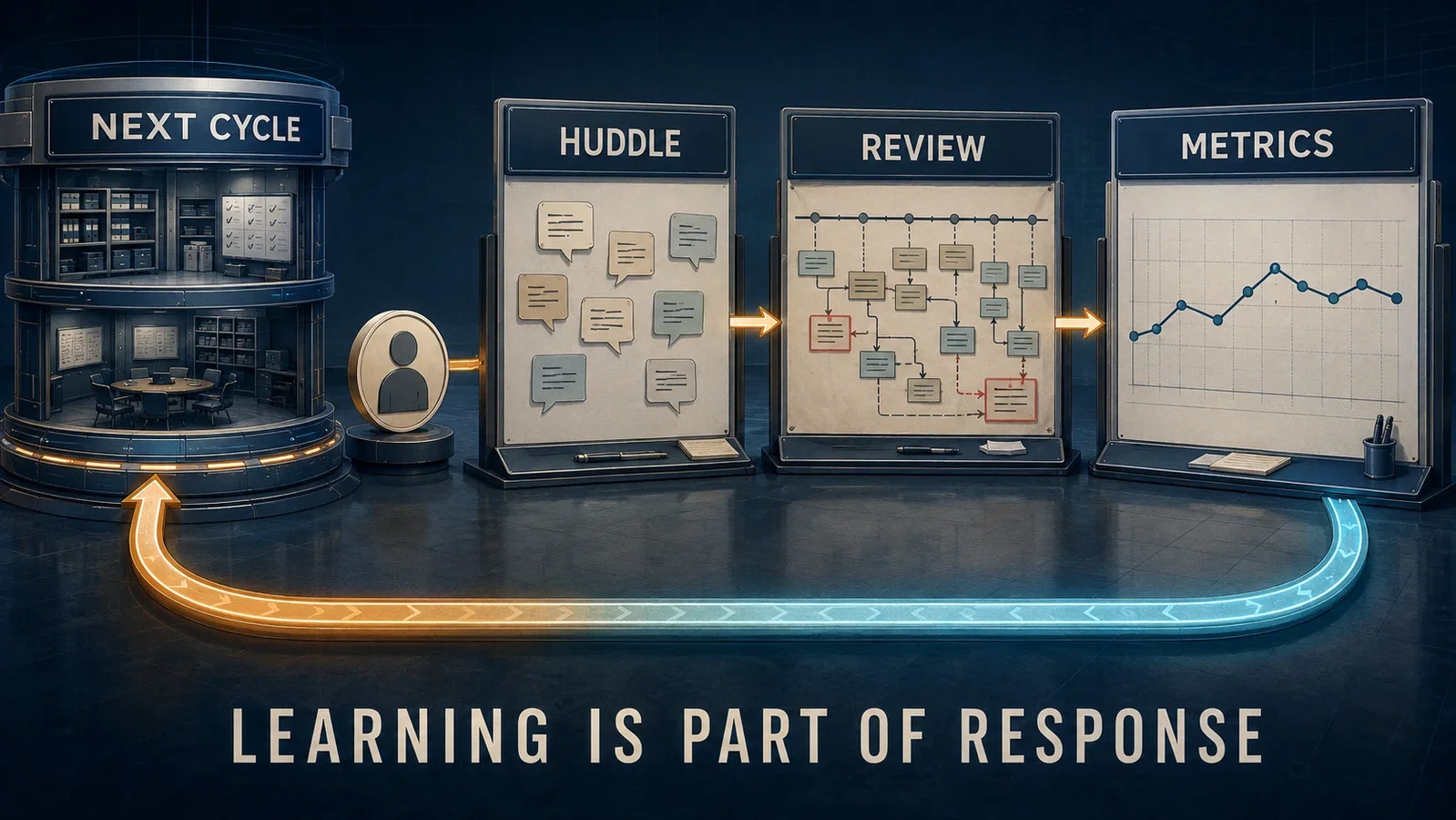
The last three elements form Reporting and Systems Learning.
Units should use huddles for high-risk situations and debrief after events. Serious hemorrhages should receive multidisciplinary review for system issues. Outcome and process measures should be followed through perinatal quality improvement.
The paper distinguished a short debrief from a formal review. A debrief can capture immediate observations from the team. A review can reconstruct a timeline, examine the record, involve leadership and risk management, and ask why the same breakdown could recur.
This is the point at which one event becomes preparation for another.
The authors suggested tracking cases involving four or more units of red blood cells or admission to intensive care. They described such events as uncommon, approximately two to four per thousand births in the cited context. They also set two limits around the measure. It was useful for following one institution over time, not for simple comparison between hospitals, and it should not create pressure to withhold transfusion when blood was needed.
Metrics were instruments for learning, not a league table and not proof that the bundle had caused an outcome.
Standardization without one national protocol
The Partnership wanted adoption in every United States birthing facility. Its 2014 introduction described an ambition to implement the three core bundles within three years and to reduce maternal death and morbidity by half within five years.
Those statements were goals. They were not reported achievements, federal mandates, or results of the 2015 consensus article.
The full bundle also rejected the idea that every facility should follow one national protocol. Details could be adapted to local resources, while standardization within each institution was strongly encouraged. Smaller or lower-resource facilities were expected to address most elements and to arrange regional support, transfer, or blood supply when a capability could not be maintained locally.
This was not a vague compromise between standardization and judgment.
The bundle sought to standardize the reliability of preparation, communication, escalation, and learning. It left clinical and operational details to the capabilities of the institution and the needs of the patient. Every unit had to answer the same questions, but no document pretended that every unit possessed the same resources.
A later correction to the transparency record
The original article included individual author disclosures. It did not contain the full organizational and funding relationship later added by correction.
In 2019, journals publishing the National Partnership series issued a correction stating that the listed consensus-bundle articles had not disclosed the relationship among the Council on Patient Safety in Women's Health Care, its Industry Forum, and the working groups. The correction described the National Partnership as a coalition working within the Council. Expert working groups wrote the bundles with support from Alliance for Innovation on Maternal Health staff, and the AIM program was funded by an HRSA grant. The Council approved the bundles and received unrestricted membership dues from Industry Forum members.
That information belongs in the history. Readers should know that the broader governance and funding structure was disclosed only later.
The same correction also stated that the Industry Forum did not participate in development or writing and that members of the working groups received no direct financial benefit from it. The record supports a conclusion of incomplete original disclosure. It does not, on its own, demonstrate that industry wrote the hemorrhage bundle, changed an element, or committed misconduct.
Transparency requires the missing relationship to be visible. Accuracy requires the inference to stop where the correction stops.
Thirteen responsibilities in one system
A one-page bundle cannot prevent hemorrhage by itself. A consensus statement cannot replace clinical judgment, predict every event, or prove a mortality effect simply by citing an improvement goal.
What the 2015 bundle changed was the shape of responsibility.
Hemorrhage now belonged to the people who maintained supplies before an emergency, the services that made medication and blood available, the clinicians who repeatedly assessed risk and cumulative loss, the team that responded in stages, and the leaders who supported those affected and repaired the process afterward.
Its four domains stretched a brief clinical event across institutional time. Readiness preceded the crisis. Recognition surrounded every patient. Response gathered the team around every hemorrhage. Review and measurement carried the event forward into the next cycle of preparation.
The consensus bundle did not discover a fourteenth way to stop bleeding.
It made thirteen distributed responsibilities visible as one system.
Sources and reading limits
Sources: Main EK et al., National Partnership for Maternal Safety: Consensus Bundle on Obstetric Hemorrhage, one consensus statement concurrently published in four journals in 2015; D'Alton ME et al., The National Partnership for Maternal Safety, 2014; Council on Patient Safety in Women's Health Care, Obstetric Hemorrhage Patient Safety Bundle, May 2015; PubMed and Crossref identity and correction records; the 2019 publisher correction and current AIM page used only as later transparency and version-boundary controls. All cited sources were read for this article.
Visual interpretations
These illustrations explore the setting and ideas. Depicted people, actions, instruments and documents are reconstructions, not evidence of their exact historical appearance.

Continue exploring
Related reading connects shared questions and contexts; it does not by itself establish historical influence.
Related reading
- 2011: The Uganda SAFE Obstetrics Pilot Builds Local Faculty
- 2012: Singh Tests MEOWS, the Chart That Triggered a Call
- 2022: POISE-3 Finds Tranexamic Acid Cuts Bleeding Without Proven Cardiovascular Noninferiority
The Source Room · About & Editorial Method
Sources and reading limits are stated above. Illustrations are labelled as original source images or AI-made. Historical accounts are educational; they are not current treatment instructions.