In 2011, SAFE-OB, Training of Trainers, and a second course taught with newly trained faculty formed one two-week sequence.
Reading Library · Anesthesia Epochs · 中文版
Watch the companion film
2011: SAFE Obstetrics — Teaching Anesthesia in Uganda · Watch on YouTube
Historical anchor: 2011. Date details and source qualifications are explained below.
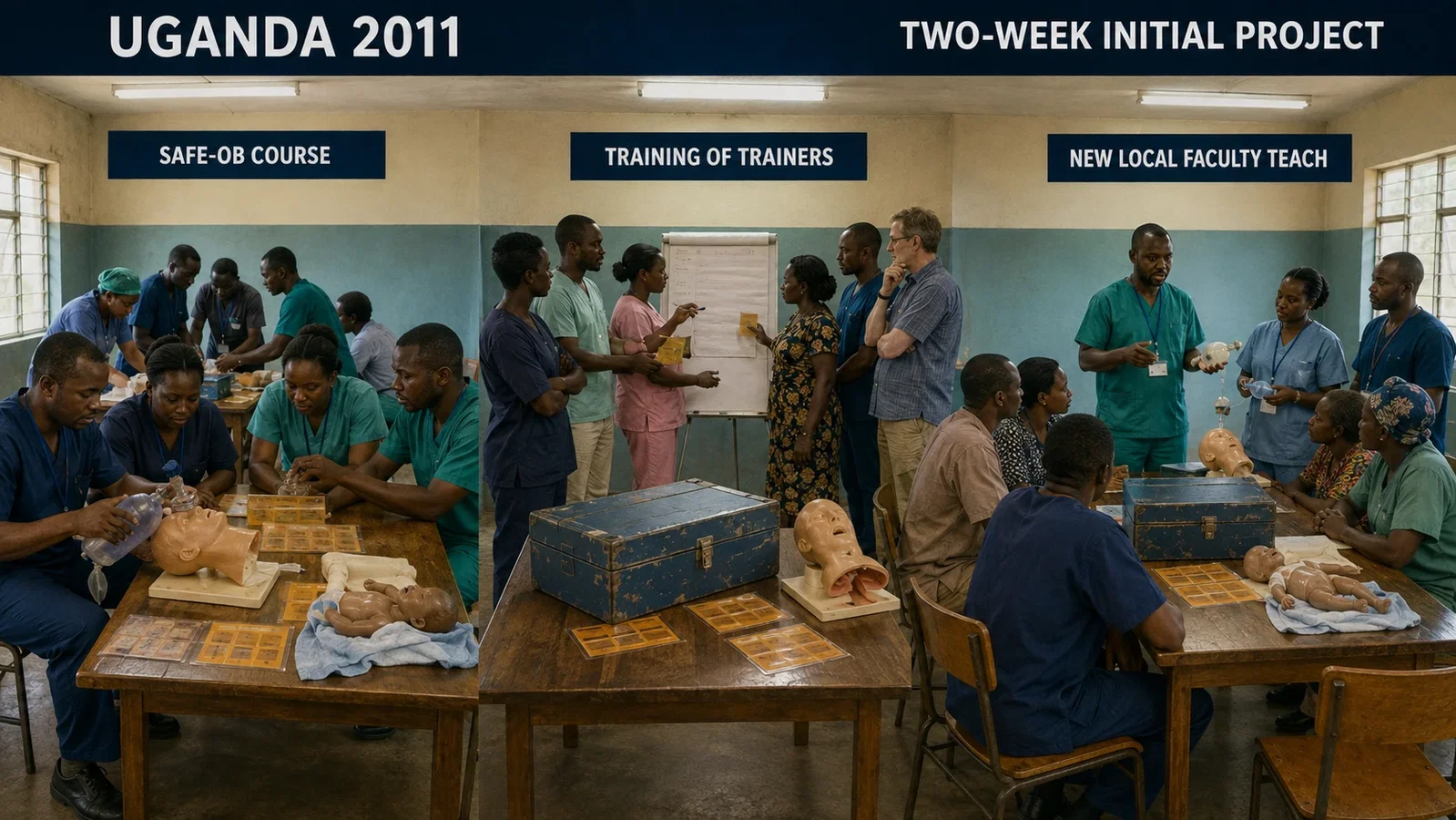
The decisive moment in the first SAFE Obstetrics project did not come when the first course opened. It came when some of its learners began teaching the next one.
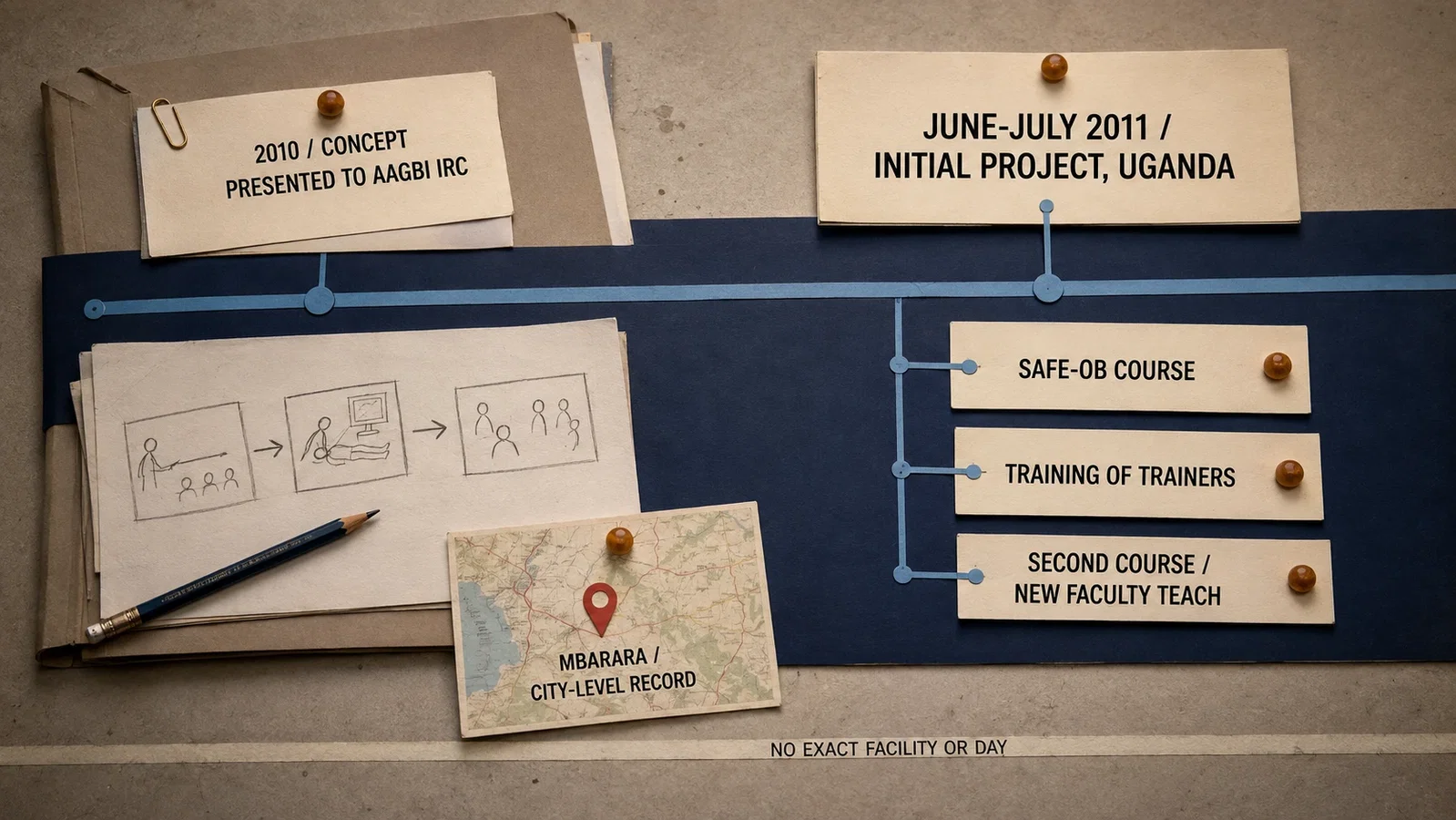
In June-July 2011, the initial Uganda project was organised as a two-week sequence. A SAFE-OB course came first. Training of Trainers followed. Then newly trained faculty helped teach another SAFE course. The sequence made a three-day refresher part of something larger: an attempt to move teaching capacity from a visiting programme into a local faculty network.
That is the historical claim this article can support. It is narrower than the promotional language sometimes attached to global health education, but more consequential than the simple statement that a course was launched. SAFE created a mechanism for knowledge to be taught again. The available evidence does not show that the course itself reduced maternal or neonatal mortality.
The second course changes the unit of analysis
If the first Uganda project is viewed only as a three-day class, its history ends when the participants leave the room. The 2015 programme account uses a different unit of analysis. It describes a two-week initiative that linked delivery, teacher development, and immediate reuse of the new teaching skills.
The account reports more than 70 delegates, representing more than 20% of Uganda's anaesthetic workforce at the time. Those figures are programme-authored measures of initial reach. They are not patient denominators, national outcome measures, or proof that the country's training needs had been met.
Their value lies elsewhere. A relatively large group entered a sequence in which course participants could become instructors within the same initial project. Training of Trainers was therefore not an abstract promise of sustainability. Newly trained faculty were given an early opportunity to teach under supervision.
This distinction also changes the visual language of the event. The central image is not a foreign lecturer facing rows of passive learners. It is the movement of people, teaching materials, and responsibility across three stations: course, teacher preparation, and local teaching.
A chronology with two steps, not one founding date
SAFE stands for Safer Anaesthesia From Education. According to the programme history, the course concept was first presented to the International Relations Committee of the Association of Anaesthetists of Great Britain and Ireland, then known as AAGBI, in 2010. A later peer-reviewed account credits Iain Wilson with developing the concept and Kate Grady with creating and implementing the original curriculum and follow-up programme.
That 2010 committee presentation is a prelude, not a delivered course. The initial project belongs to June-July 2011 in Uganda. WFSA's retrospective history timeline also states that the first SAFE courses were delivered in Uganda through WFSA-AAGBI collaboration, locates the 2011 development of SAFE Obstetrics in Mbarara, and places the Training of Trainers pilot in Uganda that year.
The sources do not establish the exact day or facility of the first course. Mbarara is therefore a city-level retrospective location, not permission to invent a hospital classroom.
Official descriptions also disagree about the programme's development year. One WFSA page says 2007, the detailed programme account specifies the 2010 committee presentation, a 2023 review uses 2010, and the current WFSA course page refers to joint development in 2011. None supplies a single uncontested legal founding date. The evidence is clearer when the story is divided into an idea entering formal discussion in 2010 and an initial Uganda project in 2011.
A portable course had to remain editable
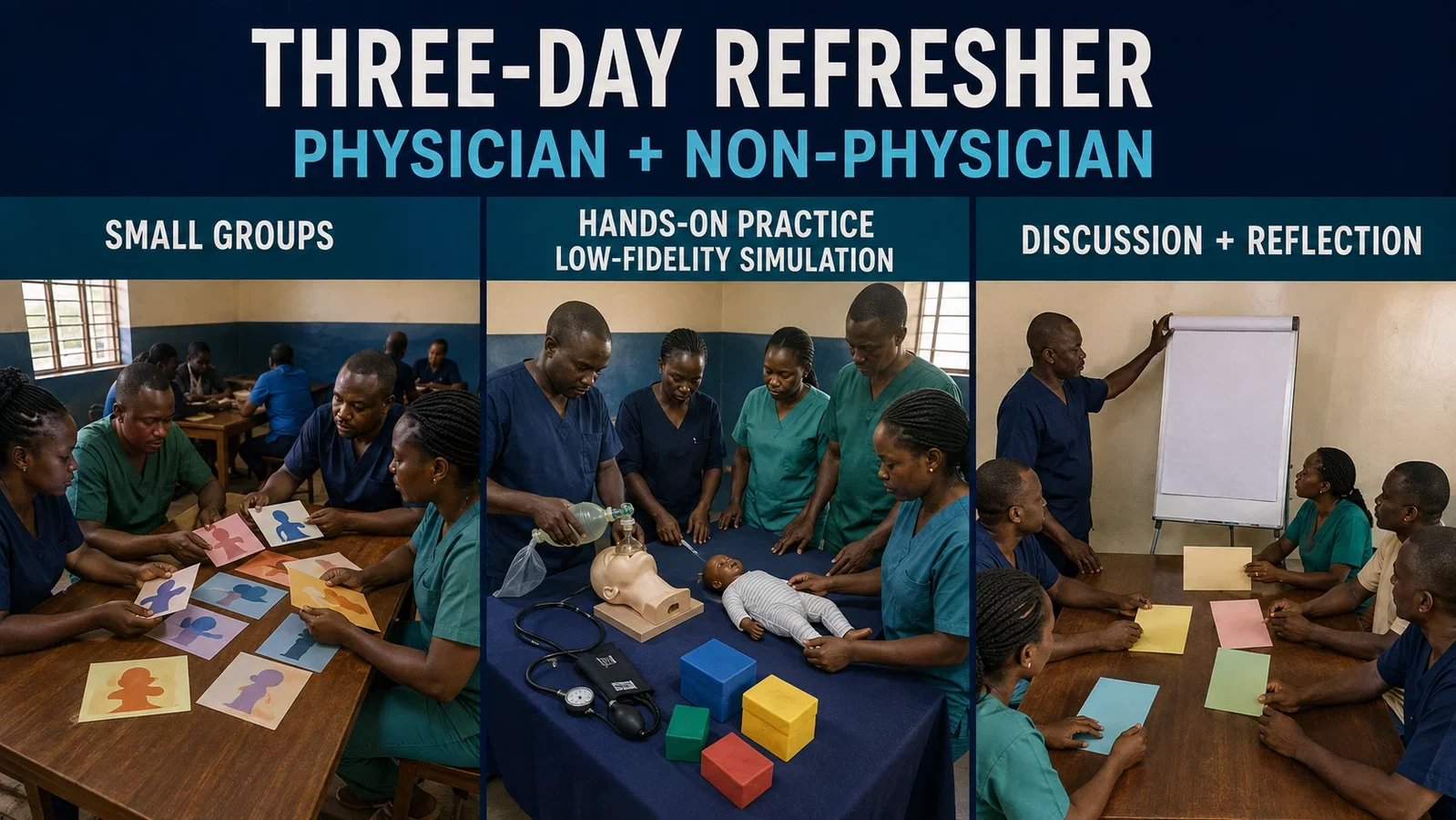
SAFE-OB was designed as a three-day refresher for people already providing anaesthesia in low-resource settings. Its audience included both physician and non-physician anaesthesia providers. Calling every participant an anaesthesiologist would erase the workforce structure the course was built to address. Calling the programme full specialty training would exaggerate what three days could provide.
The course used lectures, but lectures were only one component. Programme and official descriptions emphasise small-group teaching, hands-on practice, low-fidelity simulation, discussion, role play, reflection, and feedback. Topics included obstetric haemorrhage, pre-eclampsia and eclampsia, sepsis, airway management, general and spinal anaesthesia, newborn resuscitation, teamwork, and communication.
Those topics describe a historical curriculum. They should not be read as current clinical guidance, a drug protocol, or an endorsement of a particular device. The teaching design is the relevant evidence: participants worked through common and critical situations using methods that could function without an expensive simulation centre.
Early descriptions also emphasised a no-humiliation culture and did not reduce participation to a pass-or-fail event. Mentoring and logbooks were intended to carry reflection beyond the classroom. The approach recognised that experienced providers might know their local barriers better than visiting instructors and that honest discussion would be difficult if teaching reproduced professional hierarchy.
Portability did not mean sending an unchangeable British package from country to country. An Association retrospective describes Kate Grady's role in leading the original curriculum and Ugandan anaesthetists' role in evaluating and modifying it for local relevance. Other programme sources describe paired international and local faculty and a modular design that could respond to language, resources, and practice conditions.
Local adaptation was therefore not a ceremonial consultation at the end of the process. Ugandan clinicians and instructors helped determine how the material would be understood and taught. The faculty chain depended on them becoming curriculum interpreters, facilitators, and teachers, not merely course recipients.
Training faculty is a mechanism, not an outcome
Training of Trainers addressed a familiar weakness in short international courses. If every repeat delivery required another visiting team, the programme would remain dependent on travel, outside funding, and outside availability. Preparing local teachers was intended to reduce that dependence and allow the course to be delivered again within the country.
The 2011 sequence provides direct historical evidence that this mechanism was attempted: a SAFE-OB course was followed by teacher training and then by another course involving the new faculty. It does not establish that every participant became an independent instructor, that all later courses were locally led, or that the model worked equally well in every setting.
This is an important boundary. Sustainability is often used as a retrospective compliment, but here it should be treated as a proposed and partly observable mechanism. One can document the transition from learner to supervised teacher. Long-term faculty retention, institutional support, recurrent funding, and national integration require additional evidence.
Three later evaluations answer narrower questions
Later studies in Rwanda, the Republic of Congo and Madagascar, and Ethiopia help test what persisted after SAFE-OB courses. They differ in year, place, cohort, design, and follow-up. They should not be pooled informally or projected backward as outcomes of the 2011 Uganda pilot.
The first Rwandan SAFE course took place in January 2013. Ninety anaesthesia technicians participated, and 26 trainers, including senior technicians and residents, attended Training of Trainers. The curriculum was adapted for language and local needs, with active small-group learning and a peer and mentor network. Six months later, researchers interviewed a purposive sample of 21 participants. Participants described changes in confidence, communication, teamwork, and aspects of practice, while also identifying resistance, shortages, and organisational constraints.
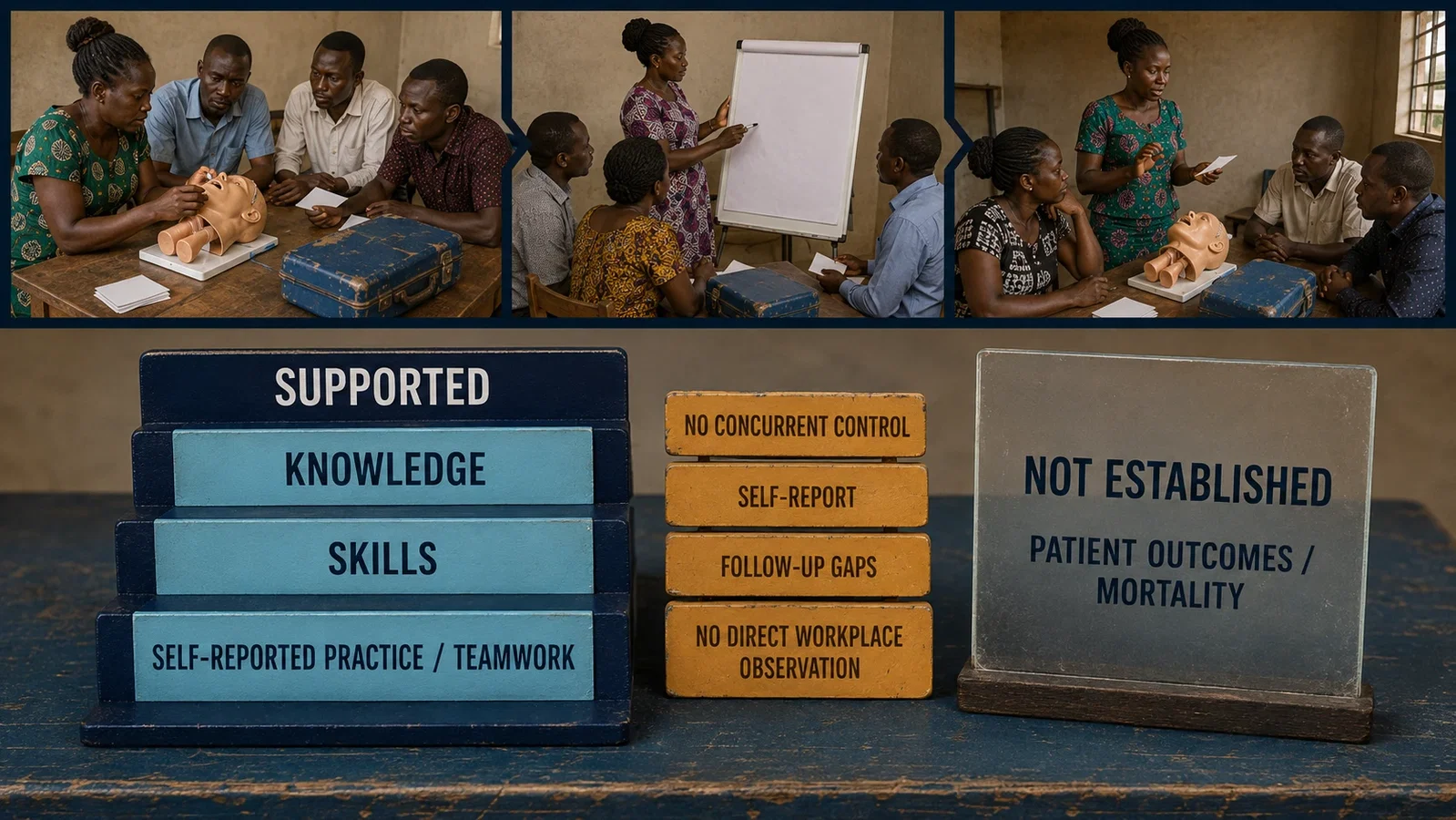
Those interviews are valuable because they show how participants understood the course after returning to work. They remain self-reports from a selected sample. They do not directly observe every reported workplace behaviour, provide a concurrent control group, or establish a mortality effect.
A mixed-method evaluation in the Republic of Congo and Madagascar covered five courses held from 2014 to 2016 and 213 participants. It found sustained performance on knowledge and skills tests among the smaller groups available at later follow-up and recorded reported changes in personal practice and organisational culture. The authors also made the causal limits explicit: no concurrent control, different follow-up cohorts, purposive interview sampling, possible reporting and recording bias, uncertain test validity and reliability, and no direct measurement of actual workplace behaviour.
The Ethiopia study followed four courses held in 2017-2018. It included 149 participants from 60 facilities, and the linked Training of Trainers courses prepared 56 local trainers. Knowledge and structured skills-test scores rose after training and remained above baseline among the participants reached at 3-11 months. Interviewees reported greater confidence, teamwork, and communication.
Follow-up was incomplete. The study's structured skills tests observed performance in assessment scenarios, but it did not directly observe routine clinical behaviour in participants' workplaces. The authors could not determine whether improved knowledge and skills translated into clinical practice or patient outcomes. That distinction is why the evidence graphic for this article must say NO DIRECT WORKPLACE OBSERVATION, rather than incorrectly suggesting that no skills were observed at all.
The missing rungs between learning and mortality
An educational intervention can plausibly improve knowledge before it changes behaviour. Behaviour can change before a health system can reliably deliver the equipment, drugs, blood, staffing, referral, and postoperative support needed for better outcomes. Patient outcomes then require suitable baseline data, comparison groups, case-mix information, and sustained surveillance.
The SAFE evaluations do not fill all of those rungs. They support learning measures, structured skills assessments in some cohorts, and participant accounts of practice and teamwork. They also document obstacles that lie outside an individual's knowledge. These are meaningful findings, but they cannot carry a claim that SAFE reduced maternal or neonatal morbidity or mortality.
A 2023 review of global obstetric anaesthesia partnerships reaches the same boundary: good-quality evidence on long-term patient outcomes remains lacking. Statements about lives saved on fundraising pages or in participant recollections belong to programme aspiration and personal testimony. They are not adjudicated outcome data.
The distinction protects rather than diminishes the programme's historical meaning. It separates what was actually built from what remains to be demonstrated. A course can create a shared vocabulary, rehearsal space, mentoring relationship, and path into teaching without already proving a population-level mortality effect.
What remained after three days
The material culture of this article is modest: paper scenarios, simple mannequins, small groups, a logbook, and a teaching case that can move to the next room. Its central transition is equally modest in appearance. Someone who entered as a participant begins to explain the material to others.
That transition is the reason to mark 2011. The first Uganda project joined content, teacher development, and another act of teaching in one sequence. It reframed the short course from a self-contained visit into the beginning of a faculty pathway.
Whether that pathway endured in every location, overcame resource constraints, or improved patient outcomes must be evaluated separately. The history does not need those questions to be prematurely closed. Its strongest claim is already specific: the initial SAFE Obstetrics project treated local teaching capacity as part of the intervention itself.
The first course ended after three days. The project did not ask the teaching to end with it.
Sources and reading limits
Sources: Enright A, Grady K, Evans F. 2015 programme history; Association of Anaesthetists, Anaesthesia News SAFE feature, 2016; WFSA official history timeline, SAFE training page, 2021 Annual Review, and official first-course recollections; Livingston P et al. Can J Anaesth. 2014;61:1028-1039. PMID 25145938. DOI 10.1007/s12630-014-0224-8; White MC et al. Anesth Analg. 2019;129:1707-1714. PMID 31743192. PMCID PMC6844653. DOI 10.1213/ANE.0000000000004329; Moore JN et al. Anaesth Intensive Care. 2020;48:297-305. PMID 32830542. DOI 10.1177/0310057X20940330; Global obstetric anaesthesia partnerships. Int J Obstet Anesth. 2023;55:103646. DOI 10.1016/j.ijoa.2023.103646. All cited sources were read for this article.
Visual interpretations
These illustrations explore the setting and ideas. Depicted people, actions, instruments and documents are reconstructions, not evidence of their exact historical appearance.
Continue exploring
Related reading connects shared questions and contexts; it does not by itself establish historical influence.
- 2011: Lifebox Works Toward Global Pulse-Oximetry Access
- 2015: Thirteen Actions Make Hemorrhage a System Responsibility
- 2018: A 25-Country Network Finds Fewer Complications but Harder Rescue
The Source Room · About & Editorial Method
Continue this reading route
Stop 3 of 3 · Back to route · How anesthesia became local practice
Previous · 1954: Japan's Anesthesia Society Is Founded and Holds Its Opening Meeting
Sources and reading limits are stated above. Illustrations are labelled as original source images or AI-made. Historical accounts are educational; they are not current treatment instructions.