Aoyagi turned hypoxemia into a signal; Lifebox worked to make that signal accessible.
Reading Library · Anesthesia Epochs · 中文版
Watch the companion film
2011: Lifebox — Pulse Oximetry for Every Operating Room · Watch on YouTube
Historical anchor: 2011. Date details and source qualifications are explained below.
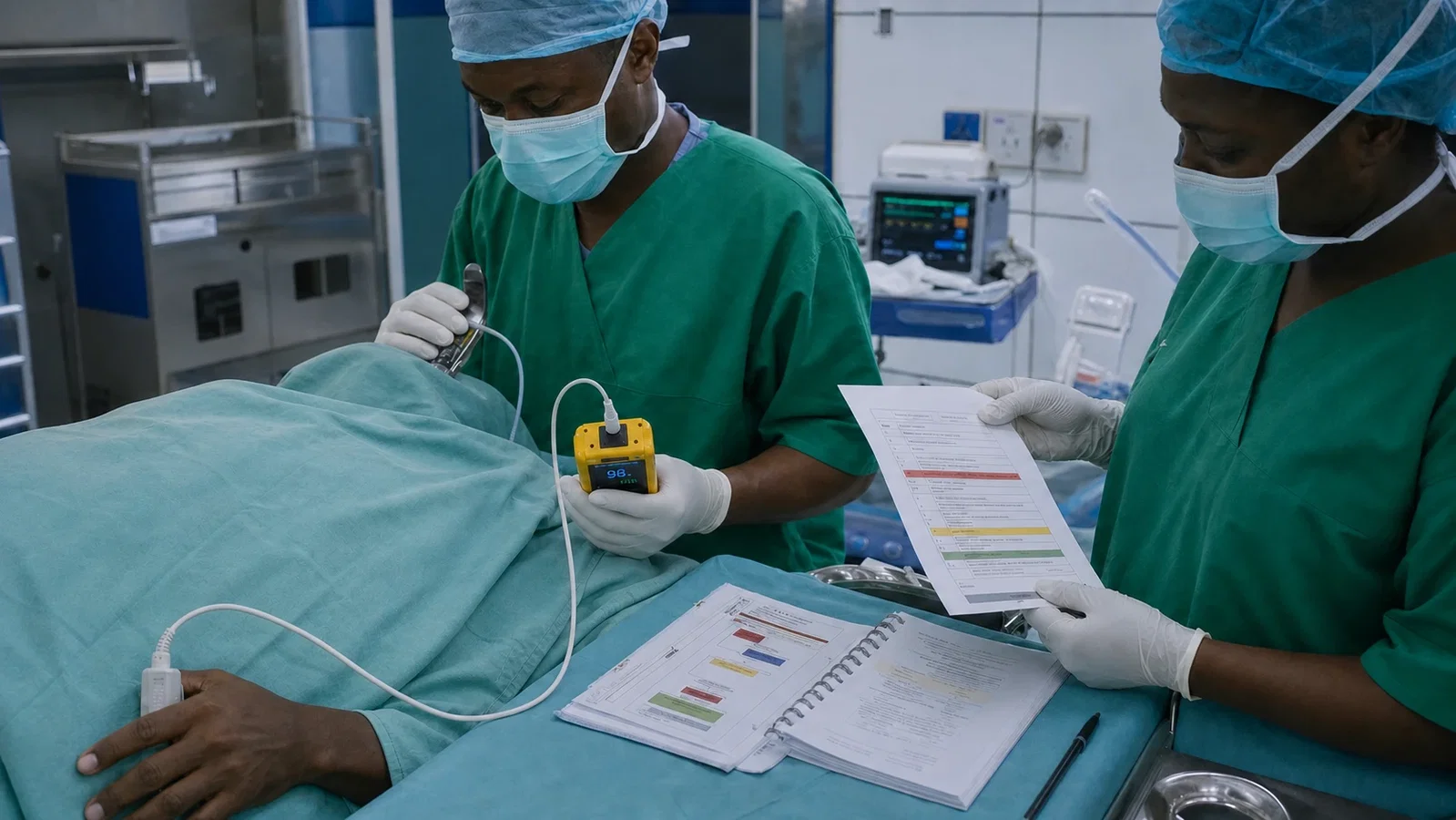
The World Health Organization's Surgical Safety Checklist asks a direct question before anaesthesia begins: “Is the pulse oximeter on the patient and functioning?” The accompanying guidance goes further. If no functioning oximeter is available, the surgeon and anaesthetist should consider postponing the operation until one can be secured. The requirement may be waived for urgent surgery to save life or limb, but only when the team agrees that proceeding is necessary.
The question assumes that an oximeter is already in the operating room. For a team without one, the box on the checklist cannot be completed through vigilance alone.
I. A Checklist Item That Could Not Be Checked
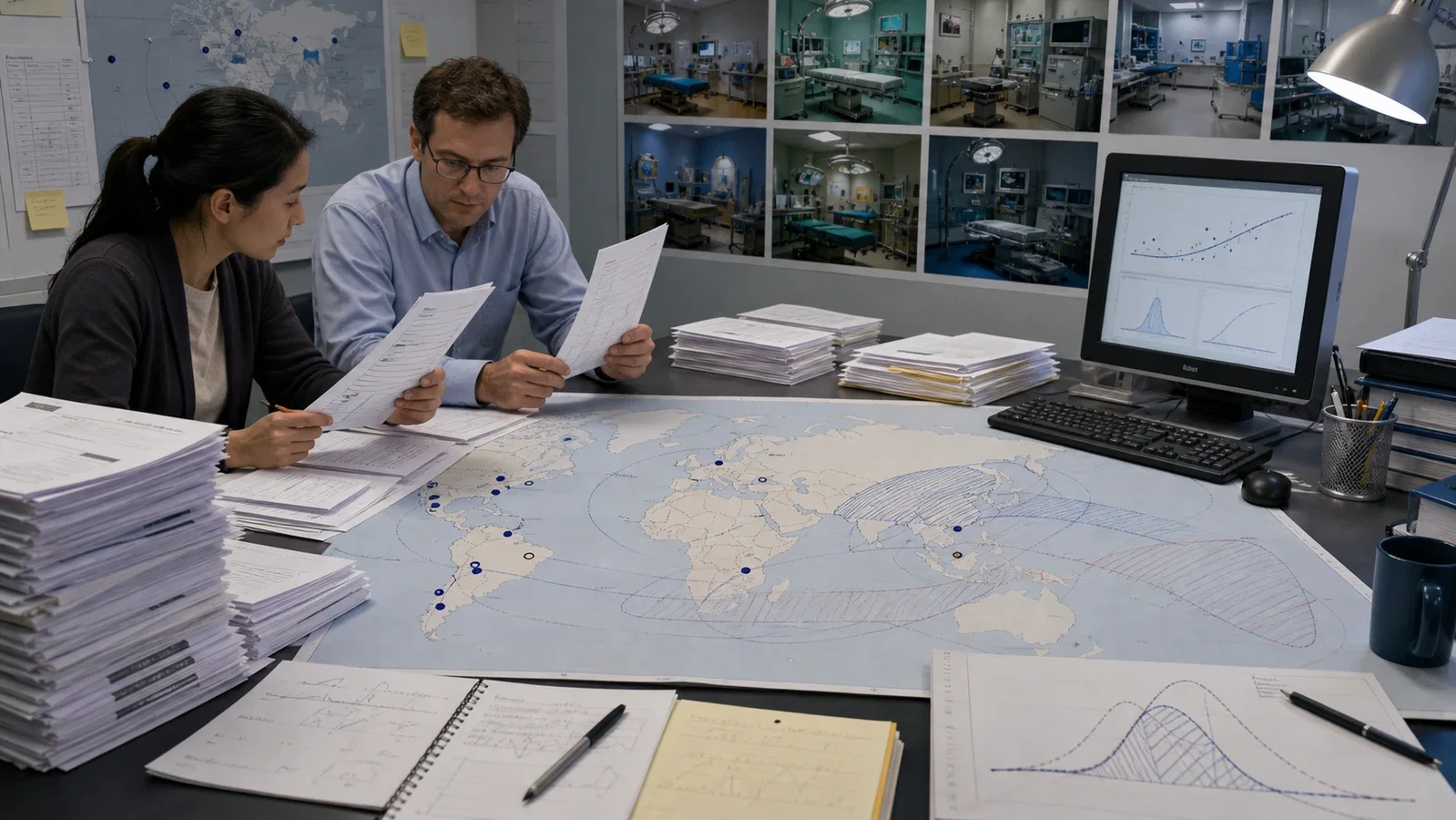
In 2010, Luke Funk and colleagues tried to estimate the size of this equipment gap. Their study was not a room-by-room global census. The operating-theatre model drew on profiles from 769 hospitals in 92 countries. A separate pulse-oximetry survey was sent to 334 anaesthesia providers in 72 countries; 172 replied, a response rate of 51%, and the final dataset contained information from 54 countries. Predictive regression and multiple imputation were then used for countries without reported data.
The central estimate was 77,700 operating theatres without pulse oximetry, with a 95% confidence interval from 63,195 to 95,533. The precision of that number should not be mistaken for a direct count. It was a model-based estimate assembled from hospital profiles, provider reports, missing data, and statistical assumptions. The interval was wide, but the analysis still indicated a large gap between global monitoring standards and the equipment available to meet them.
The checklist therefore exposed a practical divide. A safety rule had travelled farther than the equipment needed to carry it out.
II. 2004-2011: Turning a Gap into an Organization
The institutional history began before Lifebox had a name. At the 2004 World Congress of Anaesthesiologists in Paris, members of the WFSA Safety and Quality Committee discussed how pulse oximetry might be made more widely available. With support from the Association of Anaesthetists of Great Britain and Ireland (AAGBI) and GE Healthcare, projects were developed in Uganda, Vietnam, India, and the Philippines. Over 15 months, 84 oximeters were used and more than 8,000 anaesthetic cases were recorded in project logbooks.
Those projects identified a problem broader than device supply. Providers without prior experience needed formal instruction in how to use an oximeter and respond to its information. Probes, batteries, repair, replacement supplies, local coordination, and continuing service all affected whether a low-cost device remained usable. The lesson was operational: procurement could place a monitor in a room, but a supply and support system determined whether it stayed there.
WHO was developing the Safe Surgery Saves Lives initiative at the same time. In 2008, it brought together the WFSA, Harvard School of Public Health, procurement specialists, industry representatives, and other participants to define equipment specifications, purchasing arrangements, and educational materials. The 2009 safe-surgery guidance then placed a functioning pulse oximeter inside the checklist process.
In 2011, AAGBI, Brigham and Women's Hospital, Harvard School of Public Health (now the Harvard T.H. Chan School of Public Health), and the WFSA created Lifebox. The organization linked equipment procurement with education and implementation rather than treating distribution as the endpoint.
Legal record: UK Companies House records Lifebox Foundation as incorporated on 21 April 2011. The Charity Commission records its registration on 21 July 2011. These are distinct legal milestones, not evidence of a single public launch date.
III. A Box Does Not Implement Itself
The earlier projects and the 2011 account described the conditions the equipment had to withstand. Electrical power could fail. A probe could break. Repair and replacement parts might not be readily available. The selected handheld device used robust construction, a rechargeable battery that could continue operating during a power failure, and a replaceable probe. It displayed SpO₂, pulse rate, and a pulse waveform, while a changing pulse tone allowed the team to hear changes in saturation.
Affordability could not come at the expense of measurement performance. A controlled study published in 2013 exposed 57 healthy volunteers to different levels of hypoxia and obtained 1,467 paired SaO₂ and SpO₂ observations. Across an SaO₂ range of 71% to 100%, the device's root mean square error was 2.31%, within the contemporary US Food and Drug Administration criterion of less than 3%. This was an accuracy study conducted under controlled healthy-volunteer conditions. It did not test clinical outcomes or establish performance in every patient population and operating environment.
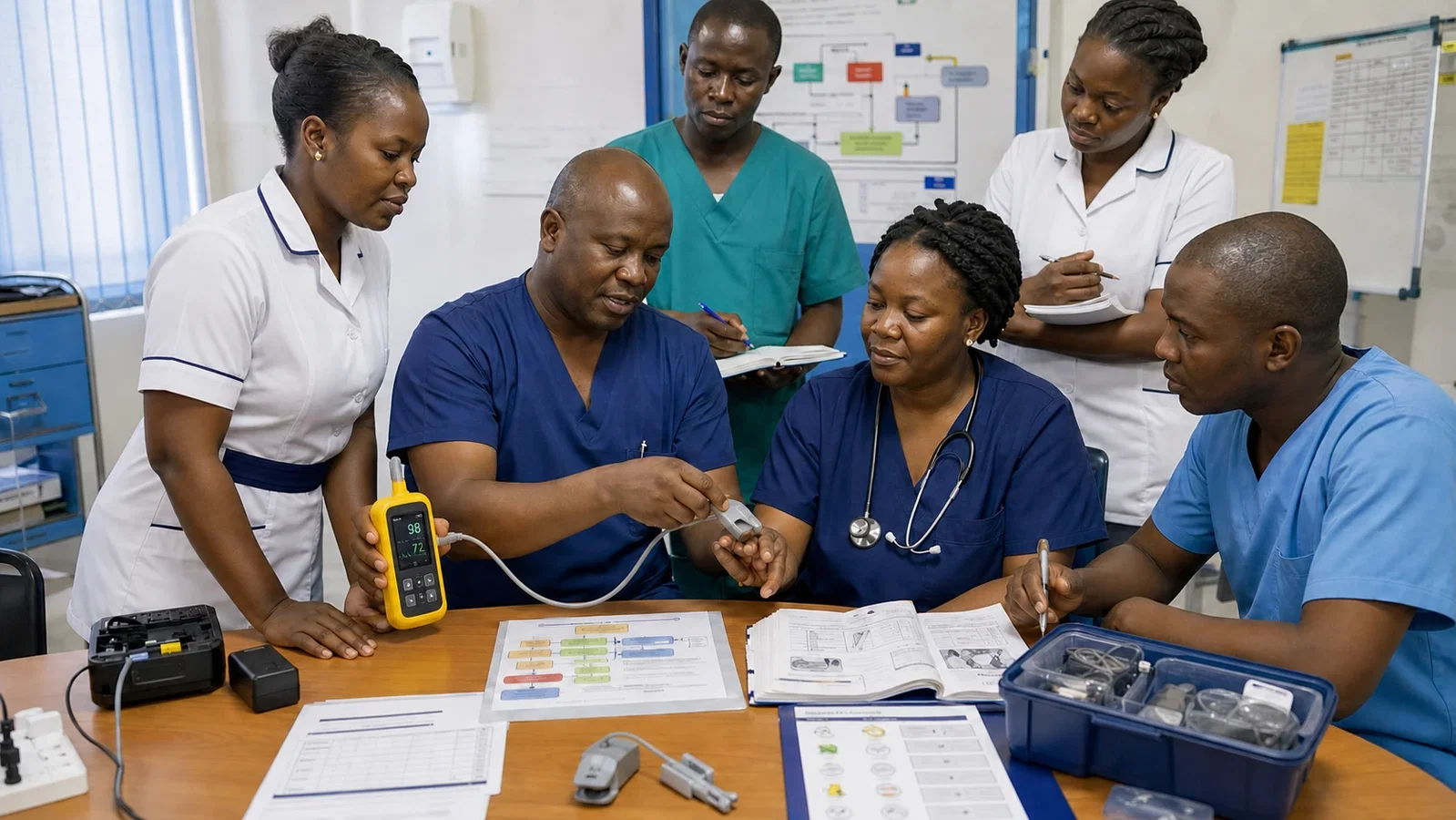
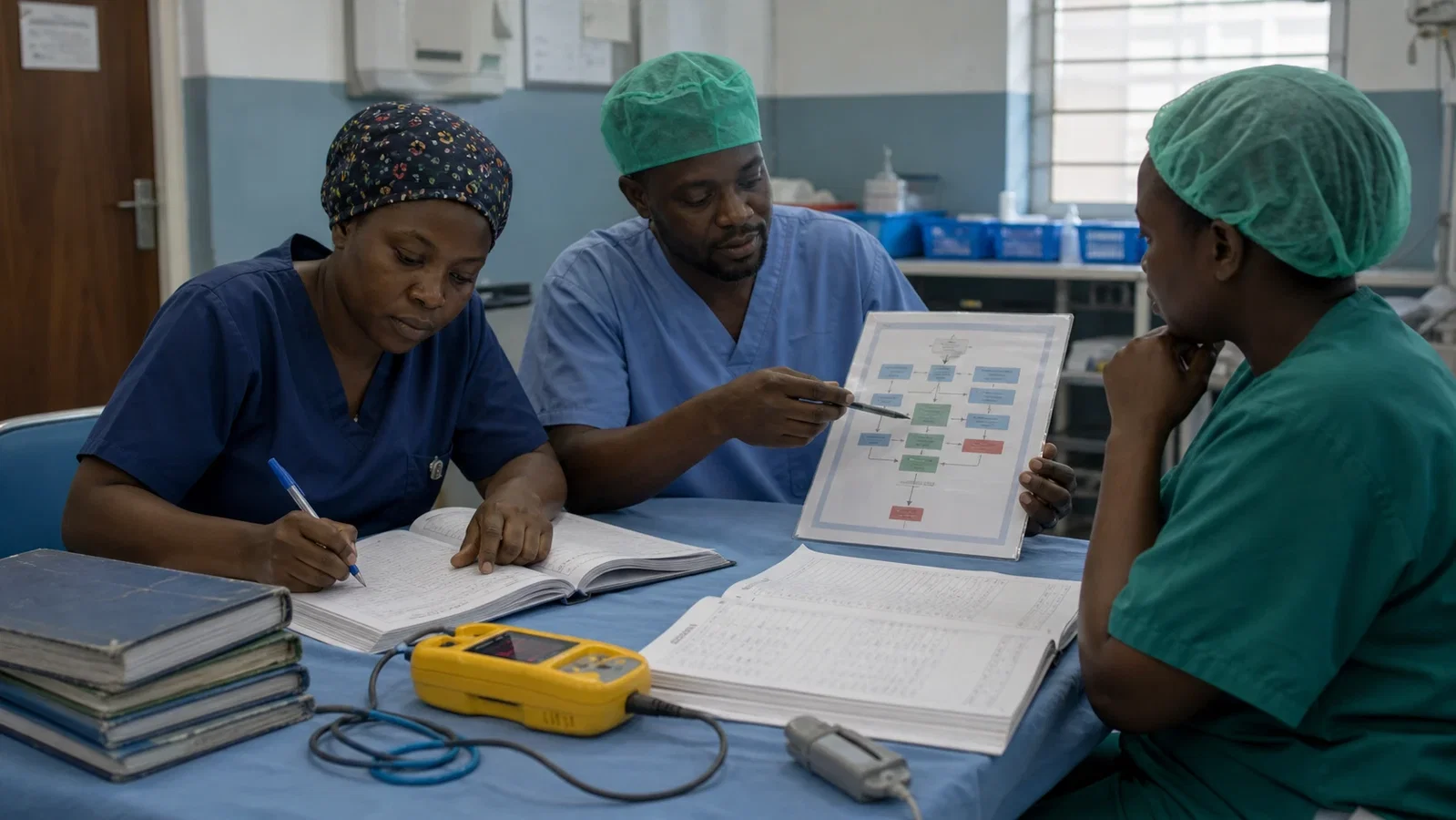
A reading also required an organized clinical response. The WHO training manual instructed users to check whether the probe, pulse, and alarm were credible, then consider Airway, Breathing, Circulation, Drugs, and Equipment when saturation fell. The monitor could detect declining oxygen saturation, but it did not directly measure respiratory rate, tidal volume, or carbon dioxide. Supplemental oxygen could also mask the effect of hypoventilation on SpO₂ for a time. A number became useful only when a clinician could judge its reliability, support ventilation, identify a cause, and correct it.
Implementation could not be measured solely by the number of devices distributed. The monitor, training, hypoxia algorithm, paper checklist, power supply, replaceable probe, local coordinator, maintenance plan, and follow-up together determined whether the alarm remained part of daily care.
IV. From Receiving a Signal to Responding to It
A project organized with AAGBI and the Uganda Society of Anaesthesia provided early implementation evidence. In 2011, 79 non-physician anaesthesia providers received oximeters and training in pulse oximetry and hypoxia management. At follow-up 3 to 5 months later, 75 of 79 devices were in routine clinical use. The median knowledge score rose from 36/50 before training to 41/50 immediately afterward and remained 41/50 at follow-up. The study supported short-term uptake and retained knowledge. It did not assess patient outcomes, and its follow-up was too short to establish how long the devices and probes would remain usable.
The Malawi study followed practice across sequential cases. Eighty-three non-physician anaesthesia providers from 27 hospitals attended a one-day course and received an oximeter, manual, WHO checklist, hypoxia algorithm, and teaching materials. At 8 months, investigators located 68 devices, 66 of which remained in routine use. Sixty returned logbooks contained 4,911 operations, with complete data for 4,772. The proportion of recorded desaturation events declined from 17.2% in the first 10 cases to 6.5% in the final 10. Comparing the second 50 cases with the first 50, the adjusted odds ratio was 0.64 (95% credible interval 0.50 to 0.82).
The study design limits how those results can be interpreted. The project introduced an oximeter, training, a manual, the checklist, and a hypoxia algorithm together, without an untreated control group. The case mix changed over time. Providers completed their own logbooks, some logbooks and follow-up assessments were missing, and several books recorded no desaturation events at all. Postoperative mortality was not assessed. The supportable conclusion is narrower than a device-effect claim: during this bundled implementation, knowledge was retained, most located devices remained in use, and provider-recorded desaturation declined over sequential cases. The study cannot show that one monitor alone caused an improvement in clinical outcomes.
As accessed on 1 September 2026, Lifebox reports that it has distributed more than 37,000 pulse oximeters to anaesthesia providers in 116 countries. This is a dated institutional measure of device reach, not an independently measured patient benefit. In its official tribute to Takuo Aoyagi, Lifebox describes its purpose as “globalizing Dr. Aoyagi's invention.” The phrase connects two adjacent articles in this history without making Aoyagi part of Lifebox's founding. Aoyagi helped turn hypoxemia into a visible and audible signal. Lifebox addressed the next problem: helping more clinical teams obtain that signal, understand it, and act when the alarm sounded.
Sources and reading limits
Sources: Walker IA et al. Anaesthesia. 2009;64:1051-1060 (PMID 19735394); Funk LM et al. Lancet. 2010;376:1055-1061 (PMID 20598365); WHO Guidelines for Safe Surgery 2009; WHO Pulse Oximetry Training Manual 2011; Enright A, Merry A. Update in Anaesthesia. 2011;27(1):4; Dubowitz G et al. Anaesthesia. 2013;68:1220-1223 (PMID 23992483); Finch LC et al. Anaesthesia. 2014;69:445-451 (PMID 24738801); Albert V et al. Anaesthesia. 2017;72:686-693 (PMID 28439886); UK Companies House 07612518; Charity Commission 1143018; Lifebox official pages archived 2026-09-01.
Visual interpretations
These illustrations explore the setting and ideas. Depicted people, actions, instruments and documents are reconstructions, not evidence of their exact historical appearance.
Continue exploring
Related reading connects shared questions and contexts; it does not by itself establish historical influence.
Historical connections
These links follow specific development, adoption or citation connections recorded in the underlying research. They do not imply that history had one inevitable path.
- Earlier connection: 1974: Takuo Aoyagi Makes Hypoxia Visible
Related reading
- 2011: The Uganda SAFE Obstetrics Pilot Builds Local Faculty
- 2018: A 25-Country Network Finds Fewer Complications but Harder Rescue
- 2020: Intubation Becomes a Team Protocol, Not Just a Technique
- 2023: The FDA Creates a Device Type for the NOL Index
- 2024: ASA Revises PACU Handoff to 'Stay with the Patient'
The Source Room · About & Editorial Method
Sources and reading limits are stated above. Illustrations are labelled as original source images or AI-made. Historical accounts are educational; they are not current treatment instructions.