The rapid March 2020 consensus connected protection, roles, primary and rescue plans, confirmation, records, and extubation while declaring itself incomplete and revisable.
Reading Library · Anesthesia Epochs · 中文版
Watch the companion film
2020: COVID-19 — Rebuilding Intubation as a Team Protocol · Watch on YouTube
Historical anchor: 2020. Date details and source qualifications are explained below.
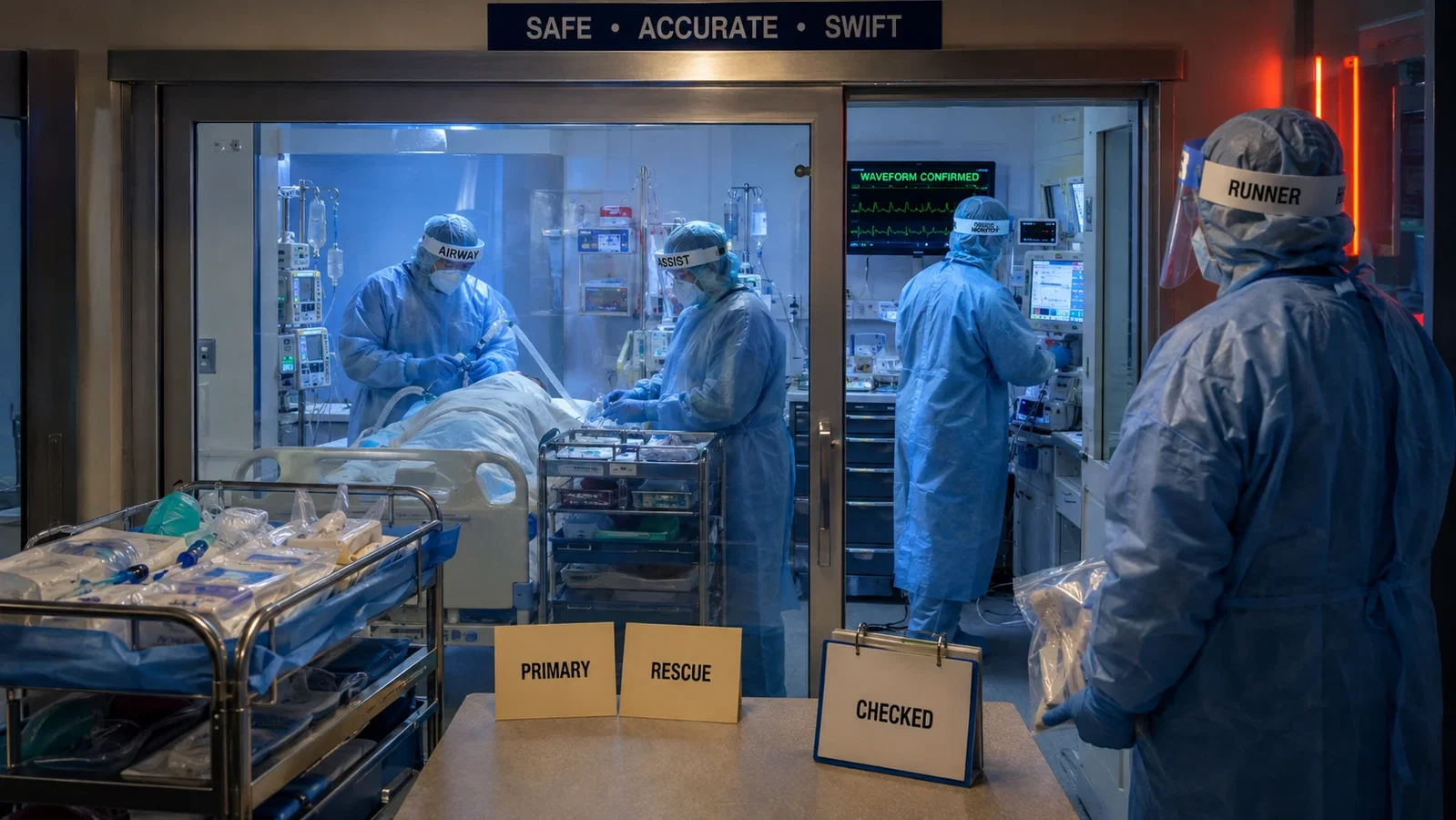
Airway management had already begun before the door opened.
Who would intubate? Who would assist? Who would administer drugs and watch the monitor? When would the team move to its rescue plan? What equipment was still missing? If the people inside needed help, who would respond from outside? Behind masks and visors, how would one person know that another had actually heard an instruction?
In March 2020, COVID-19 compressed questions that could once be distributed across experience, habit, and improvisation into a single threshold. The patient might deteriorate quickly. Tracheal intubation was also treated as a procedure carrying substantial exposure risk for healthcare workers. Time mattered, but rushing into the room could not solve the problem.
The airway guidance that emerged did not chiefly invent a new intubation technique. It redesigned intubation as a team process that began outside the room and continued beyond extubation.
Six days from working draft to public protocol
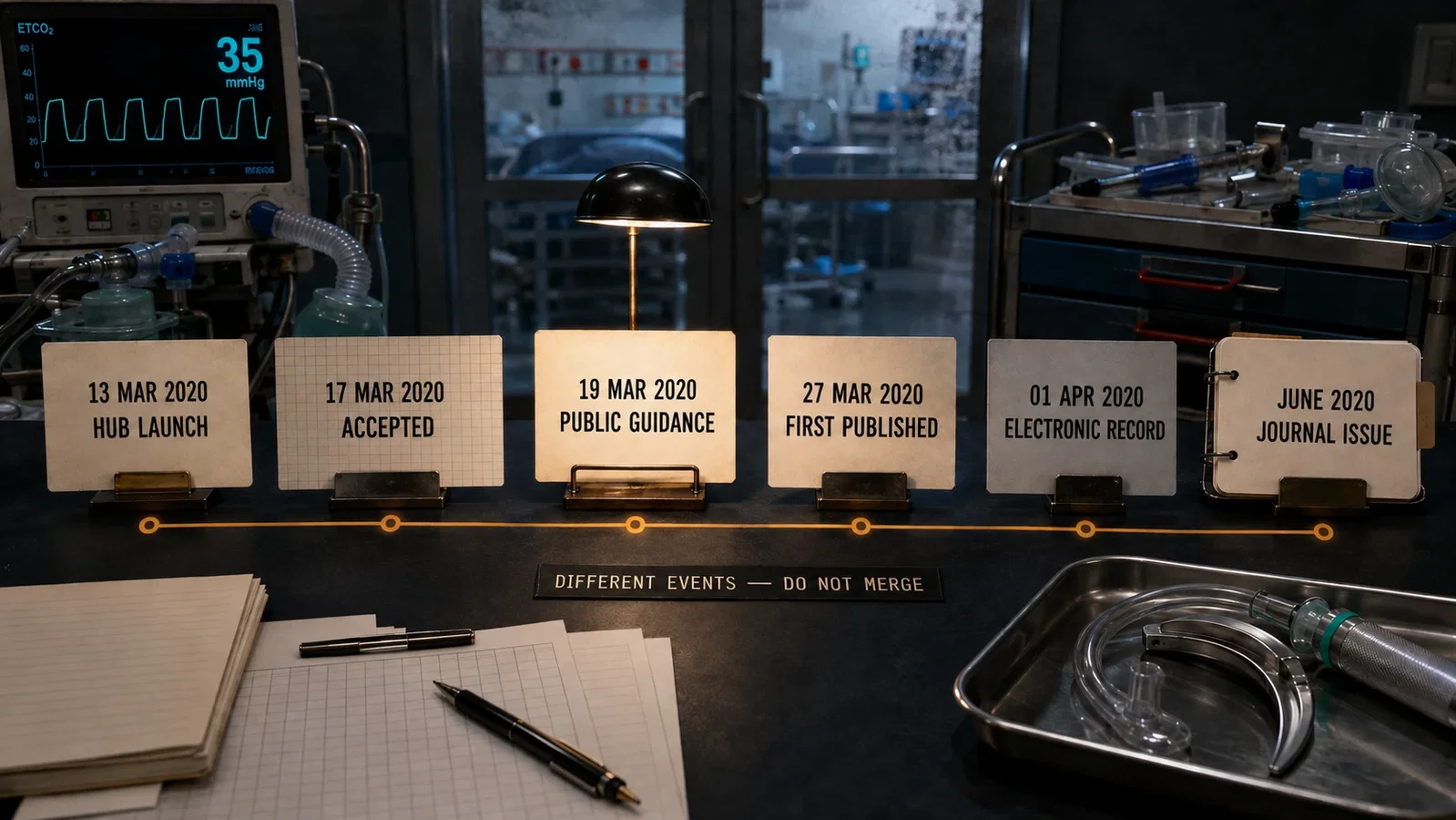
This history has several dates, and they should not be flattened into one.
On 13 March, the Royal College of Anaesthetists, Faculty of Intensive Care Medicine, Intensive Care Society, and Association of Anaesthetists announced a new multidisciplinary COVID-19 guidance hub. A surviving six-page short document carries the footer “Working final draft 130320.” That footer shows the guidance being assembled under pressure; it is not the journal publication date.
Cook and five coauthors had their consensus paper accepted on 17 March. On 19 March, the ICM Anaesthesia COVID-19 site published “COVID-19 airway management principles” with both short and full versions. The World Health Organization issued its first COVID-19 healthcare infection-prevention interim guidance on the same date.
Wiley labels the paper first published on 27 March. PubMed, Europe PMC, and Crossref also preserve a 1 April electronic-publication state and the June journal issue. These are records of a hub launch, manuscript acceptance, a dated guidance page, first online publication, database indexing, and issue assignment. They are different events, not contradictory substitutes.
The compressed chronology captures the central problem. Clinical teams could not wait for mature COVID-specific evidence before organizing their work.
Safe, accurate, and swift did not mean faster hands
The guidance reduced its aim to three words: Safe, Accurate, Swift.
“Swift” was the easiest to misread. The paper defined it as timely action without haste or delay. It sought the best chance of first-pass success because repeated airway manipulation could increase physiological risk to the patient and exposure opportunities for staff. The way to achieve that was not to pressure the operator. It was to move uncertainty and omission into the preparation phase.
Institutions were asked to prepare the room, personal protective equipment, monitoring, suction, ventilator, intravenous access, an airway trolley or pack, and both primary and rescue strategies. Teams were to use methods they already knew and for which local training and equipment existed. An emergency was not the moment to test an unfamiliar technique for the first time.
The document discussed videolaryngoscopy, two-person mask ventilation, and second-generation supraglottic rescue, but every such choice was conditional on training, availability, local practice, and the individual operator. The authors explicitly said that they were not promoting a particular device. Making a laryngoscope the hero of this article would miss the historical change.
Three people inside, one runner outside
The guidance called for the smallest number of people necessary in the room, then immediately guarded against the wrong interpretation: this was not an argument for a solo operator.
Its likely configuration placed three people inside—an intubator, an assistant, and a third person responsible for drugs and monitoring—with a runner watching from outside, able to obtain equipment or summon help.
The person performing the procedure was not assigned by a simple specialty rule. The paper used the phrase “most appropriate airway manager.” Experience, expertise, predicted difficulty, urgency, personal risk, and the availability of an intubation team all mattered.
This structure managed two hazards moving in opposite directions. Too many people created unnecessary exposure. Too few forced drugs, monitoring, equipment, rescue, and communication into the same pair of hands. “Minimum” did not mean too few to function. It meant that every person in the hazardous space had a defined role.
The checklist made the doorway a process boundary
The four supplements show how concretely the authors understood that idea.
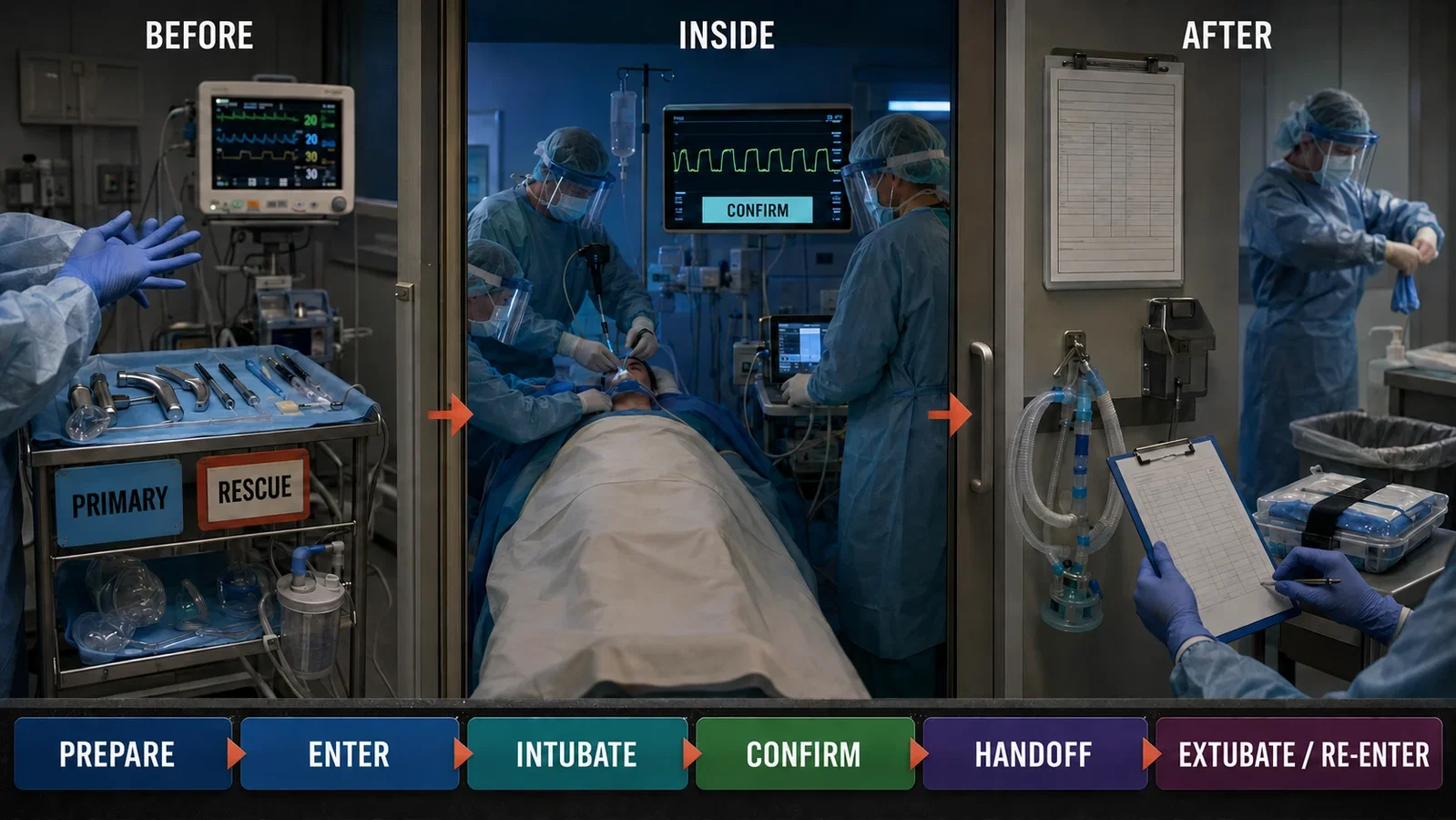
The first listed sample contents for a COVID-19 airway trolley and included a photograph of a plastic-covered cart with a handwritten COVID 19 sign. The second organized work into before, during, and after: prepare protection, drugs, equipment, assessment, and plans; delineate roles, communicate, and cross-monitor during the procedure; then manage circuit safety, doffing, hand hygiene, and debriefing.
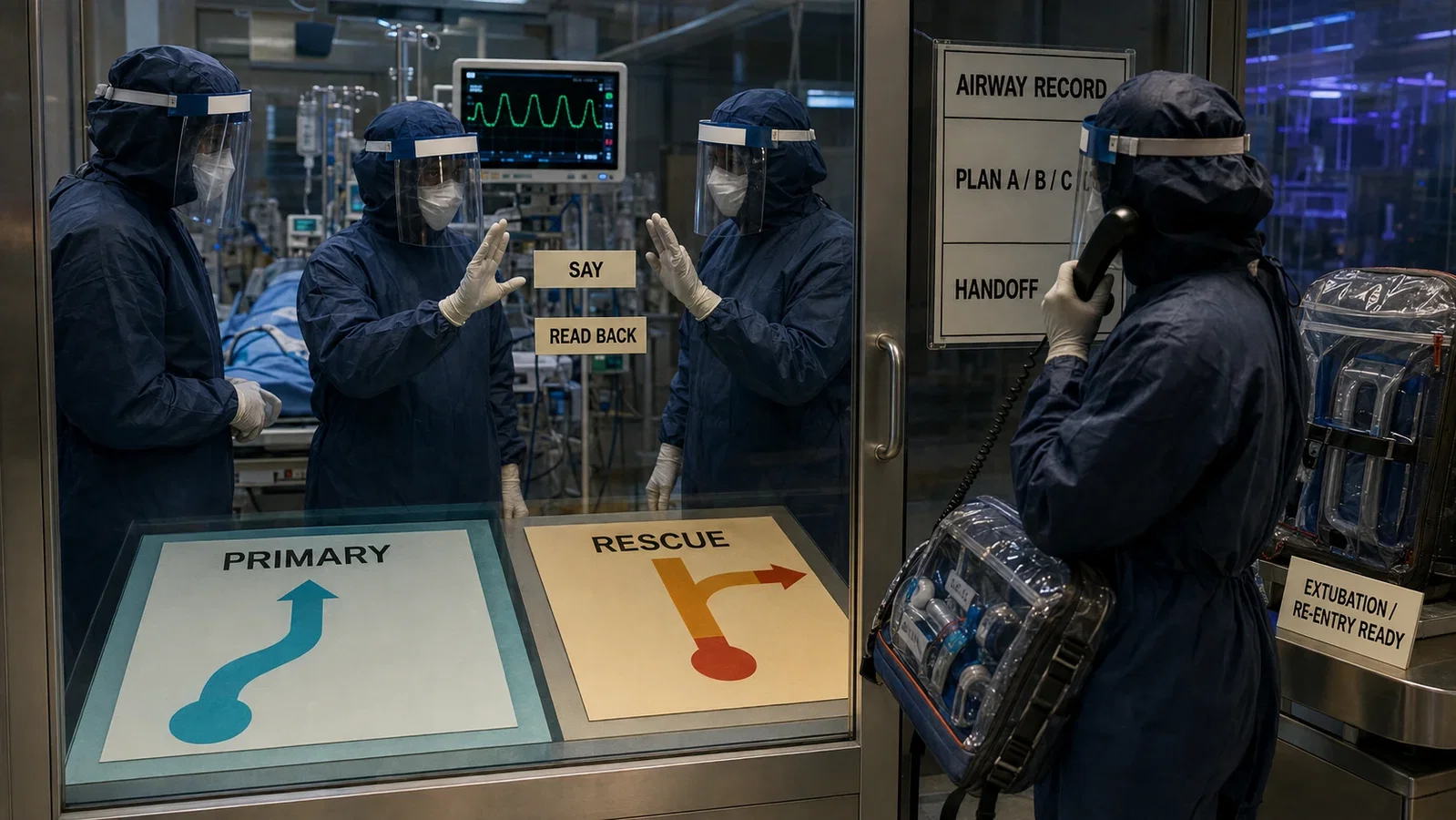
The third was a record to display at the patient's room, carrying forward the laryngoscopic view, difficulty with mask ventilation, operator, and device information. The fourth was a difficult-airway communication form that made the anticipated problem, Plans A/B/C, available equipment, and notified staff explicit.
None of these forms demonstrated an improvement in patient outcomes. They showed how the protocol worked: knowledge that once remained inside the memory of those present was converted into a state the next team could read.
Communication itself became an airway skill. PPE obscured faces and attenuated speech. The guidance therefore emphasized simple instructions, closed-loop repetition, adequate volume without shouting, and visible names on visors. Failing to recognize or hear a colleague was no longer merely awkward; it could cause the team to miss a transition in the rescue plan.
A successful intubation was not the end of the protocol
Continuous waveform capnography held a central place in confirming tube position. The paper carried forward the safety principle “no trace = wrong place”: an absent expected waveform was to be treated as a misplaced tube until proved otherwise, not resolved by hope.
The guidance did not stop when a trace appeared.
It continued through tube depth and cuff pressure, filters, suction, displacement during turning or prone positioning, accidental disconnection, accidental extubation, and communication of a difficult airway across shifts. Extubation was another exposure-risk phase, requiring preparation for oxygen delivery, coughing, equipment, staff, and possible reintubation.
Airway management thus became a continuous chain of risk: preparation, entry, procedure, confirmation, maintenance, handoff, extubation, and—if necessary—re-entry.
PPE was one part of the system
WHO's 19 March interim guidance listed tracheal intubation among aerosol-generating procedures associated with increased coronavirus-transmission risk. For such procedures it called for adequate ventilation or negative-pressure rooms, a particulate respirator at least equivalent to N95 or FFP2, eye protection, gown, gloves, and the absolute minimum number of people required for care.
The Cook guidance aligned with that context while making a broader point: PPE was only one part of a contamination-prevention system. Environmental cleaning, equipment decontamination, reduced unnecessary contact, waste handling, and observed, checklist-supported donning and doffing also belonged to the protective architecture.
The paper acknowledged the gap between ideal and available infrastructure. Negative pressure and more than 12 air changes per hour were preferred where possible, but many ICU rooms did not meet that standard, and expanded critical care might occupy spaces never designed for the same hazard. Recording the ideal while admitting its scarcity was more faithful to March 2020 than pretending that every hospital possessed the same room.
A consensus designed to be revised
The authors did not disguise an early emergency judgment as a final answer.
They called the document “probably incomplete.” It drew on the literature then available, immediate reports from clinicians in China and Italy, and UK airway expertise. It was to be adapted to local policies, and readers in other countries were told that national guidance would differ and change. The article did not determine when to intubate and did not address COVID-19 treatment or intensive-care ventilatory strategy.
Some of its aerosol-risk premise still depended on limited SARS-era literature and the first weeks of COVID-19 evidence. Oxygenation choices, drug doses, and device details belong to that historical moment. They cannot be silently reissued as present-day clinical instructions.
Most importantly, neither the Cook paper nor the contemporaneous WHO document reported that implementation reduced staff infections, increased first-pass success, lowered mortality, or improved another patient outcome. WHO provided parallel infection-control context; it did not validate the efficacy of the Cook protocol.
The documents did a different kind of work. Before mature disease-specific evidence existed, they made responsibility, transitions, confirmation, and failure planning explicit enough for a team to share and revise.
COVID-19 did not make tracheal intubation independent of skilled hands.
It made visible how much those hands depended on a team process already running outside the door.
Sources and reading limits
Sources: Cook TM, El-Boghdadly K, McGuire B, et al. Anaesthesia. 2020;75(6):785-799. PMID 32221970. PMCID PMC7383579. DOI 10.1111/anae.15054; ICM Anaesthesia COVID-19, “COVID-19 airway management principles,” 19 March 2020; World Health Organization. WHO/2019-nCoV/IPC/2020.3, 19 March 2020; archived PubMed, Europe PMC, Crossref, Wiley, RCoA, and ICM records. All technical recommendations are reported as historical March 2020 content, not current clinical guidance.
Visual interpretations
These illustrations explore the setting and ideas. Depicted people, actions, instruments and documents are reconstructions, not evidence of their exact historical appearance.
Continue exploring
Related reading connects shared questions and contexts; it does not by itself establish historical influence.
Historical connections
Related reading
- 2009: CESAR and H1N1 Bring Adult ECMO Back into Critical Care
- 2011: Lifebox Works Toward Global Pulse-Oximetry Access
- 2012: The Berlin Definition Redraws ARDS
- 2013: An Old Airway Algorithm Makes Room for Video Laryngoscopy
- 2020: COVIDSurg Turns 1,128 Patients into an International Surgical Warning
The Source Room · About & Editorial Method
Sources and reading limits are stated above. Illustrations are labelled as original source images or AI-made. Historical accounts are educational; they are not current treatment instructions.