An international task force tested its consensus draft in seven data sets, retained three oxygenation tiers, and acknowledged a mortality-prediction gain of only 0.041.
Reading Library · Anesthesia Epochs · 中文版
Watch the companion film
2012: The Berlin Definition of ARDS · Watch on YouTube
Historical anchor: 2012. Date details and source qualifications are explained below.

The most revealing part of the Berlin Definition is not one of the criteria that survived. It is the set of criteria that disappeared.
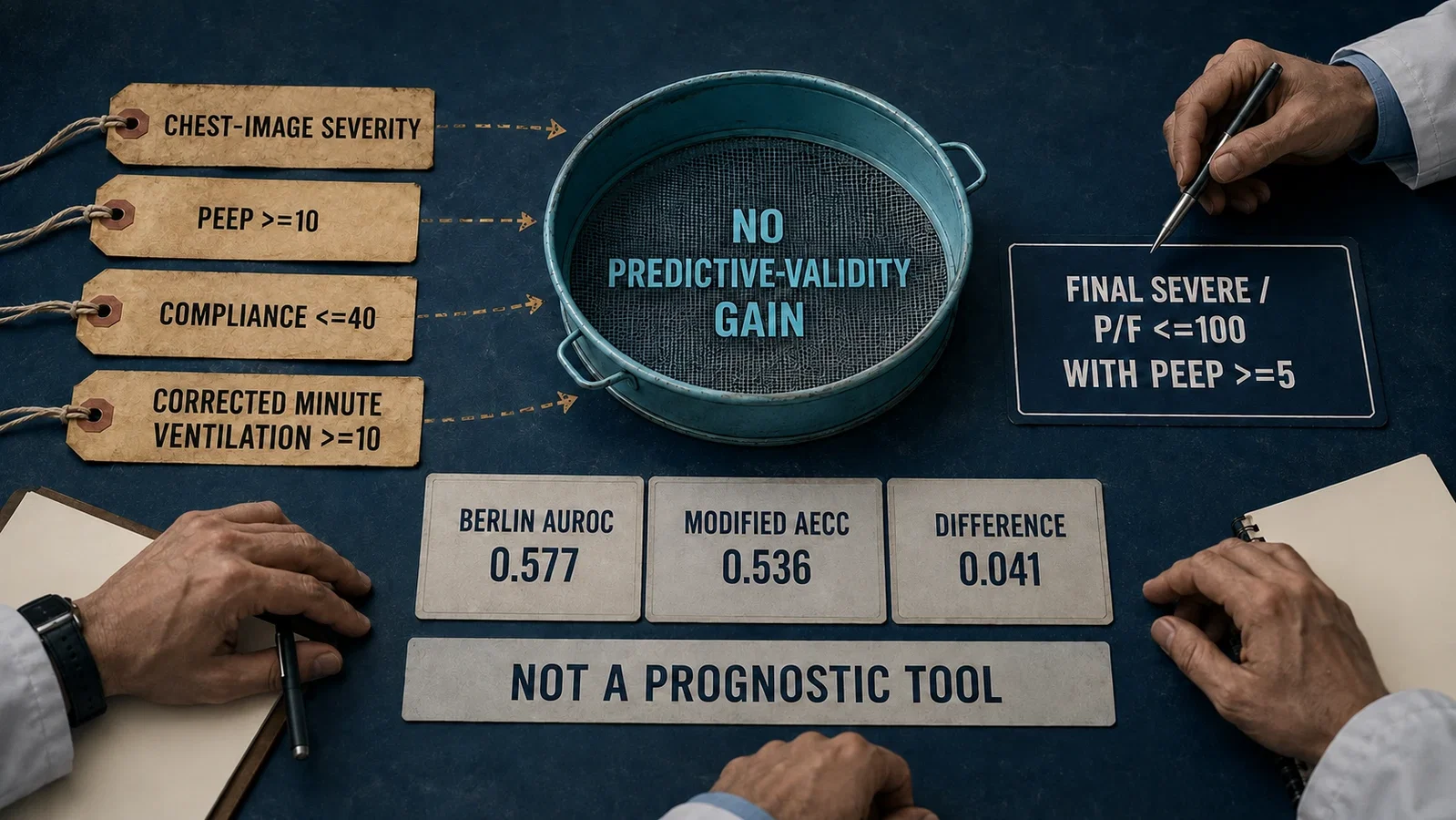
In 2011, an international task force drafted a new definition of acute respiratory distress syndrome, or ARDS. For the most severe category, the panel proposed adding four signs of greater physiological or radiographic derangement: more extensive chest-image opacities, a positive end-expiratory pressure of at least 10 cm H2O, low respiratory-system compliance, and high corrected expired minute volume.
Each addition sounded plausible. The task force then tested the draft in existing patient-level data. The four proposed additions did not improve the mortality predictive validity of the severe category. After further consensus discussion, the panel removed them.
That act of subtraction captures the real historical achievement of Berlin. The task force did not treat expert agreement as the final form of evidence. It put a consensus definition in contact with data and allowed the data to make the definition simpler.
The resulting paper appeared in the 20 June 2012 issue of JAMA. It introduced the familiar mild, moderate, and severe oxygenation categories, but it also documented a much more modest result: mortality discrimination improved by an AUROC difference of only 0.041. The authors explicitly warned that the definition was not a prognostic tool.
A shared language had become difficult to repeat
The Berlin group was revising a framework that had already changed critical-care research.
In 1994, the American-European Consensus Conference, or AECC, described ARDS through acute onset, hypoxemia, bilateral chest-image infiltrates, and the absence of evidence that left atrial hypertension explained the pulmonary edema. A PaO2/FiO2 ratio at or below 200 mm Hg defined ARDS. A broader category with a ratio at or below 300 was called acute lung injury, or ALI.
The framework gave investigators a common starting point, but repeated use exposed its weak joints. Acute had no specified time frame. The P/F ratio could change with ventilator settings, yet the definition did not require a minimum PEEP. Agreement on bilateral infiltrates was poor. Pulmonary artery wedge pressure and clinical assessment did not cleanly separate hydrostatic edema from ARDS, and the two could coexist.
The name ALI created another problem. Clinicians often used it to mean a separate, milder condition rather than the intended inclusive syndrome. Berlin removed the term and divided patients who met the complete ARDS definition into three mutually exclusive oxygenation categories. It did not declare that milder lung injury had ceased to exist.
The meeting was only the middle of the process
The European Society of Intensive Care Medicine convened the revision, with endorsement from the American Thoracic Society and the Society of Critical Care Medicine. Three co-chairs selected a geographically distributed panel, and the paper records a larger network of writing-committee members, task-force participants, and data contributors.
Preparations ran from May through September 2011. Panelists met in Berlin from 30 September to 2 October and produced a draft after two days of discussion. From October 2011 through January 2012, clinical and physiological cohorts were assembled and the draft was evaluated. Further teleconferences in February used those results to shape the final definition.
The sequence matters. Berlin was not a lone inventor's announcement and it was not simply a vote. It was an iterative process: preparation, face-to-face consensus, empirical evaluation, and consensus revision.
The clinical database drew on four multicentre sources and contained 4,188 patients. A separate physiological database drew on three single-centre sources and contained 269. These were not two arms of one 4,457-patient trial. They served different analytical purposes and had different available variables.
Even the larger database exposed an operational limit. Of the 4,188 patients who could be described under the AECC framework, 518 could not be classified by the draft Berlin Definition because PEEP was missing or below 5 cm H2O. They were not treatment exclusions and they were not deaths. They showed what happens when a new measurement condition is applied retrospectively to older data.
Three oxygenation tiers sit behind a complete definition
Berlin is often reduced to a P/F ratio ladder. The final table does not permit that shortcut.
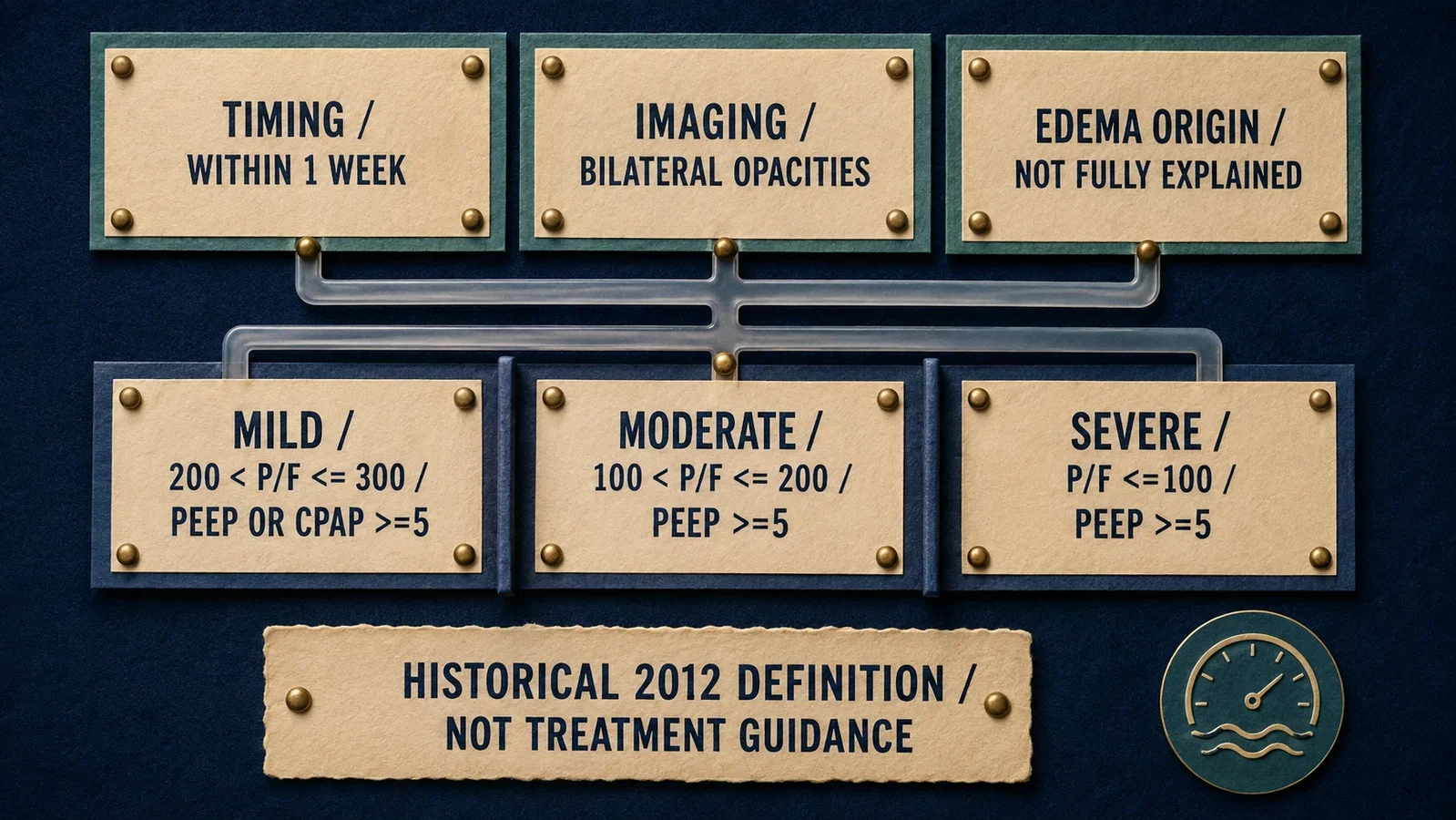
First comes timing. Respiratory symptoms must be new or worsening within one week, or ARDS must begin within one week of a known clinical insult.
Second comes imaging. A chest radiograph or CT must show bilateral opacities that are not fully explained by effusions, lobar or lung collapse, or nodules. The final definition does not require opacities in three or four quadrants. That more extensive pattern belonged to the draft severe category and did not survive as an entry condition.
Third comes the origin of edema. Respiratory failure must not be fully explained by cardiac failure or fluid overload. If no ARDS risk factor is apparent, an objective assessment such as echocardiography is needed to help exclude hydrostatic edema. Such as does not turn one test into the only acceptable method, and not fully explained allows for the clinical reality that hydrostatic edema and ARDS can coexist.
Only after those conditions are met does oxygenation establish severity:
- Mild ARDS requires 200 < PaO2/FiO2 <=300 mm Hg with PEEP or CPAP of at least 5 cm H2O. The pressure may be delivered noninvasively in this category.
- Moderate ARDS requires 100 < PaO2/FiO2 <=200 mm Hg with PEEP of at least 5 cm H2O.
- Severe ARDS requires PaO2/FiO2 <=100 mm Hg with PEEP of at least 5 cm H2O.
At altitudes above 1,000 metres, the ratio is corrected for barometric pressure. Oxygenation therefore is not an isolated laboratory number. Timing, imaging, an explanation for edema, oxygen delivery, airway pressure, and measurement conditions determine whether the number belongs inside the 2012 definition at all.
These are historical classification criteria. They are not treatment instructions for a current patient.
What the empirical evaluation showed
Among patients classifiable in the clinical database, 22% met the mild criteria, 50% the moderate criteria, and 28% the severe criteria. Mortality rose across the categories: 27%, 32%, and 45%.
Other outcomes moved in the same direction. Among survivors, median duration of mechanical ventilation increased from 5 days in mild ARDS to 7 in moderate and 9 in severe. Median ventilator-free days fell from 20 to 16 to 1. Within seven days, 29% of patients initially classified as mild progressed to moderate and 4% progressed to severe; 13% of those initially classified as moderate progressed to severe.
These gradients show that the categories separated groups with different observed outcomes. They do not assign an individual's destiny. A category did not cause a death, and the mortality percentage of a historical data set is not a bedside probability for the next patient.
The direct comparison was less dramatic than the gradients. For mortality, the final Berlin Definition produced an AUROC of 0.577. The modified AECC comparison produced 0.536. The difference was 0.041, with P<.001.
Statistical significance did not make 0.577 strong discrimination. The authors said that the absolute AUROC values and the magnitude of improvement would be clinically unimportant if the definition were intended as a clinical prediction tool. It was not. Predictive validity was one criterion for assessing a syndrome definition, not the definition's sole purpose.
The pruning of the severe category makes the same point from another direction. The proposed radiographic, PEEP, compliance, and minute-ventilation additions did not create a group with higher mortality than the simpler severe category. The panel removed them rather than preserving complexity for its own sake.
Removal did not mean that PEEP, compliance, or minute ventilation had no value in caring for a patient. It meant that these measurements had not earned a place as mandatory additions to the severe definition in this evaluation.
What Berlin did not validate
The empirical component was a patient-level analysis of existing data, not a new worldwide prospective validation study. The authors identified several consequences.
Some variables were missing because of ventilation mode or the practical limits of population research. Cohorts differed in case mix and clinical practice. The panel evaluated only the candidate variables and cutoffs it had chosen. It also could not compare the new mutually exclusive categories directly with the original overlapping AECC categories in every analysis.
The study did not empirically evaluate face validity, content validity, reliability, feasibility, or success in identifying patients for clinical-trial enrollment. Nor did it resolve the biological heterogeneity of ARDS. Similar hypoxemia and bilateral opacities can arise through different mechanisms, and a clinical syndrome definition does not convert those mechanisms into one disease.
Nothing in the study tested treatment. No intervention was assigned by severity category, and no comparison showed that relabeling patients improved survival. A definition can make trial enrollment, communication, epidemiology, and health-services planning more consistent. It cannot itself act on a patient.
The images were deliberately allowed to be uncertain
The official supplementary material by Ferguson and colleagues shows how much judgment remained inside the imaging and edema criteria.
It presented four clinical vignettes in which cardiac dysfunction, fluid loading, shock, infection, and ARDS risk factors overlapped. The central shift was from excluding any patient with evidence of left atrial hypertension to excluding cases in which left atrial hypertension alone explained the syndrome. Chest radiography, BNP, troponin T, or a single hemodynamic measurement could not reliably divide every critically ill patient into cardiogenic and noncardiogenic boxes.
The supplement also presented twelve chest radiographs: four classified as consistent with ARDS, four inconsistent, and four equivocal. Poor inspiration, obesity, chronic opacities, external equipment, backboards, and vascular markings could all mislead interpretation. No chest-image pattern was diagnostic by itself.
For an equivocal film, history, risk factors, and evolution over the next 8 to 12 hours could change the judgment. The definition supplied boundaries, but it did not eliminate the need to explain how a case fit them.
Revision was built into the definition
The Berlin authors anticipated that clinical research would revise their framework. A later Global Definition did exactly that.
The newer consensus retained the one-week timing rule but added routes for patients receiving high-flow nasal oxygen, permitted SpO2/FiO2 within an appropriate saturation range, added lung ultrasound as an imaging option, and created a resource-limited category that did not require the same respiratory-support equipment or minimum PEEP.
Those are later changes. They are not hidden components of the 2012 definition.
The Global Definition also preserved the culture of limitation. Its authors said they had not completed a formal comprehensive literature review and had not prospectively tested all new thresholds or nonintubated subsets. They identified pulse-oximetry error in people with darker skin, operator dependence in ultrasound, and possible misclassification in resource-limited settings as unresolved concerns. The document was a syndrome-definition update, not a clinical practice guideline.
This later revision does not diminish Berlin. It fulfills one of Berlin's most important premises: a useful definition must remain revisable.
A disciplined common language, not a final truth
The three P/F thresholds made Berlin memorable. The stronger lesson lies in everything that has to surround them.
A case first passes through time, imaging, edema-origin, pressure, and measurement conditions. A panel's plausible additions can be removed when data do not support them. An outcome gradient can be informative without becoming accurate individual prediction. A statistically significant difference can still be small. A definition can organize a syndrome without curing it, explaining all its biology, or becoming permanent.
Berlin gave critical care a more explicit language for ARDS. It also demonstrated a way to build that language: let consensus make a draft, let empirical evidence challenge the draft, and leave the finished definition open to the next challenge.
Sources and reading limits
Sources: ARDS Definition Task Force. JAMA. 2012;307(23):2526-2533. PMID 22797452. DOI 10.1001/jama.2012.5669; Ferguson ND et al. Intensive Care Med. 2012;38:1573-1582. PMID 22926653. DOI 10.1007/s00134-012-2682-1, official public supplementary material; Bernard GR et al. Intensive Care Med. 1994;20:225-232. PMID 8014293. DOI 10.1007/BF01704707, with parallel AJRCCM record PMID 7509706; Matthay MA et al. Am J Respir Crit Care Med. published online 2023, issue 2024;209(1):37-47. PMID 37487152. PMCID PMC10870872. DOI 10.1164/rccm.202303-0558WS. All cited sources were read for this article; inaccessible body text carries no unique claim.
Visual interpretations
These illustrations explore the setting and ideas. Depicted people, actions, instruments and documents are reconstructions, not evidence of their exact historical appearance.

Continue exploring
Historical connections
These links follow specific development, adoption or citation connections recorded in the underlying research. They do not imply that history had one inevitable path.
- Later connection: 2018: EOLIA's Rescue Door Changes the ECMO Trial
Related reading connects shared questions and contexts; it does not by itself establish historical influence.
- 1967: Ashbaugh and Colleagues Find One Respiratory Pattern in Twelve Cases
- 1970: Swan and Ganz Bring Pulmonary Artery Pressure to the Bedside
- 2000: ARDSnet Tests Lung Protection Against Clinical Outcomes
- 2018: EOLIA's Rescue Door Changes the ECMO Trial
- 2020: COVIDSurg Turns 1,128 Patients into an International Surgical Warning
- 2020: Intubation Becomes a Team Protocol, Not Just a Technique
The Source Room · About & Editorial Method
Sources and reading limits are stated above. Illustrations are labelled as original source images or AI-made. Historical accounts are educational; they are not current treatment instructions.