The case tables, PEEP observations and limits of an influential report.
Reading Library · Anesthesia Epochs · 中文版
Watch the companion film
1967: Ashbaugh and Colleagues — Twelve Cases of ARDS · Watch on YouTube
Historical anchor: 1967. Date details and source qualifications are explained below.
Better oxygenation was an observation; improved survival was a harder claim. In their 1967 report, Ashbaugh, Bigelow, Petty and Levine described five patients who received continuous positive-pressure support with positive end-expiratory pressure, or PEEP. Oxygenation improved. Three survived, compared with two of the seven patients who did not receive that treatment. The authors themselves cautioned that the small numbers left the apparent survival difference uncertain.[1]

That distinction matters when returning to a paper now familiar from histories of acute respiratory distress syndrome. Published in the Lancet on August 12, 1967, the report came from the University of Colorado Medical Center in Denver. Its twelve cases shared severe respiratory distress, cyanosis poorly responsive to oxygen, reduced pulmonary compliance and diffuse alveolar infiltrates.[1] A much later definition paper explicitly traced the syndrome’s initial description to this report.[2]
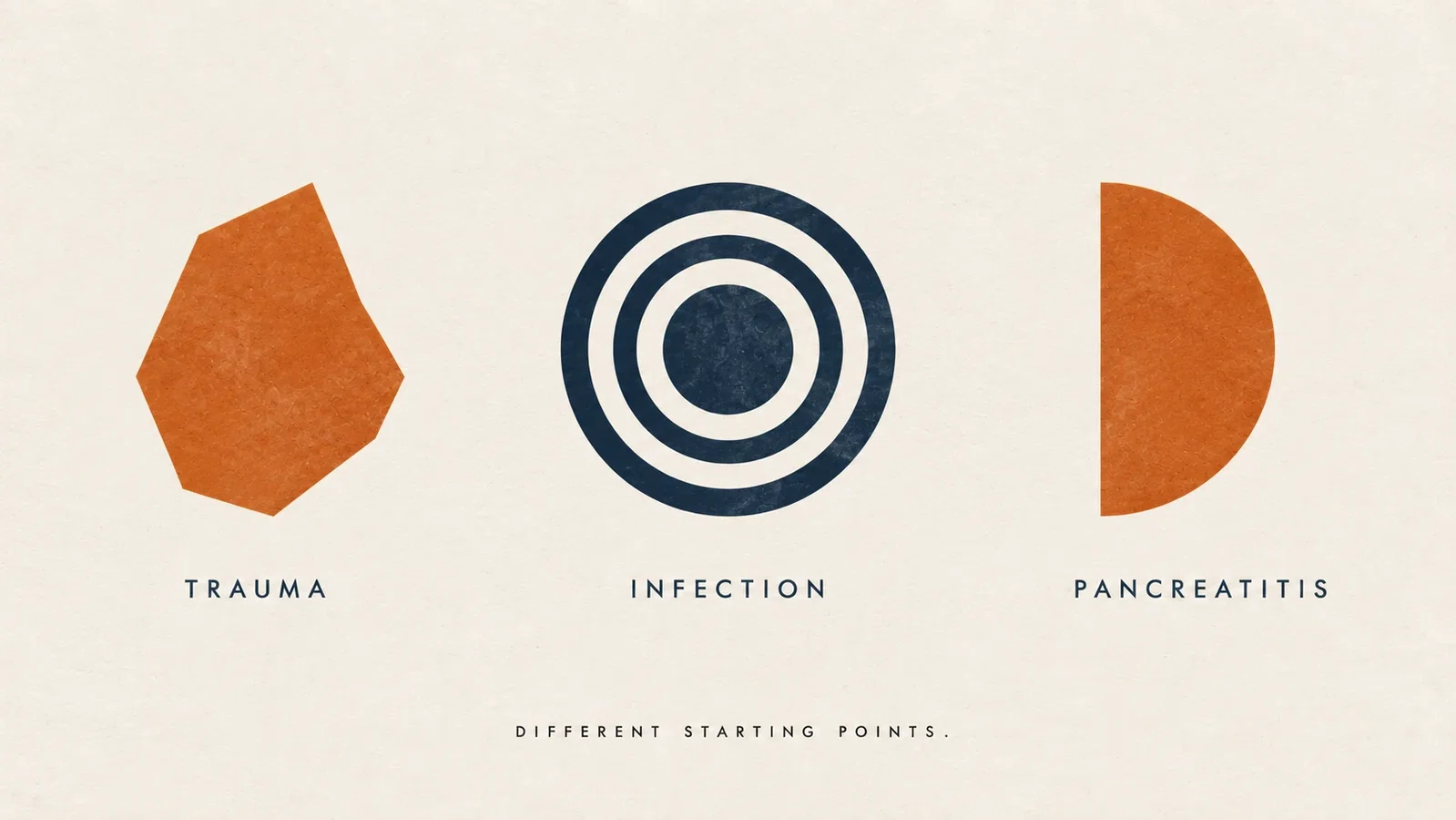
The patients did not share a single starting illness. Seven had severe trauma, four were clinically classified as having viral infection, and one had acute pancreatitis. Some of the etiologic descriptions remained tentative. Nor were all twelve adults: despite the original title, Table I includes an eleven-year-old boy. The reported ages range from eleven to forty-eight.[1]
The authors identified the pattern against a background of 272 patients receiving respiratory support. That context is not a population incidence study. Even the blood-gas observations in Table II were obtained under differing forms of support, including room air, nasal oxygen, a mask and ventilators. Reading the table preserves distinctions that a compressed account can easily erase.[1]
Radiographs and pathology helped the authors characterize what the cases had in common. Serial images illustrated the development of alveolar infiltrates in particular patients. Seven patients died and underwent necropsy; hyaline membranes were found in six.[1] These findings describe the series, not a mandatory pathological feature of every later case called ARDS. The proposed role of surfactant also remained an explanation under investigation. Direct surface-tension measurements came from only two necropsy lung specimens.[1]
The treatment section should be read with the same attention to scope. Its heading, “Therapeutic Trials,” introduced clinical attempts with several treatments, not a randomized comparison. The five PEEP observations documented physiological improvement without establishing a mortality benefit. Underlying illness could continue despite better blood gases, and some patients died after oxygenation had improved.[1] The report neither proves a general survival effect from those small groups nor establishes that PEEP was invented in 1967.
The 2012 Berlin Definition makes a useful, dated comparison. Its introduction cites the 1967 paper, describes subsequent definitions and identifies the 1994 consensus as an intervening step. The final Berlin table organizes criteria around timing, bilateral imaging abnormalities, the origin of edema and the degree of hypoxemia.[2] Those criteria belong to a later effort to make patient selection and comparison more consistent. They were not the rules applied to the original twelve patients.

The historical connection is therefore specific: a description of a recurring clinical pattern became a reference point for later work on defining a syndrome. It is not a claim that one paper, by itself, produced every subsequent definition or treatment advance. The uncertainties in the original report remain part of its contribution: disparate starting illnesses, incomplete mechanistic evidence, and a physiological response whose relationship to survival was unresolved.[1,2]
Source and image note: All five original 1967 page scans were read, including the tables and figures. Selected original pages of the 2012 paper support the explicitly dated comparison. This is a historical account, not a current treatment protocol. The four images are modern editorial interpretations, not archival patient material or clinical instructions.
Sources and reading limits
- Ashbaugh DG, Bigelow DB, Petty TL, Levine BE. Acute respiratory distress in adults. Lancet. 1967;2(7511):319–323. Published August 12, 1967. DOI; publicly displayed original page scans. All five original scanned pages were archived and read, including tables and figures. The scans are hosted by a third party; a publisher PDF is not covered.
- ARDS Definition Task Force. Acute respiratory distress syndrome: the Berlin Definition. JAMA. 2012;307(23):2526–2533. DOI; public university-library copy. For this comparison, the introduction on p. 2526, final definition in Table 3 on p. 2530, and reference 2 on p. 2533 were read in the original pages.
Continue exploring
Related reading connects shared questions and contexts; it does not by itself establish historical influence.
The Source Room · About & Editorial Method
Sources and reading limits are stated above. Illustrations are labelled as original source images or AI-made. Historical accounts are educational; they are not current treatment instructions.