EOLIA made timing, crossover, early stopping, effect size, and statistical uncertainty part of the ECMO question.
Reading Library · Anesthesia Epochs · 中文版
Watch the companion film
2018: EOLIA — Early ECMO for Severe ARDS · Watch on YouTube
Historical anchor: 2018. Date details and source qualifications are explained below.
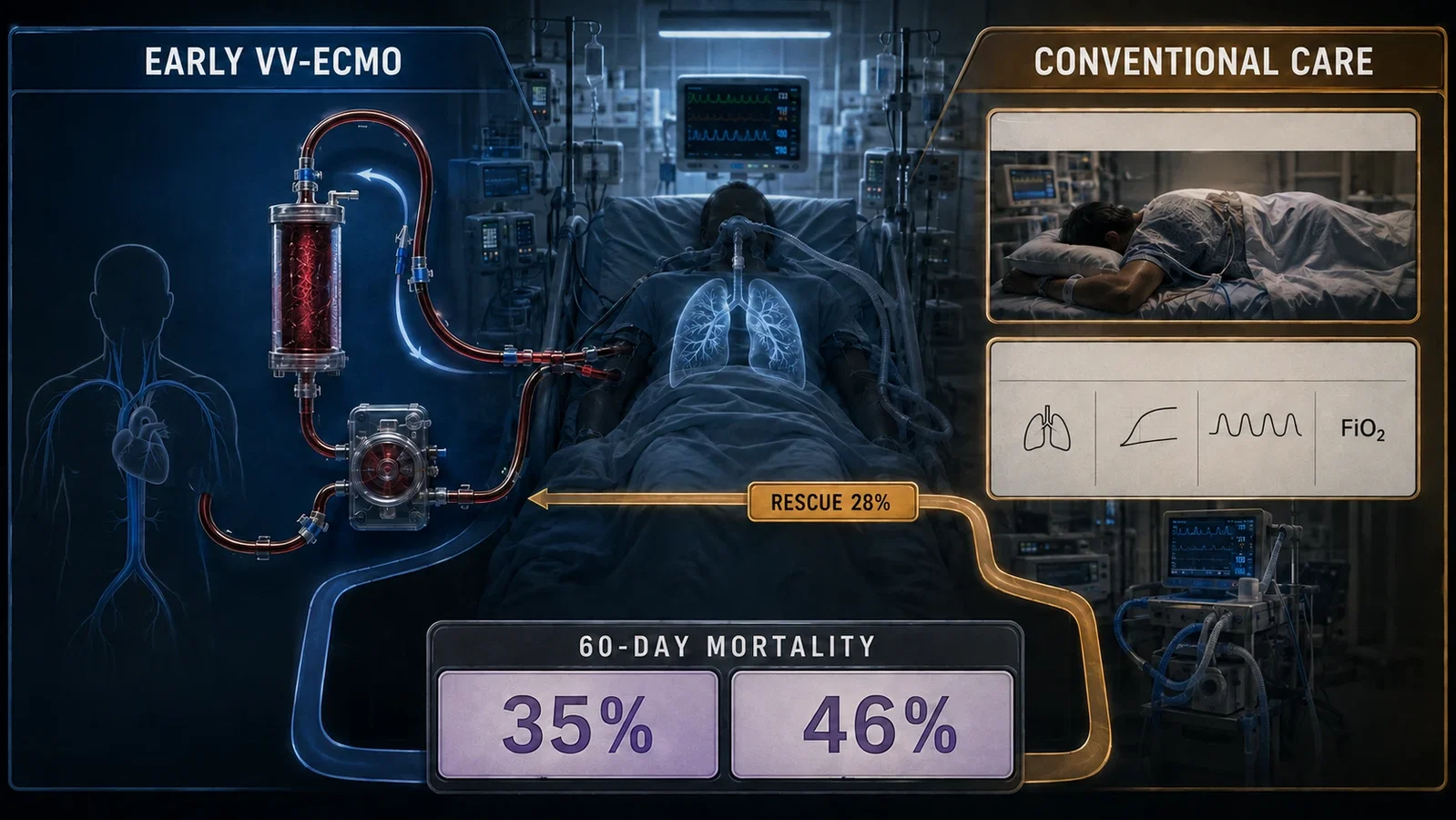
Suppose a patient randomized to conventional care remains profoundly hypoxemic for six hours. The ventilator has been optimized. Proning, paralysis, and inhaled pulmonary vasodilators have failed. Oxygen saturation is still below 80 percent. Should a trial require clinicians to keep extracorporeal support unavailable simply to preserve a cleaner comparison?
EOLIA did not require that.
Its control patients could cross to rescue extracorporeal membrane oxygenation when a strict deterioration rule was met, irreversible multiorgan failure was absent, and the treating clinician believed ECMO might change the outcome. That escape route made clinical sense. It also changed the question the randomization could answer.
The comparator was an active rescue strategy
Published in the New England Journal of Medicine on May 24, 2018, EOLIA was an international, multicenter, open-label randomized trial. It compared early venovenous ECMO with continued conventional management that retained ECMO as rescue therapy.
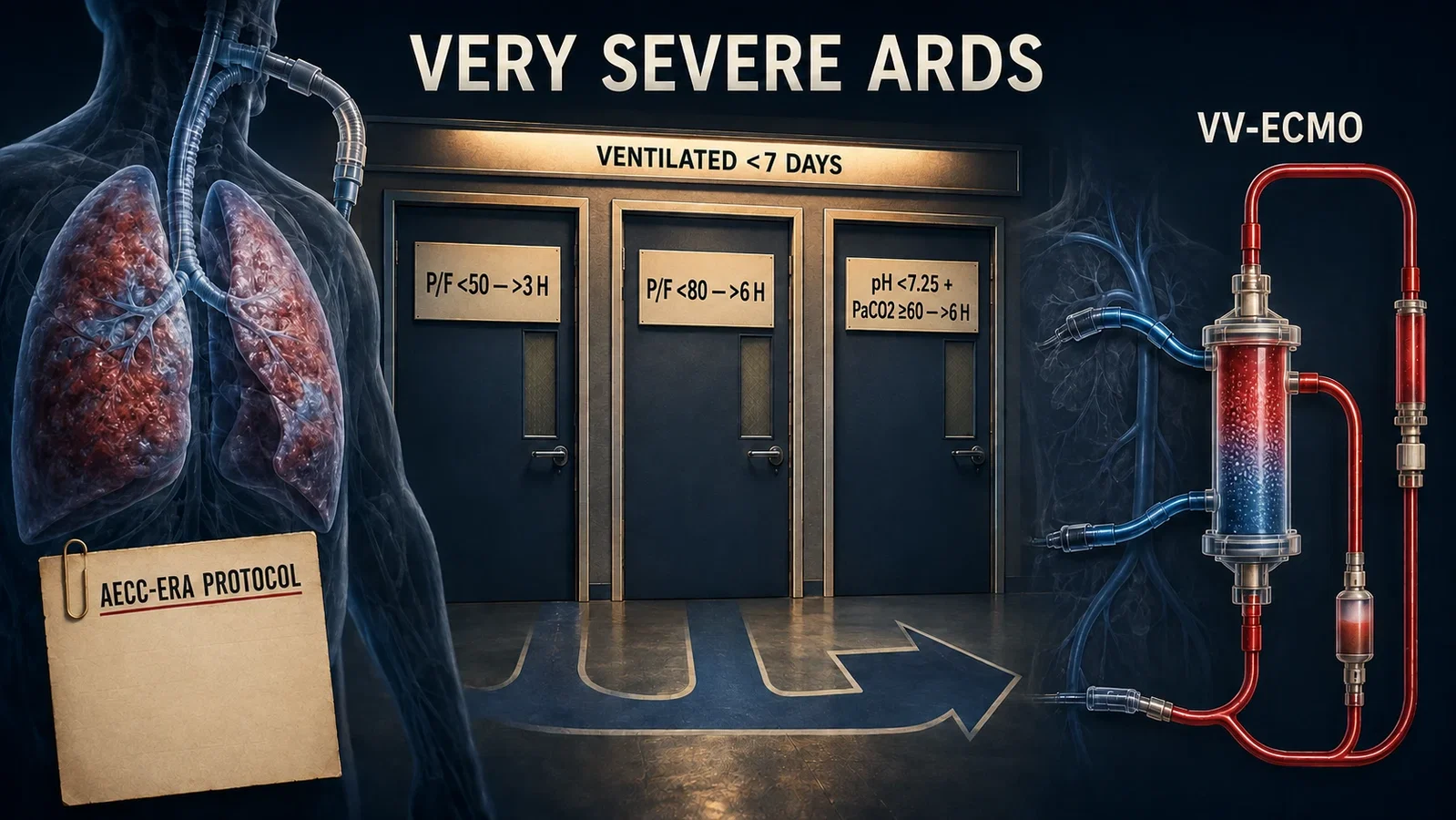
The population was deliberately narrow. Participants had received invasive ventilation for fewer than seven days and had to meet one of three physiologic thresholds despite optimized care: a PaO2/FiO2 ratio below 50 mm Hg for more than three hours; a ratio below 80 for more than six hours; or arterial pH below 7.25 with PaCO2 at least 60 mm Hg for more than six hours while respiratory rate was 35 per minute and plateau pressure no higher than 32 cm H2O.
Because the protocol was developed before the Berlin Definition, it used the earlier American-European Consensus Conference framework. Describing these patients retrospectively as though Berlin criteria had governed enrollment would quietly replace the trial that was run with a later one.
Randomization was stratified by center and by less than versus at least 72 hours of ventilation before enrollment. Of 124 patients assigned to early ECMO, 121 received it, a mean 3.3±2.8 hours after randomization.
Conventional care was not a neglected-control condition. After randomization, 90 percent of control patients were proned, 83 percent received inhaled nitric oxide or prostacyclin, and every control patient received neuromuscular blockade. EOLIA therefore contrasted an early VV-ECMO strategy with intensive lung-protective management plus a rescue outlet, not ECMO with inaction.
The design was looking for a large mortality effect
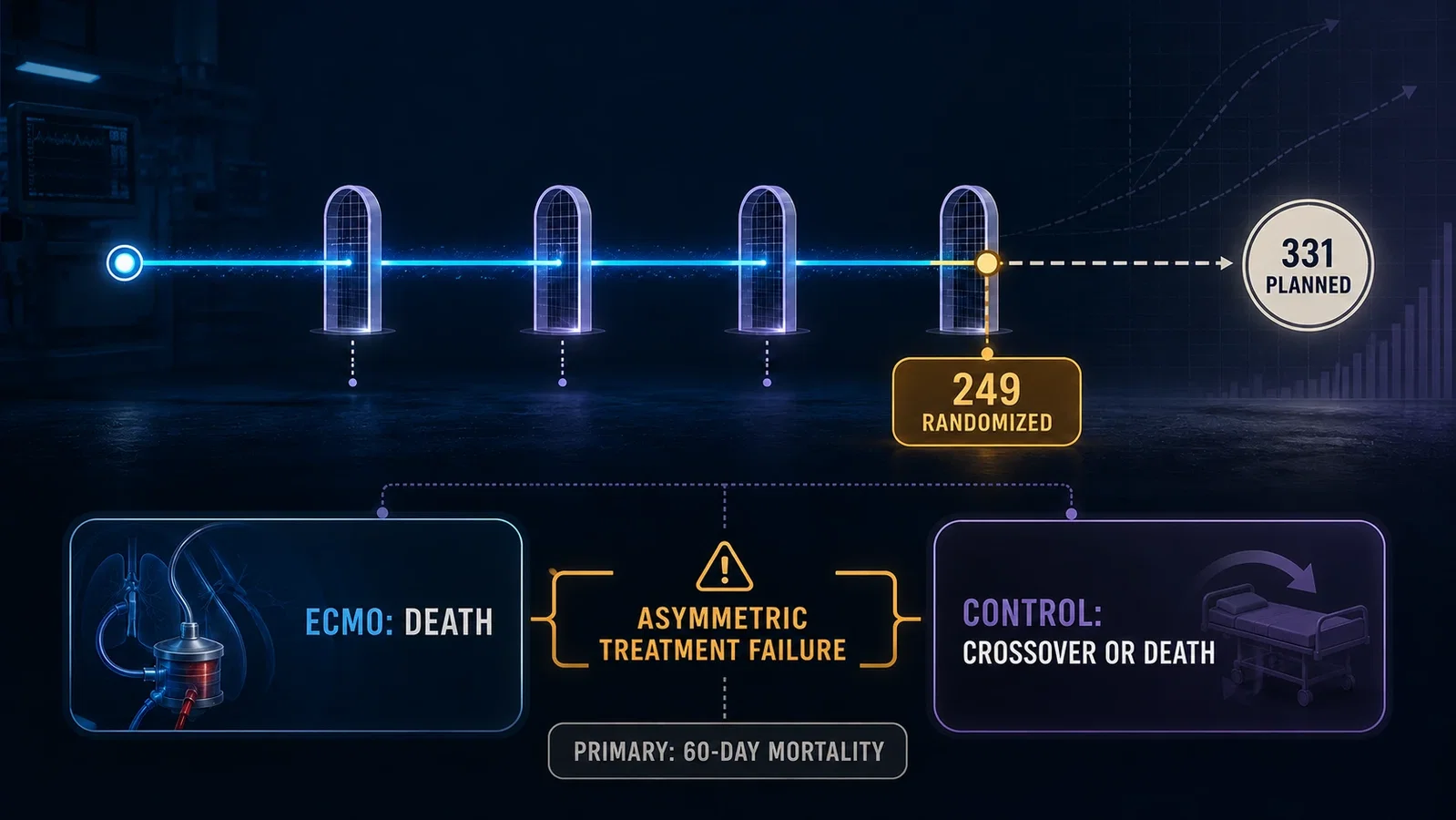
The trial planned to enroll as many as 331 patients. Its sample-size calculation assumed 60-day mortality would fall from 60 percent under control to 40 percent with early ECMO: a 20-percentage-point absolute reduction, corresponding to a relative risk of 0.67.
That target matters. EOLIA was not powered around detecting every potentially worthwhile benefit. It was designed around a very large one.
The protocol scheduled sequential reviews after each 60 patients. In April 2017, at the fourth planned interim analysis, enrollment stopped because the boundary for a low predicted probability of ultimately obtaining a statistically significant difference had been crossed. Two hundred forty patients had then been enrolled; the final intention-to-treat population reached 249, with 124 assigned early ECMO and 125 assigned control.
This was not a stop for demonstrated harm. Nor was it proof of equivalence. It was a design-based judgment that continuing toward 331 was unlikely to deliver the significant result for which the study had been planned. Any later interpretation has to remember that the original information target was never reached.
A numerical difference without a conventional primary-endpoint win
By 60 days, 44 of 124 patients assigned early ECMO had died, compared with 57 of 125 controls: 35 percent versus 46 percent. The relative risk was 0.76, with a 95 percent confidence interval from 0.55 to 1.04 and P=0.09. The hazard ratio was 0.70, 95 percent CI 0.47 to 1.04, with P=0.07.
The direction favored early ECMO, but the prespecified primary endpoint did not cross the trial's conventional significance threshold. Calling the result proof of benefit would overstate the evidence. Calling it proof of no benefit would make the opposite mistake: the point estimate represented an 11-point difference, and the uncertainty interval included clinically substantial benefit.
At 90 days, mortality was 37 percent versus 47 percent, an absolute difference of -10 points with a 95 percent CI from -22 to 2. This secondary endpoint pointed in the same direction without resolving the uncertainty.
EOLIA also reported “treatment failure” in 35 percent of the early-ECMO group and 58 percent of the control group, relative risk 0.62, P<0.001. The smaller P value is tempting, but the endpoint was structurally asymmetric. Failure meant death for an early-ECMO patient; it meant crossover to ECMO or death for a control patient. The composite describes how the two strategies encountered death or rescue, but it cannot serve as a symmetric replacement for mortality.
Crossover was rescue, not a second randomization
Thirty-five of 125 control patients ultimately received ECMO: 28 percent. The denominator is the 125 control patients, not all 249 randomized participants. Crossover occurred a mean 6.5±9.7 days after randomization, with a median of four days, an interquartile range of one to seven, and a range from zero to 50 days.
Twenty of those 35 patients died, 57 percent, compared with 37 of the 90 controls who did not cross, 41 percent. The difference does not show that delayed ECMO caused harm. Crossover patients entered the rescue pathway because they were deteriorating. At rescue, their median PaO2/FiO2 was about 51 and oxygen saturation about 77 percent; some had experienced cardiac arrest, right-heart failure, or dialysis. Clinical severity selected them into crossover.
This is the trial's central interpretive tension. Prohibiting crossover might have preserved a simpler early-ECMO-versus-never-ECMO contrast, but at the cost of a clinically implausible response to refractory collapse. Allowing rescue preserved an option for patients while leaving the randomized comparison as early ECMO versus a strategy that could include later ECMO.
The circuit carried costs as well as possible benefit
Severe thrombocytopenia occurred in 27 percent of early-ECMO patients and 16 percent of controls. Bleeding requiring transfusion occurred in 46 percent versus 28 percent. Ischemic stroke occurred in no early-ECMO patients and 5 percent of controls. Confidence intervals for secondary outcomes were not adjusted for multiple comparisons, so no single safety difference should be promoted into a definitive net-benefit verdict.
There was one ECMO-related cannulation death in each randomized strategy; the control-arm event followed rescue ECMO.
The trial was funded through Assistance Publique-Hôpitaux de Paris research structures and the French Ministry of Health. Maquet/Getinge supplied equipment, cannulas, and circuits. The report states that the company had no role in design, data collection, analysis, interpretation, manuscript preparation, or submission. Equipment support belongs in the record even when the declared analytical and publication boundary is clear.
Bayesian reanalysis widened the lens, not the sample
Later in 2018, Ewan Goligher and colleagues published a post-hoc Bayesian reanalysis in JAMA. Instead of reducing interpretation to whether P fell below 0.05, they asked how probable different sizes of mortality benefit were under several stated priors.
With a noninformative prior, the mortality relative risk was 0.78, with a 95 percent credible interval from 0.56 to 1.04. The posterior probability that relative risk was below 1 was 96 percent. The probability of at least a two-point absolute mortality reduction was 92 percent. But the probability of the 20-point absolute reduction assumed in EOLIA's original design was only 2 percent.
Under a moderately enthusiastic prior, the corresponding probabilities were 99 percent for any benefit, 97 percent for at least two points, and 0 percent for 20 points. Under a strongly skeptical prior, they were 88, 78, and 0 percent. With a prior informed by previous studies, they were 99, 98, and 4 percent.
The effect-size distinction is the heart of the exercise. “An 88-to-99-percent probability of benefit” referred to any relative risk below 1. It did not mean an 88-to-99-percent probability of the large absolute effect for which the trial had been designed. Across the four priors, the latter probability was only 0 to 4 percent.
The analysis was post hoc, unregistered, and dependent on assumptions encoded in the priors. It unfolded the same trial data into a probability landscape; it did not randomize another patient, restore the missing sample size, or remove crossover.
The protocol package also contained a post-hoc rank-preserving structural failure time analysis intended to adjust for crossover. Its hazard ratio was 0.51, 95 percent CI 0.24 to 1.02, P=0.055. Such models depend on assumptions that the observed data cannot fully verify. This estimate is an informative sensitivity analysis, not a substitute primary result.
EOLIA changed what a careful reader had to ask
The 2009 CESAR and H1N1 evidence had returned adult ECMO to critical-care attention. The 2012 Berlin Definition had made ARDS severity itself an empirically tested classification. EOLIA inherited both trajectories and produced no tidy final slogan.
It defined a very severe physiologic population, made early ECMO a treatment delivered within hours, and preserved a rescue exit for controls. The mortality estimate pointed toward benefit without crossing the conventional primary threshold. Bayesian reanalysis found that some benefit was highly probable under a range of assumptions while showing that the originally imagined 20-point benefit was highly improbable.
The historical value of EOLIA is therefore not a stamp marked positive or negative. It is a lesson in trial architecture. What exactly was compared: early versus later, or ECMO versus none? Is crossover an endpoint, a rescue, or both? How much information was lost when enrollment stopped? Are we discussing any benefit, or a benefit large enough to justify bleeding, thrombocytopenia, and the demands of extracorporeal care?
Rescue medicine needs doors. EOLIA made visible the price of opening one: the humane clinical option changes the scientific question left behind.
Sources and reading limits
Sources: Combes A, Hajage D, Capellier G, et al. N Engl J Med. 2018;378(21):1965-1975. PMID 29791822. DOI 10.1056/NEJMoa1800385, complete article, appendix, and protocol/SAP bundle; Goligher EC, Tomlinson G, Hajage D, et al. JAMA. 2018;320(21):2251-2259. PMID 30347031. DOI 10.1001/jama.2018.14276, complete author manuscript; ClinicalTrials.gov NCT01470703; PubMed, Crossref, OpenAlex, and HAL provenance records. All cited sources were read for this article.
Visual interpretations
These illustrations explore the setting and ideas. Depicted people, actions, instruments and documents are reconstructions, not evidence of their exact historical appearance.

Continue exploring
Related reading connects shared questions and contexts; it does not by itself establish historical influence.
Historical connections
These links follow specific development, adoption or citation connections recorded in the underlying research. They do not imply that history had one inevitable path.
- Earlier connection: 2009: CESAR and H1N1 Bring Adult ECMO Back into Critical Care
- Earlier connection: 2012: The Berlin Definition Redraws ARDS
Related reading
- 2009: CESAR and H1N1 Bring Adult ECMO Back into Critical Care
- 2012: The Berlin Definition Redraws ARDS
- 2020: COVIDSurg Turns 1,128 Patients into an International Surgical Warning
The Source Room · About & Editorial Method
Sources and reading limits are stated above. Illustrations are labelled as original source images or AI-made. Historical accounts are educational; they are not current treatment instructions.