In 2009, a randomized referral strategy and an Australasian pandemic cohort changed what clinicians could see without isolating a pure circuit effect.
Reading Library · Anesthesia Epochs · 中文版
Watch the companion film
2009: CESAR and H1N1 — ECMO for Severe Respiratory Failure · Watch on YouTube
Historical anchor: 2009. Date details and source qualifications are explained below.
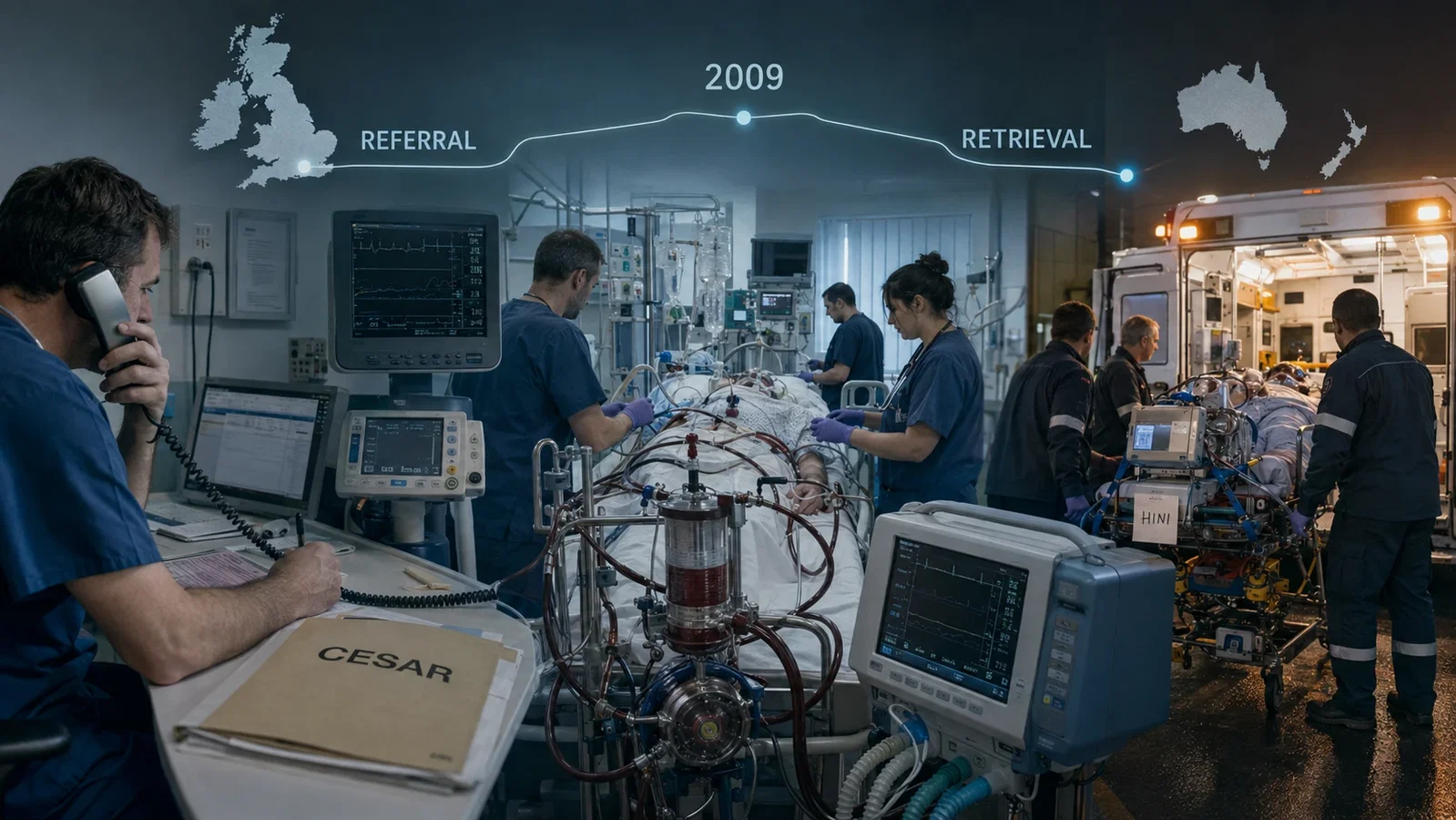
The intervention began before the circuit.
It began when an intensive-care clinician recognised refractory respiratory failure, found a specialist bed, made a telephone call, and prepared a patient for transfer. The pump and oxygenator arrived inside a longer chain of referral, transport, ventilation, staffing, and round-the-clock care.
Two publications made that chain unusually visible in 2009. In Britain, the CESAR trial compared continued conventional management with referral to a single expert centre for consideration of an ECMO-based strategy. In Australia and New Zealand, an observational study recorded how 15 intensive care units used ECMO during the H1N1 winter, often sending a mobile team to establish support before bringing a patient back.
Neither study isolated a machine from the service around it. Together, they changed the question surrounding adult extracorporeal membrane oxygenation: who should be referred, where treatment could be delivered, and how a critically ill patient could reach that place.
1. CESAR randomised a route through care
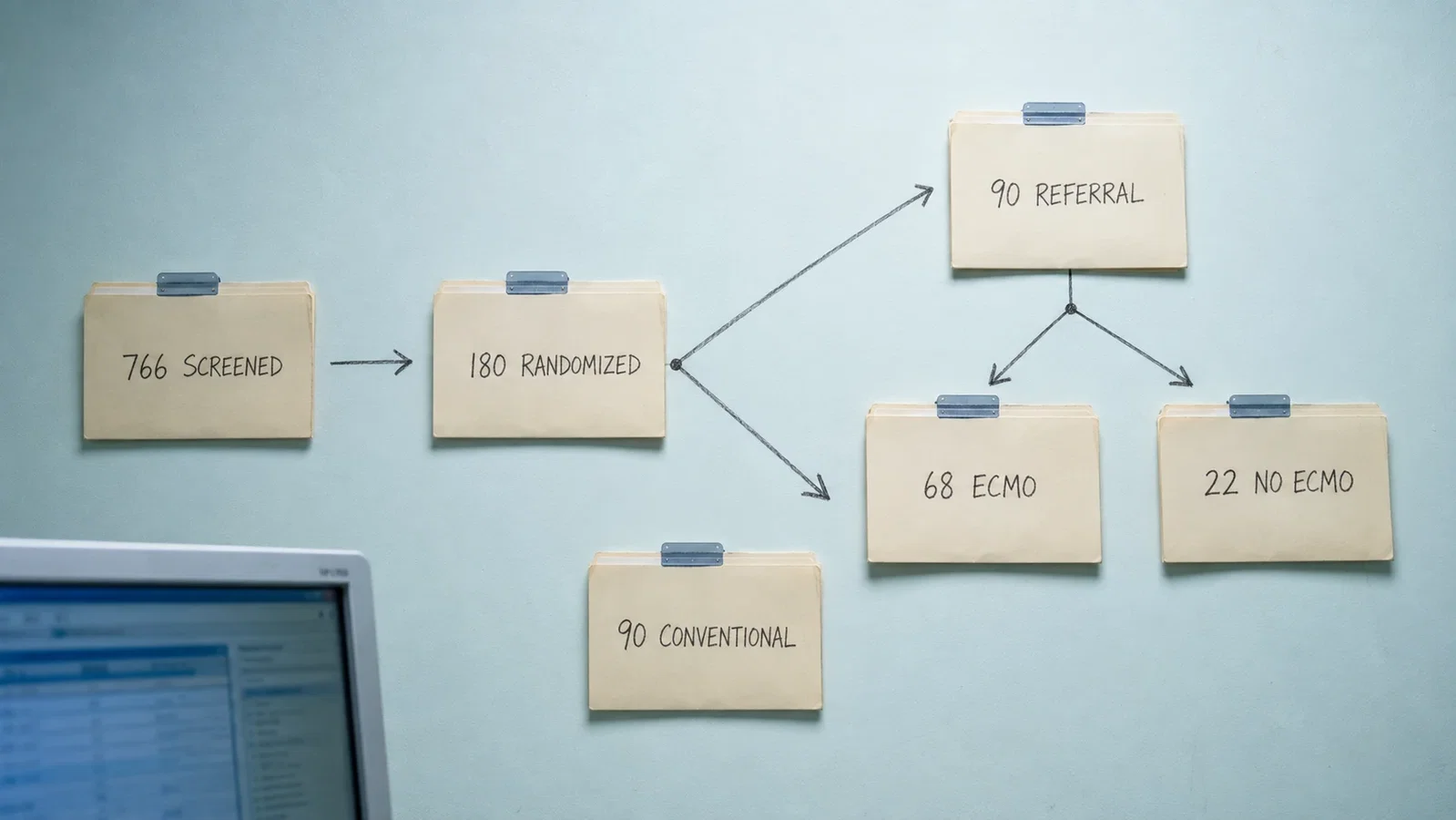
Between July 2001 and August 2006, clinicians made enquiries about 766 potentially eligible patients with severe but potentially reversible adult respiratory failure. From 68 British centres, 180 adults aged 18 to 65 entered CESAR. An independent central service randomised 90 to continued conventional management and 90 to referral to Glenfield Hospital in Leicester for consideration under an ECMO-based protocol.
That wording defines the trial. The intervention was entry into a different pathway: specialist transport when appropriate, assessment by an experienced ECMO team, lung-rest ventilation and other critical care, with ECMO available when judged necessary.
Only 68 of the 90 patients assigned to referral actually received ECMO. Of the other 22, three died before transfer could occur and two died in transit. Sixteen improved with conventional care delivered by the ECMO team, and one required an amputation and could not be heparinised.
Calling CESAR a comparison of 90 patients who received ECMO with 90 who did not would erase nearly a quarter of the referral arm. It tested a delivery strategy, not a purified contest between two devices.
No conventional-arm patient crossed to ECMO. One received an experimental arteriovenous carbon-dioxide removal device, recorded as a protocol violation. Assignment, transfer, actual treatment, and analysis remained separate layers.
2. The positive result belonged to a composite endpoint
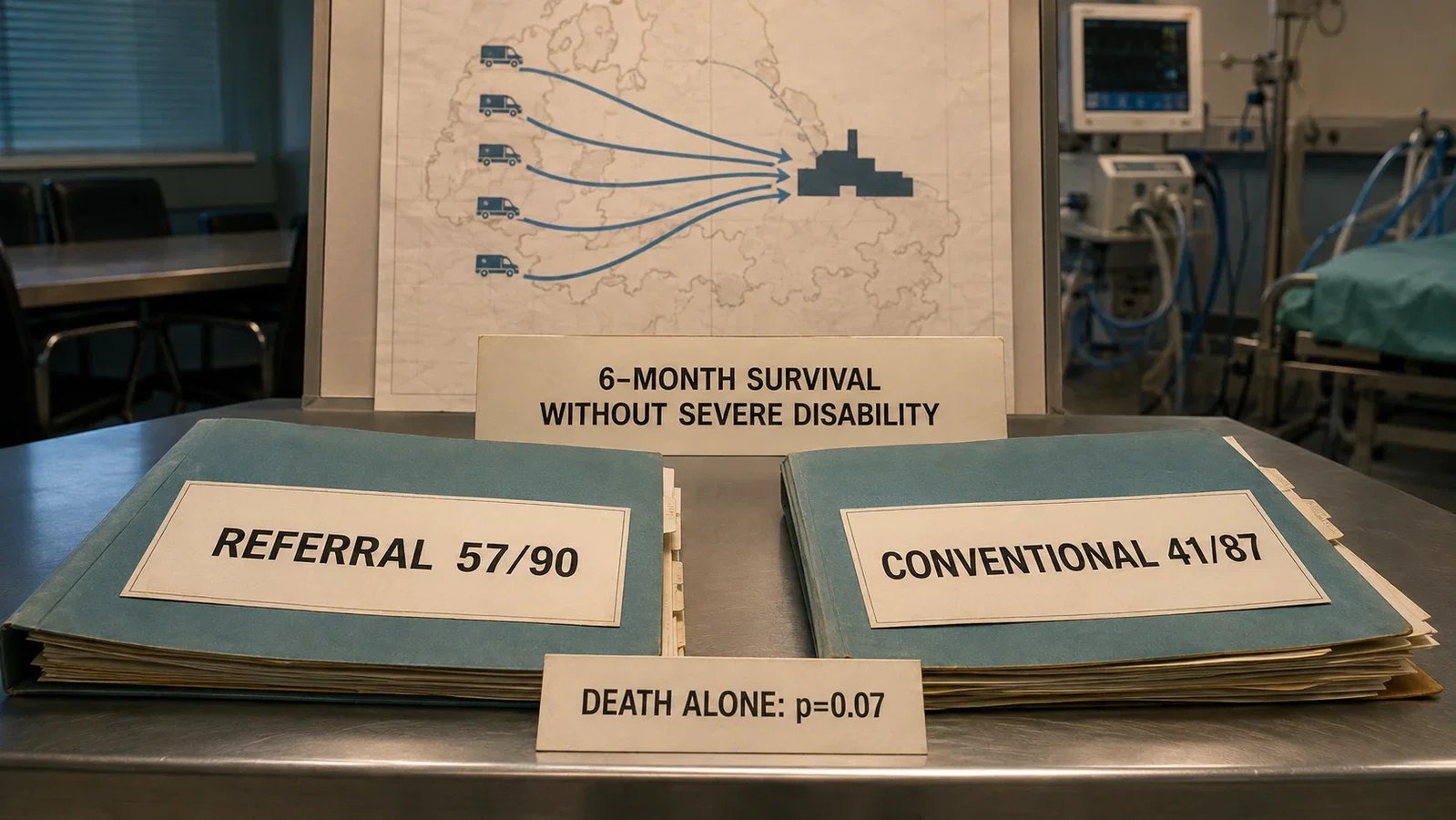
CESAR's primary outcome combined death with severe disability six months after randomisation. Expressed positively, 57 of 90 referred patients were alive without severe disability, compared with 41 of 87 conventionally managed patients. The denominator was 87 because three control patients were alive but declined disability follow-up; they were not counted as deaths.
As the adverse composite, the result was 33/90 versus 46/87, relative risk 0.69 and p=0.03. The Lancet summary and table printed a lower confidence bound of 0.05, while the NIHR executive summary and results narrative gave the coherent interval of 0.50 to 0.97. The formal correction amended four other items but not this one. This account uses 0.50 to 0.97 and records the anomaly.
Death alone did not produce the same statistical conclusion. There were 33 deaths among 90 referred patients and 45 among 90 conventionally managed patients, with a relative risk of 0.73 and p=0.07. Here, too, the detailed versions differ slightly: the Lancet table prints a 95% confidence interval of 0.52 to 1.03, while the NIHR results narrative prints 0.50 to 1.03. Both cross 1.0. Neither supports replacing the actual composite finding with the simpler slogan that ECMO had been proved to reduce mortality.
Nor was CESAR double blind. The researchers who performed the six-month follow-up assessment were masked to allocation. Patients and bedside teams could not be blinded to transfer or extracorporeal support.
3. A specialist centre could not be removed from the estimate
Patients assigned to conventional management remained under the care of their local intensivists. The trial recommended the low tidal-volume strategy associated with the ARDS Network study, but did not impose one uniform protocol across control centres.
The resulting treatment exposure differed. Low-volume ventilation was used at some point in 84 patients in the referral arm and 63 in the conventional arm. As a proportion of critical-care days, the figures were 0.86 and 0.67. This is not evidence that the conventional clinicians were careless. It is evidence that referral changed more than access to a circuit.
Patients moved to one experienced centre, encountered another team and ventilation pattern, and gained access to ECMO within a broader bundle. The trial estimated that referral strategy. It could not divide the result among transport, expertise, ventilation, selection after arrival, and extracorporeal support.
Transport also carried real hazards. The trial reported two serious adverse events: one patient died after the oxygen supply failed in an ambulance, and a vessel perforation during cannulation contributed to another death. A separate patient died in transit after catastrophic pulmonary haemorrhage, which the investigators attributed to the underlying disease rather than to the trial.
These events make retrieval part of the clinical problem. A patient may be too unstable for a long journey on conventional ventilation. The CESAR discussion pointed to one possible answer: bring the team and circuit to the referring hospital, establish support, and transport the patient on ECMO.
4. H1N1 turned retrieval into visible infrastructure
The 2009 influenza A(H1N1) pandemic supplied a severe test of that model. In Australia and New Zealand, investigators identified 72 patients considered eligible for their ECMO report between 1 June and 31 August. Four were excluded because of alternative diagnoses or the absence of ARDS, leaving 68 patients treated across 15 intensive care units.
The group was not composed entirely of laboratory-confirmed H1N1. Fifty-three had confirmed 2009 H1N1, eight had influenza A that was not subtyped, and seven were clinically suspected cases. The study was retrospective and descriptive. It did not randomise patients or create a matched counterfactual.
These were selected, severely ill patients. Their median age was 34.4 years. Before ECMO, the median ratio of arterial oxygen tension to inspired oxygen fraction was 56, median PEEP was 18 cm H2O, and median ECMO duration was 10 days. Those values describe the cohort; they are not a universal threshold for present-day treatment.
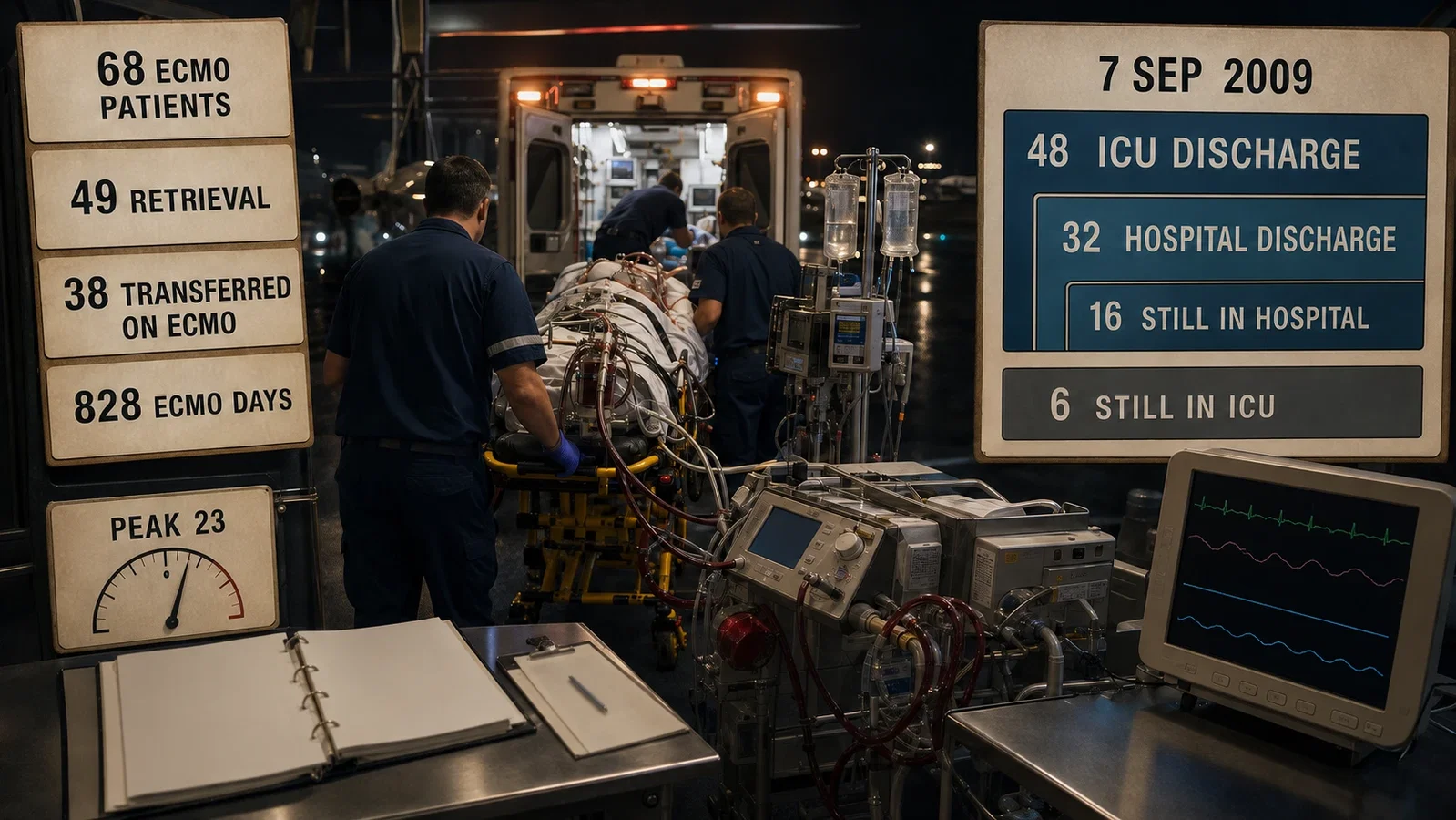
The service data show why the report attracted attention. Forty-nine of 68 patients required retrieval and interhospital transfer. In 38 of those 49 cases, a team initiated ECMO at the referring site and transported the patient on support. The cohort accumulated 828 ECMO days, and concurrent use reached 23 patients on three consecutive days in early August.
At the same sites, only four patients had received ECMO for ARDS during the 2008 winter. The contrast with 68 in the 2009 cohort documents a regional surge, not a simultaneous global revival. It reveals specialist centres, retrieval staff, transport, circuits, beds, and coordination functioning as one system.
5. The reported 71% was not a final hospital-survival rate
The H1N1 outcomes were censored at midnight on 7 September 2009, while some patients were still receiving care. By then, 48 of 68, or 71%, had survived to ICU discharge. Of those 48, only 32 had survived to hospital discharge; the other 16 remained in hospital. Fourteen patients had died, and six remained in intensive care, including two still receiving ECMO.
The categories must remain together. Writing that 48 patients survived to hospital discharge would collapse an unfinished hospital course into a final outcome. A 2011 review did exactly that, but the primary JAMA report controls the wording: 48 had left ICU, 32 had left hospital, and 16 were still hospital inpatients at the reporting cutoff.
The paper also displayed 61 ECMO-treated patients beside 133 mechanically ventilated patients who did not receive ECMO among those with confirmed or unsubtyped influenza A. The groups were not exchangeable. Patients selected for ECMO were younger, more often received vasopressors, and required longer support, among other differences. The observed ICU mortality figures of 23% and 9% cannot prove harm, and they cannot be adjusted by rhetoric into proof of benefit.
The investigators could not report what would have happened without ECMO. The cohort documented severity, feasibility, complications, resource use, and status at a specified time, but not a causal comparison.
6. Returning to view did not mean resolving uncertainty
Writing from departments of anaesthesia and intensive care in Auckland, David Sidebotham later described renewed interest in adult ECMO as arising from several developments together: CESAR, observational H1N1 experience, and advances in technology. That near-contemporaneous interpretation is a useful guide to the historical moment, provided it is not converted into a claim that one study proved the circuit or caused immediate worldwide adoption.
CESAR made referral to an ECMO-capable specialist centre testable as a clinical strategy. The Australasian H1N1 report showed a mobile regional service operating under epidemic pressure. One supplied randomisation but bundled the circuit with transfer and expert-centre care. The other made retrieval and capacity visible but lacked randomisation and still had unfinished outcomes at publication.
Adult ECMO returned to critical-care attention in 2009 because uncertainty moved to a more useful level. Clinicians had to ask when referral should begin, which centres could sustain the work, how patients could be moved safely, and how the whole service should be evaluated.
The circuit remained essential. The historical change was learning to see everything that had to happen around it.
Sources and reading limits
Sources: Peek GJ, Mugford M, Tiruvoipati R, et al. Lancet. 2009;374:1351–1363. DOI 10.1016/S0140-6736(09)61069-2; Peek GJ, Elbourne D, Mugford M, et al. NIHR Health Technology Assessment. 2010;14(35). DOI 10.3310/hta14350; Australia and New Zealand Extracorporeal Membrane Oxygenation Influenza Investigators. JAMA. 2009;302(17):1888–1895. DOI 10.1001/jama.2009.1535; WHO Director-General statement, 11 June 2009; Sidebotham D. J Extra Corpor Technol. 2011;43:P23–P26. The complete primary reports, protocol, formal correction, and exact supporting records were read and visually inspected.
Visual interpretations
These illustrations explore the setting and ideas. Depicted people, actions, instruments and documents are reconstructions, not evidence of their exact historical appearance.
Continue exploring
Historical connections
These links follow specific development, adoption or citation connections recorded in the underlying research. They do not imply that history had one inevitable path.
- Later connection: 2018: EOLIA's Rescue Door Changes the ECMO Trial
Related reading connects shared questions and contexts; it does not by itself establish historical influence.
- 2000: ARDSnet Tests Lung Protection Against Clinical Outcomes
- 2018: EOLIA's Rescue Door Changes the ECMO Trial
- 2020: Intubation Becomes a Team Protocol, Not Just a Technique
- 2020: COVIDSurg Turns 1,128 Patients into an International Surgical Warning
The Source Room · About & Editorial Method
Sources and reading limits are stated above. Illustrations are labelled as original source images or AI-made. Historical accounts are educational; they are not current treatment instructions.