In weeks, 235 hospitals converted scattered cases into a visible signal; 23.8% and 51.2% changed the 2020 conversation, but an observational cohort was neither causal proof nor a modern risk table.
Reading Library · Anesthesia Epochs · 中文版
Watch the companion film
2020: COVIDSurg — Surgery with Perioperative SARS-CoV-2 · Watch on YouTube
Historical anchor: 2020. Date details and source qualifications are explained below.
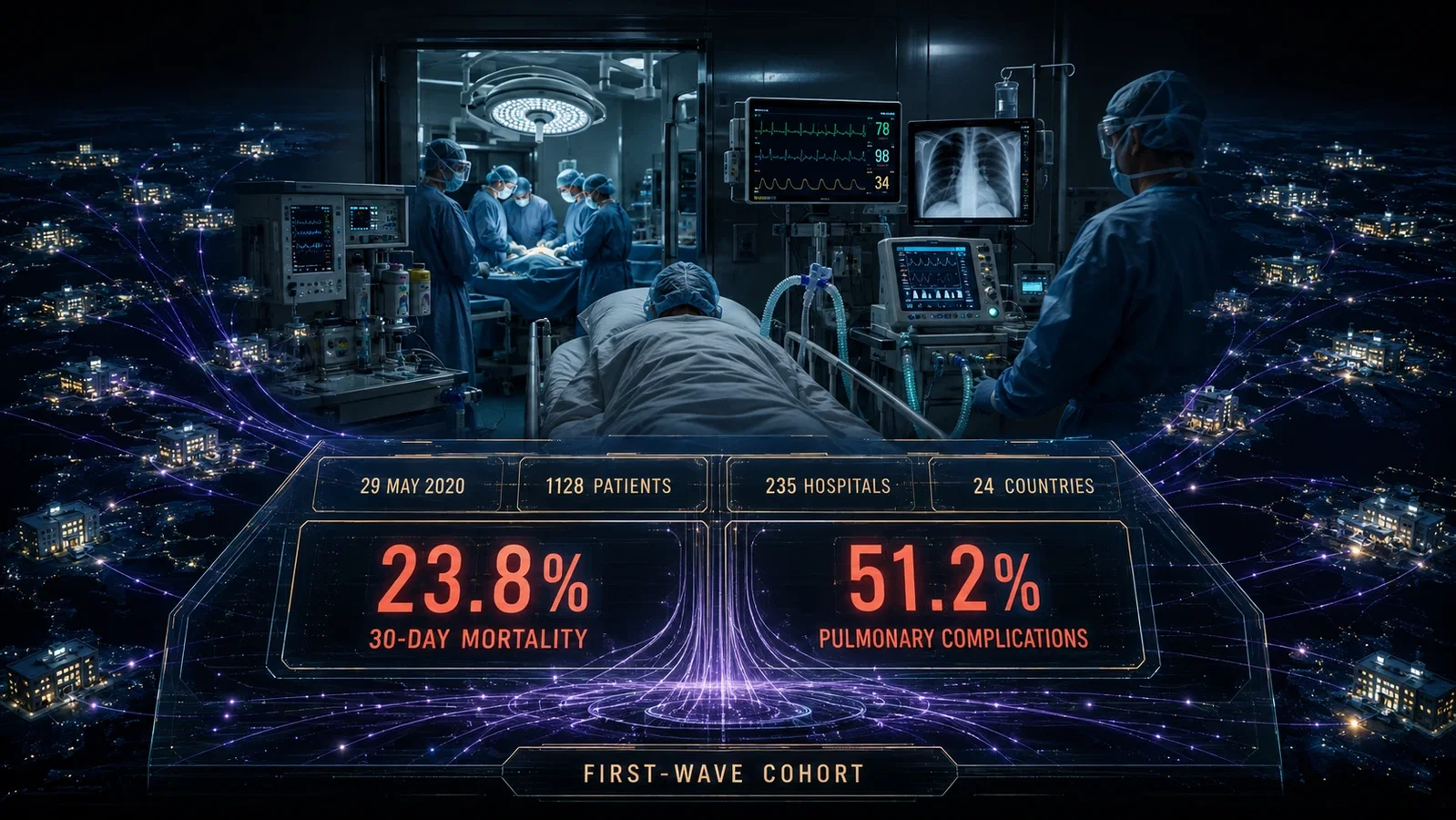
In the spring of 2020, operating rooms received rules before they received answers.
Which patients could still undergo surgery? Could an emergency wait? Had the virus already been present before an operation, or was it only discovered afterward? How much additional respiratory injury could a body absorb while recovering from major surgery?
Hospitals were already redesigning rooms, staffing, and airway procedures. What they lacked was international patient-level evidence showing what happened next. Individual cases could generate fear, but they could not supply a denominator that teams could examine together.
On 29 May, the COVIDSurg Collaborative supplied the first large denominator: 24 countries, 235 hospitals, and 1,128 patients.
The two numbers that followed—23.8% and 51.2%—turned perioperative SARS-CoV-2 into an international warning.
How 1,128 patients came together in weeks
COVIDSurg was an international, multicentre, observational cohort. Its final analysis included patients who underwent surgery between 1 January and 31 March 2020 and were diagnosed with SARS-CoV-2 from seven days before to 30 days after the operation.
Every part of that description matters.
“Surgery” meant a procedure performed by a surgeon in an operating theatre under general, regional, or local anaesthesia. The cohort was not confined to one specialty or to elective operations. Emergency surgery accounted for 835 patients and elective surgery for 280. Major procedures accounted for 841 and minor procedures for 251; the remaining records had missing grade or urgency data.
“Perioperative infection” was operationalized as a diagnosis window. SARS-CoV-2 was diagnosed before surgery in 294 patients and after surgery in 806; timing was missing in 28. Those categories cannot tell us where or on which day infection was acquired. In particular, “postoperative diagnosis” cannot be translated automatically into “hospital-acquired infection.”
The diagnostic routes also preserve the reality of the first wave. Laboratory tests confirmed infection in 969 patients. Eighty were diagnosed radiologically, 68 clinically, and 11 had no recorded diagnostic method. Investigators sought prospective, consecutive capture, but hospitals were allowed to recover cases retrospectively after a local epidemic peak. That pragmatic architecture allowed a network to move quickly while leaving open the possibility of incomplete ascertainment and nonuniform diagnostic practice.
This was not an experiment polished until every seam disappeared.
It was an observational net woven as quickly and carefully as a crisis permitted.
23.8%: 268 patients died within 30 days
The primary outcome was 30-day postoperative mortality, with the operation counted as day 0.
Of 1,128 patients, 268 died within 30 days: 23.8%. Mortality was 53 of 280, 18.9%, after elective surgery and 214 of 835, 25.6%, after emergency surgery. It was 41 of 251, 16.3%, after minor surgery and 226 of 841, 26.9%, after major surgery.
In May 2020, those proportions were difficult to absorb. They gave scale to what had been a diffuse concern. Perioperative infection was not simply adding a few days of fever or supplemental oxygen to an otherwise familiar recovery.
Yet differences between these groups did not identify the causal effect of surgery. Patients undergoing emergency or major operations differed in underlying disease, indication, physiological reserve, and the possibility of waiting. Nobody had been randomized to emergency rather than elective surgery, and the infected cohort had no contemporaneous uninfected counterpart selected through the same process.
The study observed outcomes within a high-risk group. It did not reveal a causal switch that could be turned on and off.
51.2%: three overlapping paths formed one pulmonary outcome
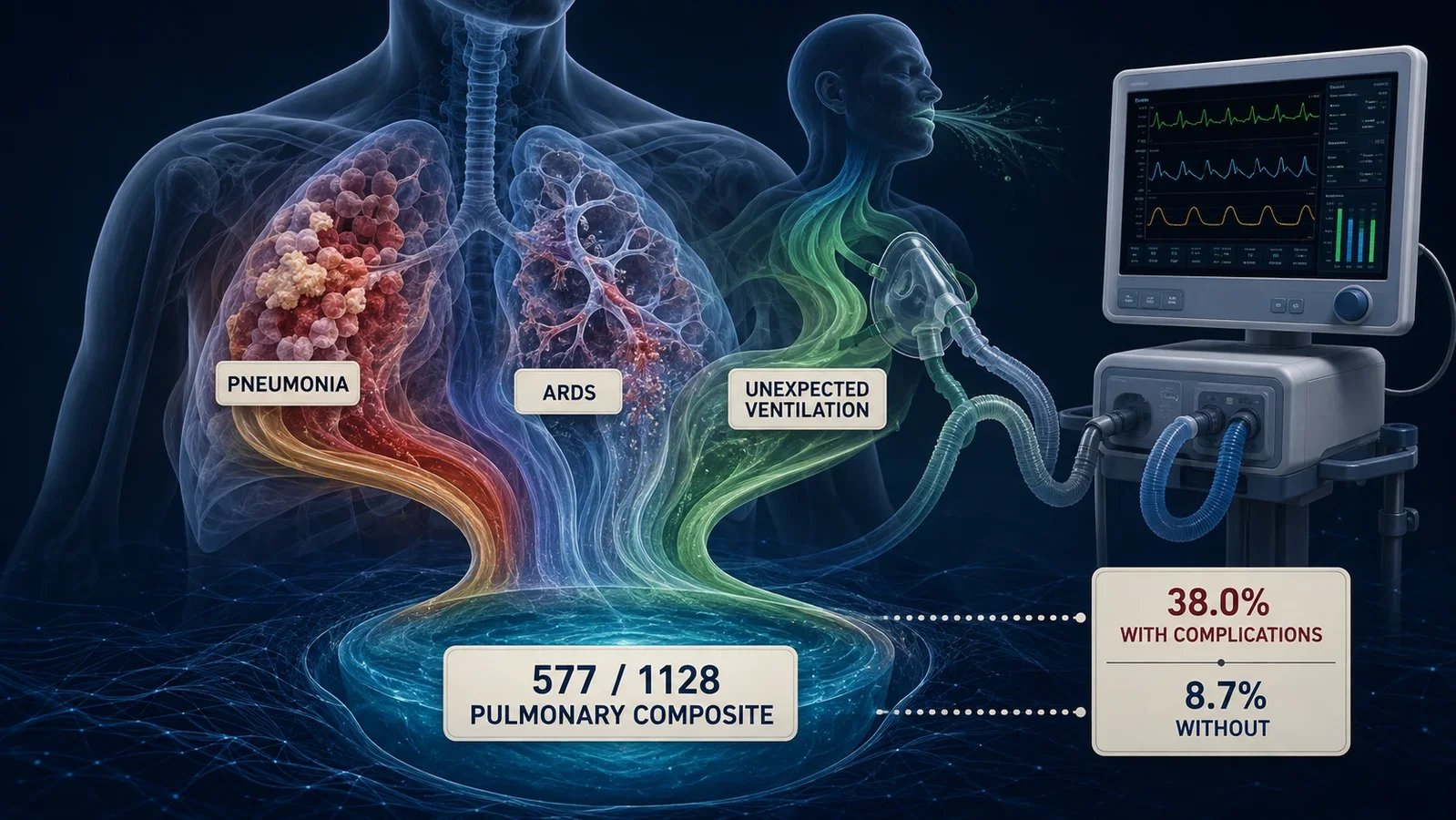
The principal secondary outcome was a composite of pneumonia, acute respiratory distress syndrome, or unexpected postoperative ventilation.
Unexpected ventilation meant more than reintubation. It included non-invasive ventilation, invasive ventilation, or extracorporeal membrane oxygenation after an initial postoperative extubation. It also included inability to extubate the patient as planned at the end of surgery.
At least one pulmonary complication occurred in 577 of 1,128 patients, 51.2%. Pneumonia was recorded in 456, ARDS in 162, and unexpected ventilation in 240. Those three counts cannot be added, because one patient could occupy two or all three categories. The seven mutually exclusive regions in the appendix add exactly to 577, showing how a composite gathers overlapping events into a patient-level outcome.
Among patients with pulmonary complications, 219 of 577 died within 30 days, 38.0%. Among 526 patients without a recorded pulmonary complication, 46 died, 8.7%. ARDS was particularly grave in this cohort: 102 of 162 patients died.
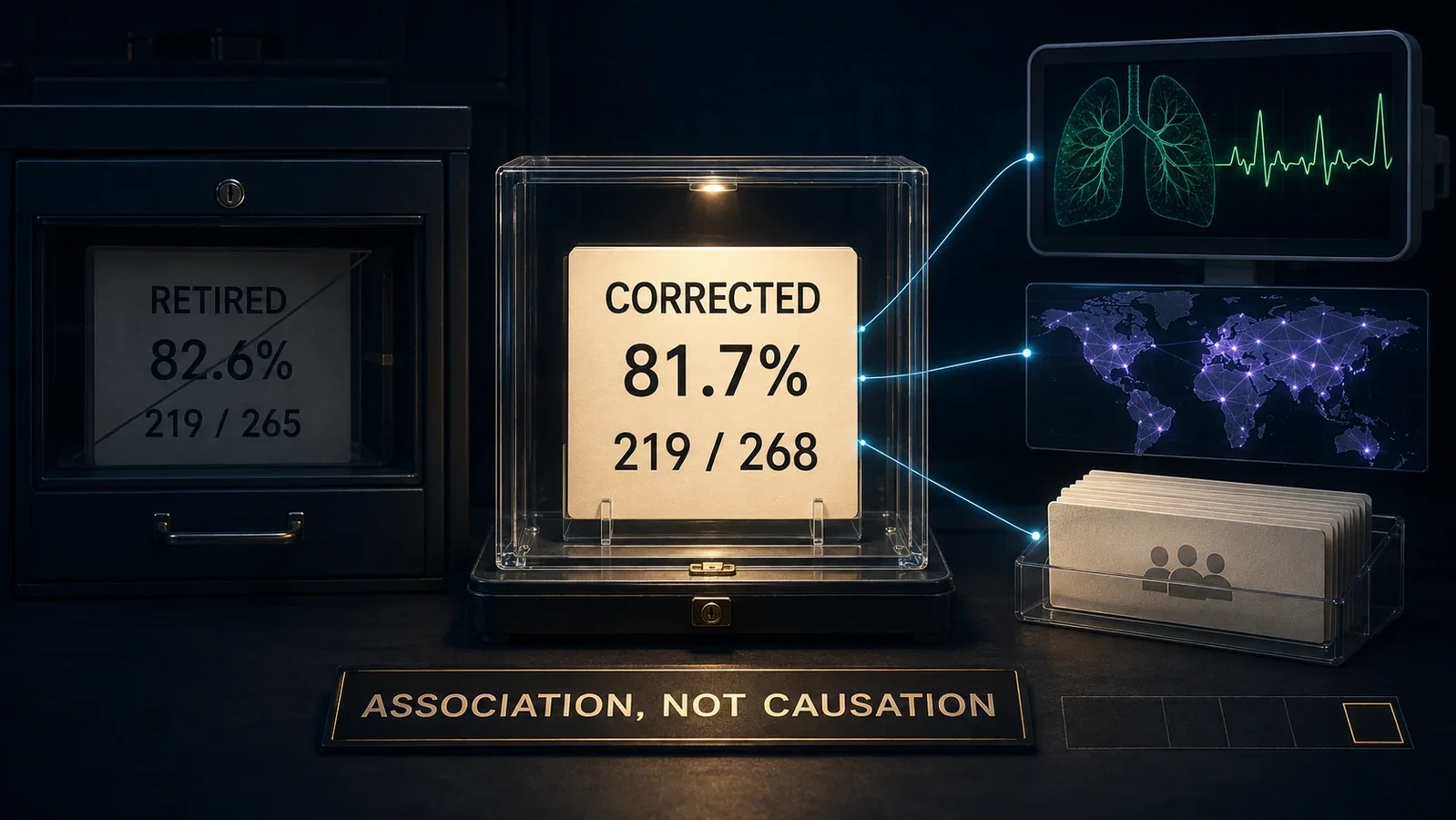
Those observations placed pulmonary injury at the centre of the paper. They still did not prove that pulmonary complications caused all of the additional deaths. More severe infection, poorer baseline health, more complex surgery, and multiorgan failure could travel together in the same patient. COVIDSurg documented powerful co-occurrence, not a simple attributable fraction.
A formal correction established 81.7%
One of the paper's most memorable figures is also one of its easiest to misquote.
The formal correction states that 219 of the 268 patients who died had pulmonary complications: 81.7%. The corrected Summary, main Results, Figure 4, PubMed abstract, and Department of Error notice all use 81.7% (219/268).
Yet even the publisher-layout PDF marked as corrected retains a different sentence in its Research in context panel: 82.6% (219/265). That is not an equally valid alternative calculation. It is superseded text that the correction did not completely remove from every part of the article.
This article therefore uses only 81.7% (219/268) as the controlling result.
The surviving seam belongs in the history. Rapid research did not become flawless because it was important. Reliability came from correction, denominator checking, and a record clear enough to show which version governs the conclusion.
The appendix contains another seam. Its 24 country rows add exactly to 235 hospitals, but their displayed patient counts sum to 1,129—one more than the analytic cohort repeated throughout the paper. The appendix offers no explanation. The responsible response is not to choose a country row and alter it. It is to disclose the mismatch while retaining 1,128, confirmed repeatedly in the main text and analyses, as the cohort denominator.
Adjusted associations were not destiny
For the mortality model, the investigators used multilevel logistic regression with country as a random effect and hospital nested within country. Only 1,037 complete cases entered the model. Missing covariates excluded seven patients who died and 84 who did not.
Within that analysis, age 70 or older, male sex, ASA grades 3-5, malignant disease, emergency surgery, and major surgery were associated with higher odds of 30-day mortality.
The model helped teams see combinations that appeared especially vulnerable in the first wave. It should not turn six characteristics into labels of fate. An odds ratio is not an absolute risk, and a complete-case model is not a lossless copy of all 1,128 patients. Unmeasured confounding and selection could still travel with every association.
Even the ASA estimate needs a version boundary. The Summary and abstract give the adjusted odds ratio for ASA grades 3-5 as 2.35, with a 95% confidence interval of 1.57-3.53. Figure 3 and the corrected appendix table give 2.36, with an interval of 1.58-3.53. When an exact model value is needed here, the table and figure value, 2.36, controls; the abstract discrepancy is noted here rather than being silently erased.
The adjusted pulmonary model told a somewhat different story. Male sex and ASA grades 3-5 remained associated with pulmonary complications, while emergency status and major grade did not. Mixing crude proportions with adjusted results would create a conclusion the paper did not report.
Timing of diagnosis also resisted a simple story. Postoperative rather than preoperative diagnosis was not independently associated with 30-day mortality in the adjusted model. That result neither proves equivalence nor reveals when infection was acquired. It shows why a recorded diagnosis date should not be asked to answer a transmission question.
A three-page protocol shows a study taking shape while it ran
The Royal College of Surgeons of England preserves a three-page COVIDSurg protocol V0.3. It described an investigator-led, non-commercial, non-interventional international cohort using routine anonymous data. Thirty-day mortality was the primary outcome from the beginning.
The protocol encouraged prospective, consecutive collection while explicitly permitting retrospective identification where the epidemic peak had already passed. It anticipated emergency and elective operations, diagnoses before and after surgery, multiple anaesthetic techniques, and all surgical indications. It also planned stratification by laboratory-confirmation status.
The protocol and publication are not identical. V0.3 specified adults aged 18 or older. The final paper explicitly included children and adults and allowed hospitals to apply local age cutoffs. The protocol anticipated a broader collection period extending toward September 2020; the published analysis selected operations from January through March. Respiratory failure and ARDS among the planned secondary outcomes became the final composite of pneumonia, ARDS, and unexpected ventilation.
Those differences need not be concealed. They show a global network turning an emergency plan into an analysable dataset. They also show why the final methods must control the final results: an early protocol cannot be used to overwrite the published cohort.
There was no concurrent uninfected comparator
The limitation most likely to disappear in retelling is also among the most important: COVIDSurg had no contemporaneous SARS-CoV-2-negative surgical control group.
The authors compared their findings with pre-pandemic studies to show how unusual the signal appeared. But those cohorts differed in case mix, selection, pressure on hospital resources, and outcome definitions. They supplied context, not a counterfactual drawn from the same hospitals at the same moment through the same selection process.
Testing and radiological interpretation were not standardized. Laboratory scarcity made clinical diagnosis necessary and could also produce false-negative exclusions. Case ascertainment might have missed less severe infections. Most contributing hospitals were in Europe and North America during early outbreaks.
The cohort also belongs to a biological and clinical era that no longer exists unchanged: ancestral virus, no vaccination, limited testing, and none of the later antiviral and immunomodulatory treatment structure. Subsequent variants, immunity, screening pathways, therapies, surgical organization, and timing strategies are not contained in these 1,128 patients.
The 23.8% and 51.2% figures therefore occupy a clearly marked historical coordinate.
They cannot simply be copied from May 2020 into a present-day consent conversation.
COVIDSurg did not leave a timeless percentage
The boundaries do not diminish the study's importance.
They reveal a new speed of evidence-making. Across different approval systems, testing constraints, and hospital pressures, 235 centres used common definitions to contribute de-identified patient records. Surgeons and anaesthetists built a network that turned scattered experience into an international cohort capable of peer review, correction, and reanalysis within weeks.
COVIDSurg did not prove that surgery caused a 23.8% mortality rate, and it did not answer every later question about when to operate after infection. It performed an earlier task. It showed teams that perioperative SARS-CoV-2 was not simply another familiar postoperative risk, that pulmonary outcomes belonged at the centre of discussion, and that business as usual needed to be tested against evidence.
The first wave passed. The risk estimates changed as the virus, immunity, treatment, and pathways changed.
The method of response did not become obsolete: connect cases when the world changes suddenly; make denominators, missingness, and corrections visible; let a strong signal justify caution without disguising it as proven causation.
The 1,128 patients did not leave behind a risk table valid forever.
They left a way to turn uncertainty into shared evidence before certainty was available.
Sources and reading limits
Sources: COVIDSurg Collaborative. Lancet. 2020;396(10243):27-38. PMID 32479829. PMCID PMC7259900. DOI 10.1016/S0140-6736(20)31182-X; corrected supplementary appendix; The Lancet Department of Error. PMID 32531186. PMCID PMC7282738. DOI 10.1016/S0140-6736(20)31350-7; COVIDSurg protocol V0.3; archived authoritative bibliographic, project, repository, and publisher-route records. This is a history of the first-wave cohort, not current perioperative COVID-19 guidance.
Visual interpretations
These illustrations explore the setting and ideas. Depicted people, actions, instruments and documents are reconstructions, not evidence of their exact historical appearance.

Continue exploring
Related reading connects shared questions and contexts; it does not by itself establish historical influence.
Historical connections
- Earlier connection: 2020: Intubation Becomes a Team Protocol, Not Just a Technique
Related reading
- 2009: CESAR and H1N1 Bring Adult ECMO Back into Critical Care
- 2012: The Berlin Definition Redraws ARDS
- 2018: EOLIA's Rescue Door Changes the ECMO Trial
- 2018: A 25-Country Network Finds Fewer Complications but Harder Rescue
- 2020: Intubation Becomes a Team Protocol, Not Just a Technique
- 2022: POISE-3 Finds Tranexamic Acid Cuts Bleeding Without Proven Cardiovascular Noninferiority
- 2024: GPT-4 Turbo Classifies Preoperative Text but Struggles to Predict Duration
The Source Room · About & Editorial Method
Sources and reading limits are stated above. Illustrations are labelled as original source images or AI-made. Historical accounts are educational; they are not current treatment instructions.