A one-week network across 25 countries and 247 hospitals made postoperative mortality visible, while leaving a rescue hypothesis rather than a causal verdict or a census of Africa.
Reading Library · Anesthesia Epochs · 中文版
Watch the companion film
2018: ASOS — The African Surgical Outcomes Study · Watch on YouTube
Historical anchor: 2018. Date details and source qualifications are explained below.

The most revealing ASOS comparison runs in the wrong direction.
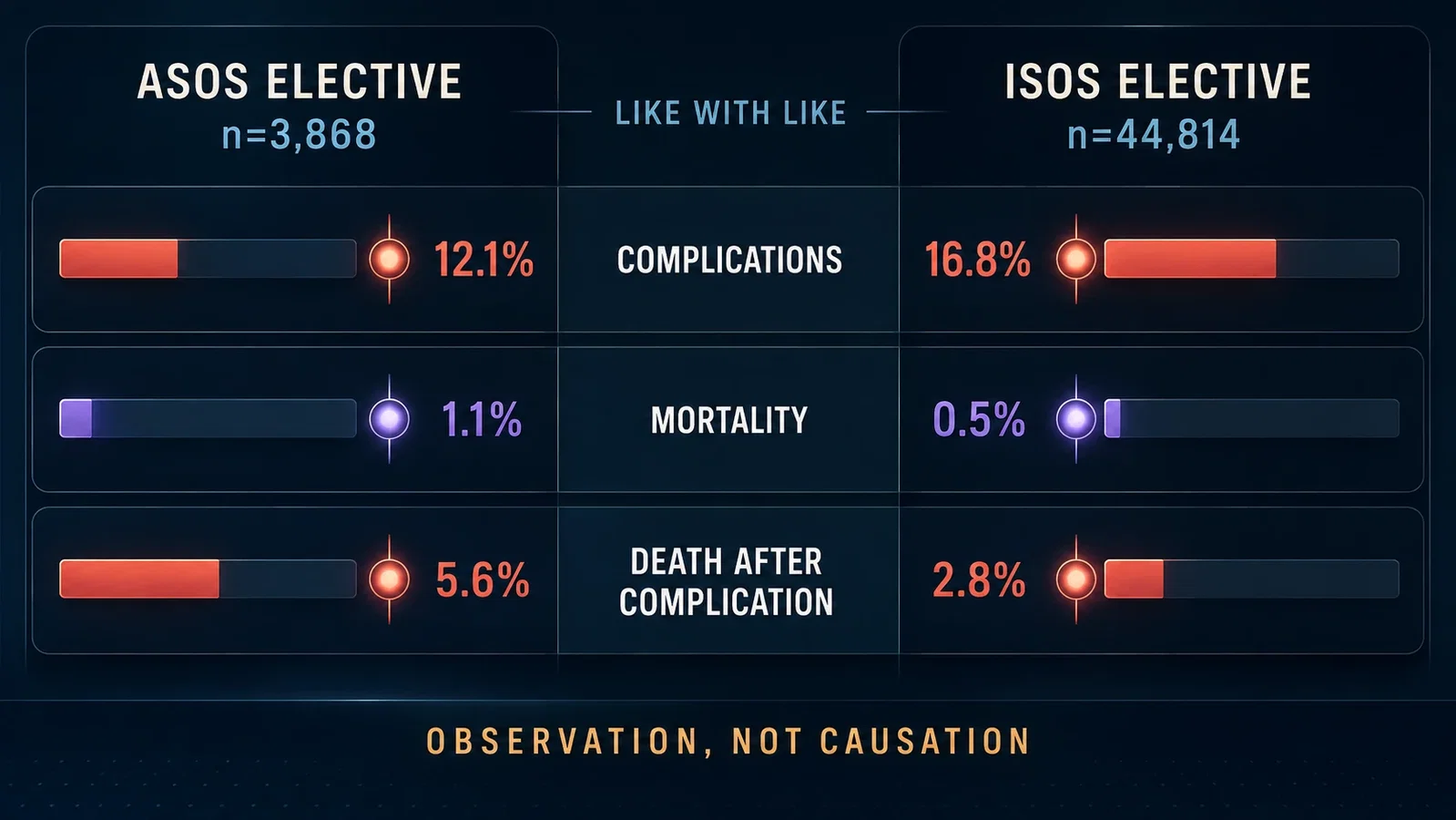
Among comparable elective cohorts, postoperative complications were recorded in 12.1% of the African Surgical Outcomes Study group and 16.8% of the International Surgical Outcomes Study group. Yet in-hospital mortality was 1.1% versus 0.5%. Among patients who developed a complication, mortality was 5.6% versus 2.8%.
Fewer recorded complications. About twice the mortality. About twice the mortality after a complication.
That pattern did not identify a treatment effect or convict one part of a health system. It did something historically prior to both. It made postoperative rescue a visible research problem across a multicountry African surgical network.
The comparison only works if elective is compared with elective
The ASOS report appeared online in The Lancet on January 3, 2018. Its full cohort included elective, urgent, and emergency operations. The earlier ISOS paper, used as an international comparator, included elective inpatient surgery only.
This creates an easy numerical trap. Full-cohort ASOS mortality was 2.1%, while ISOS mortality was 0.5%. Dividing one by the other produces a dramatic fourfold contrast, but the arithmetic combines different clinical populations.
The peer-reviewed ASOS appendix provides the intended comparison in Supplementary Table 3. It restricts ASOS to 3,868 elective patients from the countries that met the study's per-protocol participation rule and places them beside all 44,814 elective ISOS patients.
The ASOS group was younger, more frequently classified as ASA physical status 1, and more likely to have minor surgery. Those differences do not make the cohorts interchangeable or eliminate residual confounding. They do make it difficult to dismiss the mortality contrast as a simple consequence of older, sicker patients undergoing larger procedures.
The approximately twofold statement belongs to that bounded comparison. It does not describe every operation in Africa, and it is not a biological constant called the global average.
A continental collaboration was built from short observation windows
ASOS enrolled 11,422 adults at 247 participating hospitals in 25 African countries. Each country selected one seven-day recruitment week between February and May 2016.
Eligible patients were at least eighteen years old and underwent elective or non-elective surgery with a planned overnight hospital stay. Planned day surgery and radiological procedures that did not require anaesthesia were excluded. Follow-up continued until hospital discharge and was censored on postoperative day 30 for patients who remained in hospital.
The one-week design was deliberately pragmatic. It could be implemented by hospitals with very different levels of research infrastructure without converting an outcomes study into a permanent administrative burden. Local teams recorded identifiable follow-up information on paper, stored it securely, replaced identity with a numerical code, and entered the coded data into an electronic case-report system. The protocol provided secure fax or mail alternatives for centres unable to use the internet system.
The method did not make every hospital equally visible. Recruitment used a convenience strategy through a collaborating network, and the registry classifies sampling as non-probability. The strength was coordinated prospective observation, not probability sampling of a continent.
That distinction matters because the collaboration itself was part of the event. ASOS did not merely export a questionnaire to passive sites. More than a thousand clinician-investigators across African institutions contributed to a common dataset, using shared definitions and one operational window. A dispersed set of outcomes became a collective object of inquiry.
Eleven thousand four hundred twenty-two was not every denominator
The largest cohort number is memorable, but it cannot be attached to every result.
Complication data were missing for 537 patients. Mortality data were missing for 229. The study therefore reported postoperative complications in 1,977 of 10,885 patients, or 18.2%, and in-hospital death in 239 of 11,193 patients, or 2.1%.
Among patients with the necessary complication follow-up, 188 of 1,970 died, or 9.5%. Critical care was used to treat complications in 321 of 1,972, or 16.3%. Infection was the most frequent complication, recorded in 1,156 of 10,970 patients; 112 of those 1,156 patients died.
The changing denominators are not statistical clutter. Replacing each one with 11,422 would create estimates the investigators did not publish. It would also conceal the limits of collection in a study designed to operate across very different clinical settings.
The follow-up label needs similar discipline. A patient was observed until discharge, with a day-30 censor for someone still in hospital. ASOS did not continue community follow-up to thirty days after surgery for every patient who had already left hospital. Its endpoint was in-hospital outcome within that observation boundary.
The operating room was not where most observed deaths occurred
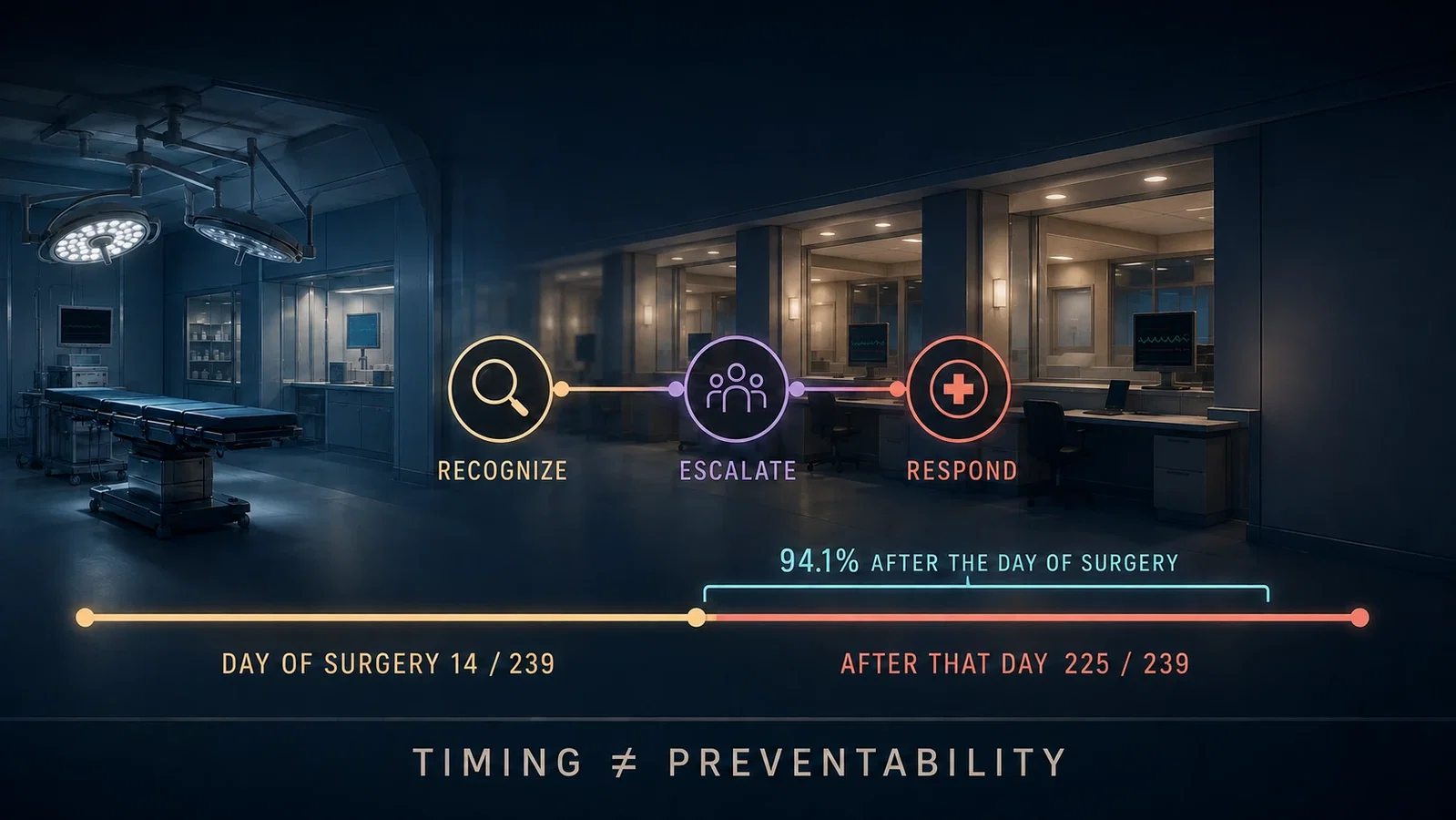
Only 14 of the 239 recorded deaths occurred on the day of surgery. The other 225, or 94.1%, occurred after that day. Median time to death was five postoperative days, with an interquartile range of two to eleven.
This was a temporal finding, not an adjudication of preventability. A death after the day of surgery is not automatically a missed rescue, and its cause cannot be assigned from timing alone.
The timing nevertheless changes what investigators need to ask. If a large share of harm occurred during induction or the operation, attention would settle on intraoperative technique. When death accumulated later, the pathway after theatre became central: observation on the ward, recognition of physiological deterioration, communication across teams, escalation, access to higher-level support, and the ability to respond after a complication had already occurred.
ASOS authors interpreted the pattern through failure to rescue and called for better surveillance of deteriorating patients together with resources to act. The phrase can sound like a single dramatic intervention. In practice, rescue is a chain. A change must be observed, understood, communicated, accepted, and followed by effective care.
The study did not randomize any link in that chain. Its data support the question and the hypothesis. They do not quantify what would have happened if one monitoring system, staffing model, or critical-care policy had been substituted for another.
Resource measures supplied context, not a causal verdict
ASOS documented the environments in which the participating hospitals worked. Among reporting sites, the median catchment population was 810,000. The median hospital had 300 beds, four operating rooms, and three critical-care beds capable of invasive ventilation. Critical-care beds represented 0.9% of hospital beds.
Median specialist staffing was three surgeons, one anaesthetist, and two obstetricians. Combined, those three groups amounted to 0.7 specialists per 100,000 people in the reported catchment. The median annual surgical volume was 212 procedures per 100,000 population.
The patient mix also shaped the observed outcomes. Mean age was 38.5 years and median ASA status was 1. HIV was recorded in 1,253 patients, or 11%. Urgent and emergency procedures accounted for 6,504 of 11,378 operations, or 57.1%. Caesarean delivery was the largest procedure category, 3,792 of 11,393, or 33.3%.
A WHO Surgical Safety Checklist or similar checklist was recorded in 6,183 of 10,836 operations, or 57.1%. This is a process measurement. ASOS did not randomize checklist use, so the number cannot establish that non-use caused mortality or that a particular target would produce a defined benefit.
The facility figures also belong to the participating sample. Most facility data came from 216 of 247 hospitals, while university affiliation was available for 212. Of those 212, 103, or 49%, were university affiliated. Smaller, lower-volume, and remote hospitals could therefore be underrepresented. The medians are not national inventories of workforce or capacity.
Resources and outcomes appeared in the same study because resources were plausible parts of the rescue problem. That makes them a research agenda. It does not make co-occurrence a completed causal analysis.
Shared definitions improved comparability without equalizing diagnosis
The 64-page ASOS appendix includes the outcome guide that is absent from the nominal appendix pages of the standalone protocol file. It specifies anaesthetic events and postoperative complications, including acute kidney injury, ARDS, myocardial infarction, pneumonia, bleeding, pulmonary embolism, stroke, and surgical-site infection. Many surgical complications were graded as mild, moderate, or severe.
The severe-hypoxia definition is especially revealing. It used peripheral oxygen saturation below 90% when pulse oximetry was available, or clinical impression when it was not.
A common definition limits one form of inconsistency, but it cannot supply the same diagnostic tools to every site. The main paper acknowledged that definitions developed largely in high-income settings might perform differently where investigations were less available. Myocardial infarction could be missed. Surgical-site infection retained subjective elements. Uniform investigator training could not be guaranteed.
Lower recorded complication incidence may therefore reflect more than one thing: actual case mix, surgical complexity, length of observation, diagnostic access, and classification. It should not be translated into the unqualified statement that surgery was safer before the rescue system failed.
Twenty-five countries were not one analysis set
The full dataset included 25 countries, but the protocol established a country-level participation threshold. A country needed at least ten participating hospitals, or at least half of its surgical centres if fewer than ten existed, with high eligible-patient capture at participating sites.
Only eleven countries met that per-protocol rule. They contributed 9,024 patients from 175 hospitals. The other fourteen countries contributed 2,398 patients from 72 hospitals but did not meet the representative-sample threshold.
This does not render their patients unreal or their records useless. It limits what those records can support. The paper estimated that roughly 3,000 patients would be required for a stable country mortality estimate and 1,400 for a stable complication estimate. Most national samples were far smaller. A country table could describe collection, but it could not responsibly become a league table.
The accompanying Lancet Comment made the representation boundary explicit. It called ASOS a valuable snapshot and emphasized the need for longitudinal, representative data. Africa is heterogeneous. A short convenience-sampled cohort cannot stand for every health system, hospital, season, or patient across 54 countries.
The Comment also identified a population that ASOS could not count: people who needed surgery but never obtained it. Outcomes among recipients of surgery address quality and safety. They do not measure unmet access. Surgical access, volume, and outcome therefore have to be interpreted together.
The durable result was a question that could be organized
ASOS did not close the case on why surgical patients died. It organized the case well enough for a continent-spanning research network to ask better questions.
Its full cohort showed that most recorded deaths occurred after the day of surgery. Its elective comparison showed that fewer recorded complications could coexist with higher mortality and higher death after complication. Its facility survey placed recognition and response inside a constrained system. Its own limitations prevented the sample from becoming a census or a country ranking.
That combination is the study's historical importance. Perioperative safety does not end when a patient leaves the operating room, and a complication rate cannot explain an outcome system by itself. The interval between complication and death became measurable, discussable, and open to intervention research.
Fewer complications, harder rescue is not a verdict on a continent. It is a bounded description of two observed cohorts and the hypothesis they forced into view.
The study's restraint is part of the achievement. ASOS made the problem visible without making its first snapshot pretend to be the final answer.
Sources and reading limits
Sources: Biccard BM et al. Lancet. 2018;391(10130):1589-1598. PMID 29306587. DOI 10.1016/S0140-6736(18)30001-1; complete peer-reviewed ASOS supplementary appendix; ASOS protocol version 1 final, June 26, 2015; International Surgical Outcomes Study group. Br J Anaesth. 2016;117(5):601-609. PMID 27799174. DOI 10.1093/bja/aew316; Dare AJ, Onajin-Obembe B, Makasa EM. Lancet. 2018;391(10130):1553-1554. DOI 10.1016/S0140-6736(18)30002-3. All cited sources were read for this article.
Visual interpretations
These illustrations explore the setting and ideas. Depicted people, actions, instruments and documents are reconstructions, not evidence of their exact historical appearance.

Continue exploring
Related reading connects shared questions and contexts; it does not by itself establish historical influence.
- 2011: The Uganda SAFE Obstetrics Pilot Builds Local Faculty
- 2011: Lifebox Works Toward Global Pulse-Oximetry Access
- 2020: COVIDSurg Turns 1,128 Patients into an International Surgical Warning
- 2022: POISE-3 Finds Tranexamic Acid Cuts Bleeding Without Proven Cardiovascular Noninferiority
The Source Room · About & Editorial Method
Sources and reading limits are stated above. Illustrations are labelled as original source images or AI-made. Historical accounts are educational; they are not current treatment instructions.