Predicted body weight, ventilation strategies and distinct primary outcomes.
Reading Library · Anesthesia Epochs · 中文版
Watch the companion film
2000: ARDSNet — Lower Tidal Volume Ventilation · Watch on YouTube
Historical anchor: 2000. Date details and source qualifications are explained below.
May 4, 2000 · A randomized trial and its outcome definitions
Mechanical ventilation can sustain gas exchange while exposing an injured lung to further stretch. On May 4, 2000, the ARDS Network published a multicenter randomized comparison of two ventilation strategies in patients with acute lung injury or ARDS. Enrollment ran from March 1996 through March 1999: 432 patients received the lower tidal-volume strategy and 429 the traditional strategy, for a total of 861. This was not the first low tidal-volume trial. The authors discussed earlier studies with conflicting results; the new trial supplied outcome evidence on a larger scale.[1, pp.1301–1304,1307;2]
The meaning of body weight is essential to the comparison. Initial tidal-volume targets were 6 and 12 milliliters per kilogram of predicted body weight, calculated from sex and height rather than measured weight. The lower tidal-volume arm also had a lower plateau-pressure target ceiling, and the protocol allowed adjustments under specified conditions. The intervention was therefore a ventilation strategy with pressure limits and adjustment rules. Its results cannot be reduced to an isolated number six or to an assertion that every patient received an unchanged volume throughout treatment.[1, pp.1301–1303]
The mortality result needs its endpoint definition. The trial assessed death before discharge home with unassisted breathing, following patients to 180 days or the earlier attainment of that discharge condition. For analysis, patients in other types of healthcare facilities at 180 days were regarded as discharged and breathing without assistance. Table 4 reported mortality of 31.0% and 39.8%, P=0.007: an absolute difference of 8.8 percentage points. This was not 28-day mortality, and the roughly 22% relative reduction should not be restated as a 22-point reduction.[1, pp.1303–1304,1306]
The other primary outcome was ventilator-free days during days 1 through 28 after randomization: a mean of 12 versus 10 days, with a standard deviation of 11 days in each group. Unassisted breathing required at least 48 consecutive hours. This outcome reflects survival as well as liberation from ventilation; it does not mean that every survivor was extubated two days sooner. The paper separately reported a median of eight ventilation days in both groups among patients discharged alive. That conditional description and the primary outcome for the randomized population address different questions.[1, pp.1303–1304,1306–1307]
The stopping decision also has a documentary history. Version III of the ARMA protocol, dated September 11, 1998 and preserved by NHLBI, planned a maximum of 1,000 participants with interim analyses. The final publication reported stopping enrollment after the fourth interim analysis crossed the prespecified efficacy boundary. Planned enrollment and the observed total of 861 must therefore remain distinct. The interim P value and the final tabulated P=0.007 also came from different analysis points and should not be substituted for one another.[1, pp.1303–1304;3, PDF pp.1,5,35–36]
Better outcomes did not settle every question about mechanism. Barotrauma did not differ significantly between groups, so the study did not establish that preventing pneumothorax explained the survival result. Its inflammatory-marker findings and discussion of earlier work likewise did not validate every proposed mechanism. Its more direct contribution was evidence of better primary clinical outcomes with the lower tidal-volume strategy in the patients and treatment comparison actually studied.[1, pp.1305–1308]
The enrolled population also belongs to its period. Eligibility used the contemporary acute lung injury and ARDS framework, including a PaO₂/FiO₂ ratio no greater than 300, bilateral infiltrates and criteria excluding left atrial hypertension. The 2012: The Berlin Definition Redraws ARDS examines the later organization of onset timing, PEEP conditions and hypoxemia categories. Reading these sources together shows why the definition matters when describing a trial population. The 2012 criteria should not be projected back onto enrollment in the 2000 report.[1, p.1302;4, pp.2526,2530]
The ARDSnet paper put lung protection to a clinical-outcome test while making the conditions of comparison indispensable: who entered the trial, how body weight was calculated, which strategies were delivered and how outcomes were defined. Its historical significance extends beyond remembering a smaller tidal-volume target. Those conditions belong alongside the result whenever the study is interpreted. This account uses the original publication, a dated protocol version and the later definition paper to reconstruct that development; it does not prescribe ventilator settings for an individual patient.[1;3;4]
Images
Modern editorial reconstruction of a ventilator and trial binder in a circa-2000 setting; not a historical photograph of a documented ward.
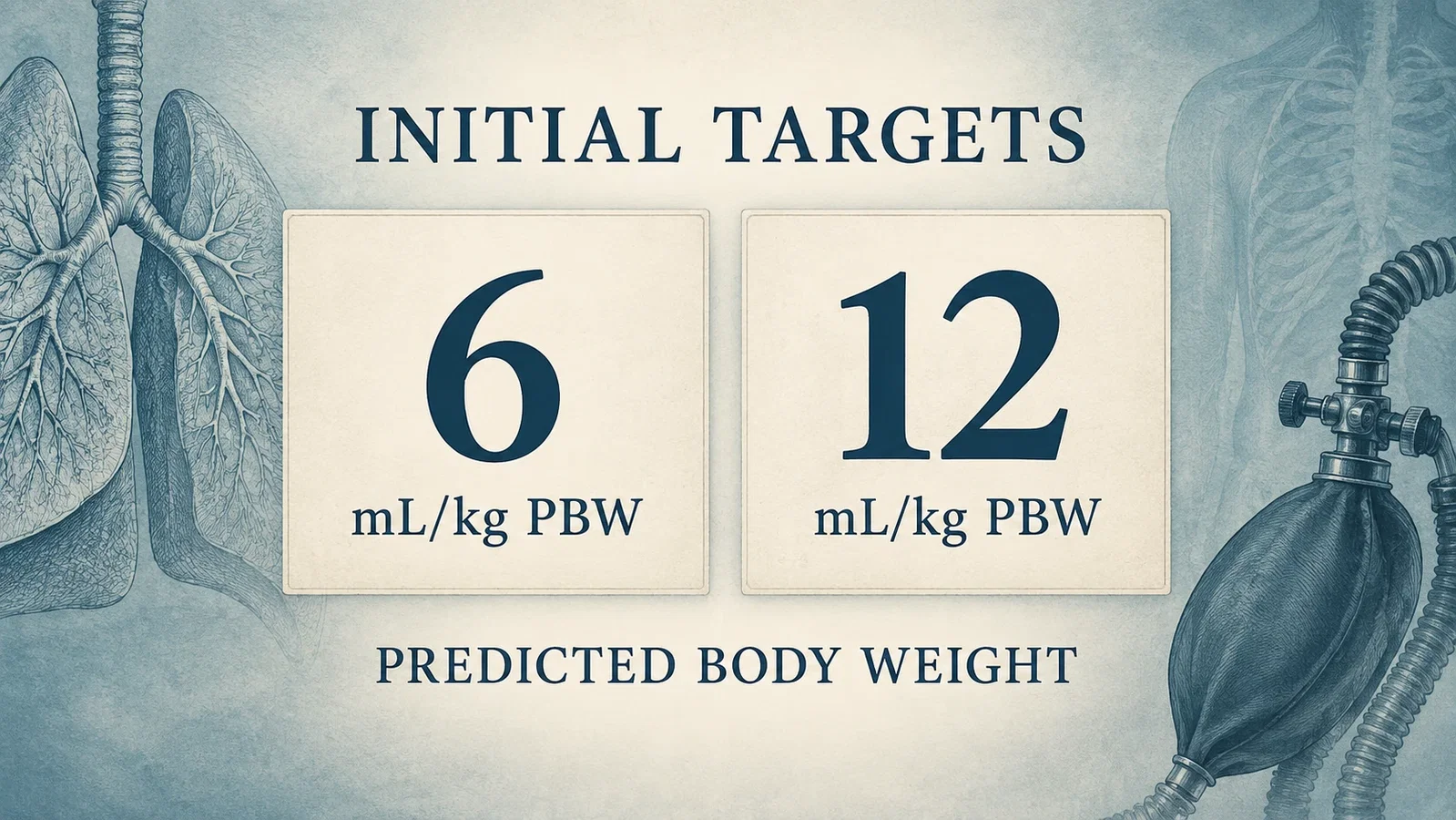
Editorial illustration of the trial’s initial targets based on predicted body weight; pressure constraints and adjustment rules were also part of the strategies.
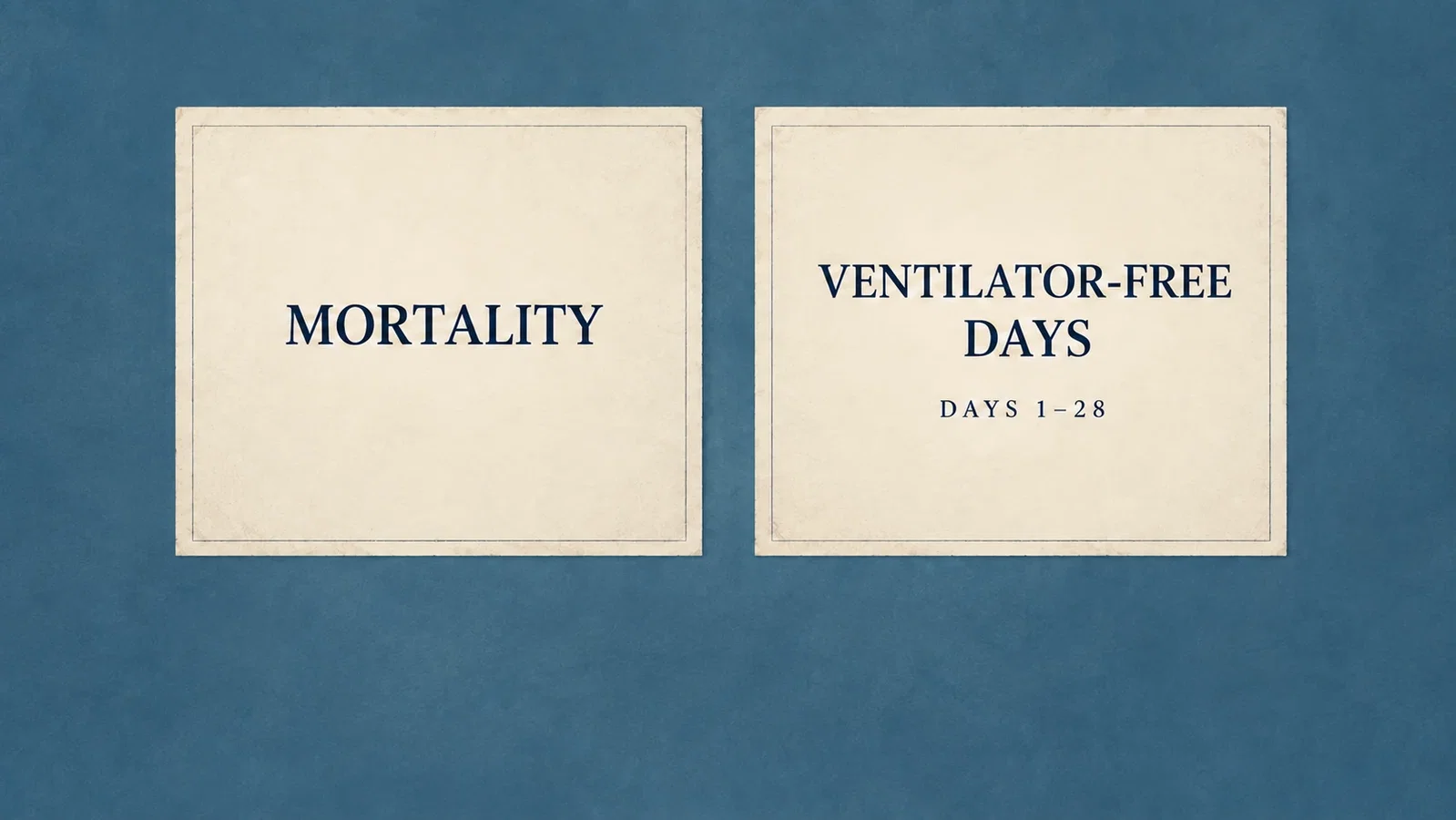
Editorial illustration separating mortality from ventilator-free days during days 1–28. Each outcome had its own definition.

Editorial timeline distinguishing the 2000 trial from the 2012 definition; later criteria do not redefine the earlier enrollment process.
Sources and reading limits
- Acute Respiratory Distress Syndrome Network. Ventilation with lower tidal volumes as compared with traditional tidal volumes for acute lung injury and the acute respiratory distress syndrome. N Engl J Med. 2000;342(18):1301–1308. DOI:10.1056/NEJM200005043421801. Original journal PDF in the public Critcon archive. All eight pages read; publisher-direct download was unavailable.
- NLM PubMed 10793162. Bibliographic record and abstract cross-check; not independent trial evidence.
- ARDS Network Study 01, ARMA. Protocol Version III, September 11, 1998. Official NHLBI BioLINCC protocol. Selected PDF pp.1,2,3,5,6,7,35,36 of 55 scanned pages; not the full protocol or the original 1996 version.
- ARDS Definition Task Force. Acute respiratory distress syndrome: the Berlin Definition. JAMA. 2012;307(23):2526–2533. DOI:10.1001/jama.2012.5669. JAMA bibliographic page. Selected printed pp.2526,2530,2533 read from an archived copy of the original layout.
Reading scope: the full eight-page original article, eight selected pages of the 1998 protocol and three selected pages of the 2012 paper. The official study-archive overview states 860 participants, whereas the original reports 861; this account follows the original. The full 55-page scanned protocol, all cited earlier studies and subsequent comments were not read. Images are modern editorial concepts in the original landscape format.
Sources and reading limits are stated above. Illustrations are labelled as original source images or AI-made. Historical accounts are educational; they are not current treatment instructions.
Continue exploring
Related reading
Related reading connects shared questions and contexts; it does not by itself establish historical influence.