On 17 February 2023, DEN210022 brought a multiparameter physiological signal into Class II anesthesiology regulation—and wrote clinical judgment, vital signs, and non-independent use into the device type.
Reading Library · Anesthesia Epochs · 中文版
Watch the companion film
2023: The NOL Index — FDA De Novo for Nociception Monitoring · Watch on YouTube
Historical anchor: 2023. Date details and source qualifications are explained below.
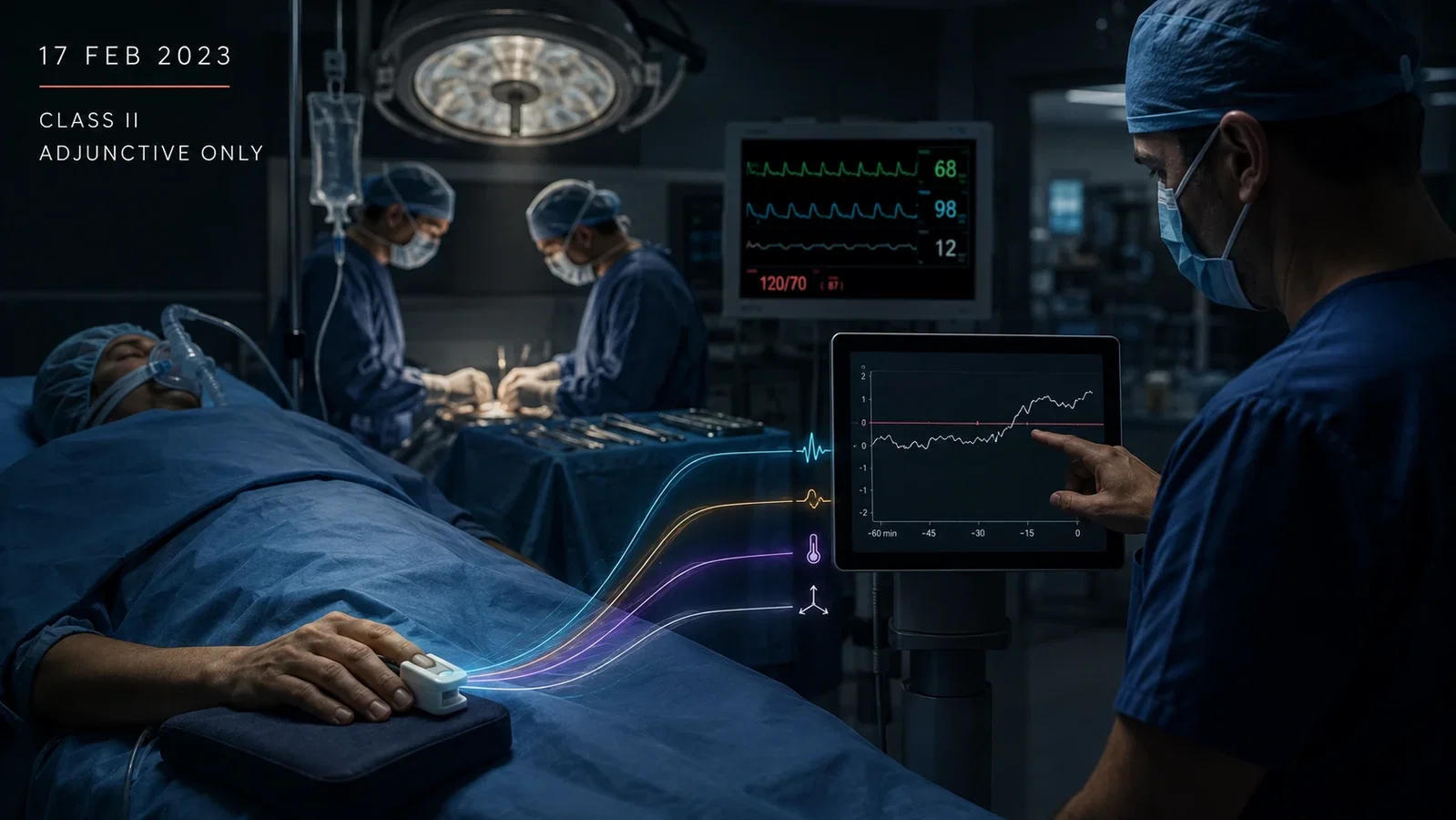
An anesthetized patient cannot answer the most ordinary question in pain care: “How much does it hurt?”
The absence of an answer does not mean the absence of nociception. Surgical incision, traction, and instrumentation continue to provoke physiological responses. The anesthesiologist has to infer whether analgesia is adequate from blood pressure, heart rate, movement, sweating, tearing, the surgical moment, and the patient's condition.
On 17 February 2023, the US Food and Drug Administration gave that inference another instrument.
FDA granted De Novo request DEN210022 for Medasense Biometrics' PMD-200 and created a new Class II generic type: an adjunctive pain measurement device for anesthesiology. The regulation number was 21 CFR 868.2200 and the product code was QVE.
The generic name invites an expansive story—a machine had made pain objective. The authorized indication tells a more exact one.
A physiological response is not a patient's pain report
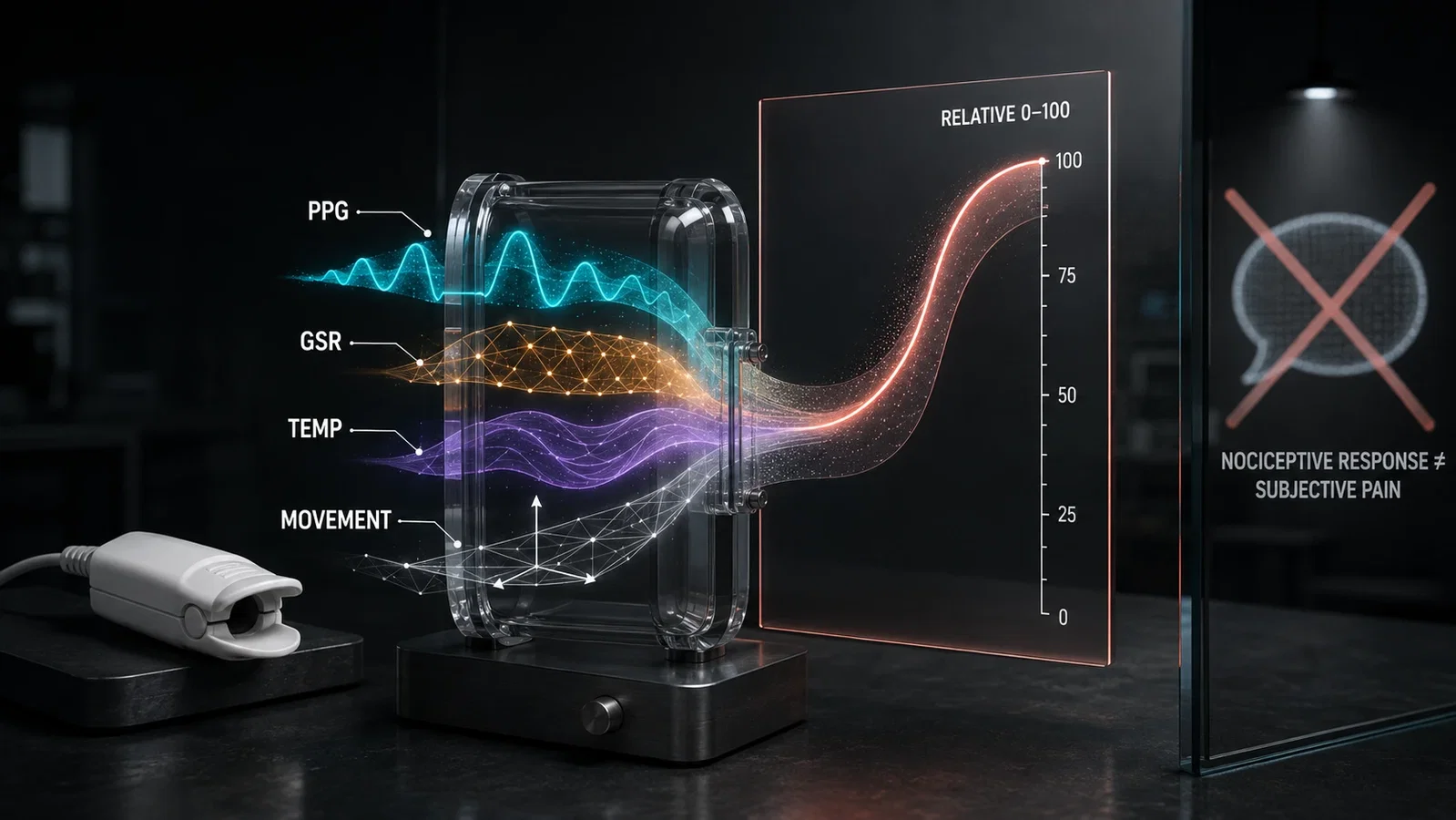
PMD-200 uses a finger probe and sensor to gather photoplethysmography, galvanic skin response, peripheral temperature, and movement. Its software combines features from those signals into the Nociception Level Index, or NOL, and displays both a current value and a trend.
FDA described NOL as a patient-normalized, relative, nonlinear scale from 0 to 100. It is not a universal linear ruler on which 60 must represent twice as much experience as 30.
Nor are nociception and pain interchangeable.
Nociception is the nervous system's encoding and physiological response to potentially harmful stimulation. Pain is a conscious, subjective experience. During general anesthesia, NOL is built from the physiological traces of the former. In the outcome studies, the latter was assessed only after surgery, when patients could report a 0-to-10 numerical pain score.
The monitor therefore does not reveal how much pain an unconscious person is “really feeling.” It offers another clue about the response to noxious stimulation when self-report is unavailable.
A threshold identifies a moment for reassessment, not a drug dose
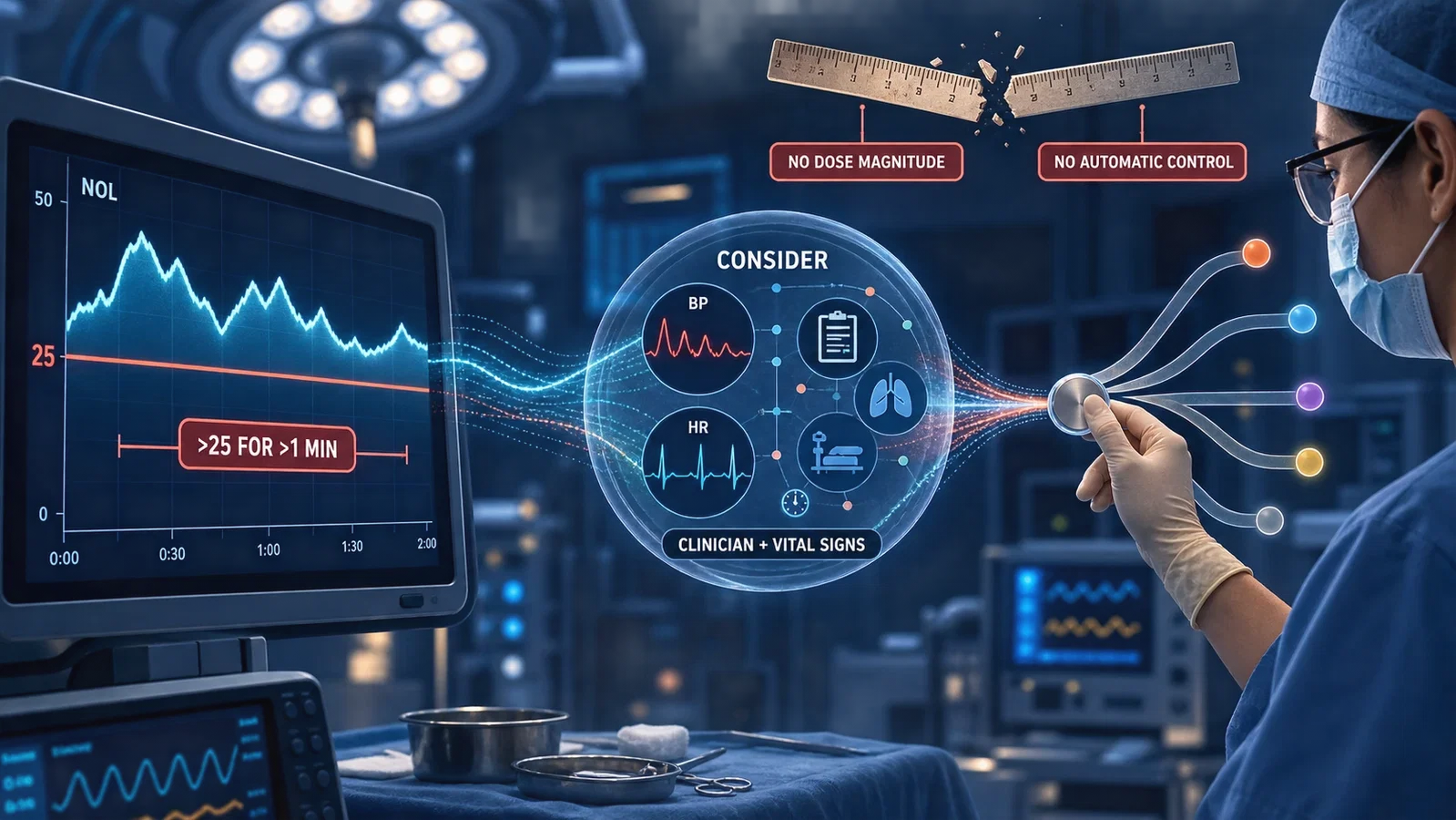
The FDA review described an interpretation framework. A NOL value above 25 for more than one minute may indicate that additional analgesia should be considered. Values from 0 to 25 suggest that the physiological response to noxious stimulation is being appropriately suppressed.
The boundary lies in the verbs.
The value may prompt consideration. The amount by which it exceeds 25 does not specify the size of an opioid dose. A reading of 50 is not an instruction to give twice whatever would follow a reading of 25.
The device also cannot anticipate the next noxious event. A low reading before an incision does not remove the need to maintain a minimum level of analgesia.
In the two randomized studies reviewed by FDA, the threshold did not activate an infusion pump. Clinicians continued to consider blood pressure and heart rate. They could override the protocol, select a different dose, or give fentanyl below the NOL threshold.
This was not closed-loop anesthesia. It was an additional gauge in a cockpit that still had a human pilot.
De Novo did more than permit one monitor to be marketed
The De Novo pathway can classify a novel device for which no suitable legally marketed predicate exists when general and special controls can provide reasonable assurance of safety and effectiveness. The PMD-200 order therefore did two things at once: it allowed the submitted device to be marketed under the stated controls, and it defined the regulatory architecture for substantially equivalent devices of the new type.
That architecture treated the algorithm, sensors, user, labeling, and clinical environment as one safety system.
Clinical evidence had to represent the intended population and range of use. Machine-learning validation data had to be separate from training data. Software documentation had to address noisy, missing, and poor-quality inputs. Usability work had to reduce misinterpretation. Patient-contacting components needed biocompatibility evidence; hardware needed electrical-safety and electromagnetic-compatibility testing. Labeling had to identify compatible sensors, performance limitations, patient conditions and therapies that could distort the output, and the requirement for adjunctive interpretation.
The historical change was not simply the appearance of a new number on an operating-room screen. A composite nociception algorithm had acquired a device class with explicit evidentiary and human-factors obligations.
Pass did not disclose every achieved performance value
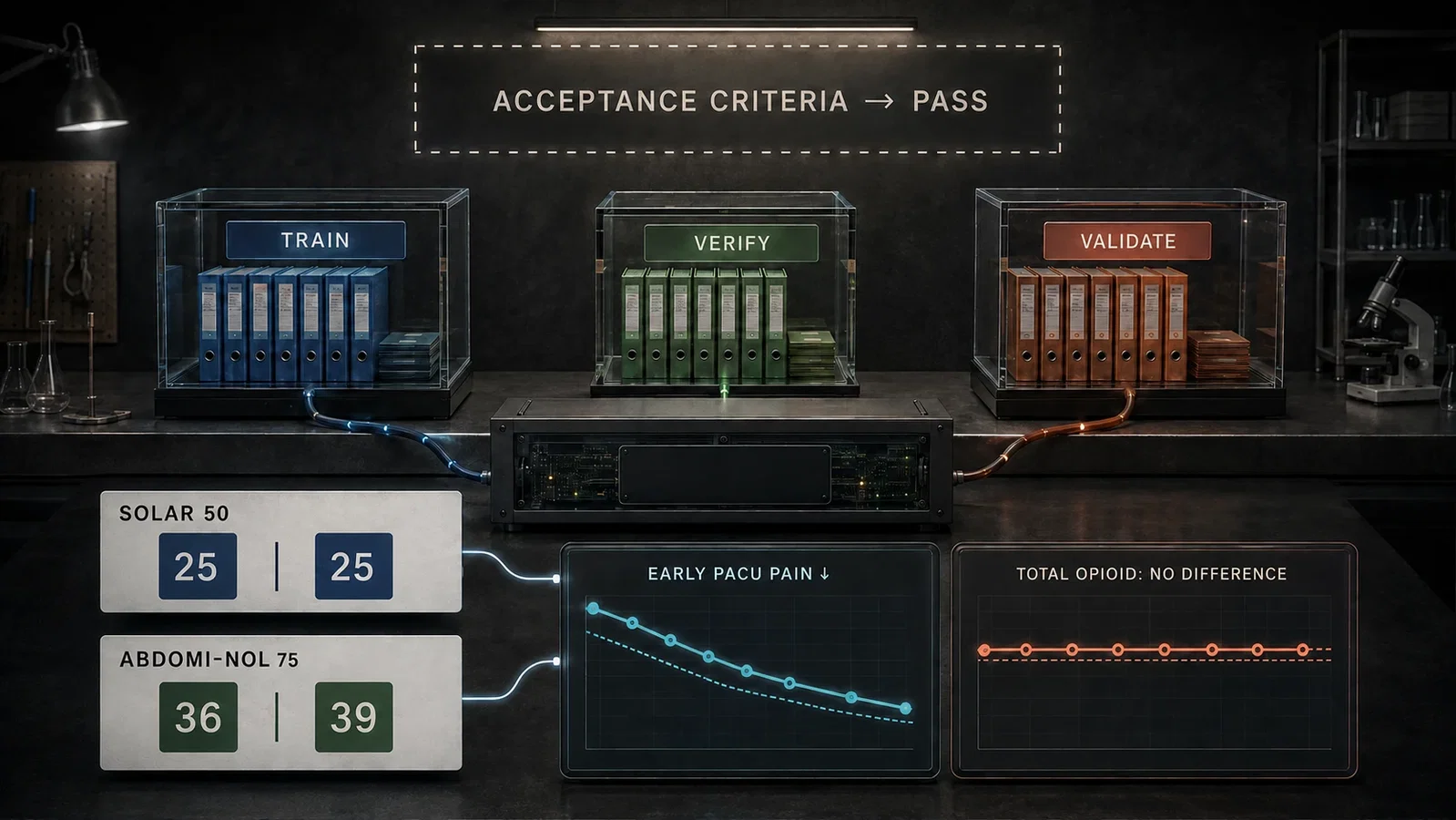
The decision summary describes multinational, multicenter algorithm verification and validation records from adults undergoing major abdominal or gynecologic surgery under general anesthesia. Training, verification, and validation data were separated. Subgroup testing considered sex, age, body mass index, and the use of remifentanil or fentanyl.
Yet the public FDA tables usually present an acceptance criterion and then report Pass. They do not publish the achieved numerical AUC, sensitivity, specificity, and accuracy for every prospective algorithm test.
That distinction matters. A value such as 0.85 in the acceptance column cannot be repeated as if it were an observed AUC. The subgroup rows also overlap; adding women, men, age groups, BMI groups, and drug groups would manufacture a sample size that never existed.
FDA additionally reviewed a retrospective database of 500 adults assembled from five institutions or data sources. It supported discrimination between noxious and non-noxious periods across several cohorts. Some labels and cells in the public table appear duplicated or misaligned, however. The defensible lesson lies in the validation structure, not in forcing every ambiguous cell into a marketing statistic.
No pediatric data were extrapolated to support the request.
Two small randomized trials connected the intraoperative signal to early recovery pain
The clinical-outcome package included SOLAR and Abdomi-NOL. Both compared a NOL-guided fentanyl protocol with standard hemodynamic and clinical guidance during sevoflurane/fentanyl anesthesia. Their central outcome was not an intraoperative machine score. It was pain reported by patients in the post-anesthesia care unit.
SOLAR randomized 50 adults undergoing abdominal surgery at two Dutch centers, 25 per group. During the first 90 minutes in PACU, each patient's median pain score was 3.2 in the NOL-guided group and 4.8 with standard care. The difference was 1.6 points (95% CI, 0.5 to 2.7; p=.006). Severe pain occurred in 8 of 25 versus 15 of 25 participants.
Total intraoperative fentanyl did not differ significantly. Neither did postoperative morphine-equivalent use. The investigators argued that the timing and individual distribution of fentanyl, rather than a lower group total, may have contributed to the pain result.
That is a more interesting finding than the simple “opioid-sparing monitor” story—and a less convenient one. A signal might change when clinicians treat without changing how much drug the groups receive overall.
Abdomi-NOL began with 95 patients approached or monitored at a single Jerusalem center. Ten randomized participants were subsequently excluded for pre-existing exclusion criteria and ten more did not complete the procedures, leaving a completer analysis of 75: 36 under NOL guidance and 39 under standard care.
At 90 minutes, median PACU pain scores were 3.0 and 5.0. After correction for the sex imbalance, the difference was 1.5 points (95% CI, 0.4 to 2.6).
Again, total intraoperative fentanyl and postoperative morphine equivalents did not differ significantly. Neither did inadequate-anesthesia events or the other exploratory outcomes.
The study was not designed to settle discharge readiness, complications, or chronic pain. It excluded regional and multimodal analgesia, combined several types of surgery, did not fully standardize PACU treatment, and experienced COVID-era oversight problems that contributed to exclusions after randomization. The paper calls the study single-blind; the registry's structured masking field says NONE. That discrepancy belongs in the record rather than being silently resolved.
Lower early pain scores did not become proof of long-term benefit
Together, the trials support a bounded statement: in two small randomized protocols, patients whose intraoperative fentanyl was guided with NOL reported lower early PACU pain scores.
They did not demonstrate lower total opioid use. They did not establish faster recovery, fewer complications, prevention of persistent postsurgical pain, or reduced long-term opioid use.
FDA's benefit-risk discussion proposed that less postoperative pain may reduce prolonged postsurgical opioid use. The word may describes a plausible path. It is not a long-term outcome measured by these trials.
Safety needs the same precision. Neither randomized paper reported a device-related adverse event, but the broader FDA evidence noted three isolated minor pressure marks on patients' fingers. They resolved without treatment. More consequential risks arose from the information itself: a false or misread value could contribute to under- or overdosing, with insufficient analgesia on one side and respiratory depression, hypotension, bradycardia, nausea, or delayed recovery on the other.
That is why algorithm validation cannot be separated from interface design, labeling, and the behavior of the person reading the display.
The new signal entered monitoring; responsibility stayed with the clinician
The PMD-200 decision did not make pain an objective number that could be trusted without context.
It did something narrower and more durable. It turned a composite of pulse-wave, skin-conductance, temperature, and movement changes into a regulated anesthesiology signal—one that could be tested technically, linked to clinical outcomes, and constrained by a defined intended use.
The signal had a threshold, but not a dose formula. It could support reassessment, but not predict the next stimulus. Two small trials linked its use to lower early recovery-room pain, but not to less total opioid or proven long-term benefit.
The essential word in the FDA device type was adjunctive.
It was not a footnote added after the technology failed to become autonomous. It was the organizing principle of the authorization.
On 17 February 2023, nociceptive response gained another regulated gauge. The patient remained under direct observation. Vital signs, surgical context, and clinical judgment remained present.
The instrument entered the cockpit.
Responsibility did not leave the pilot.
Sources and reading limits
Sources: US FDA. De Novo Classification Order and Decision Summary, DEN210022, PMD-200, decision 17 February 2023; FDA De Novo database and FDA Roundup, 21 February 2023; Meijer F et al. Br J Anaesth. 2020;125(6):1070-1078. PMID 32950246. PMCID PMC7771114. DOI 10.1016/j.bja.2020.07.057; Fuica R et al. J Clin Monit Comput. 2023;37(2):481-491, published online 17 August 2022. PMID 35976578. PMCID PMC9383658. DOI 10.1007/s10877-022-00906-1; ClinicalTrials.gov NCT03970291; archived PubMed and Crossref identity records. This is a history of a bounded FDA De Novo action and its submitted evidence, not individualized analgesic guidance.
Visual interpretations
These illustrations explore the setting and ideas. Depicted people, actions, instruments and documents are reconstructions, not evidence of their exact historical appearance.
Continue exploring
Related reading connects shared questions and contexts; it does not by itself establish historical influence.
Related reading
- 1974: Takuo Aoyagi Makes Hypoxia Visible
- 2011: Lifebox Works Toward Global Pulse-Oximetry Access
- 2018: Prediction Enters the Monitor, Not the Treatment Order
- 2024: GPT-4 Turbo Classifies Preoperative Text but Struggles to Predict Duration
The Source Room · About & Editorial Method
Sources and reading limits are stated above. Illustrations are labelled as original source images or AI-made. Historical accounts are educational; they are not current treatment instructions.