The 2018 De Novo brought arterial-waveform forecasting to the bedside while making signal quality, clinical review, and algorithmic overreliance part of one Class II device definition.
Reading Library · Anesthesia Epochs · 中文版
Watch the companion film
2018: Hypotension Prediction Index — FDA Authorization · Watch on YouTube
Historical anchor: 2018. Date details and source qualifications are explained below.
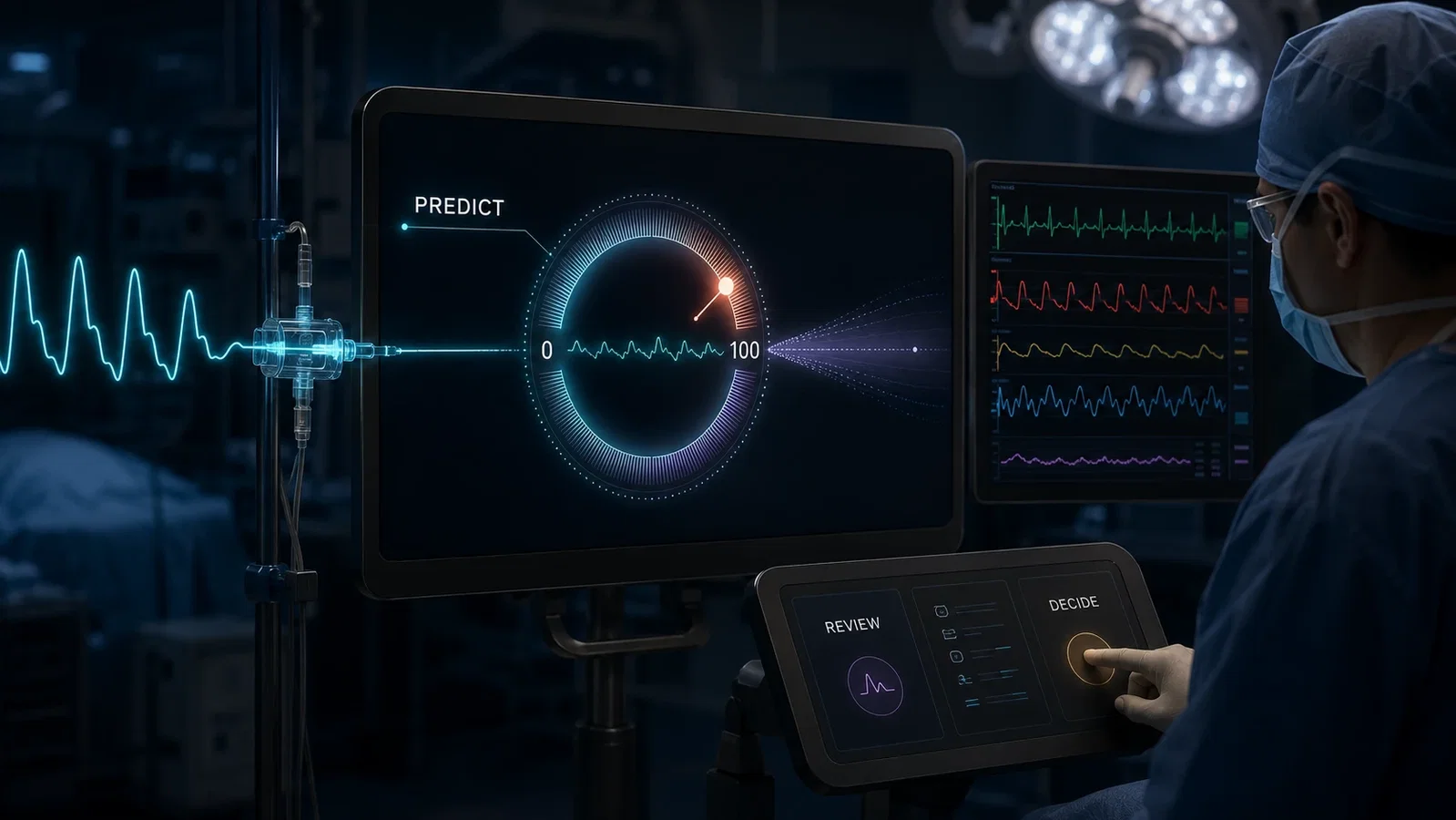
The most important word in the FDA's 2018 name for a new device type was not predictive. It was adjunctive.
The Acumen Hypotension Prediction Index, or HPI, analyzed an arterial pressure waveform and returned a number from 0 to 100. That number was related to the likelihood that mean arterial pressure would fall below 65 mmHg for at least one minute within the next 15 minutes. Above 85, the monitoring platform generated a high-priority alarm.
This sounded like a decisive threshold. The authorized interpretation was deliberately less dramatic. HPI was additional quantitative information. It was not to be used exclusively to treat a patient, and no therapeutic decision was to be based on the parameter alone. The clinician was expected to review the patient's hemodynamics before acting.
On March 16, 2018, predictive monitoring acquired a formal place at the bedside. It did not acquire the right to decide treatment by itself.
FDA had to name a new kind of device
Edwards Lifesciences submitted direct De Novo request DEN160044 in September 2016. FDA granted it on March 16, 2018 and classified the Acumen HPI Feature Software as Class II, under product code QAQ and 21 CFR 870.2210.
The generic name was adjunctive predictive cardiovascular indicator.
That classification did more than authorize one software feature. It defined a regulatory category for prescription software that analyzes cardiovascular vital signs and predicts a future status or event. It also embedded a limit in the category itself: the prediction was to be used with other vital signs and patient information, not to direct therapy independently.
The FDA record gives this history a concrete shape. A model became a medical device only after the model, sensor, display, labeling, user behavior, and limits of interpretation were treated as one safety problem.
The original system began at a radial artery
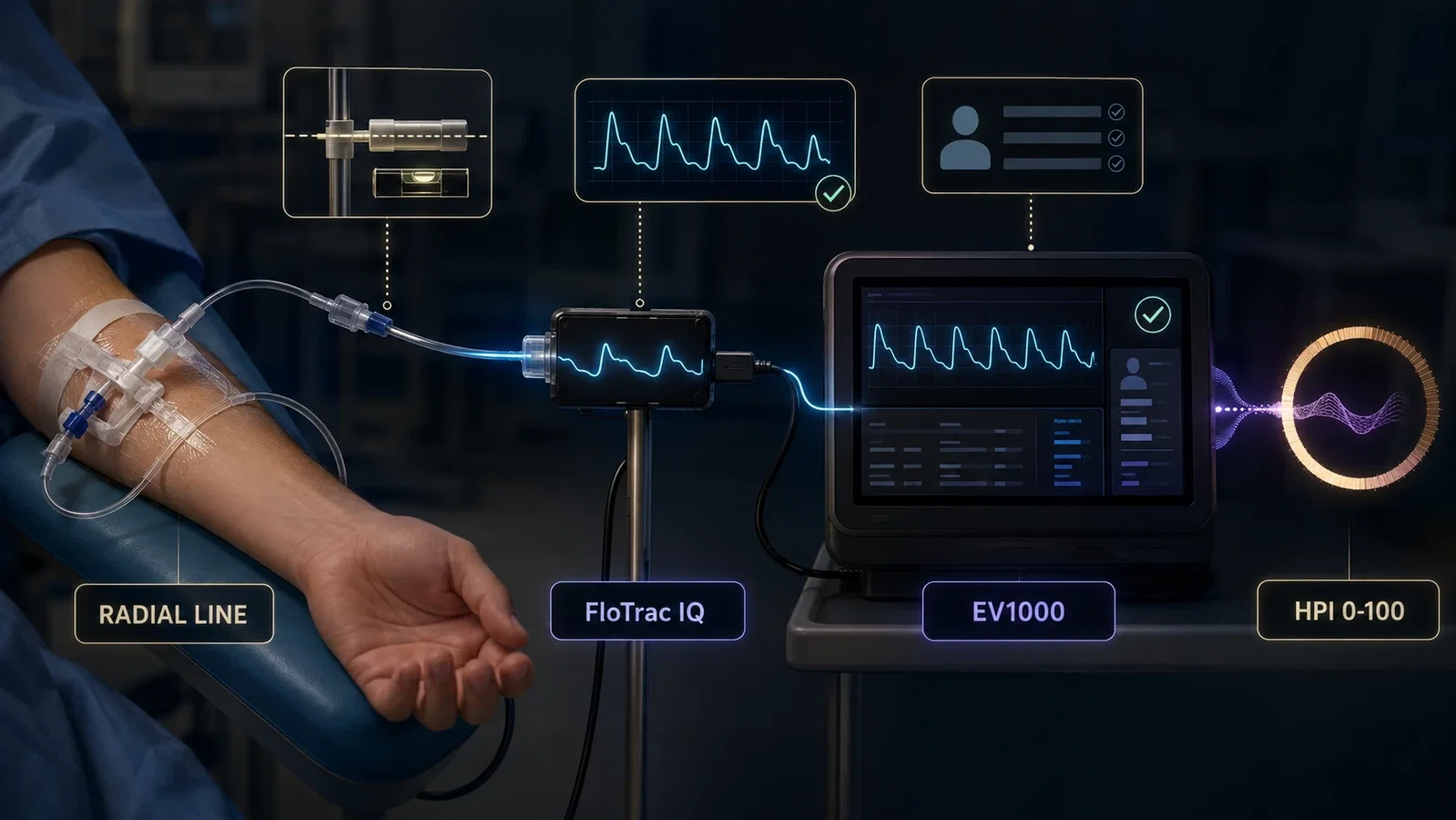
The De Novo device was not free-floating software that could analyze any hospital data stream. It ran on the Edwards EV1000 platform and was paired with a FloTrac IQ extravascular blood-pressure transducer and a radial arterial catheter.
The system included HPI, dynamic arterial elastance, a parameter related to left-ventricular contractility, and a secondary screen that gathered hemodynamic information in one place. Its input was a high-fidelity arterial waveform.
FDA therefore treated signal acquisition as part of predictive performance. The arterial line had to be reliable rather than damped, the pressure sensor had to be properly leveled and zeroed, the connections had to be correct, and patient demographics had to be entered. The review also identified conditions that could distort the waveform or derived values, including extreme peripheral vasoconstriction, hyperdynamic states, patient movement, electrosurgical interference, an intra-aortic balloon pump, and aortic regurgitation.
The clinical object was not simply an equation. It was a chain from artery to catheter, transducer, monitor, software, display, and human interpretation. A weak link anywhere in that chain could change the apparent certainty of the output.
Eighty-five opened a review, not a treatment pathway
HPI represented the likelihood of a defined event within 15 minutes. It did not display a predicted MAP, and it was not a countdown to hypotension. A low value did not exclude an event during the next 5 to 15 minutes.
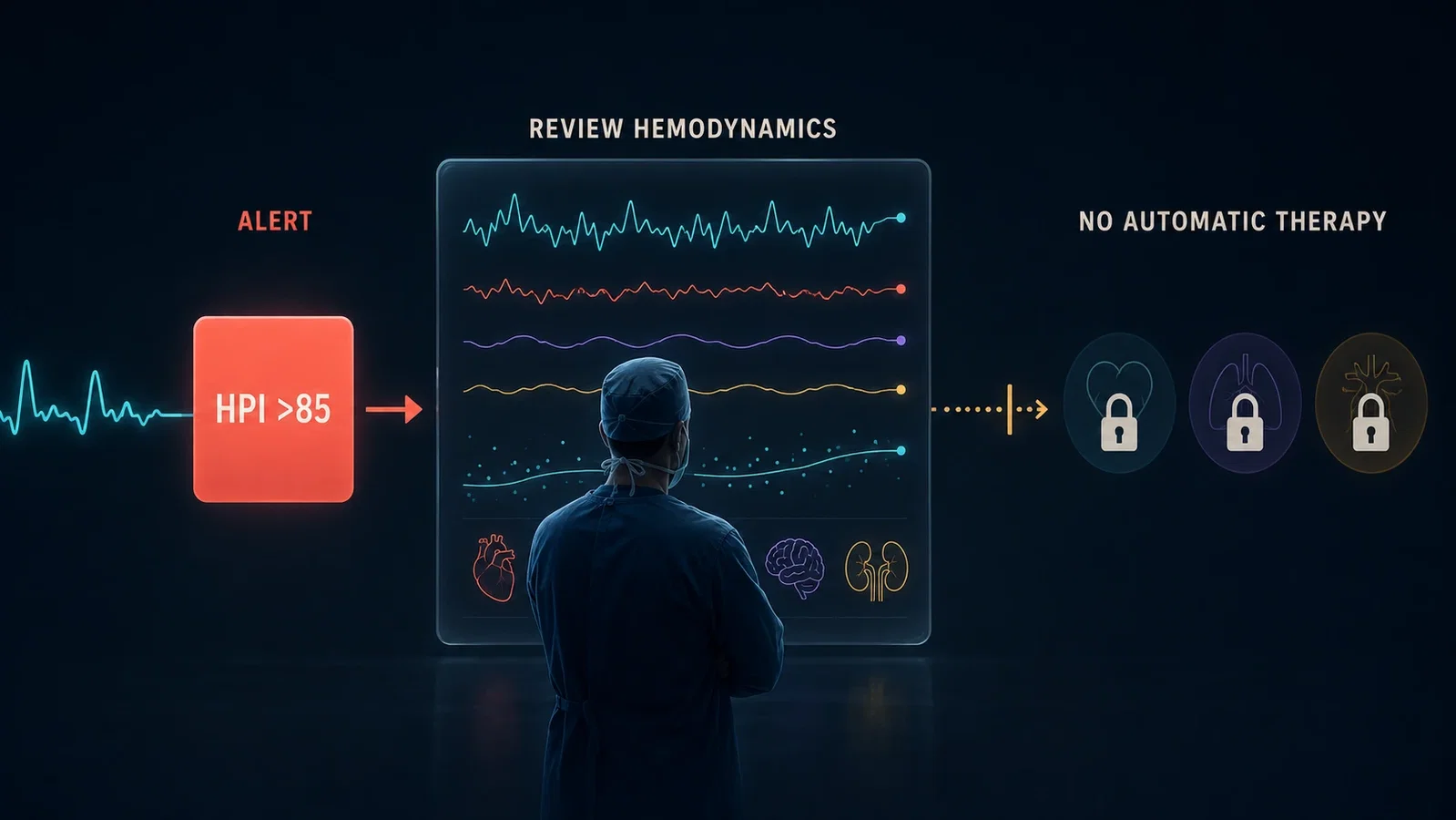
The EV1000 platform produced a red high-priority alarm when HPI exceeded 85. A high-alert popup appeared when the value remained above 85 for two consecutive 20-second updates or reached 100. Some features were compared with a baseline formed during the first ten minutes of monitoring, and the labeling warned that performance could differ during that initial period.
What happened after an alarm is where the regulatory design becomes revealing. The user was told to inspect the secondary screen, primary monitoring parameters, trends, and other vital signs to investigate the potential cause of the increased likelihood. HPI did not diagnose whether preload, afterload, contractility, bleeding, anesthesia, or another process explained the risk.
The alarm called for attention. It did not select a fluid bolus, a vasopressor, a dose, or any other treatment.
Overreliance became a formally recognized hazard
FDA identified two broad routes to harm. An erroneous output caused by software or algorithm failure could lead to delayed or incorrect treatment. A correct or incorrect output could also be misinterpreted or relied on too heavily by the user, with the same consequence.
The special controls were built around both routes. They required software verification and validation based on a comprehensive hazard analysis; characterization of algorithms and sensor hardware; data-quality controls; mitigations for user and subsystem failure; a justified prediction horizon; and sensitivity, specificity, positive predictive value, and negative predictive value reported as percentages and counts.
They also required scientific justification, validation with an independent data set, a clinical-data assessment, and human-factors work directed at misinterpretation. Labeling had to explain what the device measured, which sensors it used, what assumptions it made, how acquisition could fail, how far ahead it predicted, which populations had been studied, and how the output should be interpreted alongside other information.
This was an early regulatory answer to a recurring problem in clinical prediction. A prominent score can influence behavior even when its mathematical performance is unchanged. Interface, alarm, and trust are therefore not downstream details. They are part of the risk profile.
The performance figures belong to different records
The FDA decision summary describes two prospective operating-room validation collections. One included 52 patients from global acute-care sites. At an HPI threshold of 85, sensitivity was 83.7%, specificity 99.8%, and area under the receiver operating characteristic curve 0.95. The second included 204 patients from a university hospital, with sensitivity 65.8%, specificity 99.4%, and AUC 0.88.
The 2018 Anesthesiology article by Feras Hatib and colleagues reports a related but differently organized analysis in its structured abstract. The retrospective training source contained 1,334 patient records, 545,959 minutes of arterial waveform, and 25,461 episodes of hypotension. A prospective local external-validation source contained 204 records, 33,236 minutes, and 1,923 episodes. The algorithm used 3,022 features per cardiac cycle.
At 15 minutes before an event, the abstract reports sensitivity of 88%, specificity of 87%, and AUC of 0.95. At ten minutes the figures were 89%, 90%, and 0.95; at five minutes they were 92%, 92%, and 0.97.
The shared topic and repeated number 204 make the two records easy to collapse. They should remain separate. The FDA tables report device performance at threshold 85 in two validation sets. The journal abstract reports discrimination at three time horizons within a training and external-validation framework. Their populations, denominators, statistical questions, and presentation are not interchangeable.
The complete FDA documents are publicly accessible and were read for this article. The journal's structured PubMed and Crossref abstracts were also archived and read, but its full body remained behind subscriber access and no lawful repository manuscript was located. Claims about the article are therefore limited to what the complete abstract actually reports. Unseen tables, methods, discussion, and disclosures do not silently enter the story.
Neither record demonstrates that using HPI reduced organ injury, mortality, or another patient outcome. Predicting a waveform-defined event and improving what happens to a patient are different claims.
Authorization, launch, platform integration, and expansion were four events
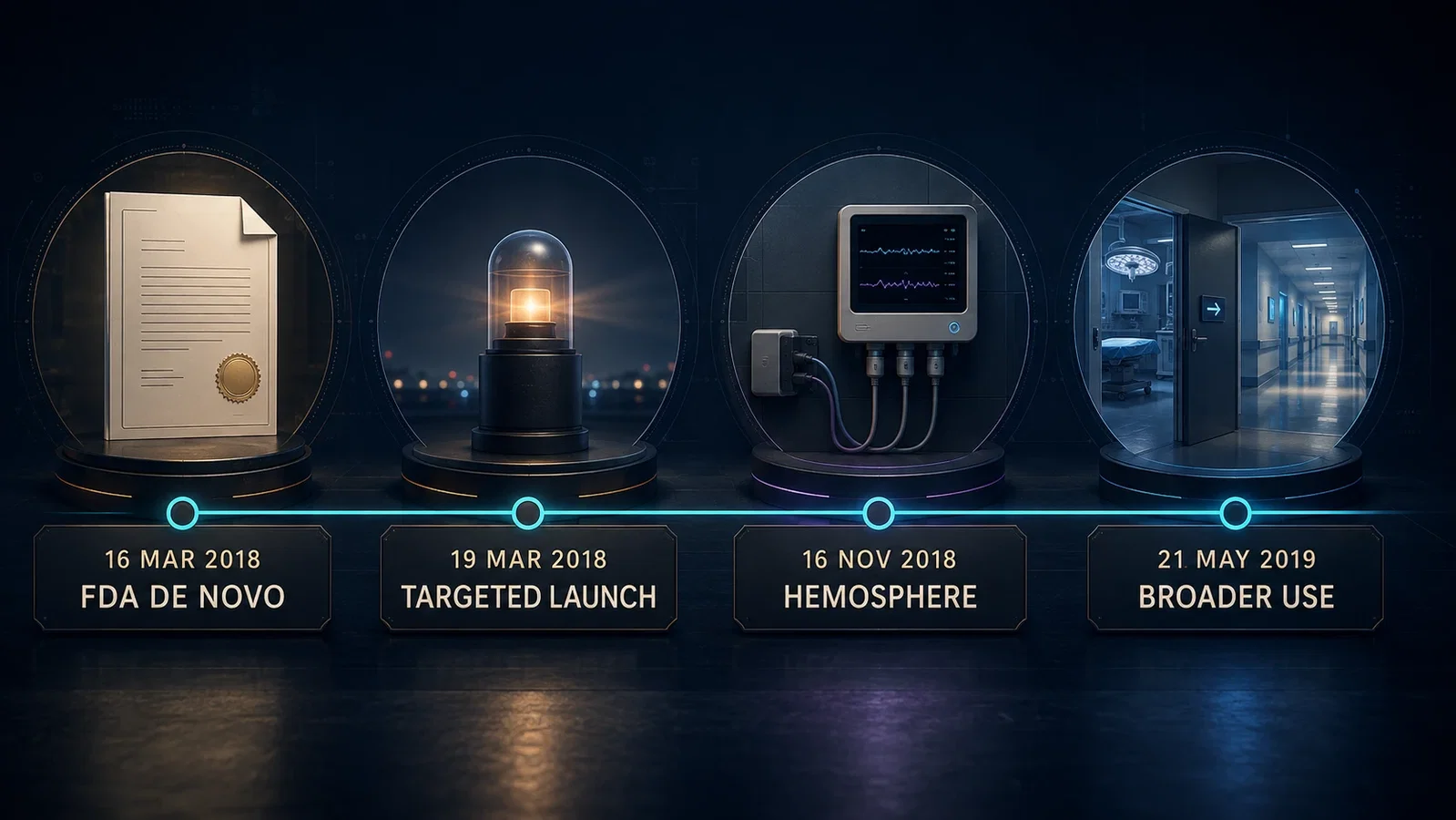
The FDA classification order said that Edwards could immediately market the device as described in the De Novo request, subject to general and special controls. That was regulatory authorization.
On March 19, three days later, Edwards announced that it would begin a targeted United States launch. That statement documents a company action, not a measured adoption rate. FDA did not itself commercialize the product, and the announcement did not prove widespread use.
The hardware chronology also matters. The March De Novo configuration ran on EV1000. HPI was added to the HemoSphere Advanced Monitoring Platform through a separate 510(k), K180881, with a decision dated November 16, 2018. The submission added the HemoSphere Pressure Cable and used the earlier De Novo feature as a predicate. Its public summary relied on bench, system, software, electrical, electromagnetic, wireless, and 32-user usability work and explicitly states that new clinical data were not required.
The original HPI indication was for operating-room patients receiving advanced hemodynamic monitoring. FDA did not expand the wording to surgical or non-surgical patients receiving such monitoring until K183646, decided on May 21, 2019.
Thus “commercialized in 2018” is too compressed to carry the history. It merges algorithm publication, a De Novo grant, a manufacturer's targeted launch, platform integration, and a later indication expansion into one vague achievement.
Prediction entered a human decision system
Descriptive monitoring asks what the patient's physiology is doing now. HPI introduced a new bedside question: what event might the recent waveform be approaching?
The FDA record did not answer that question by treating prediction as authority. It surrounded the prediction with conditions. The waveform had to be trustworthy. The index had to be interpreted within its population, threshold, and horizon. Other hemodynamics had to be reviewed. Human factors had to be tested. Overreliance had to be anticipated. A company launch could not substitute for outcome evidence.
This restraint is not an afterthought to the innovation. It is the form in which the innovation was allowed to become clinical.
HPI placed a forecast on the monitor. The clinician remained responsible for deciding what the forecast meant, whether it was credible, and what, if anything, should happen next.
Sources and reading limits
Hatib et al. is used only at abstract level.
Sources: FDA De Novo DEN160044 classification order and decision summary, granted March 16, 2018; FDA K180881, decision November 16, 2018; FDA K183646, decision May 21, 2019; Hatib F et al. Anesthesiology. 2018;129(4):663-674. PMID 29894315. DOI 10.1097/ALN.0000000000002300, abstract-level use only; Edwards Lifesciences targeted-launch announcement, March 19, 2018. All cited sources were read for this article.
Visual interpretations
These illustrations explore the setting and ideas. Depicted people, actions, instruments and documents are reconstructions, not evidence of their exact historical appearance.
Continue exploring
Related reading connects shared questions and contexts; it does not by itself establish historical influence.
- 1974: Takuo Aoyagi Makes Hypoxia Visible
- 2023: The FDA Creates a Device Type for the NOL Index
- 2024: GPT-4 Turbo Classifies Preoperative Text but Struggles to Predict Duration
- 2024: Nine Organizations Turn Preoperative Cardiac Clearance into a Continuous Pathway
The Source Room · About & Editorial Method
Sources and reading limits are stated above. Illustrations are labelled as original source images or AI-made. Historical accounts are educational; they are not current treatment instructions.