On 23 October 2024, ASA revised a key handoff sentence within an existing five-standard responsibility chain, moving the endpoint from presence in a room to presence with the patient until the receiving nurse accepts nursing care.
Reading Library · Anesthesia Epochs · 中文版
Watch the companion film
2024: ASA Standards for Postanesthesia Care — The Handoff Relay · Watch on YouTube
Historical anchor: 2024. Date details and source qualifications are explained below.

A bed crosses the operating-room threshold. The monitors are still sounding, the oxygen remains connected, and a recovery nurse is waiting. Everyone can see that the patient has arrived.
Arrival, however, is not acceptance.
On 23 October 2024, the American Society of Anesthesiologists amended its Standards for Postanesthesia Care. The document contains five standards, not eight. Its most revealing change did not add a monitor, a drug, or a score. It changed where an anesthesia care team member had to remain while responsibility was being transferred.
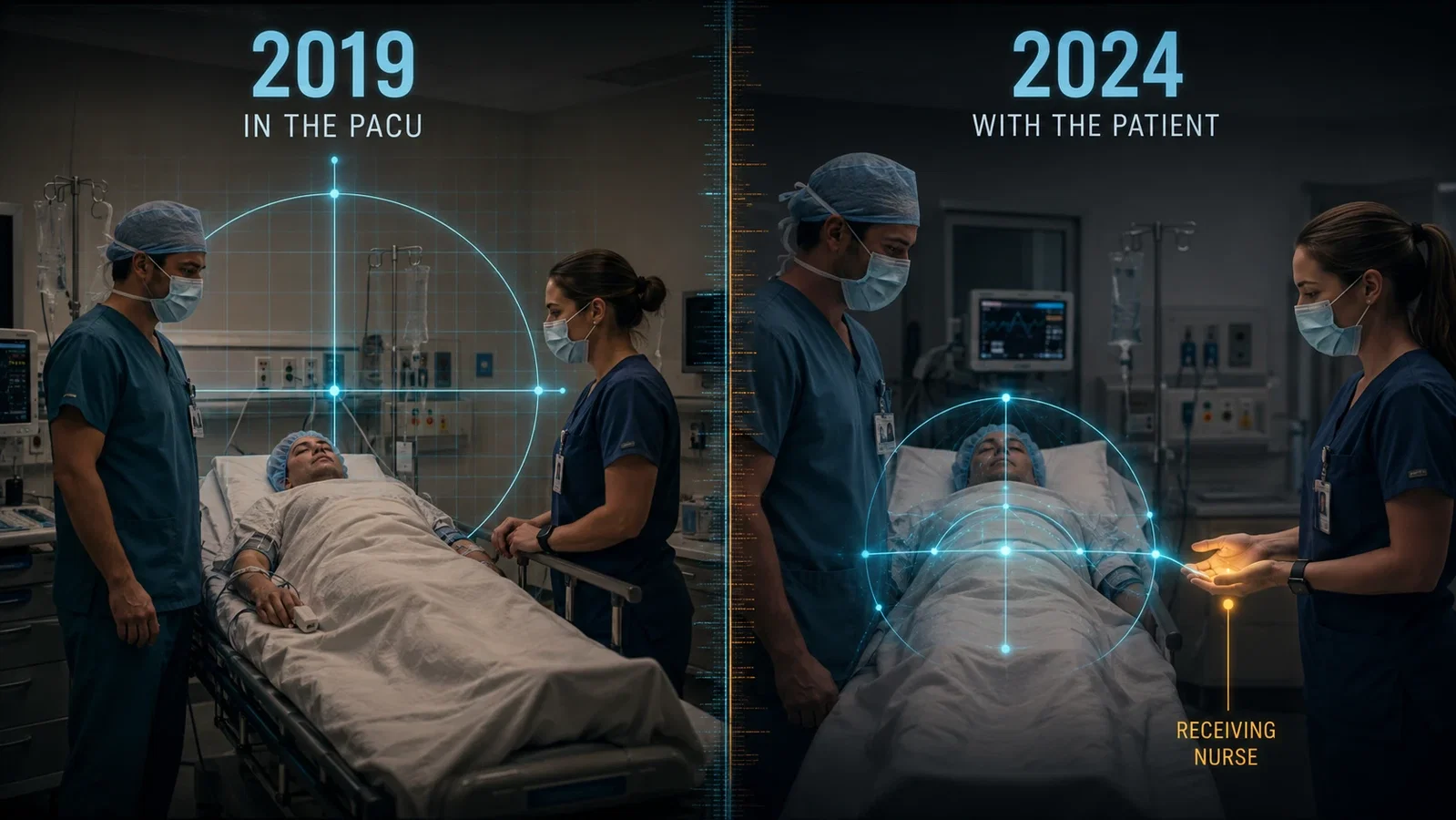
The 2019 text placed that person in the PACU until the PACU nurse accepted nursing responsibility. The 2024 text follows the patient instead. A team member remains with the patient until the receiving nurse accepts responsibility.
The room did not disappear. It ceased to be the endpoint of the sentence.
The word that matters is “with”
The current ASA page displays an original approval date of 27 October 2004 and a last-amended date of 23 October 2024. An Internet Archive capture from June 2024 preserves the preceding page, which was still labeled as amended on 23 October 2019. Another capture from April 2025 contains the 2024 wording. Together, the two archived pages create a stable comparison around a live document that ASA says remains subject to revision.
The clearest seam appears in Standard III.
In 2019, the accompanying member of the anesthesia care team was to remain “in the PACU.” The person receiving the report and accepting nursing care was repeatedly called the “PACU nurse.” In 2024, the accompanying team member remains “with the patient,” while the recipient is the “receiving nurse.”
Those are small editorial changes with a precise operational meaning. Merely entering a room does not complete the transfer. The relevant endpoint is that a receiving professional has accepted nursing responsibility for this patient.
That interpretation should not be inflated. The source does not report why the committee selected each word, and it presents no trial comparing the two phrasings. The amendment can support a history of changing language and explicit responsibility. It cannot support a claim that ASA discovered handoff in 2024 or proved that the new sentence reduced complications.
Five standards form one relay
Read in sequence, the document describes a relay from the end of anesthesia through discharge.
First comes destination and governance. Anyone who has received general anesthesia, regional anesthesia, or monitored anesthesia care is to receive appropriate postanesthesia management. A PACU or an area providing equivalent postanesthesia care must be available. The 2024 page offers an ICU as an example, not as the only possible equivalent. Admission to the PACU or equivalent follows unless the responsible anesthesiologist gives a specific order otherwise. Department-approved policies and the facility's accreditation and licensing requirements govern the care environment.
Next comes transport. A member of the anesthesia care team who knows the patient's condition accompanies the patient. Evaluation and treatment continue during the move, with monitoring and support appropriate to the patient's condition. The corridor is not an unregulated gap between two clinical units.
Then comes arrival and acceptance. The patient is re-evaluated. The accompanying team member gives a verbal report. Arrival status is documented, and information about the preoperative condition and surgical and anesthetic course reaches the receiving nurse. The team member stays with the patient until that nurse accepts nursing responsibility.
Recovery adds continuing surveillance. The patient's condition is evaluated continually in the PACU. The standard calls particular attention to oxygenation, ventilation, circulation, level of consciousness, and temperature. It retains an asterisk-marked requirement for quantitative oxygenation assessment during the initial recovery phase, together with a narrowly written obstetric limitation. An accurate recovery-period record is maintained, and an appropriate scoring system is encouraged to assist management and discharge readiness.
Discharge closes the relay without erasing responsibility. A physician is responsible for discharge from the postanesthesia care unit. Criteria, when used, require approval by the Department of Anesthesiology and the medical staff, and they may differ according to whether the patient goes to a hospital room, an ICU, a short-stay unit, or home. If the responsible physician is absent, the PACU nurse determines whether the criteria have been met, but the record still names the physician accepting responsibility for discharge.
The sequence is not a list of interchangeable tasks. Location, accompaniment, nursing acceptance, surveillance, local policy, and physician responsibility perform different jobs.
Most of the relay predates the amendment
The pre-amendment page prevents a seductive historical mistake.
All five parts of the responsibility chain were already visible in 2019. That page already required a PACU or equivalent area, a specific anesthesiologist order for bypass, knowledgeable accompaniment, continuing care during transport, arrival reevaluation, verbal report, a defined nursing-acceptance point, recovery monitoring, a written record, a scoring aid, and physician responsibility for discharge.
The 2024 amendment therefore did not build the relay from nothing. It revised how several parts were described.
The ICU example became less surgically specific. The report recipient changed from a responsible PACU nurse to a responsible nurse. Information went to a receiving nurse rather than a PACU nurse. The written document became a record of the recovery period rather than the PACU period. The score was described as an aid to management and discharge readiness rather than through a list of PACU time points. The obstetric note changed from regional anesthesia to regional analgesia.
These edits share a direction: less dependence on one room label, more emphasis on the receiving role, the patient, and the recovery process. That is an interpretation of the visible text, not a claim about an undocumented committee intention.
Nor does the changed scoring sentence prove that patients should be scored less often. It shows only that the five-item standard no longer names the old admission, interval, and discharge time points. Local policy and clinical need still shape practice.
A score can inform discharge; it cannot own it
Recovery scores invite automation. A number rises above a threshold, an electronic gate turns green, and the patient appears ready to leave.
The 2024 standard stops short of that model.
It encourages an appropriate scoring system as an aid. It does not name Aldrete, PADSS, or another proprietary or published tool. It does not supply one universal cutoff. Most importantly, it does not transfer responsibility to the score.
Standard V still assigns discharge to a physician. The PACU nurse may determine that locally approved criteria are met when the responsible physician is absent, but a physician accepts responsibility and is identified in the record. Score, criteria, nursing assessment, and physician responsibility are connected layers, not synonyms.
The destination-specific clause reinforces the point. Readiness for a hospital room is not identical to readiness for an ICU, a short-stay unit, or home. A professional standard provides an architecture; local institutions must define the usable criteria within their own environments.
The asterisk is narrow
Two kinds of flexibility appear in the document, and they should not be collapsed.
The preamble says that the responsible anesthesiologist may exceed the standards on clinical judgment. A minimum is not a ceiling.
The footnote addresses waiver. Under extenuating circumstances, the responsible anesthesiologist may waive requirements marked with an asterisk, and the page recommends recording the fact and reasons in the medical record. On the visible standard, the asterisk is attached to quantitative oxygenation assessment during initial recovery.
This is not permission to waive all five standards. It is not a convenience exception with no trace. It is a narrow route tied to a marked requirement, unusual circumstances, a responsible physician, and recommended documentation.
The accompanying obstetric sentence is equally bounded. It says that the initial quantitative-oxygenation clause is not intended for recovery after regional analgesia used for labor and vaginal delivery. It does not exclude every obstetric patient from postanesthesia standards.
A practice standard is not a guideline, a trial, or a statute
ASA maintains a separate official statement explaining its practice-parameter taxonomy.
In that framework, a practice standard supplies rules or minimum clinical requirements and represents generally accepted patient-management principles. A practice guideline is different. It offers evidence-based recommendations developed through systematic review and is not intended as a standard or minimum requirement. A practice advisory addresses a field in which the evidence is more limited still.
The 2013 Practice Guidelines for Postanesthetic Care belongs to the second category. Its complete 17 pages update a 2002 guideline and review evidence about assessment, nausea and vomiting, emergence, antagonists, and discharge. It is useful context for how ASA distinguishes evidence-based recommendations from standards. It is not the 2024 five-standard document, and its medication details cannot be imported into the amendment.
The distinction also works in the other direction. Calling something a minimum professional standard does not turn it into a randomized experiment. The ASA pages do not show that every institution implemented the 2024 wording or that complication and mortality rates improved afterward. The standard's own preamble says that it encourages quality but cannot guarantee a particular outcome.
Neither does an ASA standard automatically become identical to legislation or a universal negligence test. ASA says that practice parameters are interpreted within local institutions, organizations, and practice conditions, and that they are not the unique or exclusive indicators of appropriate care. How a jurisdiction uses a professional standard is a separate legal question.
Responsibility has to be accepted, not assumed
The 2024 amendment is historically modest. It introduced no new machine and announced no therapeutic discovery. It rearranged several nouns around one of medicine's most vulnerable transitions.
The recovery room still matters. Monitors, written records, scores, and approved criteria still matter. Yet a room cannot accept responsibility, and a score cannot accept responsibility. People do that.
One person accompanies a patient while anesthesia is ending. Another receives the report and accepts nursing care. An anesthesiologist coordinates medical care. A physician accepts responsibility for discharge. Institutional policies define how the chain works in that place.
The 2019 sentence kept the accompanying professional in the PACU.
The 2024 sentence keeps that professional with the patient.
The threshold stayed where it was. The center of responsibility moved.
Sources and reading limits
This is a history of a professional standard, not individualized medical or legal advice.
Sources: American Society of Anesthesiologists. Standards for Postanesthesia Care, amended 23 October 2024, original approval 27 October 2004; official page archived before and after amendment by the Internet Archive; ASA Statement on Practice Parameters, reaffirmed 13 October 2021; Apfelbaum JL et al. Anesthesiology. 2013;118(2):291-307. PMID 23364567. DOI 10.1097/ALN.0b013e31827773e9.
Visual interpretations
These illustrations explore the setting and ideas. Depicted people, actions, instruments and documents are reconstructions, not evidence of their exact historical appearance.


Continue exploring
Related reading connects shared questions and contexts; it does not by itself establish historical influence.
Related reading
- 1953: Virginia Apgar Gives the Newborn a Common Language
- 1974: Takuo Aoyagi Makes Hypoxia Visible
- 2011: Lifebox Works Toward Global Pulse-Oximetry Access
- 2013: An Old Airway Algorithm Makes Room for Video Laryngoscopy
- 2024: Nine Organizations Turn Preoperative Cardiac Clearance into a Continuous Pathway
The Source Room · About & Editorial Method
Sources and reading limits are stated above. Illustrations are labelled as original source images or AI-made. Historical accounts are educational; they are not current treatment instructions.