From competition at the receptor to host–guest encapsulation in plasma.
Reading Library · Anesthesia Epochs · 中文版
Watch the companion film
2002: Sugammadex — A Ring for Rocuronium · Watch on YouTube
Historical anchor: 2002. Date details and source qualifications are explained below.
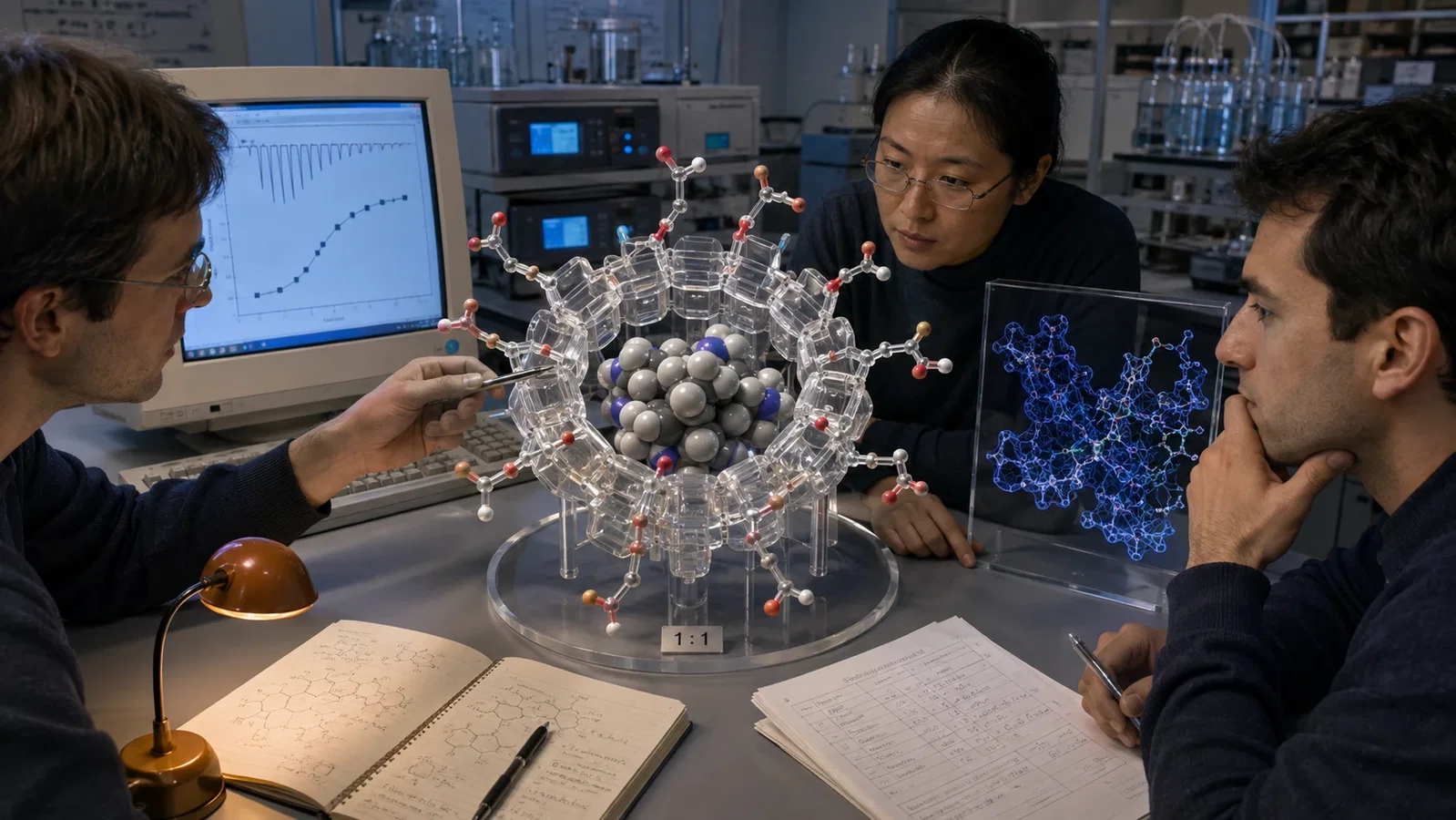
The decisive move did not occur at the receptor.
For decades, reversal of nondepolarizing neuromuscular block meant increasing acetylcholine at the neuromuscular junction. Drugs such as neostigmine slowed acetylcholine breakdown, allowing more transmitter to compete with the blocker. The strategy could work, but it did not remove the blocking drug. Its effect had a ceiling, and the same rise in acetylcholine acted beyond skeletal muscle, which is why an antimuscarinic drug such as atropine or glycopyrrolate was usually needed beside it.
On 18 January 2002, Anton Bom and ten coauthors published a different proposition in Angewandte Chemie International Edition. Instead of trying to win the competition at the neuromuscular junction, they asked whether the free blocker could first be reduced in plasma. Their candidate, Org 25969, offered rocuronium a molecular host.
I. The Paper Was a Public Milestone, Not a Birth Certificate
The journal communication anchors this article, but the work did not begin in 2002. One patent line claimed priority on 13 August 1999. Its PCT application was filed in 2000 and published as WO 01/12202 in February 2001. The patent defined a chemical chelator as a host and the neuromuscular blocking agent as its guest. Noncovalent intermolecular forces held the resulting host–guest complex together. The document used the related terms inclusion, encapsulation, and chemical chelation.
A second line claimed priority on 29 November 1999 and appeared as WO 01/40316 in June 2001. It narrowed the program to 6-mercapto-cyclodextrin derivatives, provided nineteen synthesis examples, and compared their reversal activity in anaesthetized guinea pigs. By the time the 2002 communication appeared, the underlying idea had already passed through patent disclosure, molecular design, synthesis, and animal screening.
Calling 2002 the year sugammadex was invented would flatten that sequence and turn a large collaboration into a single moment. What happened in January 2002 was more specific: a developed host–guest reversal concept entered a peer-reviewed journal.
II. Designing a Cavity Instead of Another Antagonist
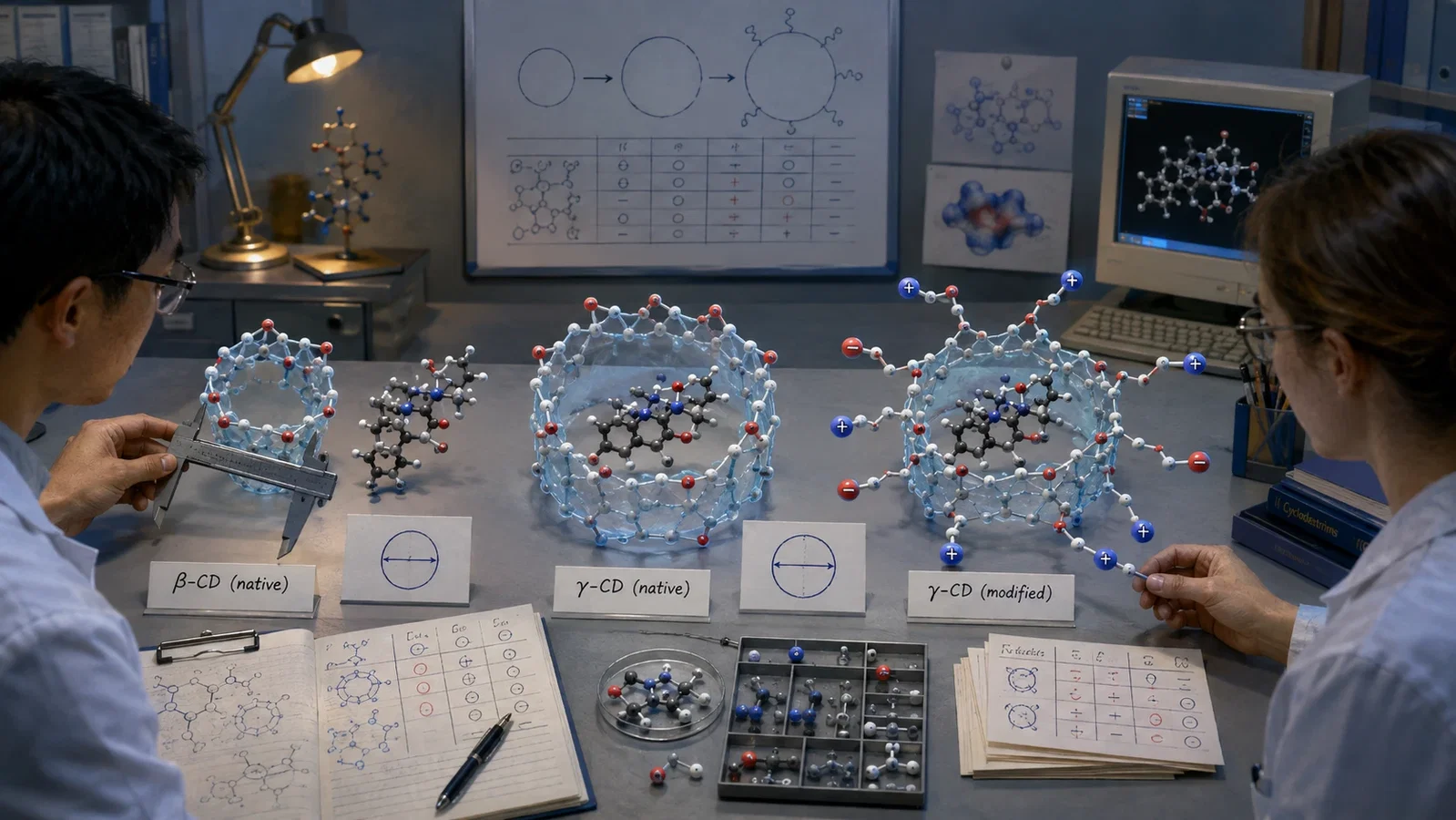
A cyclodextrin is a ring assembled from glucose units. Its exterior is hydrophilic, while its internal cavity is comparatively lipophilic. A guest molecule of the right shape can sit within that cavity in water. Alpha-, beta-, and gamma-cyclodextrins contain different numbers of glucose units and therefore offer different cavity dimensions. Gamma-cyclodextrin, with eight glucose units, provided a more suitable space for the steroidal framework of rocuronium.
The first patent used a Job plot to identify a 1:1 complex between rocuronium and native gamma-cyclodextrin. Nuclear magnetic resonance measurements gave association constants of about 10,000 to 20,400 M−1 for native gamma-cyclodextrin, compared with 3,100 to 3,900 M−1 for native beta-cyclodextrin. Those values established a starting geometry, not the final drug.
The researchers then modified the cyclodextrin rim. Cavity size, hydrophobic contact, hydrogen bonding, electrostatic attraction, van der Waals forces, and the reach of each side chain could all change how well the host fit its guest. WO 01/40316 turned that design problem into a comparative table.
Its Example 4 was 6-per-deoxy-6-per-(2-carboxyethyl)thio-gamma-cyclodextrin sodium salt. In the guinea-pig model, its ED50 for 50% reversal was 0.09 µmol/kg, with 97% maximum reversal at 0.53 µmol/kg. Parent gamma-cyclodextrin had an ED50 of 4 µmol/kg, and parent beta-cyclodextrin an ED50 of 20 µmol/kg. The comparison showed how strongly chemical modification could alter activity.
The patent table did not label Example 4 “sugammadex” or “Org 25969.” Its chemical name and experimental result can be reported from the patent; the later drug identity must come from the publisher and regulatory records. Nor was Example 4 simply the smallest ED50 in the table. Medicinal chemistry was selecting a usable profile, not awarding a prize to one isolated number.
III. What the 2002 Evidence Had Reached
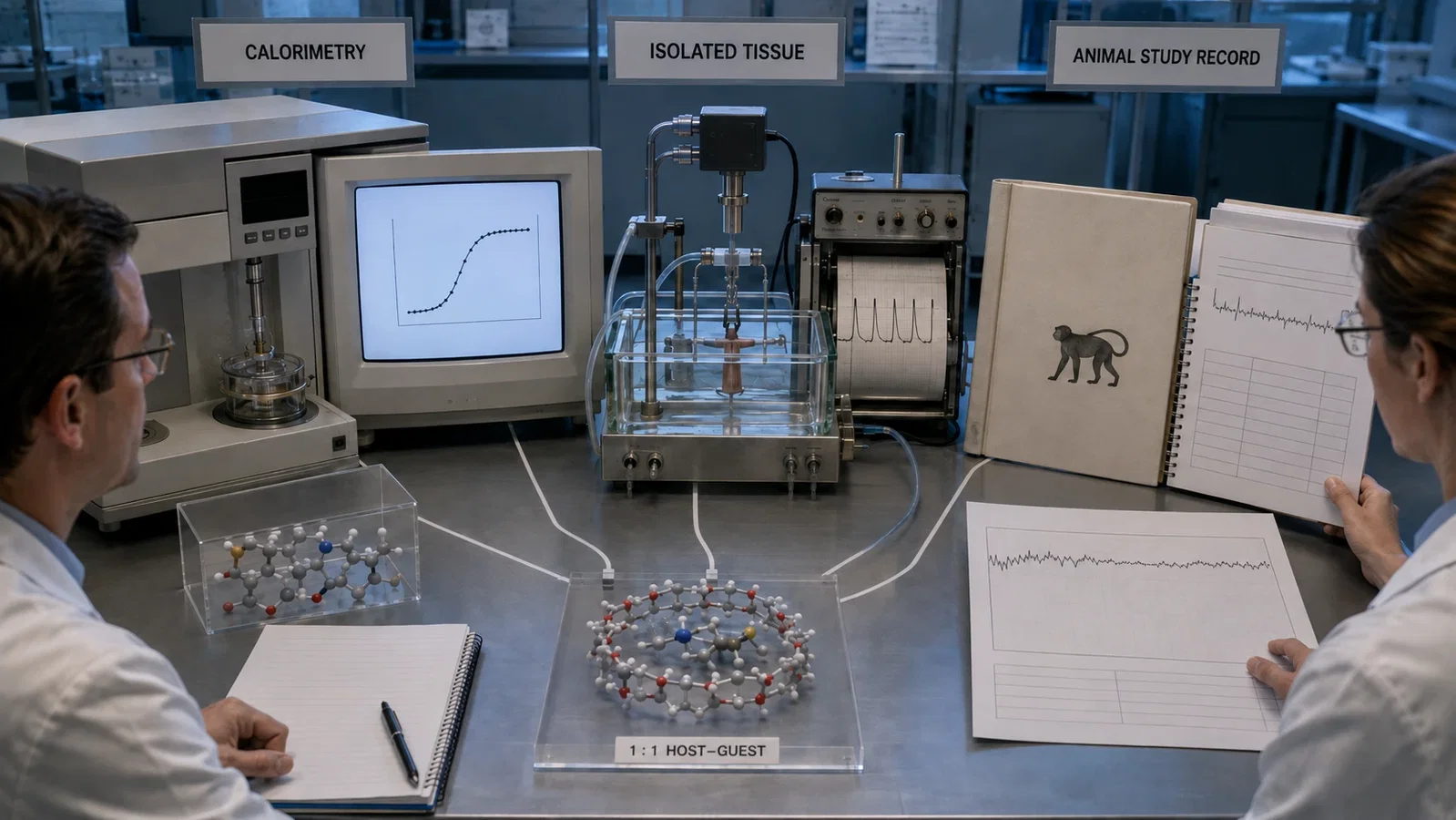
The publisher's public graphical abstract describes Org 25969 and rocuronium as a high-affinity binary host–guest complex, with an association constant of approximately 10^7 M−1. The public acknowledgements also widen the authorship story. They credit additional scientists for scale-up, in-vitro and in-vivo pharmacology, analytical work, graphical presentation of the X-ray crystal structure, and independent reproduction of the calorimetry data. The communication represented a network of synthesis, measurement, structural analysis, and pharmacology rather than one investigator's flash of insight.
The experimental endnotes that the publisher makes public show where the evidence stood. In the mouse phrenic-nerve hemidiaphragm preparation, rocuronium at 3.60 µM produced about 90% twitch block. Reversal agents were then added cumulatively, and the investigators recorded 50% and maximum recovery. In rhesus monkeys, they again produced about 90% block and compared spontaneous recovery, atropine 15 µg/kg plus neostigmine 40 µg/kg, and Org 25969 at 1.0 mg/kg.
The methods visible in the publisher record describe physicochemical, isolated-tissue, and animal experiments, not treated patients. The readable 2002 evidence provided a mechanistic rationale for taking the candidate forward into clinical development, not a claim that human recovery was already faster or safer. A scene of a patient suddenly moving, breathing, or being extubated would place a later clinical story inside the wrong year.
IV. Moving the Blocker Back into Plasma
The European regulator later provided a fuller official account of Org 25969. Sugammadex is a modified gamma-cyclodextrin. It forms 1:1 inclusion complexes with rocuronium or vecuronium. After intravenous administration, complex formation reduces the amount of free neuromuscular blocker available to bind receptors at the neuromuscular junction. Regulatory data also showed an increase in plasma rocuronium or vecuronium after sugammadex was given, consistent with redistribution from the site of action into plasma as the complex formed.
Sugammadex therefore does not compete at the nicotinic acetylcholine receptor, and it does not chemically destroy rocuronium. It changes the balance between free and complexed drug. The fit between cavity, side chains, and guest gives that change its selectivity.
Selectivity is both the method's strength and its boundary. The later European indication covered blockade induced by rocuronium or vecuronium. The regulator explicitly stated that sugammadex did not reverse block caused by succinylcholine or benzylisoquinolinium compounds. It should not be described as an antidote to every neuromuscular blocker, and certainly not as a general reversal agent for classic d-tubocurarine merely because curare begins this branch of the history.
V. Curare's Problem, Rocuronium's Host
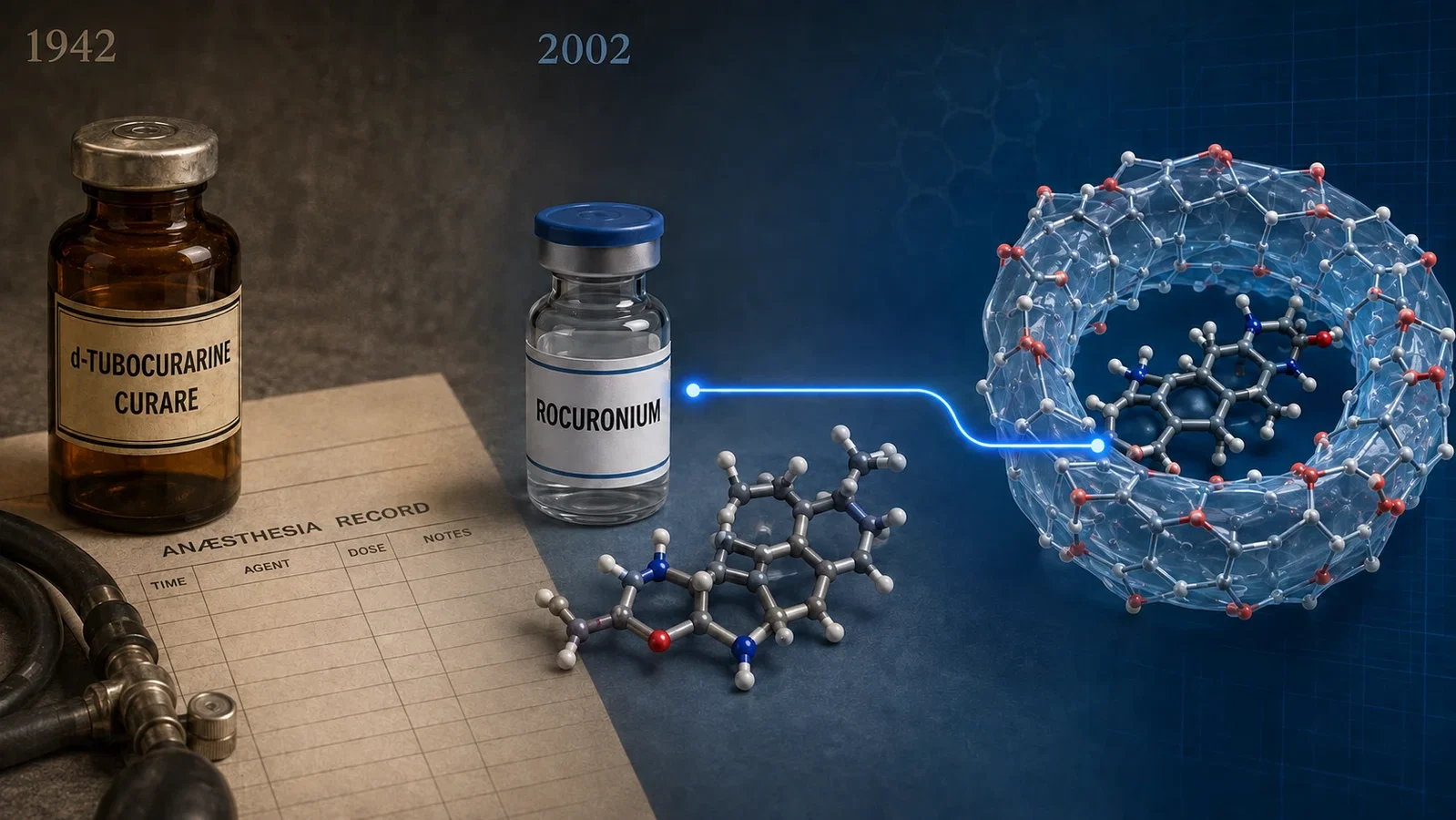
Griffith and Johnson separated muscular relaxation from anaesthetic depth in 1942. Their clinical use of curare made neuromuscular block an independently adjustable component of anaesthesia. The 2002 host–guest program made a second separation. It began to detach reversal of a selected blocker from the broad cholinergic strategy used for many nondepolarizing agents.
The connection between the two articles is therefore a problem lineage, not a direct drug pair. Sugammadex was not designed as the universal answer to the d-tubocurarine in Griffith's glass vial. Rocuronium was the guest. The shared question was what followed from deliberately creating neuromuscular block: the anaesthetist also had to monitor it, support the patient's ventilation, and bring the block to an end with equal precision.
On 25 July 2008, the European Commission authorised Bridion for reversal of neuromuscular block induced by rocuronium or vecuronium. Its clinical trials, risk–benefit assessment, and regulatory conditions belong to the next article in this branch. The 2002 article records the earlier conceptual shift. Reversal no longer had to begin with more transmitter at the receptor. It could begin with the fit of one guest inside one molecular cavity.
Sources and reading limits
Sources: Bom A et al. Angew Chem Int Ed. 2002;41(2):265–270 (PMID 12491405; DOI 10.1002/1521-3773(20020118)41:2<265::AID-ANIE265>3.0.CO;2-Q; publisher public content read, complete body access controlled); WO 01/12202 A2; WO 01/40316 A1; European Medicines Agency. Bridion EPAR Public Assessment Report. 2008, EMEA/H/C/000885.
Sources and reading limits are stated above. Illustrations are labelled as original source images or AI-made. Historical accounts are educational; they are not current treatment instructions.
Visual interpretations
These illustrations explore the setting and ideas. Depicted people, actions, instruments and documents are reconstructions, not evidence of their exact historical appearance.
Continue exploring
Historical connections
These links follow specific development, adoption or citation connections recorded in the underlying research. They do not imply that history had one inevitable path.
- Later connection: 2008: Bridion Enters the European Union
Related reading
Related reading connects shared questions and contexts; it does not by itself establish historical influence.
- 1942: Griffith and Johnson Use Curare in Twenty-Five Patients
- 2015: The FDA Approves Sugammadex After Seven Years
- 2020: Japan Approves Remimazolam for General Anesthesia
The Source Room · About & Editorial Method
Continue this reading route
Stop 7 of 7 · Back to route · From Ether to Balanced Anesthesia
Previous · 1993: Kehlet and Dahl Make the Case for Balanced Analgesia