FDA had already seen rapid reversal; speed became approvable only after hypersensitivity, coagulation, and study reliability acquired reviewable boundaries.
Reading Library · Anesthesia Epochs · 中文版
Watch the companion film
2015: Sugammadex — The Long Road to FDA Approval · Watch on YouTube
Historical anchor: 2015. Date details and source qualifications are explained below.

The risks were not insignificant. They were monitorable.
That distinction sits near the end of the Food and Drug Administration's 2015 Summary Review for sugammadex. It also explains why the drug's United States history cannot be reduced to a fast reversal agent waiting seven years for a slow regulator.
FDA had accepted the efficacy evidence during its first review cycle. The application did not remain unresolved because reviewers could not see that sugammadex reversed rocuronium- or vecuronium-induced neuromuscular block. It remained unresolved because a dramatic pharmacologic effect did not answer quieter questions about hypersensitivity, anaphylaxis, coagulation, occasional delayed or absent response, and the reliability of studies built to measure those risks.
The eventual approval on 15 December 2015 was therefore not a declaration that the safety questions had disappeared. It was a decision that efficacy, risk characterization, study integrity, labeling, monitoring, and continuing obligations had become coherent enough to support use in adults undergoing surgery.
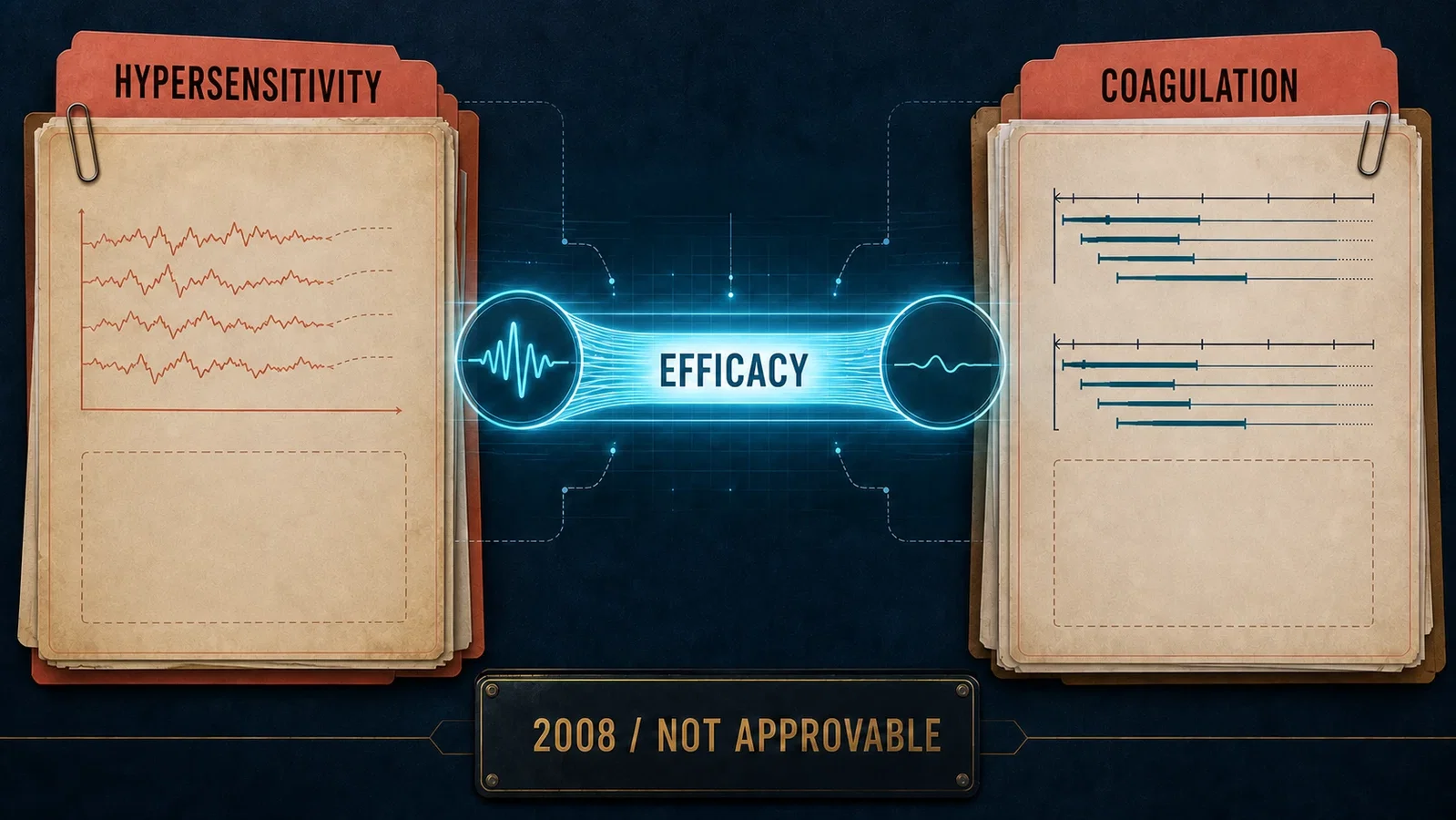
Three regulatory objects tell that story: a 2008 letter that efficacy could not close, a sequence of hypersensitivity studies whose data had to become trustworthy, and an approval package that kept uncertainty visible.
A letter with two open files
The new drug application was dated 30 October 2007 and received by FDA the following day. On 31 July 2008, the agency issued a document formally headed NDA NOT APPROVABLE.
The language matters. It belongs to the regulatory framework of its time and should not be retroactively renamed a Complete Response letter. More important, the deficiencies it listed were clinical safety questions, not a failure to demonstrate reversal.
One open file concerned hypersensitivity and anaphylaxis. The development program had not adequately characterized reactions observed during clinical trials, particularly what might happen after repeat exposure. An approximate 1% anaphylaxis signal in healthy subjects receiving a single dose, together with possible Type I reactions in surgical patients, led FDA to request a study that could define frequency, timing, clinical features, and any immunologic basis after appropriately spaced repeated doses.
That approximate 1% cannot be lifted from its early healthy-subject setting and advertised as a universal perioperative incidence. It functioned as a reason to investigate, not as a settled denominator for all future patients.
The second file concerned coagulation. In vitro observations suggested changes in aPTT, PT, and INR. A comparison of hemorrhagic events in the development program had also left a signal whose mechanism and clinical importance were unclear. FDA wanted a surgical study capable of separating laboratory change from clinically relevant bleeding.
The central efficacy channel was already visible. It simply could not close either safety file.
A study can exist without answering its question
The first dedicated attempt to address repeat-exposure hypersensitivity was Study P06042. Its result did not fail because the question was unimportant. It failed as regulatory evidence because FDA could not rely on how the answer had been produced.
In its 20 September 2013 Complete Response letter, the agency described protocol deviations and deficiencies in case-report forms and other data capture. Those defects affected the validity, reliability, and integrity of the trial. A percentage extracted from that record could not bear the weight the application placed upon it.
This should not be turned into a story of fraud. The official record concerns study conduct, documentation, and interpretability; it does not establish criminal intent or authorize a morality play about individual investigators.
Its historical importance lies elsewhere. Drug regulation evaluates not only the answer but the path by which the answer was obtained. A study designed for the correct clinical question is still inadequate when exposure, observation, adjudication, or documentation cannot be reconstructed with sufficient confidence.
P06042 made data provenance part of the drug's safety profile.
P101 and the difference between more data and reviewable data
The replacement study, P101, was a randomized, double-blind, placebo-controlled parallel-group trial in healthy volunteers. It evaluated adjudicated hypersensitivity after repeated single administrations.
Yet P101 also encountered a review boundary. On 22 April 2015, FDA issued another Complete Response letter, this time identifying protocol deviations, potential unblinding within the sponsor's statistical environment, and associated data-integrity questions. The agency asked for sensitivity analyses comparing participants with and without protocol violations and results before, during, and after the possible unblinding interval. Source documents would have to support those comparisons, or a repeat study might be necessary.
The June 2015 response did more than submit the same total again. Its analyses tested whether the suspected-hypersensitivity pattern materially changed across the period of possible unblinding. FDA reported no meaningful shift. The remaining four clinical sites were inspected: one received a Voluntary Action Indicated classification, but the observed violations were considered unlikely to change the primary safety analysis; three were classified No Action Indicated. Reviewers found no evidence that site personnel knew treatment allocation, and they considered the study data usable for a regulatory decision.
The sequence matters. A sensitivity analysis did not prove that every datum was perfect, and an inspection did not certify an infallible trial. Together they answered the narrower question that had blocked the review: whether the observed result was sufficiently robust to protocol deviations and possible unblinding to be relied upon.
Denominators as regulatory memory
P101 randomized and treated 375 participants. Seventy-six received placebo, 151 received sugammadex at 4 mg/kg, and 148 received sugammadex at 16 mg/kg. The two active groups therefore contained 299 unique healthy volunteers exposed to sugammadex.
Using a predefined list of possible signs and symptoms and a targeted assessment, the applicant identified 137 suspected hypersensitivity cases in 94 participants. Adjudication identified one case of anaphylaxis. It occurred after the first dose in the 16 mg/kg group. Within this study, the frequency was therefore 1 among 299 sugammadex-exposed participants, or 0.33%.
Each number describes a different object. The 375 are all treated participants. The 299 are unique participants who received sugammadex. The 137 are suspected cases, not people. The 94 are the participants in whom those cases were identified. The single adjudicated anaphylaxis case supplies the numerator for 1/299.
Removing any of those labels changes the meaning.
Suspected hypersensitivity appeared more often in the 16 mg/kg group, generally within 35 minutes, and more often after the first exposure. The mechanistic evidence did not establish a clear pathway. The total evidence did not suggest that sensitization developed through repeated exposure or that risk increased with repeat dosing.
That conclusion does not mean repeated exposure was proved safe. It means P101 did not show the trend the 2008 letter had anticipated. FDA's allergy reviewers still concluded that sugammadex causes hypersensitivity and anaphylaxis and that the signal appeared stronger at higher doses. They also noted how difficult it was to compare that risk with the shifting background of other agents used during anesthesia.
P101 narrowed uncertainty. It did not abolish it.
Coagulation without a victory claim
Study P07038 addressed the other file opened in 2008. It enrolled patients undergoing major orthopedic surgery who also received heparin or low-molecular-weight heparin thromboprophylaxis. Sugammadex was compared with usual care, which included neostigmine or spontaneous recovery according to the clinical plan.
The all-patients-as-treated population included 596 patients in the sugammadex group and 588 in usual care. Within 24 hours, adjudicated unanticipated bleeding events occurred in 17 of 596 patients, or 2.9%, and 24 of 588, or 4.1%. The estimated relative risk was 0.70 with a 95% confidence interval from 0.38 to 1.29.
In that defined population, the analysis did not show increased adjudicated bleeding with sugammadex. Because the interval included no difference, it also did not prove that sugammadex prevented bleeding.
Laboratory effects remained measurable. At 10 minutes, the estimated difference from usual care was an increase of 5.5% in aPTT and 3.0% in PT/INR. By 60 minutes, both estimated differences were about 0.9%.
The study therefore closes off two tempting simplifications. Early coagulation signals cannot be retold as proof of universal major bleeding. A negative clinical-bleeding comparison in one surgical context cannot be retold as proof of no coagulation effect.
The regulatory answer preserved both observations at their proper scale.
The fourth cycle was an act of assembly
FDA described the 2015 submission as the fourth review cycle since the 2008 action. By then, chemistry and manufacturing, nonclinical work, clinical pharmacology, and efficacy did not contain an issue that precluded approval. The remaining task was to assemble a reviewable safety account.
That account included the P101 sensitivity analyses and inspections, the coagulation study, an expanded clinical-development safety database, worldwide postmarketing experience, cardiac-rhythm events, and the possibility of delayed or absent response. It also had to acknowledge that the healthy-volunteer hypersensitivity study could not precisely estimate outcomes in patients with varying illness and comorbidity.
On 6 November 2015, the Anesthetic and Analgesic Drug Products Advisory Committee voted 13 to 1 that hypersensitivity and anaphylaxis risk had been sufficiently characterized. It voted 14 to 0 that cardiac-dysrhythmia risk had been sufficiently characterized, and 14 to 0 that the efficacy, safety, and overall risk-benefit profile supported approval.
Committee members still wanted better information about people with morbid obesity, patients with significant comorbid conditions, and apparent nonresponders. They judged that these questions did not have to be resolved before approval.
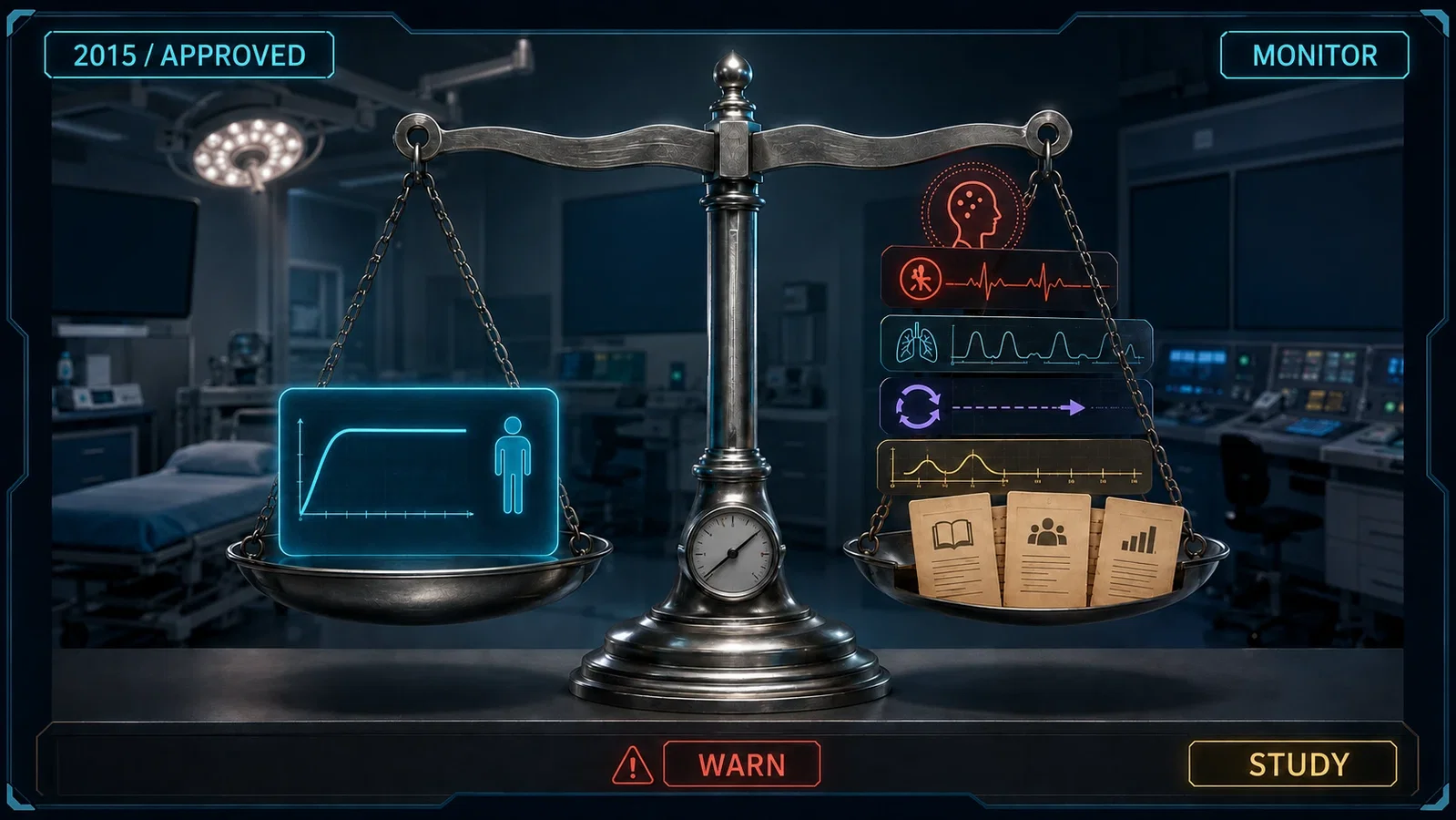
Approval was possible because unresolved questions had acquired a location in the regulatory system. Some became warnings. Some became monitoring expectations. Some became postmarketing requirements.
None had to be pretended away.
What the initial label kept visible
The final indication covered reversal of neuromuscular blockade induced by rocuronium bromide or vecuronium bromide in adults undergoing surgery.
The initial 2015 prescribing information linked administration to measured depth of block and described 2, 4, and 16 mg/kg contexts. Those are historical label facts, not dosing instructions for this article or its images. Current patient care requires current labeling, contemporary guidance, and individual clinical judgment.
More important for this article, the label retained boundaries. It warned of anaphylaxis and hypersensitivity; marked bradycardia, at times with cardiac arrest; the need for respiratory monitoring; prolonged or recurrent neuromuscular blockade; constraints around re-administration of neuromuscular blockers; interactions; coagulation considerations; and use in severe renal impairment.
The approval letter added a deferred pediatric study and postmarketing requirements. FDA required further work on apparent nonresponders, cardiac arrhythmias in patients with ASA physical status 3 or 4, and dosing and safety in morbid obesity.
An approval package is sometimes imagined as the document that closes a case. Here it also functioned as an inventory of what the decision did not close.
A monitored setting was part of the conclusion
The final Summary Review did not call the risks trivial. It described them as not insignificant but monitorable, emphasizing the clinical setting in which sugammadex would be used.
That setting was not a rhetorical convenience. An adult undergoing surgery is already within a system capable of observing ventilation, neuromuscular recovery, rhythm, and an acute reaction, and of responding when a problem occurs. Monitoring was therefore part of the benefit-risk frame, not scenery placed behind the drug.
This does not mean that anything becomes acceptable inside an operating room. It means the regulatory judgment was conditional on a particular use context, a labeled scope, and a care system able to detect and manage relevant events.
Nor was the decision a global first. The Summary Review recorded that sugammadex had already been approved in 75 countries and marketed in more than 50, according to the applicant. The United States action belongs late in the international chronology. Its historical value is not priority but the unusually visible record of how one regulator converted persistent safety and evidence-integrity questions into a bounded approval.
When speed acquired accountability
Sugammadex entered the FDA review with an effect that could be measured in minutes. It left with a record measured in letters, protocols, denominators, inspections, warnings, and required studies.
The 2008 Not Approvable letter separated efficacy from two open safety files. The 2013 Complete Response showed that a study cannot answer a risk question when its data trail cannot be relied upon. The 2015 Complete Response required the replacement study to survive sensitivity analysis and inspection. The final approval then carried the remaining uncertainty forward rather than deleting it.
Seven years did not make rapid reversal slower. They made its public claim more exact.
Speed became approvable only after risk acquired a denominator, evidence acquired a trustworthy path, and use acquired a monitored setting and a plan.
Sources and reading limits
Sources: United States Food and Drug Administration, NDA 022225 Bridion (sugammadex sodium) Other Action Letters, Summary Review for Regulatory Action, approval package and approval letter effective 2015-12-15, initial 2015 prescribing information, and bundled statistical reviews; Drugs@FDA and openFDA identity records. All cited sources were read for this article. The initial label is used only as a historical source and not as current clinical instruction.
Visual interpretations
These illustrations explore the setting and ideas. Depicted people, actions, instruments and documents are reconstructions, not evidence of their exact historical appearance.

Continue exploring
Related reading connects shared questions and contexts; it does not by itself establish historical influence.
Related reading
- 2002: The Sugammadex Concept Builds a Molecular Pocket for Rocuronium
- 2008: Bridion Enters the European Union
- 2020: Japan Approves Remimazolam for General Anesthesia
The Source Room · About & Editorial Method
Sources and reading limits are stated above. Illustrations are labelled as original source images or AI-made. Historical accounts are educational; they are not current treatment instructions.