From a CHMP scientific opinion to a clinical authorisation tied to monitoring, ventilation, and limits.
Reading Library · Anesthesia Epochs · 中文版
Watch the companion film
2008: Bridion — EU Authorisation of Sugammadex · Watch on YouTube
Historical anchor: 2008. Date details and source qualifications are explained below.
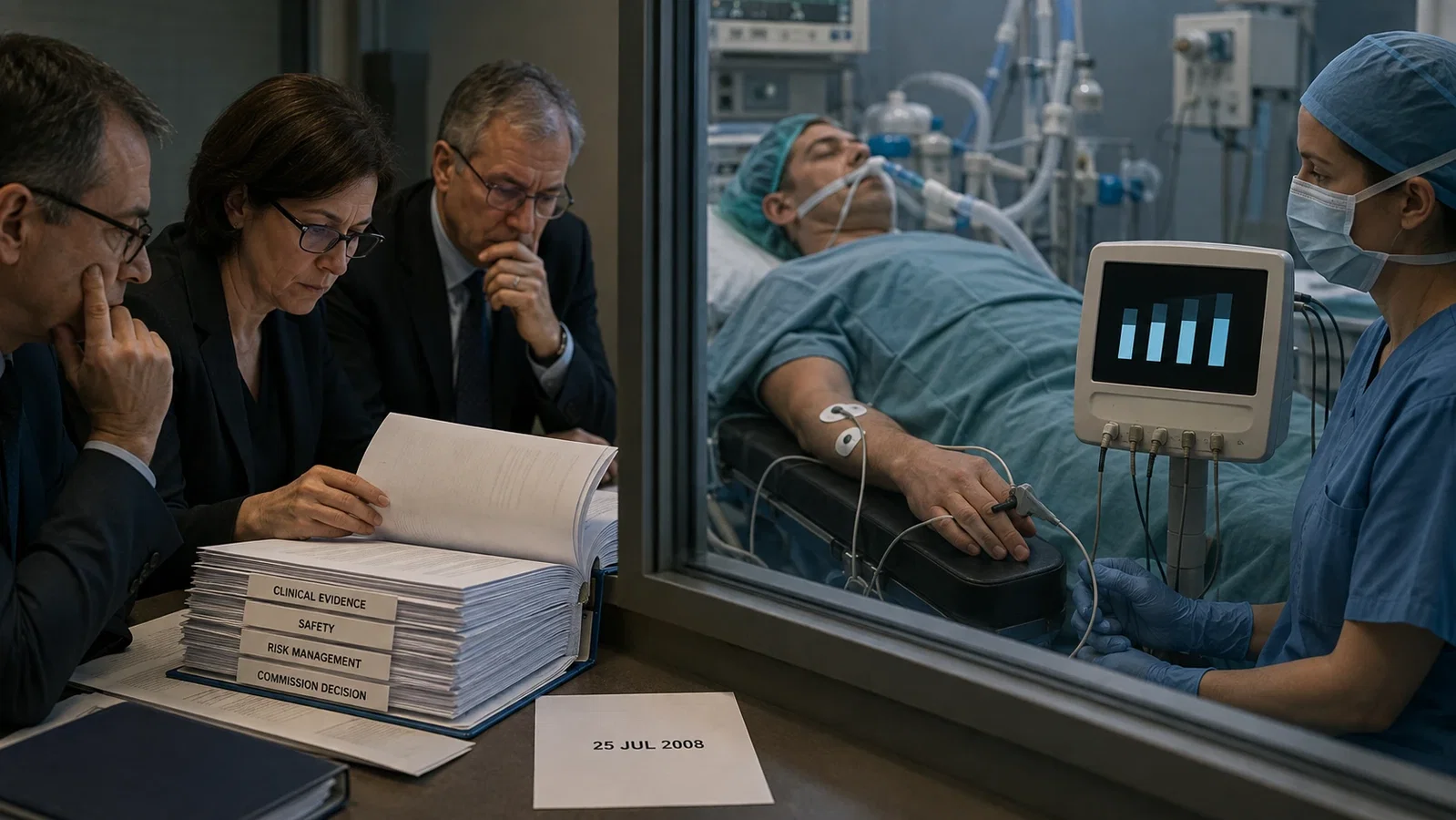
A recovery time can look decisive in a table. A medicine cannot be authorised by a recovery time alone.
When the European Commission granted a marketing authorisation for Bridion on 25 July 2008, it approved more than the proposition that sugammadex could reverse neuromuscular block quickly. The decision rested on a defined indication, doses tied to measurable depths of block, comparative human trials, safety data, and a plan for managing risks that remained. Ventilation and postoperative observation did not become optional. The authorisation treated the drug as one part of a monitored clinical system.
That distinction matters because the molecular idea was already public. In 2002, Bom and colleagues had described a modified gamma-cyclodextrin designed to form a host-guest complex with rocuronium. The 2008 question was no longer whether that chemistry was plausible. Regulators had to decide whether the resulting medicine could be used reproducibly in patients, for specified blockers and under stated conditions.
I. One Authorisation, Three Regulatory Dates
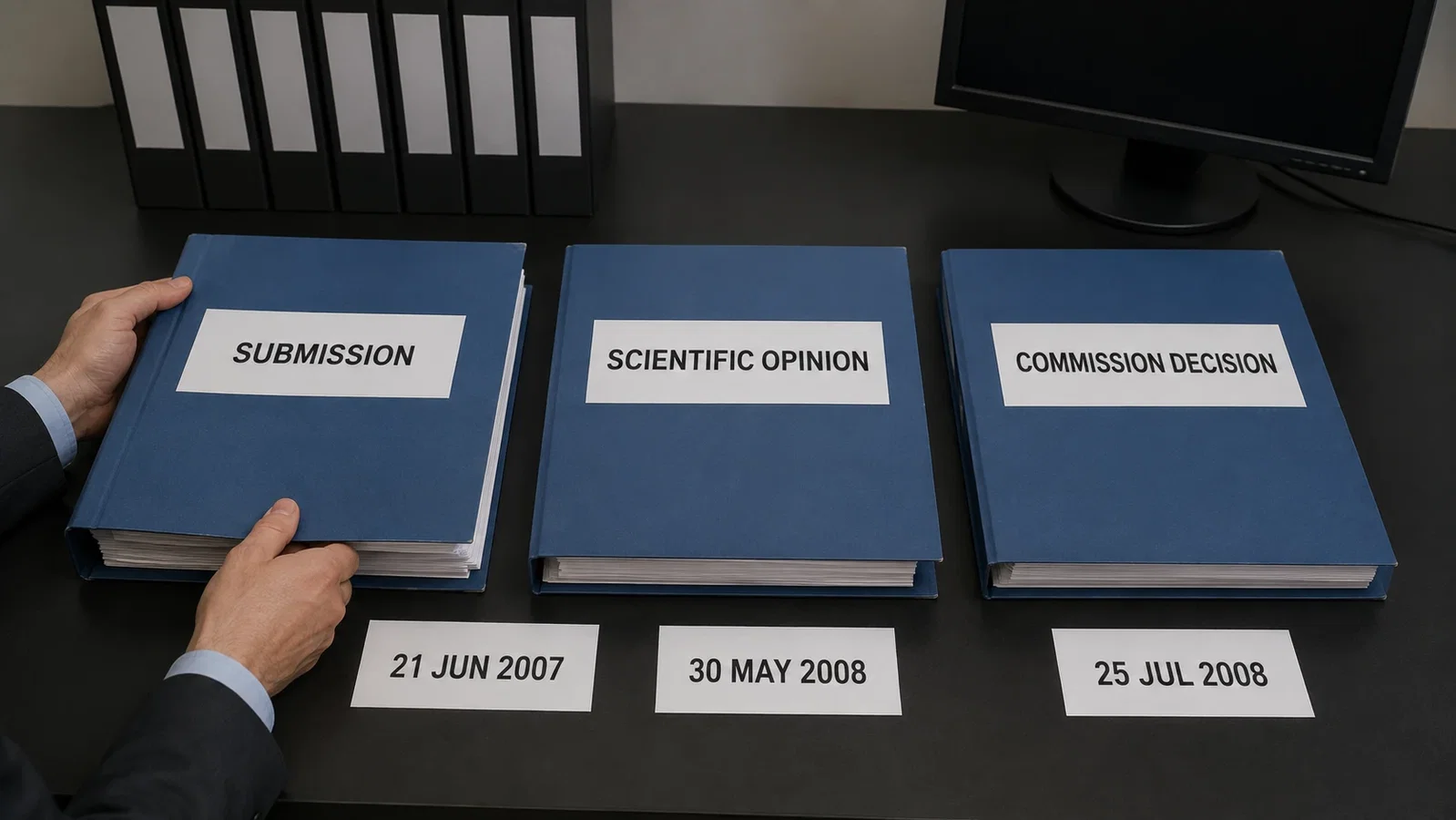
The approval did not occur in a single institutional instant. The EMEA received N.V. Organon's application on 21 June 2007, and the European assessment procedure began on 20 July. Rapporteurs reviewed the dossier, the Committee for Medicinal Products for Human Use raised questions, and the applicant supplied responses as the evaluation progressed.
On 30 May 2008, the CHMP adopted a positive opinion. It concluded that the quality, safety, and efficacy evidence supported a favourable benefit-risk balance and recommended that marketing authorisation be granted. That was the scientific judgment, not the final legal act.
The European Commission issued Decision C(2008)4105 on 25 July, granting the Community marketing authorisation for Bridion-sugammadex under register number EU/1/08/466. The Union Register records 29 July as the procedure-closure date. Treating all three milestones as an undifferentiated "EMA approval" would erase how a scientific recommendation became a legally effective authorisation. This article is anchored to 25 July.
II. The Dossier Turned Block into Something Measurable
The public assessment report described a program of 29 submitted clinical trials, including 14 phase II and 10 phase III studies. Across the completed clinical trials, 1,833 participants had been exposed to sugammadex for the safety evaluation. Those numbers describe the development program, not one unusually large pivotal trial.
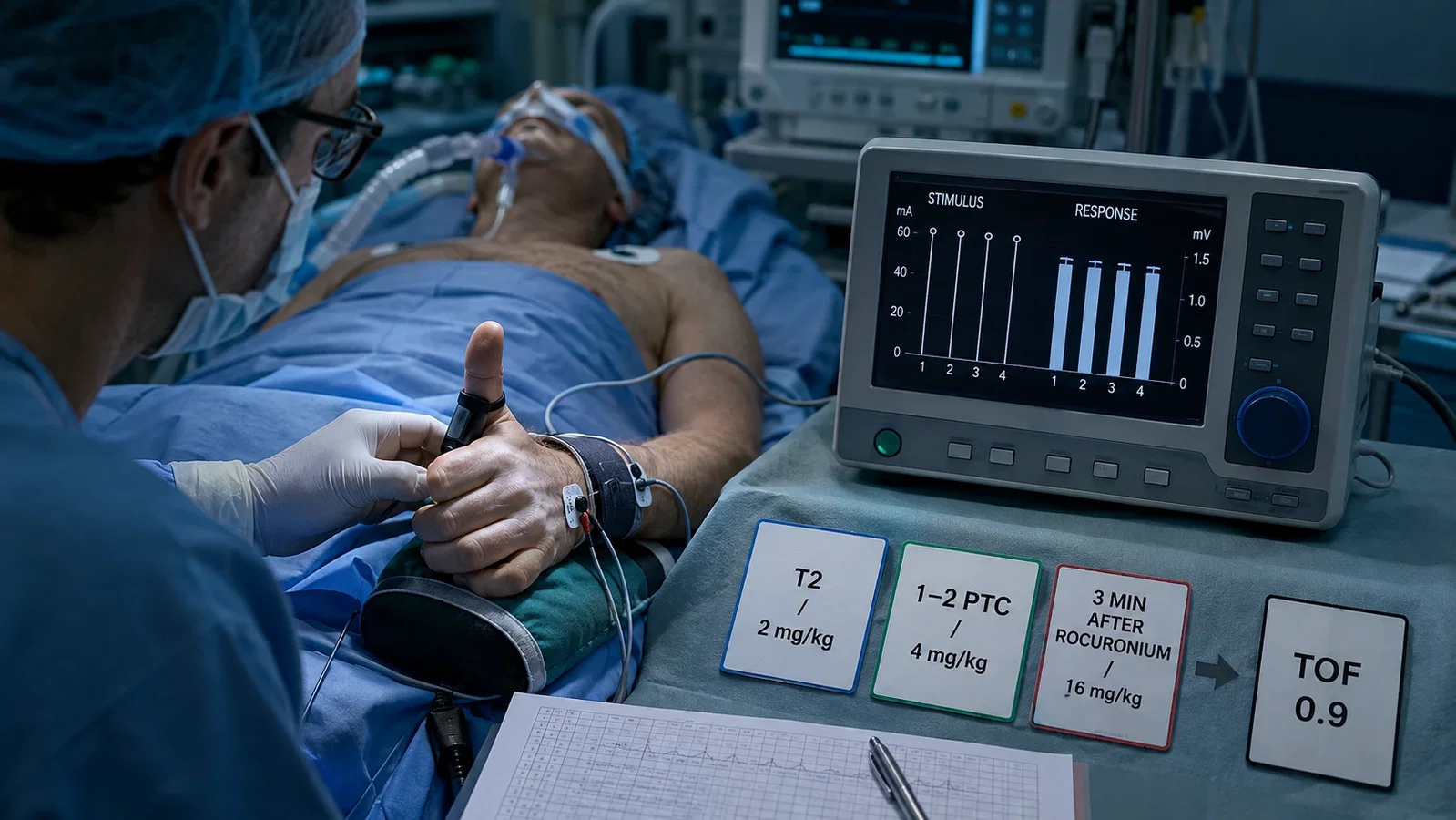
The trials also shared a measurement framework. Stimulation of the ulnar nerve produced responses at the thumb, and acceleromyography recorded recovery of the adductor pollicis. A train of four supplied four successive stimuli. The ratio between the fourth and first twitch, T4/T1 or the train-of-four ratio, made residual fade quantifiable. Recovery to a ratio of 0.9 served as a clinically relevant endpoint in the efficacy program.
Block depth affected when reversal was attempted and which dose was used. Reappearance of the second twitch, T2, represented moderate block. One or two post-tetanic counts identified a deeper state in which ordinary train-of-four responses were still absent. These are not interchangeable labels. By connecting T2 and post-tetanic count to different doses, the development program converted "reversal" from a general aspiration into a set of testable clinical situations.
III. The Comparisons Were Conditional, Not Universal
At moderate block, treatment was given when T2 reappeared. After rocuronium, the median time to a train-of-four ratio of 0.9 was 1.4 minutes with sugammadex 2 mg/kg and 17.6 minutes with neostigmine 50 micrograms/kg. After vecuronium, the corresponding medians were 2.1 and 18.9 minutes.
The deep-block study began at one to two post-tetanic counts. With sugammadex 4 mg/kg, the median was 2.7 minutes after rocuronium, compared with 49.0 minutes for neostigmine 70 micrograms/kg given with glycopyrrolate. After vecuronium, the medians were 3.3 and 49.9 minutes.
These findings gave the new mechanism clinical weight, but their grammar cannot be discarded. The moderate and deep studies used different treatment points and different doses. The comparator doses also differed. Recovery was defined by an instrument-derived endpoint, and individual recovery times varied around the medians. "Every patient recovered completely within two minutes" would not be a simplified version of these results. It would be a different and unsupported claim.
The regulatory record therefore did something more disciplined than celebrate speed. It specified the blockers, depth of block, dose, comparator, and recovery threshold that made each comparison meaningful.
IV. Immediate Reversal Did Not Replace Airway Management
A separate phase III trial examined an immediate-reversal setting. One group received rocuronium 1.2 mg/kg followed three minutes later by sugammadex 16 mg/kg. The comparison group received succinylcholine 1.0 mg/kg and recovered spontaneously.
Measured from administration of the neuromuscular blocker to recovery of the first twitch to 10 percent, the medians were 4.2 minutes for the rocuronium-sugammadex sequence and 7.1 minutes after succinylcholine. A pooled analysis used another clock: from administration of sugammadex to a train-of-four ratio of 0.9, the median after rocuronium was 1.5 minutes.
Keeping those clocks separate is essential. So is preserving the regulator's caution. The assessment considered sugammadex a valuable option when rapid reversal of rocuronium-induced block was needed, including an emergency airway context. It also stated that the drug was not the only solution to a cannot-intubate-cannot-ventilate event. Anaesthetics and opioids could still suppress breathing, and the established difficult-airway process and measures to secure oxygenation and ventilation still had to continue.
The initial product information drew another boundary around the same evidence. Immediate reversal with 16 mg/kg was recommended after rocuronium. There were no data to recommend immediate reversal after vecuronium. A rapid route out of one component of paralysis did not remove the rest of the anaesthetic or airway problem.
V. What the Licence Required to Remain True
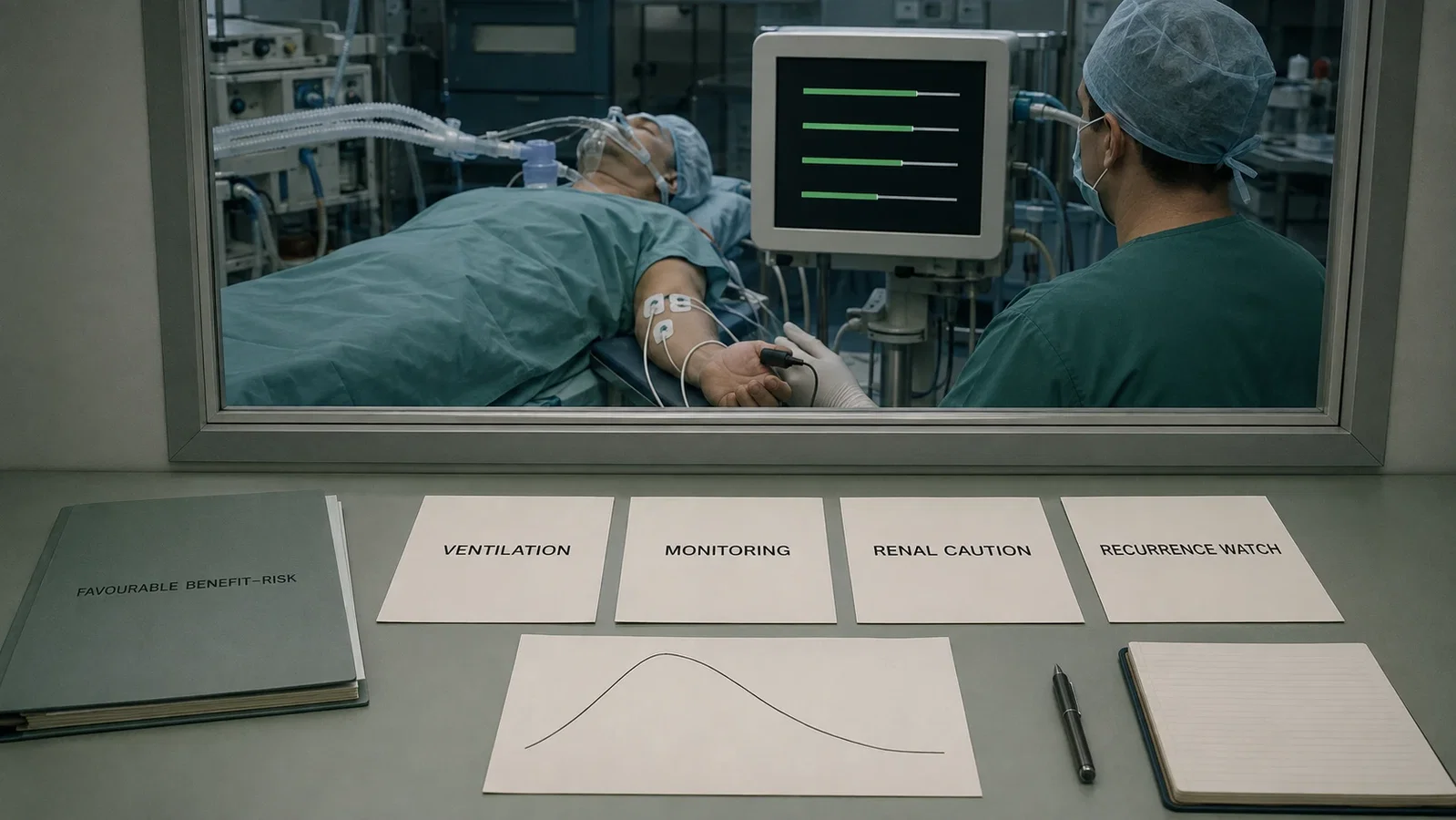
Bridion was to be administered by, or under the supervision of, an anaesthetist. The initial product information recommended an appropriate neuromuscular-monitoring technique and immediate postoperative observation for untoward events, including recurrence of block. It linked 2, 4, and 16 mg/kg to different measured conditions rather than presenting them as interchangeable choices.
Respiratory support remained explicit. Ventilatory support was mandatory until adequate spontaneous respiration had returned. Even after neuromuscular recovery appeared complete, other perioperative medicines could continue to depress respiratory function. A train-of-four ratio of 0.9 was an important neuromuscular endpoint, not a declaration that every anaesthetic risk had ended.
The authorisation also retained uncertainty. Use in severe renal impairment was not recommended in the 2008 product information. Recurrence, displacement or capturing interactions, signs of light anaesthesia, allergic-like reactions, and observations concerning QT intervals remained matters for warnings, pharmacovigilance, or further study. Evidence in several special populations was limited.
The CHMP's favourable benefit-risk conclusion should be read in that setting. It did not mean that risk had disappeared. It meant that the expected benefit supported authorisation when the medicine was used for the defined indication, at a dose appropriate to block depth, with monitoring, ventilation, postoperative observation, and continuing safety surveillance.
VI. Selective Reversibility and the Curare Lineage
The historical connection to curare is not that sugammadex became an antidote to every paralysing drug. Griffith and Johnson's 1942 use of curare helped establish neuromuscular block as a controllable component of general anaesthesia. It also made ventilation, assessment of recovery, and safe termination of block durable responsibilities of the anaesthetist.
Sugammadex changed one branch of that problem. Its authorised targets in 2008 were block induced by rocuronium or vecuronium. The selective host-guest mechanism did not extend to succinylcholine or benzylisoquinolinium blockers such as classic d-tubocurarine. Even within the authorised pair, the immediate-reversal evidence was limited to rocuronium.
The 2008 authorisation was therefore not the arrival of a universal "anti-curare" drug. It was the regulatory translation of selective molecular binding into a measurable clinical capability. Speed became useful because it had an object, a dose, an endpoint, and a set of obligations around it. Approval did not make monitoring obsolete. It made monitoring part of what the new capability meant.
Sources and reading limits
Sources: Commission Decision C(2008)4105 of 25 July 2008, EU/1/08/466; European Medicines Agency, Bridion Public Assessment Report, EMEA/CHMP/317523/2008; European Commission, initial 2008 Annex I–III for Bridion 100 mg/ml; CHMP Summary of Positive Opinion, EMEA/CHMP/246405/2008. All four official PDFs were read in full.
Visual interpretations
These illustrations explore the setting and ideas. Depicted people, actions, instruments and documents are reconstructions, not evidence of their exact historical appearance.
Continue exploring
Related reading connects shared questions and contexts; it does not by itself establish historical influence.
- Earlier connection: 2002: The Sugammadex Concept Builds a Molecular Pocket for Rocuronium
- 1942: Griffith and Johnson Use Curare in Twenty-Five Patients
- 2015: The FDA Approves Sugammadex After Seven Years
- 2020: Japan Approves Remimazolam for General Anesthesia
Anesthesia Epochs · The Source Room · About & Editorial Method
Sources and reading limits are stated above. Illustrations are labelled as original source images or AI-made. Historical accounts are educational; they are not current treatment instructions.