Combining treatments while testing function and harms.
Reading Library · Anesthesia Epochs · 中文版
Watch the companion film
1993: Kehlet and Dahl — Balanced Analgesia · Watch on YouTube
Historical anchor: 1993. Date details and source qualifications are explained below.
November1993 | A history-of-anesthesia article
Pain assessed while a patient rests does not answer every question about recovery. In their 1993 review, Henrik Kehlet and Jørgen B. Dahl gave particular attention to pain during coughing and mobilization. They asked how treatments acting through different mechanisms might provide useful analgesia while taking function and adverse effects into account.[1, pp.1048,1052] This made the choice of outcome part of the argument for combining treatments.
Published in the November 1993 issue of Anesthesia & Analgesia, their article examined “multimodal” or “balanced analgesia.” Its authors were based at Hvidovre University Hospital in Denmark; the first page records acceptance on May 14.[1, p.1048;4] The paper reviewed existing research. It also referred to their earlier advocacy of combined regimens, so its publication cannot establish the first clinical use of analgesic combinations.
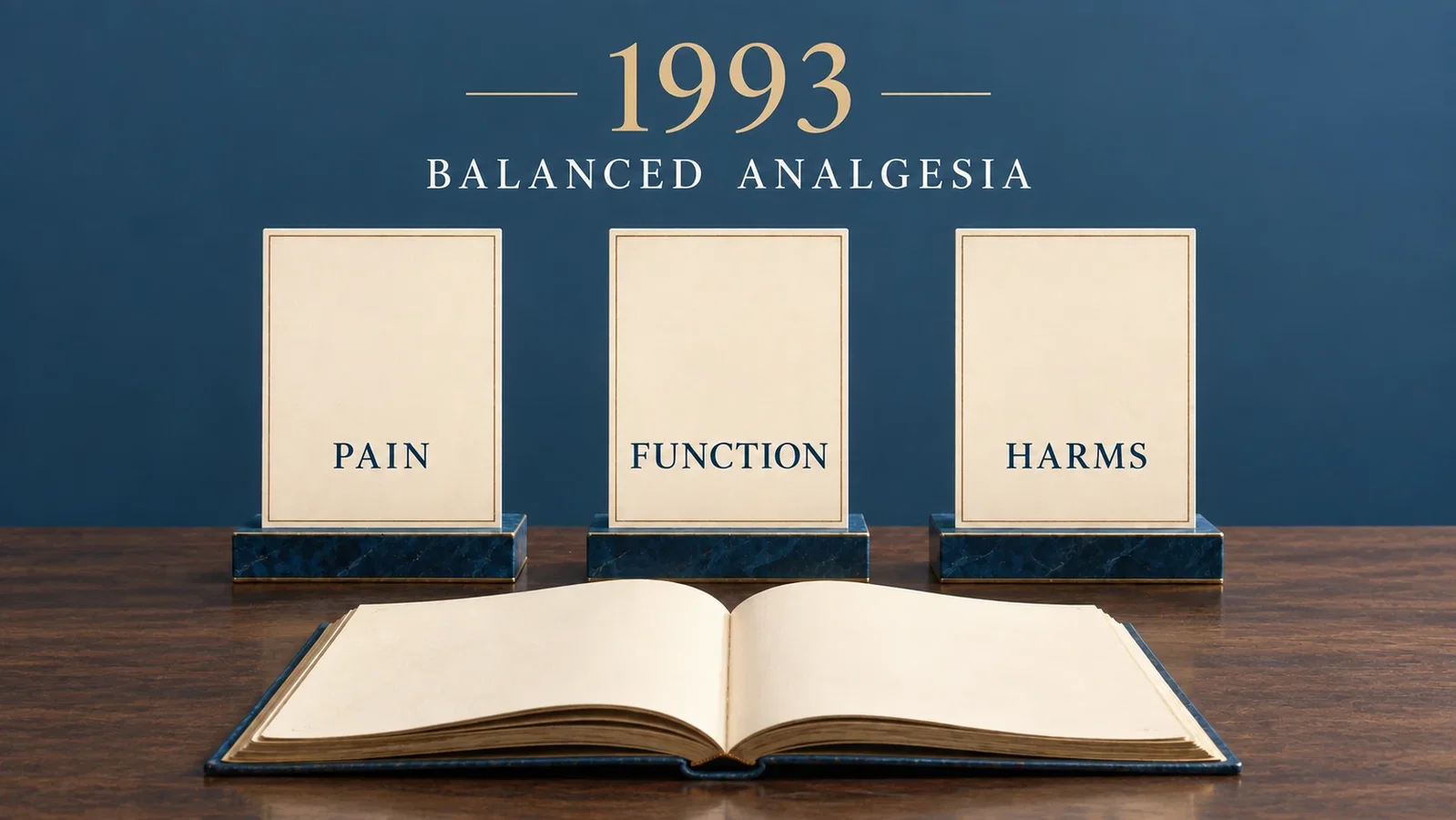
The rationale was to seek additive or synergistic analgesia, with lower doses and different adverse-effect profiles potentially improving the balance of benefit and harm.[1, p.1048] Local anesthetics, opioids and nonsteroidal anti-inflammatory drugs were among the treatments discussed. Opioids remained components of several regimens. The proposal neither required their universal elimination nor established synergy for every possible combination.
The review concentrated on moderate or severe postoperative pain and prolonged treatment, whether continuous or intermittent. It excluded a general review of obstetric and pediatric pain and did not evaluate postoperative outcomes because sufficient studies were lacking.[1, p.1048] Individual obstetric studies nevertheless appeared as examples.[1, pp.1049,1052] These scope limits concern what the review evaluated; they should not be confused with the populations covered by later guidelines.
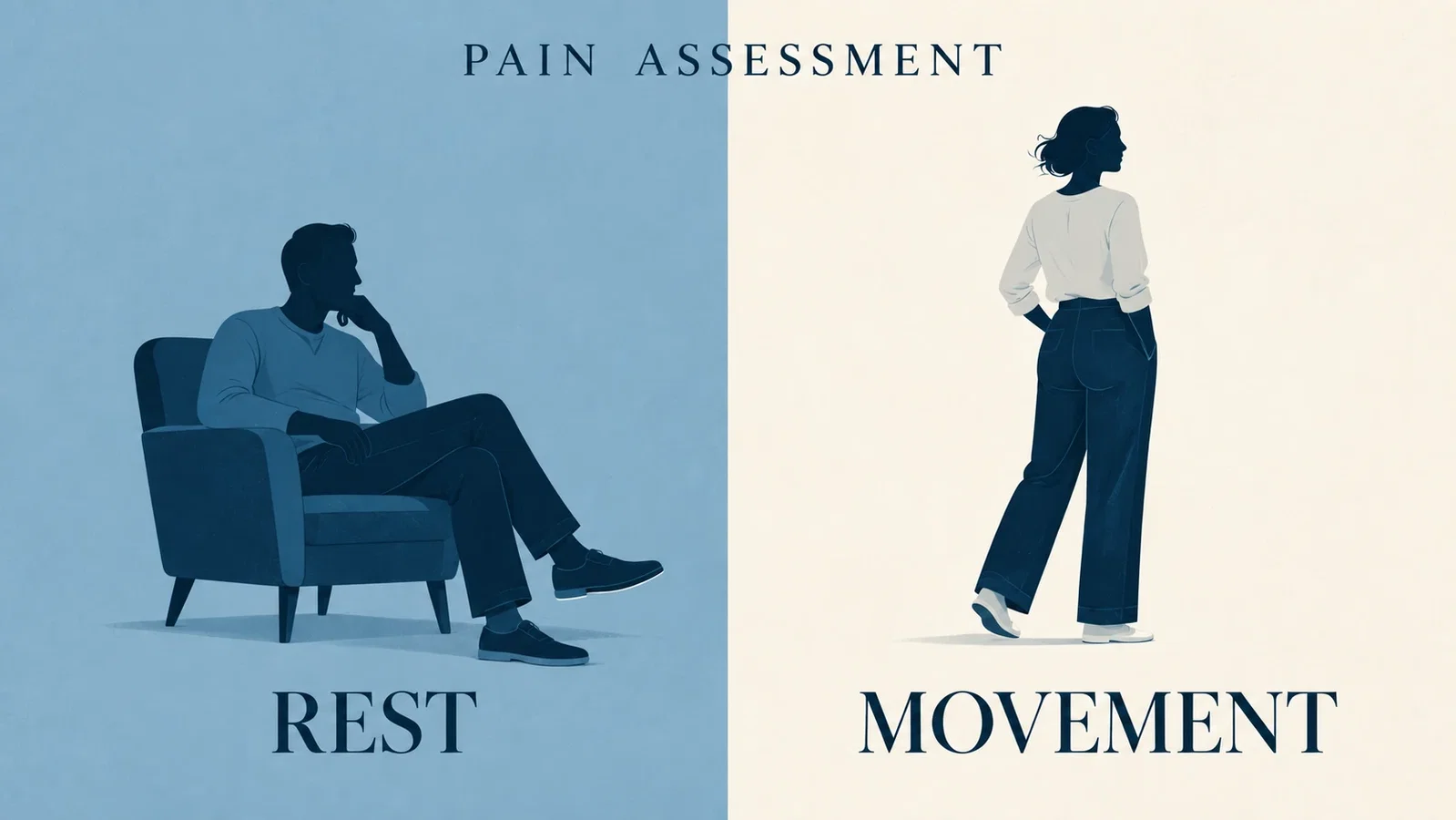
Its comparison tables also resist a simple claim that combinations always work better. Results for epidural local anesthetic and opioid mixtures depended on the comparator. In some studies, an advantage appeared during coughing or movement without a corresponding difference at rest.[1, pp.1050–1052,Tables1–2] Small studies limited assessment of harms. The conclusion called for further evaluation of composition, duration and risk; reduced morbidity and shorter hospitalization remained prospective goals.[1, p.1054]
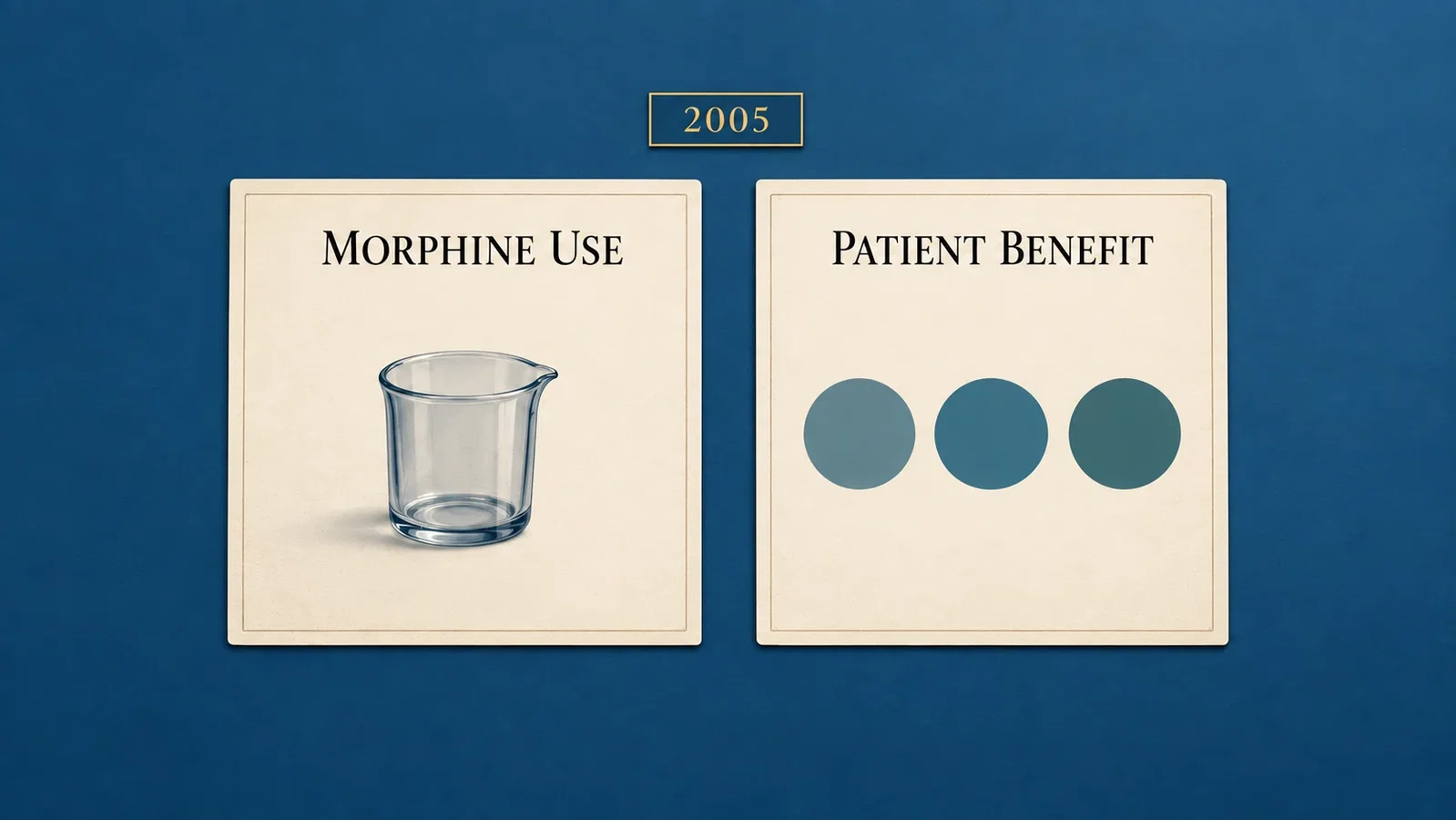
A later review sharpened the question of what counts as benefit. In 2005, Elia, Lysakowski and Tramèr distinguished reduced morphine consumption from better pain relief, fewer opioid-related adverse effects and harms introduced by an additional drug.[2, pp.1296,1300–1302] That methodological distinction is the point used here. This account does not adopt the older pooled drug-effect estimates as current efficacy findings or attribute its patient data to the 1993 paper.
The 2016 postoperative-pain guideline made a strong recommendation for multimodal analgesia, rated as supported by high-quality evidence. Its scope included children and adults and incorporated nonpharmacological interventions.[3, pp.132,136] The following page emphasized procedure, patient factors and preferences, the limited testing of many combinations, and variable findings about adverse events.[3, p.137] These are later recommendations, with explicit requirements for selection and monitoring, rather than a universal regimen inherited from 1993.
Kehlet and Dahl also identified patient-controlled multimodal therapy as a question requiring evaluation. Fixed regimens could be poorly suited to differences in analgesic need.[1, p.1054] This provides a specific connection to the PCA device article: delivery control and the composition of a treatment plan address related problems. It does not mean that this review tested a particular LifeCare model or established the safety of patient control.
The historical contribution of the review includes its questions about movement, function, adverse effects and individual variation.[1, pp.1048,1054;2,p.1302;3,p.137] A combination must still be evaluated in a defined setting. Following that requirement keeps the history of multimodal analgesia tied to comparative evidence as well as to the appeal of combining different treatments.

Sources and reading limits
- Kehlet H, Dahl JB. The value of “multimodal” or “balanced analgesia” in postoperative pain treatment. Anesth Analg.1993;77(5):1048–1056. Original article. PMID8105724; DOI10.1213/00000539-199311000-00030.
- Elia N, Lysakowski C, Tramèr MR. Does multimodal analgesia with acetaminophen, nonsteroidal antiinflammatory drugs, or selective cyclooxygenase-2 inhibitors and patient-controlled analgesia morphine offer advantages over morphine alone? Anesthesiology.2005;103:1296–1304. Published version, University of Geneva. DOI10.1097/00000542-200512000-00025.
- Chou R et al. Management of postoperative pain: a clinical practice guideline. J Pain.2016;17(2):131–157. Original guideline (archived copy). DOI10.1016/j.jpain.2015.12.008.
- NLM PubMed8105724 bibliographic record. November1993; publication type: review.
All nine pages of the 1993 article were read. Selected original pages were read for 2005 (1296–1297,1300–1302) and 2016 (131–132,136–137); their remaining pages and underlying trials were not individually verified. These documents serve different roles, rather than providing three independent validations. The 2005 review includes work associated with later retraction concerns; its pooled effect estimates are not adopted here. The 2016 guideline explicitly discusses exclusions, but this article does not independently reproduce that analysis. Images are modern editorial illustrations. Historical doses are not treatment instructions.
Continue exploring
Related reading connects shared questions and contexts; it does not by itself establish historical influence.
The Source Room · About & Editorial Method
Continue this reading route
Stop 6 of 7 · Back to route · From Ether to Balanced Anesthesia
Previous · c. 1964: Block-Aid Makes Muscle-Relaxant Action Repeatedly Observable
Next · 2002: The Sugammadex Concept Builds a Molecular Pocket for Rocuronium
Combining analgesics and reversing neuromuscular block are separate interventions. Read the next paper for the particular drug effect its authors proposed to reverse.
Sources and reading limits are stated above. Illustrations are labelled as original source images or AI-made. Historical accounts are educational; they are not current treatment instructions.