A product date and the later debate over interface design.
Reading Library · Anesthesia Epochs · 中文版
Watch the companion film
1988: LifeCare PCA Plus II — Patient-Controlled Analgesia · Watch on YouTube
Historical anchor: 1988. Date details and source qualifications are explained below.

LifeCare PCA Plus II entered Abbott’s product range in 1988, according to a 2000 account by Charles McLeskey, the company’s clinical-development director. He described it as an advance on an earlier product.[1] The date therefore belongs to this model; it does not mark the invention of patient-controlled analgesia (PCA).
A review published that year by Owen, Mather and Rowley already described PCA as widely used in the United States and Europe. It outlined patient requests, delivery under prescribed settings and lockout intervals.[2, pp437–439] Patients could participate in their analgesia while professionals remained responsible for the medication, settings and observation.

The 1988 review also discussed programming and administration errors, respiratory adverse effects and staff familiarity with equipment.[2, pp440–441] Drug selection and settings affected comparisons between analgesic methods. The name of a delivery technique could not, by itself, establish its effectiveness or safety.
In 2000, the LifeCare 4100 interface became the subject of public debate. Human-factors researcher Kim Vicente described two hospital-activated configurations in which accepting an initially displayed low concentration could create a mismatch with the actual medication. He argued that training could not fully compensate for interface problems.[3] His analysis concerned particular configurations, not an identical failure in every PCA pump.

Writing at Abbott’s request, consultant Anthony Andre warned that changing defaults or menu order could conflict with experienced users’ learned habits. He favored a systems approach encompassing equipment, people and their working environment.[4] Vicente subsequently clarified that he had proposed no quick fix and had conducted no clinical trial of an alternative interface.[5] The exchange preserved disagreement; it did not supply a clinical comparison establishing the safest redesign.
The manufacturer’s article described plans for barcode recognition of drug information and cited internal data about experience with its device.[1] A plan is not evidence of a completed launch, and usage counts do not establish a safety rate. Those internal records and original incident files are not covered in this account. The 2000 debate is kept separate from the 1988 product date.
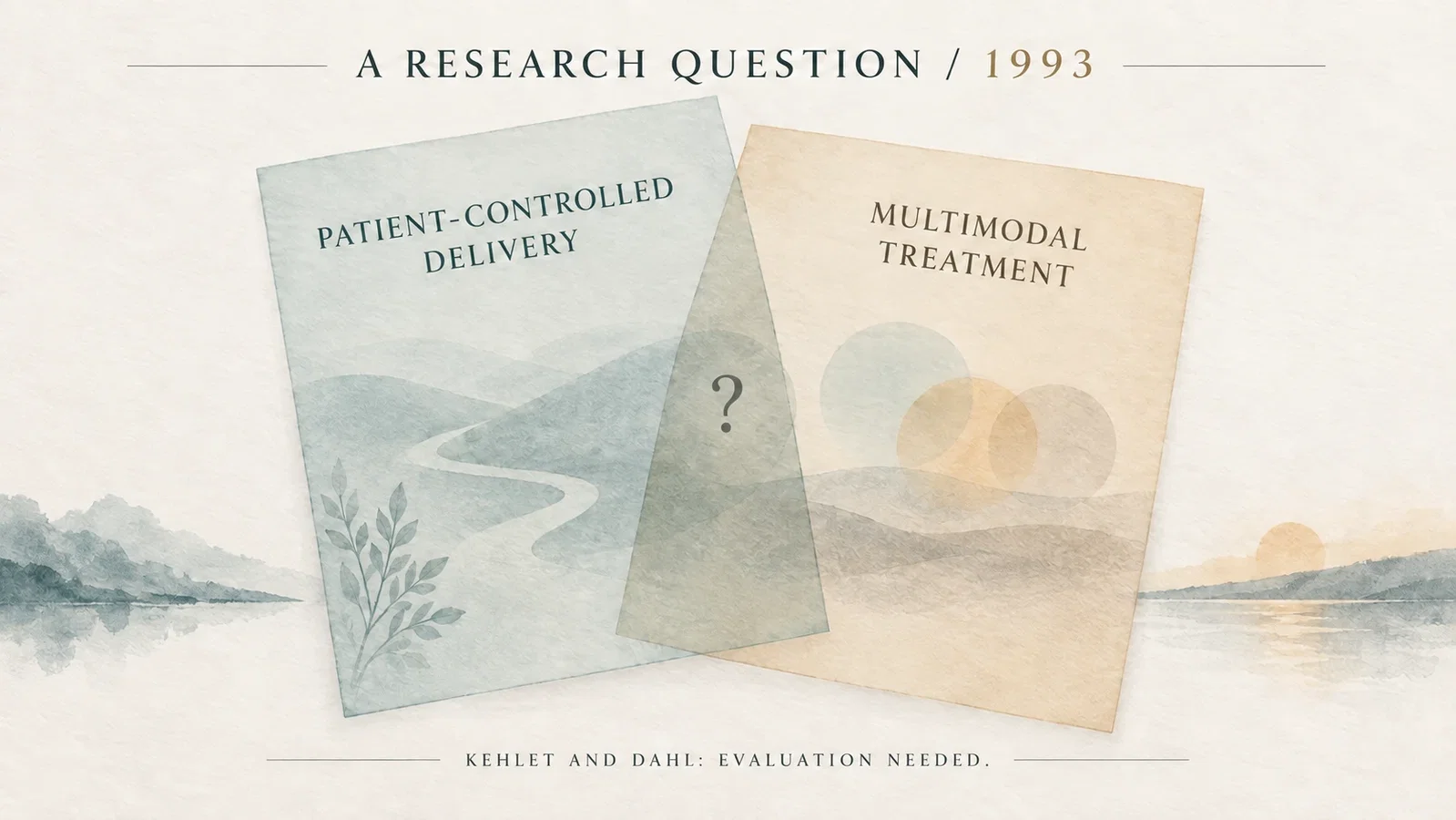
Delivery also belongs within a wider analgesic strategy. In their 1993 paper on multimodal analgesia, Kehlet and Dahl explicitly identified patient-controlled multimodal therapy as a question requiring evaluation, noting differences in individual analgesic needs.[6, p1054] This provides a documented connection between the two articles. Responding to patient demand and combining treatments are related research questions; the paper does not establish that LifeCare generated the multimodal concept.
This history moves attention from the patient’s button to the settings, interface and care surrounding it. The 1988 date has an identified manufacturer source, while the later debate records questions that remained open. Keeping the authors and dates visible makes room for both patient participation and continuing scrutiny of device design.
Images are modern editorial concepts, not product reconstructions, historical photographs or clinical instructions.
Sources and reading limits
- McLeskey CH. Abbott Addresses Medication Errors Through Advanced PCA Technology. APSF Newsletter. September 10, 2000. Full original web article read. Manufacturer author; 1988 model date is attributed to this retrospective account, not an independently obtained launch notice.
- Owen H, Mather LE, Rowley K. The development and clinical use of patient-controlled analgesia. Anaesth Intensive Care. 1988;16(4):437–447. DOI:10.1177/0310057X8801600409. Publisher-indexed text of pp437–441 and opening of 442 read; PDF download and page-image capture unavailable. Earlier studies cited there were not independently read.
- Vicente KJ. Point-Counterpoint on PCA Pump Safety / Human Factors Researcher Alarmed by Deaths During PCA. APSF Newsletter. September 10, 2000. Full original opinion and references read; not a clinical trial or original incident investigation.
- Andre AD. Human Factors Consultant Rebuts PCA Pump Danger Charges. APSF Newsletter. September 10, 2000. Full original counterargument and references read; published at Abbott’s request.
- Vicente KJ. Patients Perceived Still at Risk with PCA Pumps. APSF Newsletter. December 10, 2000. Full original rejoinder and references read. Same author as source 3, not independent confirmation.
- Kehlet H, Dahl JB. The value of multimodal or balanced analgesia in postoperative pain treatment. Anesth Analg. 1993;77(5):1048–1056. Publisher identity; public original-page scan. DOI:10.1213/00000539-199311000-00030. All nine original pages read; p1054 supports the research-question connection, not a product-origin claim.
Continue exploring
Related reading connects shared questions and contexts; it does not by itself establish historical influence.
The Source Room · About & Editorial Method
Sources and reading limits are stated above. Illustrations are labelled as original source images or AI-made. Historical accounts are educational; they are not current treatment instructions.