A portable nerve stimulator, in clinical testing from about 1964 and described by Katz in 1965, let the anesthesiologist follow a muscle relaxant's effect by repeated observation.
Reading Library · Anesthesia Epochs · 中文版
Watch the companion film
c. 1964–1965: Block-Aid — Watching the Response · Watch on YouTube
Historical anchor: 1964. Approximate placement; see the essay for the date range and evidence.
A small box with a dial, two switches and an indicator lamp is a useful place to begin this history. The Block-Aid Monitor preserved by the Wood Library-Museum has no digital display. Its role was to stimulate a peripheral nerve so that the anesthesiologist could assess the resulting muscle response.[3] The clinical question was how to follow the effect of a muscle relaxant during anesthesia.
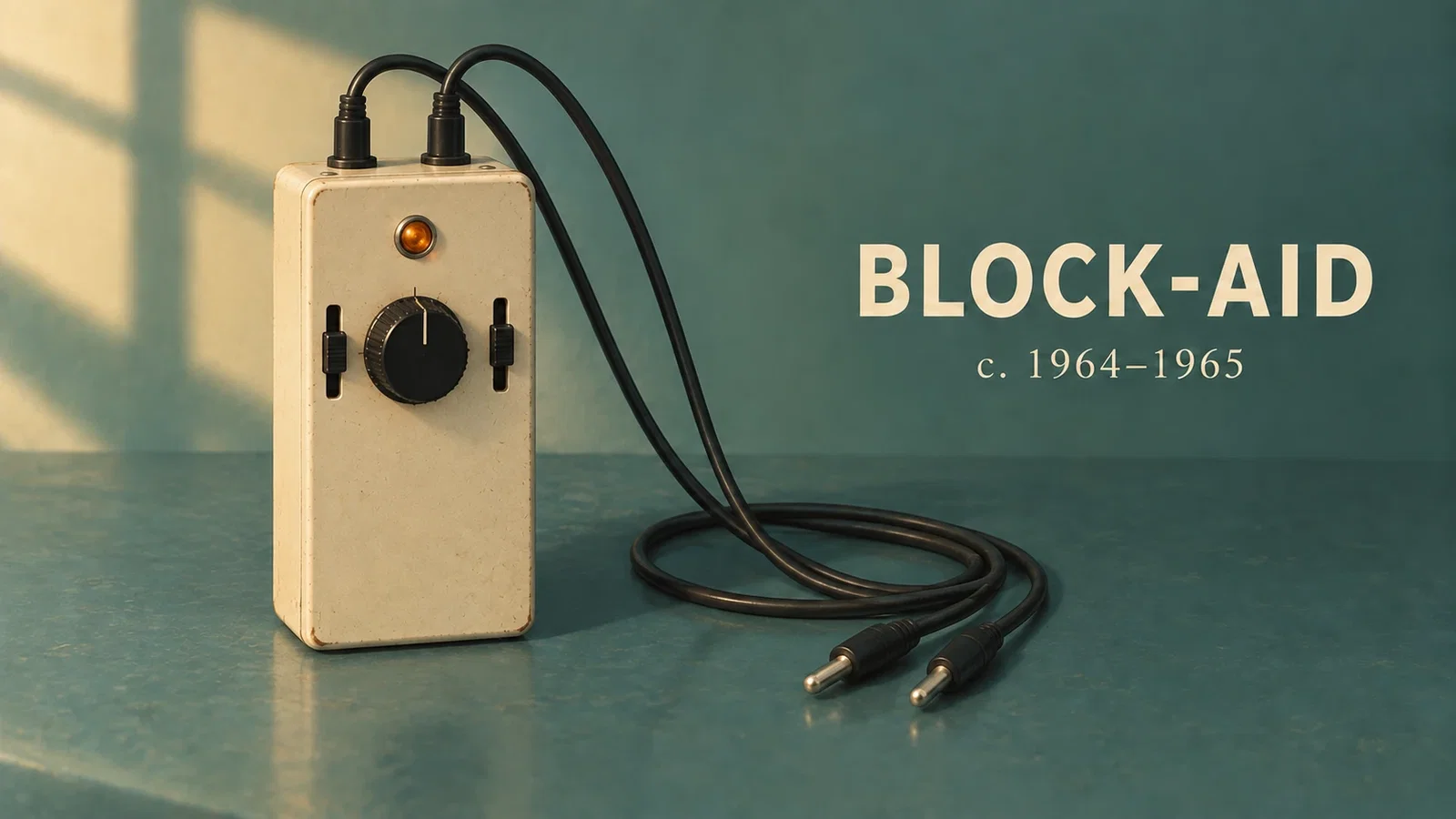
Ronald L. Katz described the instrument in a two-page article in Anesthesiology in 1965.[1] For this essay, the complete text available for reading was its published Spanish translation in Actas Peruanas de Anestesiología. A footnote identifies the English source as the November–December 1965 issue.[2] The English publisher record was checked, but the original English full text is not covered. The translation preserves the report in another language; it is not a second clinical study.
The date needs that distinction too. In the translation, Katz says the instrument had been developed and supplied for clinical testing approximately a year earlier.[2] The museum uses that statement to support an approximate 1964 beginning.[3] We therefore place the article at about 1964–1965, separating an inferred testing prelude from the documented publication year. Neither source provides a precise launch day.
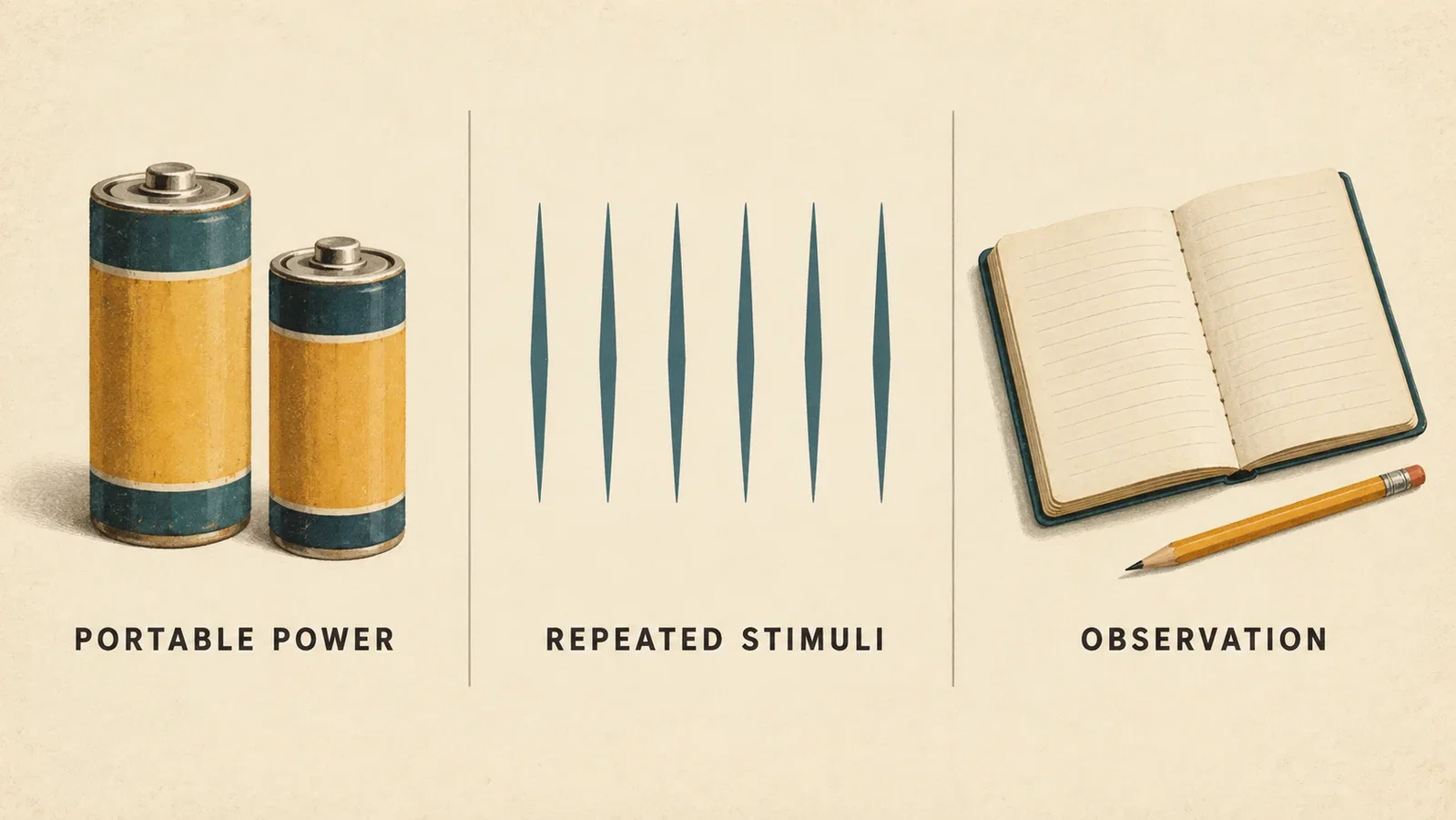
The report also explains why calling Block-Aid the first nerve stimulator would be misleading. Katz discusses equipment already available, from research instruments to inexpensive homemade devices. His desired combination was practical: a compact, portable, battery-operated instrument that was easy to use and could switch between repeated single stimuli and tetanic stimulation.[2] The historical interest lies in that combination and its intended clinical use, rather than an unsupported claim of priority.
Repeated observation was a central concern. The author found it difficult to compare an intermittent test with a response remembered from earlier; repeated stimulation let him follow changes as they occurred.[2] This was an account of clinical experience with an instrument. It did not establish a quantified improvement in patient outcomes, and the device was not a digital train-of-four ratio monitor.
Nerve localization does appear among the uses listed in the translation. It should not be erased from the account. But the main discussion concerns muscle-relaxant action, including the degree of blockade, the possible need for an antagonist and the contribution of these drugs to postoperative apnea.[2] That supports a history of neuromuscular monitoring. It does not establish the first clinical performance of a regional nerve block with a stimulator.
An earlier report gives this question a useful counterpart. In 1942, Harold Griffith and Enid Johnson described obtaining skeletal muscle relaxation during general anesthesia and emphasized that curare itself was not an anesthetic.[4] Read beside Katz, the two reports address different parts of the same concrete problem: producing relaxation and observing the drug’s effect.[2,4] This is an editorial comparison, not evidence that the earlier paper directly caused the later device’s development.
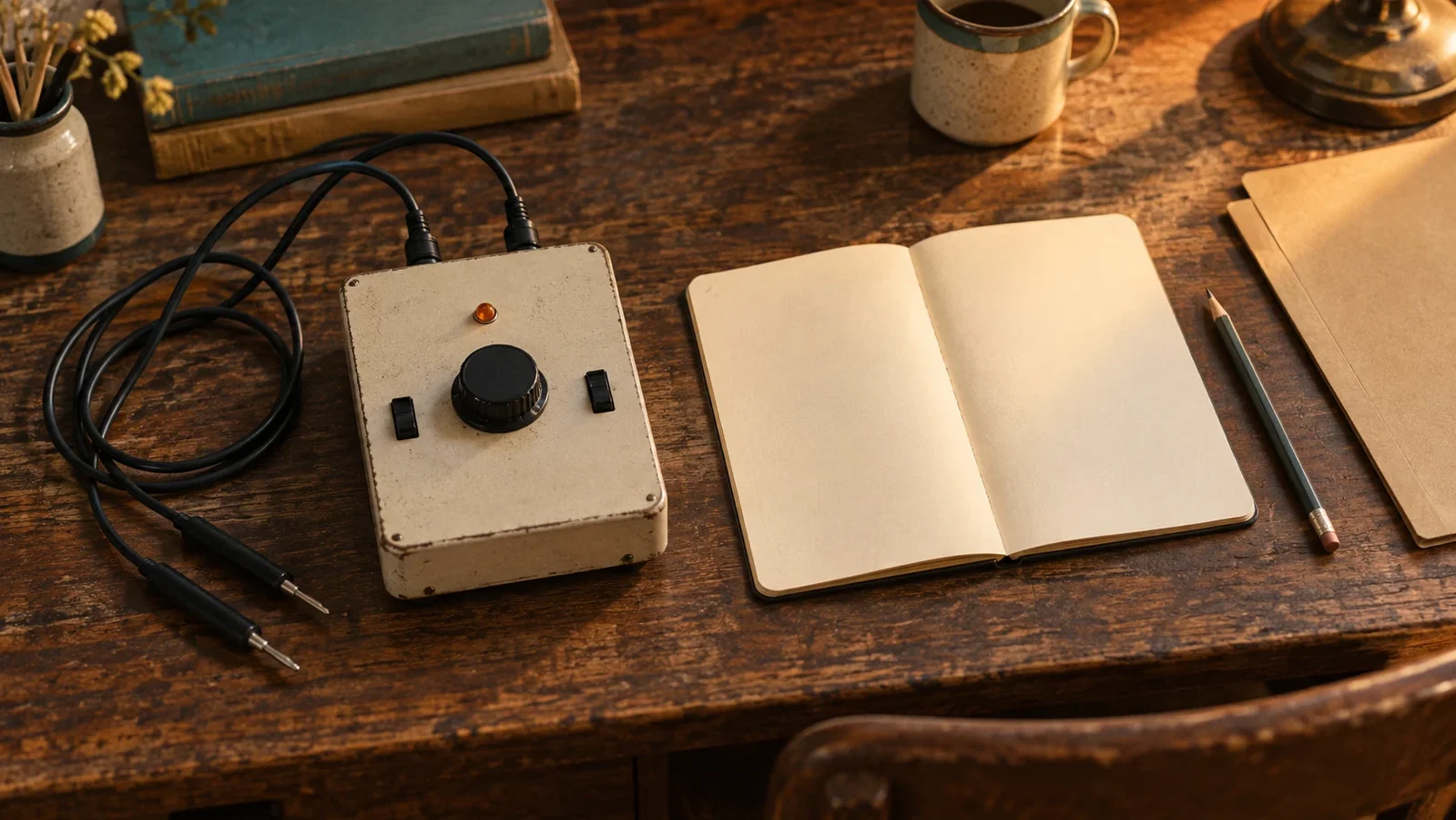
Katz’s closing caution is consistent with that limited role. As preserved in the translation, nerve stimulation was another useful tool for observation and teaching, not a replacement for clinical observation itself.[2] Block-Aid made a peripheral response available for repeated assessment while leaving interpretation with the clinician.
Source and image note: The two-page published translation and the complete two-page authorized reprint of the 1942 paper were read. The English 1965 full text remains unavailable. Internally inconsistent electrical figures in the translation are not reproduced here. All four images are modern editorial interpretations, not archival scenes or procedural demonstrations.
Sources and reading limits
- Katz RL. A nerve stimulator for the continuous monitoring of muscle relaxant action. Anesthesiology. 1965;26(6):832–833. Publisher/DOI. PMID 5844275. Publication metadata checked; English full text not covered.
- Katz RL. El estimulador de nervio periférico para el monitoraje continuo de la acción de los relajante neuro-musculares. Actas Peruanas de Anestesiología. 1(2), two-page published Spanish translation, final printed page 97. Both pages read; first page has no visible page number. Footnote identifies English source, November–December 1965. Repository issue grouping is consistent with the May–August 1967 header on another article in the same issue (Repebis, Actas Peru Anestesiol v1n2, article a6), PDF p. 2, printed p. 28; that article is used only for issue context. A public full-text link for this translation has yet to be verified.
- Wood Library-Museum of Anesthesiology. Block-Aid Monitor · Archived copy. Object akiy, accession 2010-07-20-2 E. Description, catalog record and gallery read September 15, 2026. Approximate dating partly depends on Katz; the object photograph is dated January 17, 2013.
- Griffith HR, Johnson GE. The use of curare in general anesthesia. Anesthesiology. 1942;3:418–420. Complete authorized reprint in Maltby JR, Shephard DAE, eds. Harold Griffith: His Life and Legacy. 1992, printed pp. 56–57, PDF pp. 60–61. Canadian Anesthesiologists’ Society volume. These two pages were read; the full 150-page volume was not read for this article.
Continue exploring
Related reading connects shared questions and contexts; it does not by itself establish historical influence.
The Source Room · About & Editorial Method
Sources and reading limits are stated above. Illustrations are labelled as original source images or AI-made. Historical accounts are educational; they are not current treatment instructions.
Continue these reading routes
Stop 5 of 7 · Back to route · From Ether to Balanced Anesthesia
Previous · 1942: Griffith and Johnson Use Curare in Twenty-Five Patients
Next · 1993: Kehlet and Dahl Make the Case for Balanced Analgesia
Block-Aid tracked muscle response. Kehlet and Dahl examined postoperative pain and the reasons for combining analgesic treatments.
Stop 3 of 7 · Back to route · Making Anesthesia Safer: From Observation to Continuous Monitoring
Previous · 1894: Cushing and Codman Put Anesthesia on the Record
Next · 1974: Takuo Aoyagi Makes Hypoxia Visible
Block-Aid tracked a response to stimulation. Aoyagi’s work used the pulsatile optical signal to estimate arterial oxygen saturation.