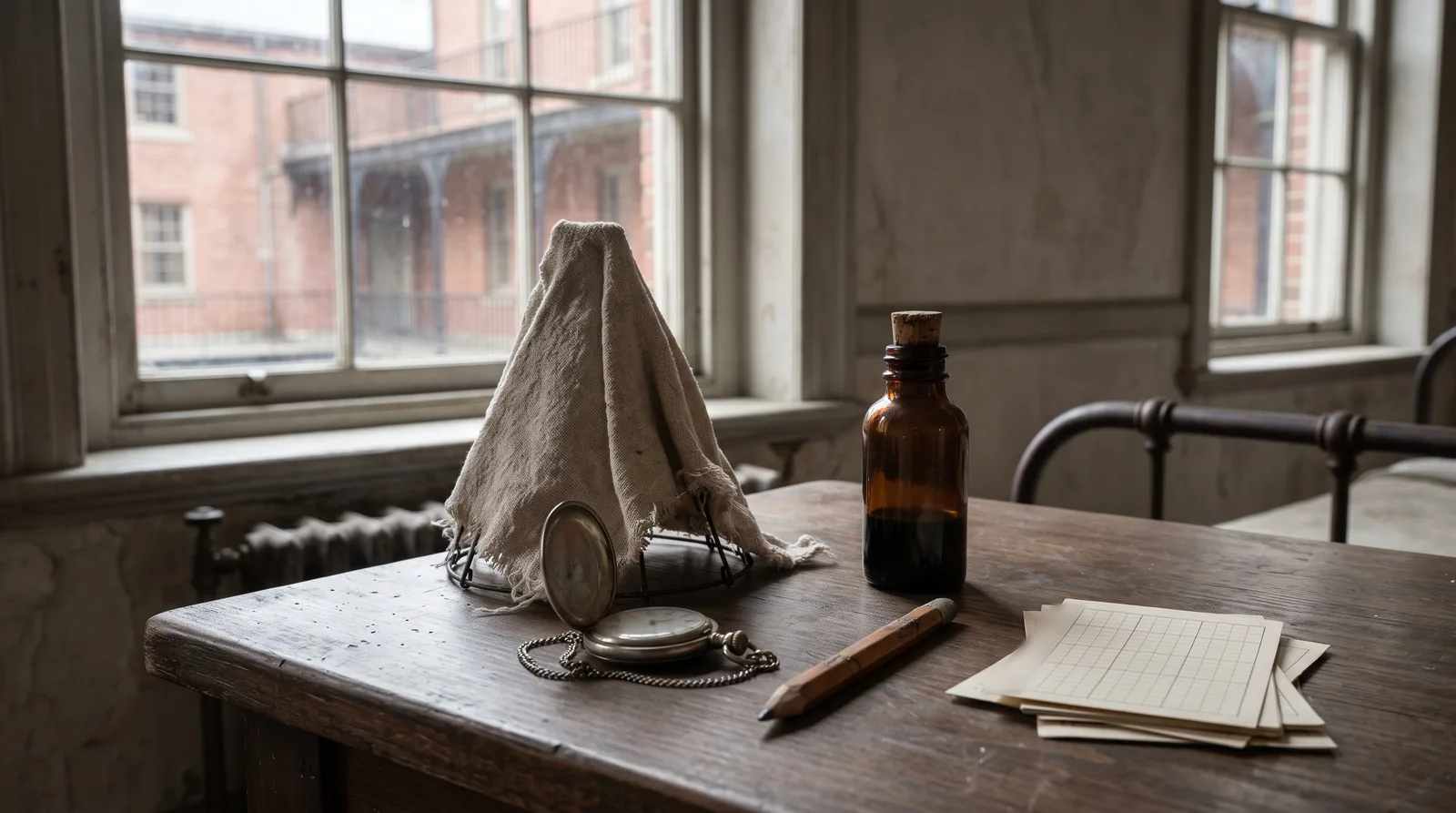
In 1894–1895, as Harvard medical students giving ether at the Massachusetts General Hospital, Ernest Amory Codman and Harvey Cushing began keeping anesthesia records that plotted pulse and respiration against the minutes of an operation, with notes on drugs and events beside them.
Reading Library · Anesthesia Epochs · 中文版
Watch the companion film
1894–1895: Cushing and Codman’s Anesthesia Records · Watch on YouTube
The useful starting point is not a story about a wager. It is a collection of paper records.
The 2018 archival study reports 44 Codman records and 66 Cushing records in the collection examined by its authors. Four of them are reproduced in the study’s supplements.[1–2]
In Boston during their early medical training, Harvey Cushing and Ernest Amory Codman began leaving records of anesthesia. This account focuses on 1894–1895. It does not assign a single invention day to a practice that would take much longer to become routine.[1,3]
What the surviving pages can show
This collection does not supply a simple before-and-after estimate of deaths prevented by charting. Preservation, missing entries and legibility shape what can be reconstructed. A historical assessment of the importance of a practice is different from a comparison that isolates its clinical effect.[1,3]
A form that asks questions in advance
The two official Codman supplements show different cases recorded on the reverse of the same type of form. They are not the front and back of one patient’s card.[2]
The printed fields ask about the operation and surgeon, when the inhalation cone was applied and removed, anesthetic quantities, previous drugs, mucus and the heart. Below them, separate pulse and respiration scales face repeated minute divisions. One example contains a relatively short plotted series and sparse notes. Another carries more writing across the grid.[2]
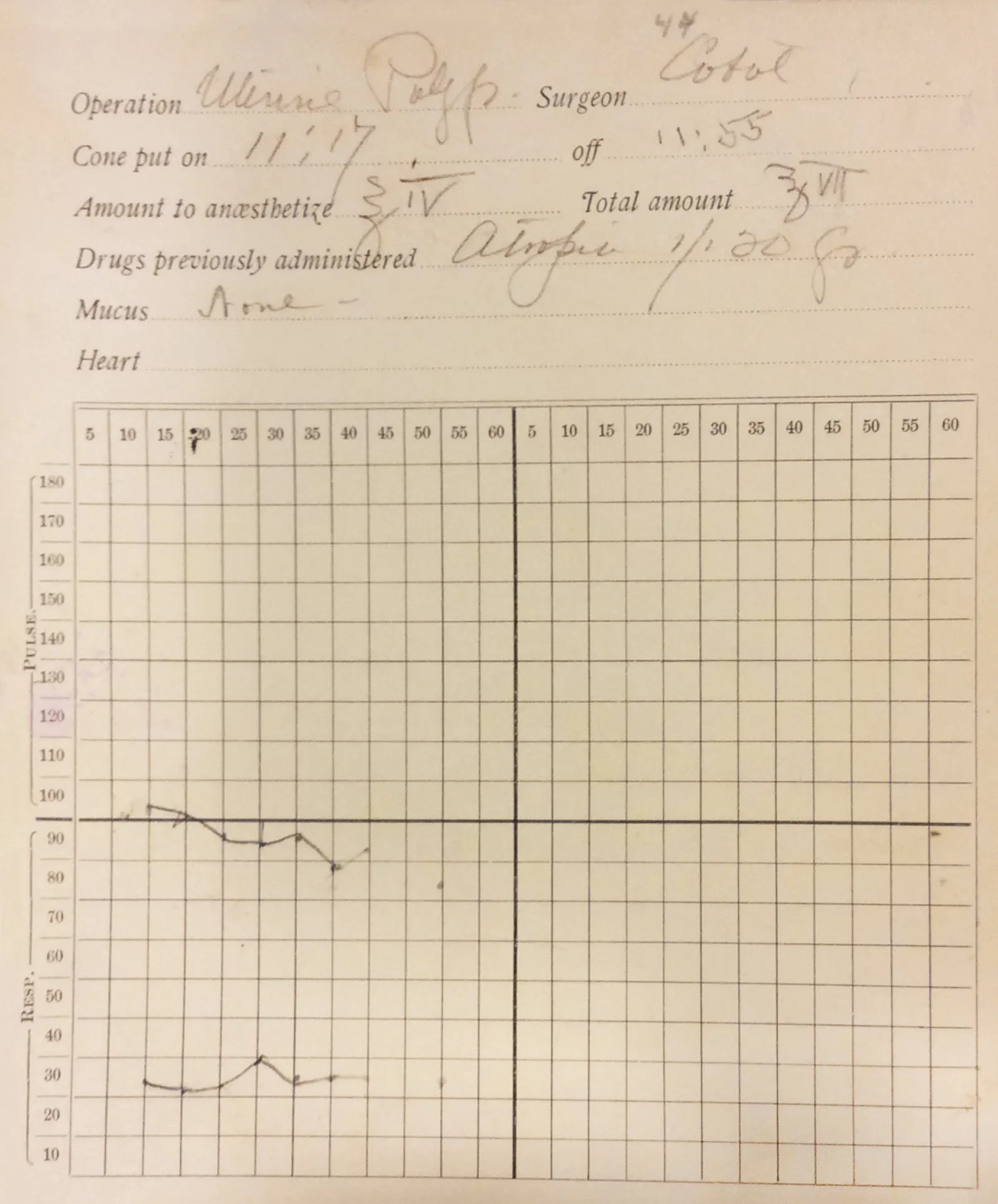
A printed field creates a place for information; it does not guarantee that someone entered it. That distinction is visible before we try to decipher every abbreviation. The framework remains recognizable, while the amount of surviving detail changes from one example to another.
The useful historical question is therefore not simply whether the forms resemble ours. It is what relationships they make available to a reader. An intervention, a recorded observation and an event can occupy neighboring positions in time. That arrangement invites comparison, although proximity on paper cannot establish causation.
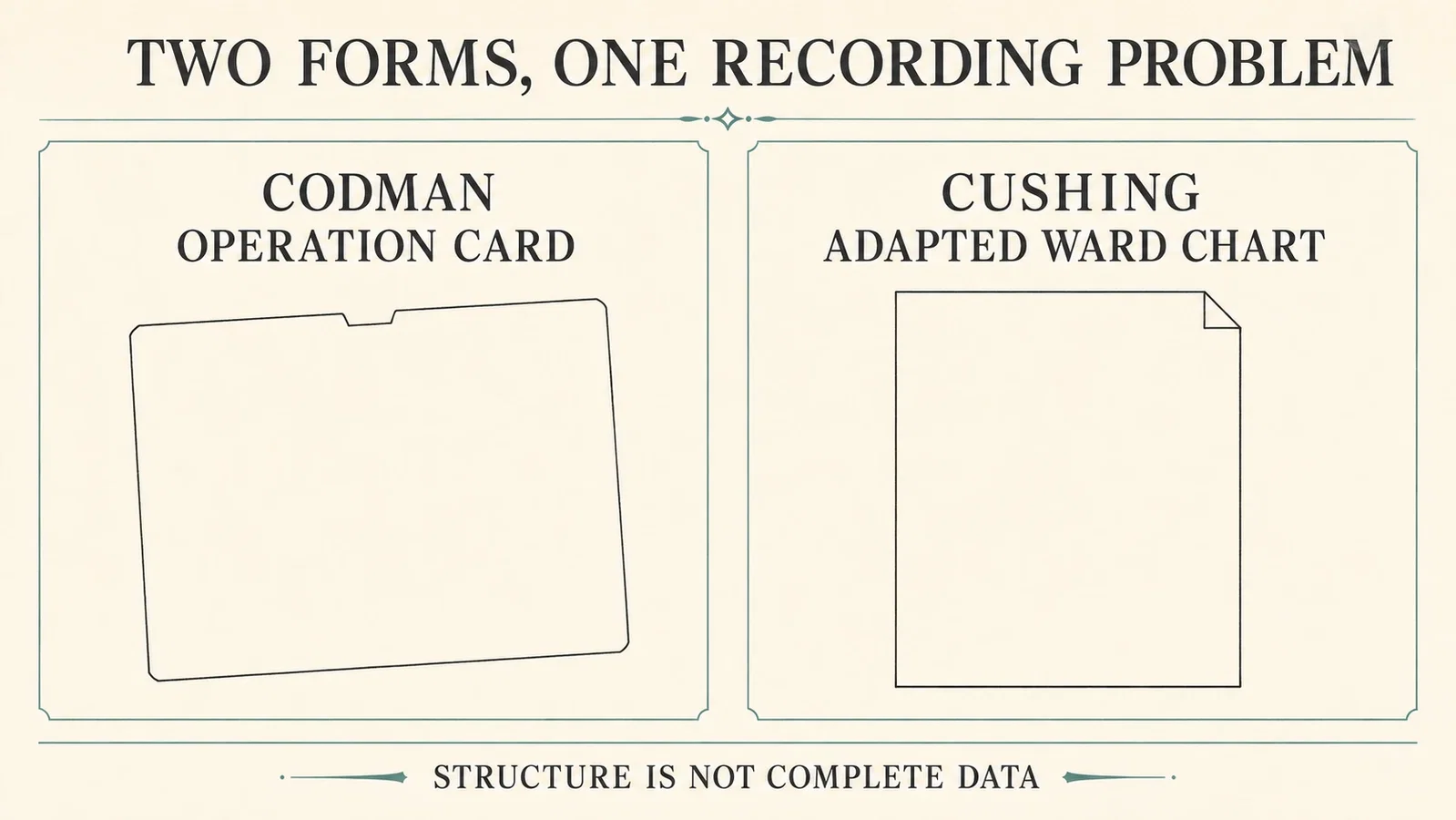
Modern structural guide: Codman’s operation card and Cushing’s adapted ward chart. Folder and page outlines are modern editorial icons, not original document shapes, facsimiles or invented patient records. The distinction draws on the article’s description and its four reproduced examples.[1–2]
Writing beyond the printed boxes
Cushing’s two reproduced examples have spaces for days of the month and days of the disease across the top. Small M and E labels divide the grid into morning and evening. Yet handwritten times, plotted observations and crowded annotations have turned this ward-style sheet toward a different task: following a patient through an operation.[2]
Cushing’s examples retain temperature, pulse and respiration headings, but handwritten material runs around the edges, through the grid and into spaces organized around a daily rhythm of observation.[2]
The reader must separate the form’s printed capacity from its actual contents. A temperature heading is not proof of a complete temperature series. An empty field is not, by itself, proof that no observation or action occurred. Some marks are clearer than others, and the surviving page cannot answer every question we bring to it.
The official reproductions conceal the patients’ names.[2]
There is still much to read without doing so. Curves preserve recorded variation; annotations can preserve events or the recorder’s interpretation. Neither is a complete account of the room. Their value lies partly in allowing a later reader to move between different kinds of information instead of relying on one retrospective verdict that the anesthetic went well or badly.
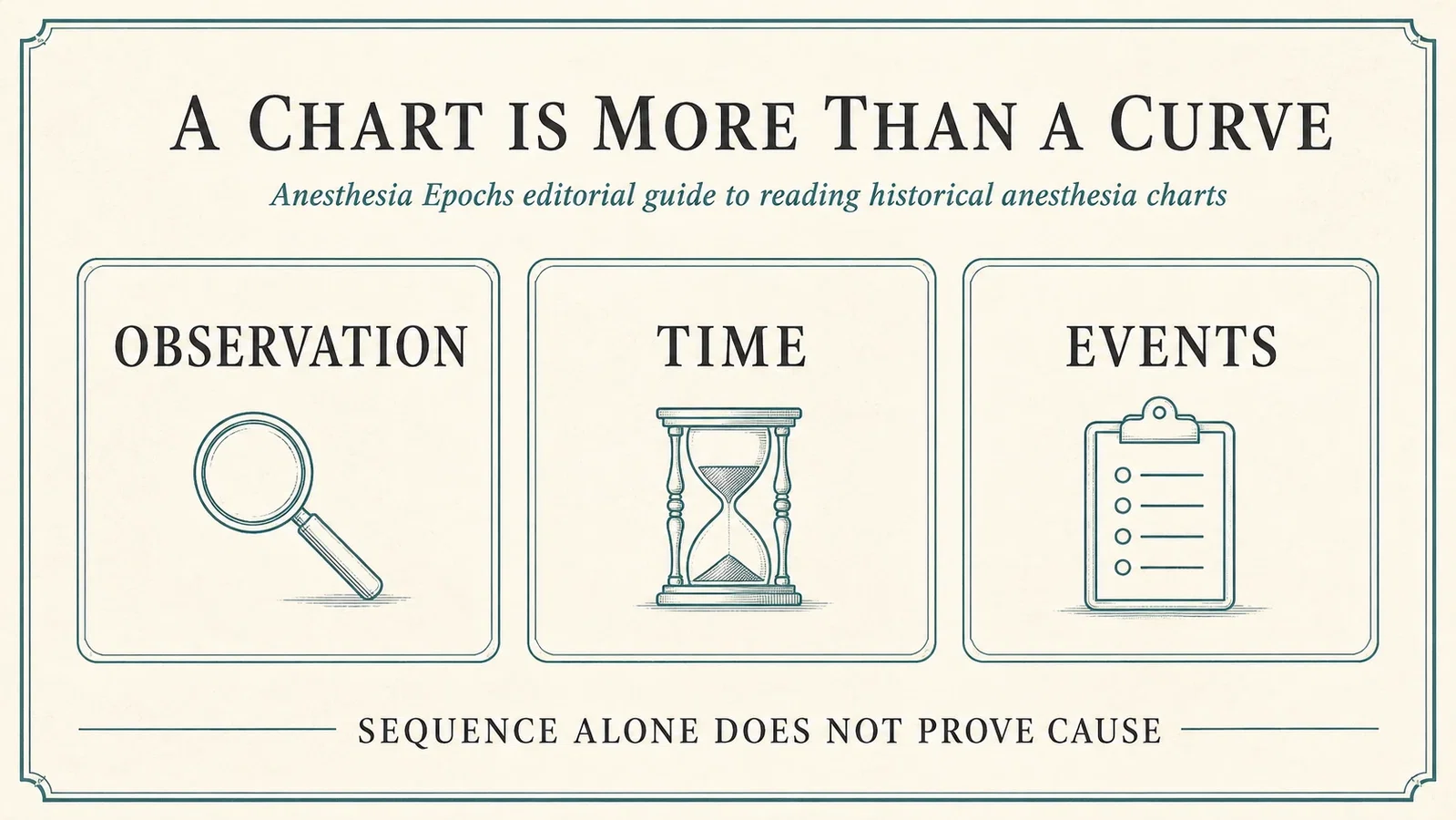
An editorial reading guide, not a clinical decision algorithm. Magnifier, hourglass and clipboard are generic modern icons, not evidence of period instruments. Event notes and curves belong in the same reading, but chronological sequence alone does not establish a cause.[2]
The origin story is not the whole evidence
The familiar dinner-wager story comes through later recollection. Sundararaman and Desai place it beside an account in which Harrington directed Codman to begin recording. Neither account fixes a single moment of invention.[1]
Kim’s historical discussion also separates the early charts from later efforts to establish monitoring in practice. Retrospective accounts differ over when routine records emerged at MGH. Kim, following Beecher, dates the hospital’s own anesthesia records to 1915.[1,3]
The paper artifacts do not need a perfectly resolved anecdote to remain interesting. They preserve decisions about what to write, where to put it and how a later reader might connect it.
Do not move blood pressure backward in time
Cushing’s encounter with Riva-Rocci’s apparatus in Italy in 1901 belongs to a later development. It should not be inserted into the earlier charting scene. A pulse-rate plot in the four early examples is not a blood-pressure trace.[2–4]
The Yale Cushing Center offers a useful visual warning. Its Medical Innovations drawer discusses the early charts, but the sheet displayed at the upper left is headed Peter Bent Brigham Hospital and belongs to a later period. A museum caption can cover a long history; an adjacent object does not automatically illustrate its earliest date.[4]
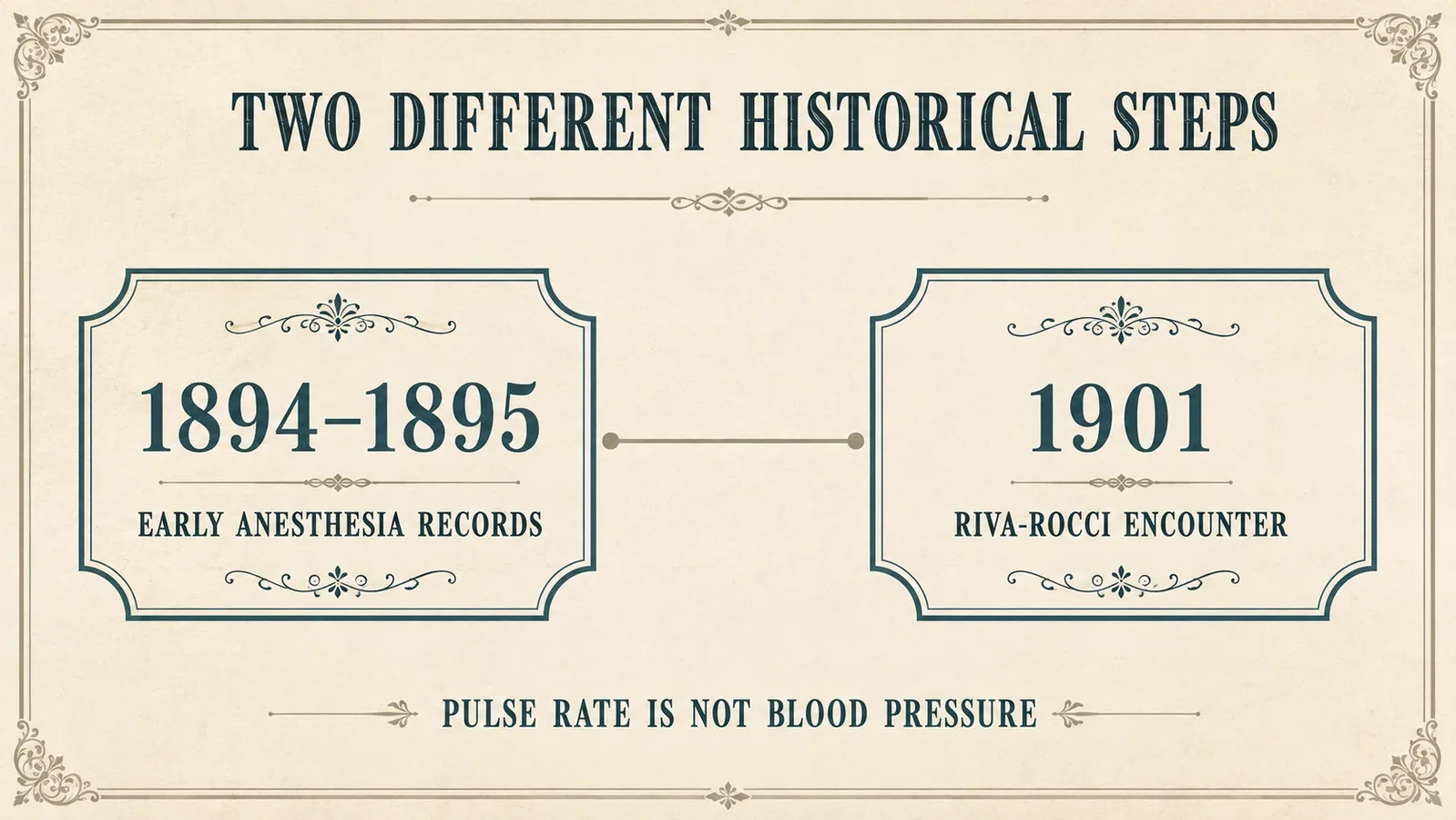
1894–1895 record keeping and the 1901 encounter are separate historical layers. This does not claim that nobody measured blood pressure earlier, or that a later form is an original MGH chart.[2–4]
These records are not self-acting safeguards. Their smaller, tangible achievement is to leave observations in relation to time, with room for events beside them. That makes an anesthetic available for another reading, including questions that its first recorder did not settle.
Sources and reading limits
Read: Sundararaman and Desai’s 2018 study in the author-posted advance version, with the four record images in its official supplements; Kim 2006, sections 1 and 5; the Yale Cushing Center’s Discovery Drawers text and drawer photograph.
Not covered: the complete collection of 110 records; the historical letters behind the competing origin accounts; the rest of Kim’s article. Kim dates the start of the ether charts to 1895. The sheet at the upper left of the Yale drawer is a later Peter Bent Brigham Hospital form, not an 1894 Massachusetts General Hospital original.
- Sundararaman LV, Desai SP. The Anesthesia Records of Harvey Cushing and Ernest Codman. Anesth Analg. 2018;126(1):322–329. PMID 29099433; DOI; author-posted advance version.
- Official supplements to the same paper: Figure 1, Figure 1a, Figure 2, Figure 2a. Two Codman and two Cushing examples.
- Kim OJ. Experimental Sciences in Surgery: Harvey Cushing’s Work at the Turn of the Twentieth Century. Korean J Med Hist. 2006;15(1):49–76. Journal PDF.
- Yale, Cushing/Whitney Medical Library. Discovery Drawers, 5T Medical Innovations.
Continue exploring
Related reading connects shared questions and contexts; it does not by itself establish historical influence.
- 1847: Snow Makes Ether a Question of Observation and Control
- 1893: London's Society of Anaesthetists Brings Experience Before Peers
Anesthesia Epochs · The Source Room · About & Editorial Method
Sources and reading limits are stated above. Illustrations are labelled as original source images or AI-made. Historical accounts are educational; they are not current treatment instructions.
Continue this reading route
Stop 2 of 7 · Back to route · Making Anesthesia Safer: From Observation to Continuous Monitoring
Previous · 1847: Snow Makes Ether a Question of Observation and Control
Next · c. 1964: Block-Aid Makes Muscle-Relaxant Action Repeatedly Observable
A chart preserves an observation. Block-Aid let the observer elicit another response and compare it with the last.