John Snow's 1847 book on ether connected the patient's responses, the supply of vapour and the surgical outcome without making them interchangeable.
Reading Library · Anesthesia Epochs · 中文版
Watch the companion film
1847: Snow and Ether · Watch on YouTube
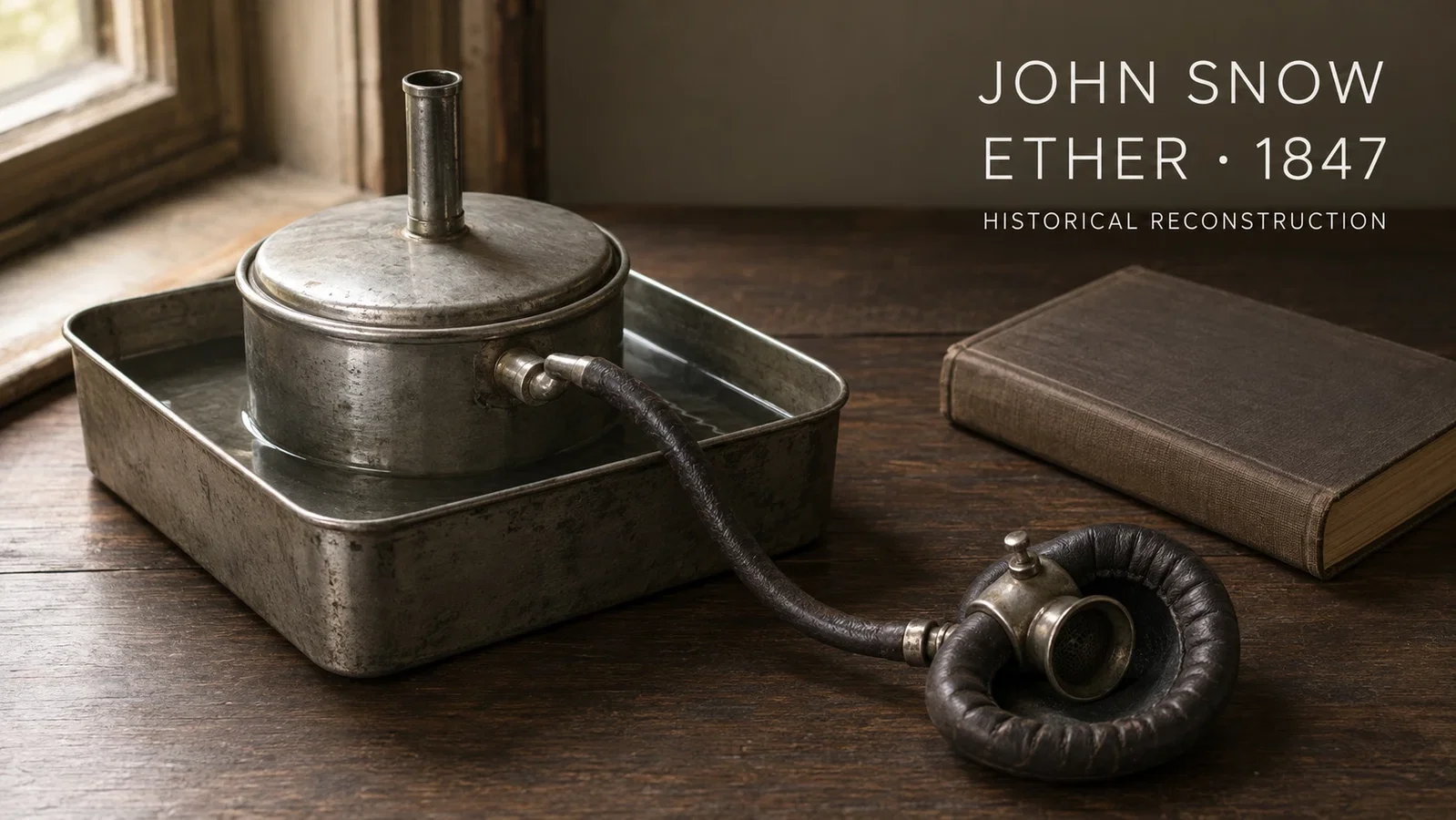
The last case was not finished.
Near the end of John Snow's 1847 book on ether, a patient who had undergone an operation for a bladder stone was reported to be progressing well. That was an update, not a final outcome. In the pages that followed, Snow explained why one lithotomy had been left out of the outcome tables: too little time had passed to declare the result.[1, pp 76–77]
This small admission is a useful place to enter a book often remembered for its apparatus and its five degrees of etherization. A patient's condition during an operation was one problem. The eventual result was another. Making the operation possible did not settle everything that came after it.
A denominator at the back of the book
The title promised an account of nearly eighty operations at St George's and University College Hospitals. Reading the lists explains why that phrase should not become a story of eighty uncomplicated successes.
The numbered St George's list ends at 52. Snow then adds four emergencies in which T. B. Bumpsted, the hospital's house surgeon, administered ether. The University College list reaches 23. That makes 79 listed or discussed operative episodes, not a verified count of distinct patients and not 79 occasions on which Snow personally gave the anaesthetic.[1, pp 71–72,76]
The final outcome summary uses a different denominator:56 operations at St George's and 22 at University College. One case was still awaiting an outcome that could be declared. The two hospitals had four and two deaths respectively.[1, pp 76–79]
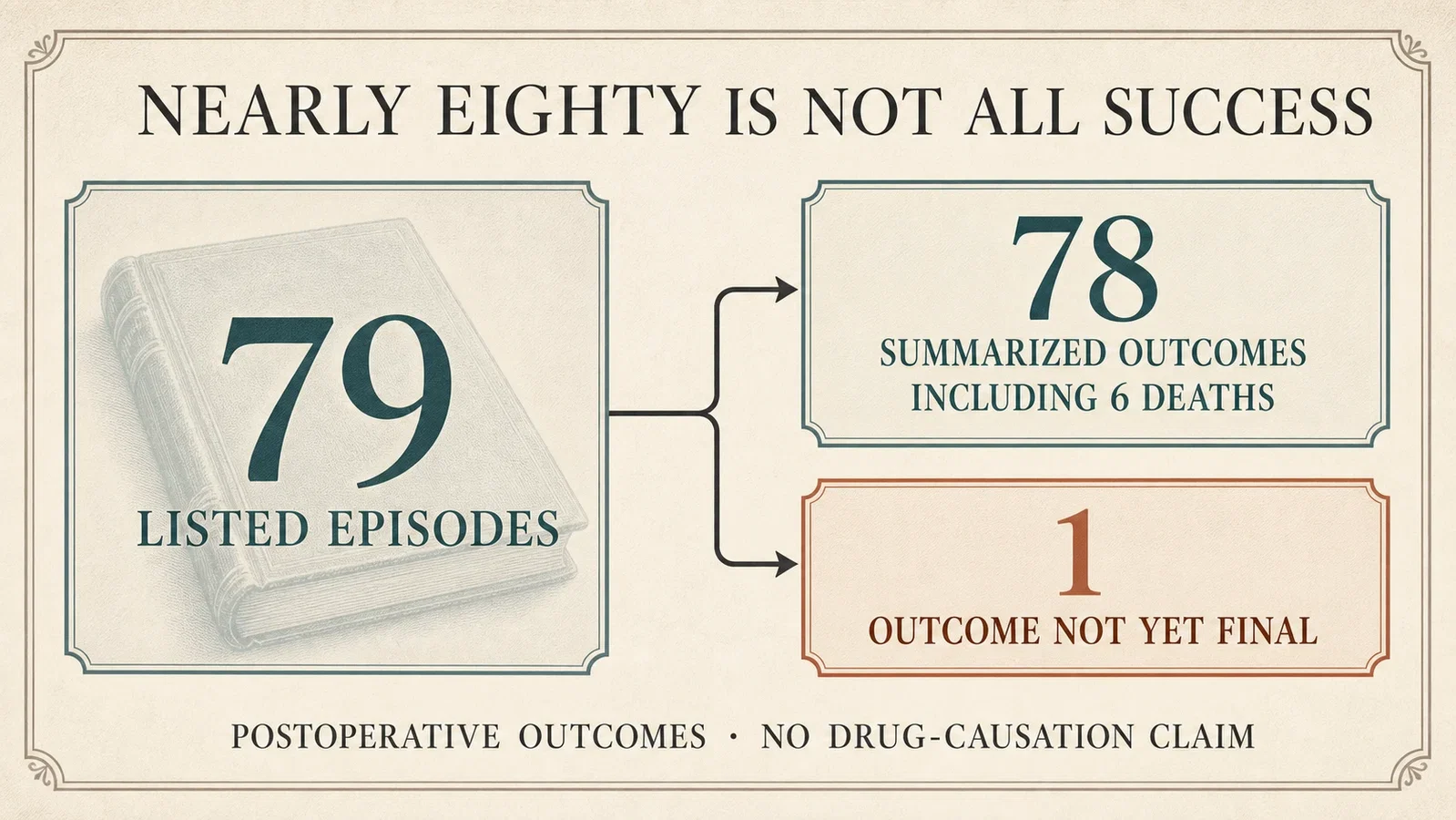
Snow argued that the deaths had sufficient explanations other than ether. That was Snow's interpretation, not independent proof that ether could have played no part. The comparison of some larger operations with historical results likewise could not establish a survival benefit across different case mixes. Snow acknowledged that the number of operations was too small to decide the question.[1, pp 76–79]
Yet the decision to examine outcomes mattered. Earlier in the book, Snow had urged an examination of actual results instead of relying on the benefit one expected to find.[1, pp 54–55] The case lists made that ambition visible, even where Snow's confidence outran what the evidence could settle.
What could an observer know?
Turn back to the opening pages and the same difficulty appears in another form. How should the person administering ether interpret the body in front of them?
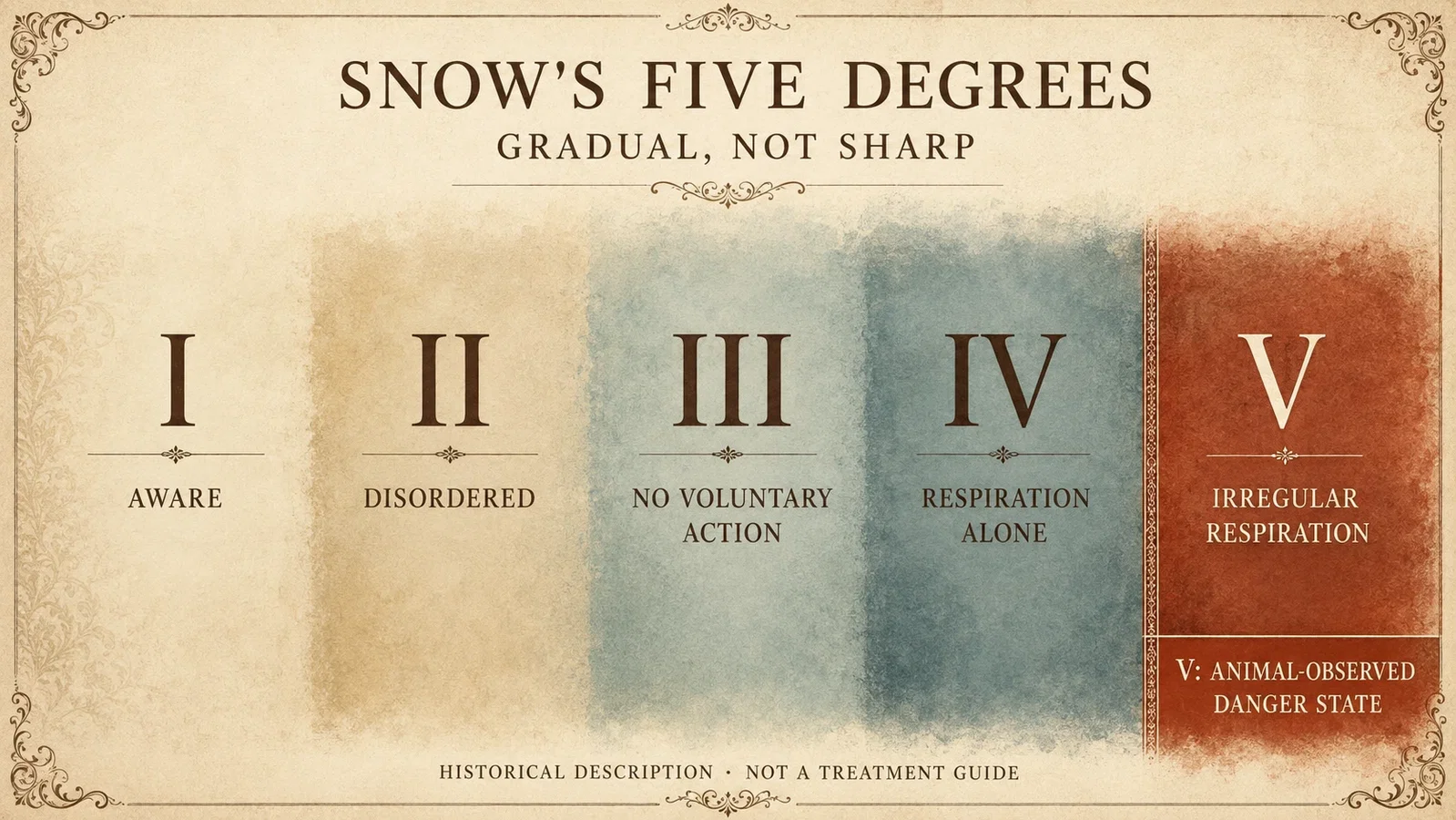
Snow described five degrees of effect, but did not present them as five neatly separated compartments: the divisions were arbitrary, the changes gradual, and the boundaries not always clearly distinguishable.[1, pp 1–2]
The account moved from preserved awareness and voluntary action, through disordered mental and motor activity, to states with no evidence of mental function or voluntary movement but possible muscular contractions. In a deeper degree, respiratory movements alone remained. The fifth involved weakened, irregular respiration. Crucially, Snow had not witnessed that fifth degree in a human being; its description came from animal observations and identified a state to avoid.[1, pp 1–2,9]
Nor could memory or movement act as a single reliable verdict on pain. In an appendix, Snow cautioned that a patient's later denial of pain did not prove its absence when there had been unequivocal signs of it. Snow also resisted the reverse shortcut: every slight movement or moan did not establish pain, and its expression did not directly measure its intensity.[1, pp 86–87]
Consciousness, recollection, voluntary action and other movements had to be distinguished. Recognizing that effort does not require accepting every physiological explanation in the book as current knowledge. It means reading the distinctions before compressing them into the claim that the patient was simply asleep.
Controlling the supply did not measure the absorbed dose
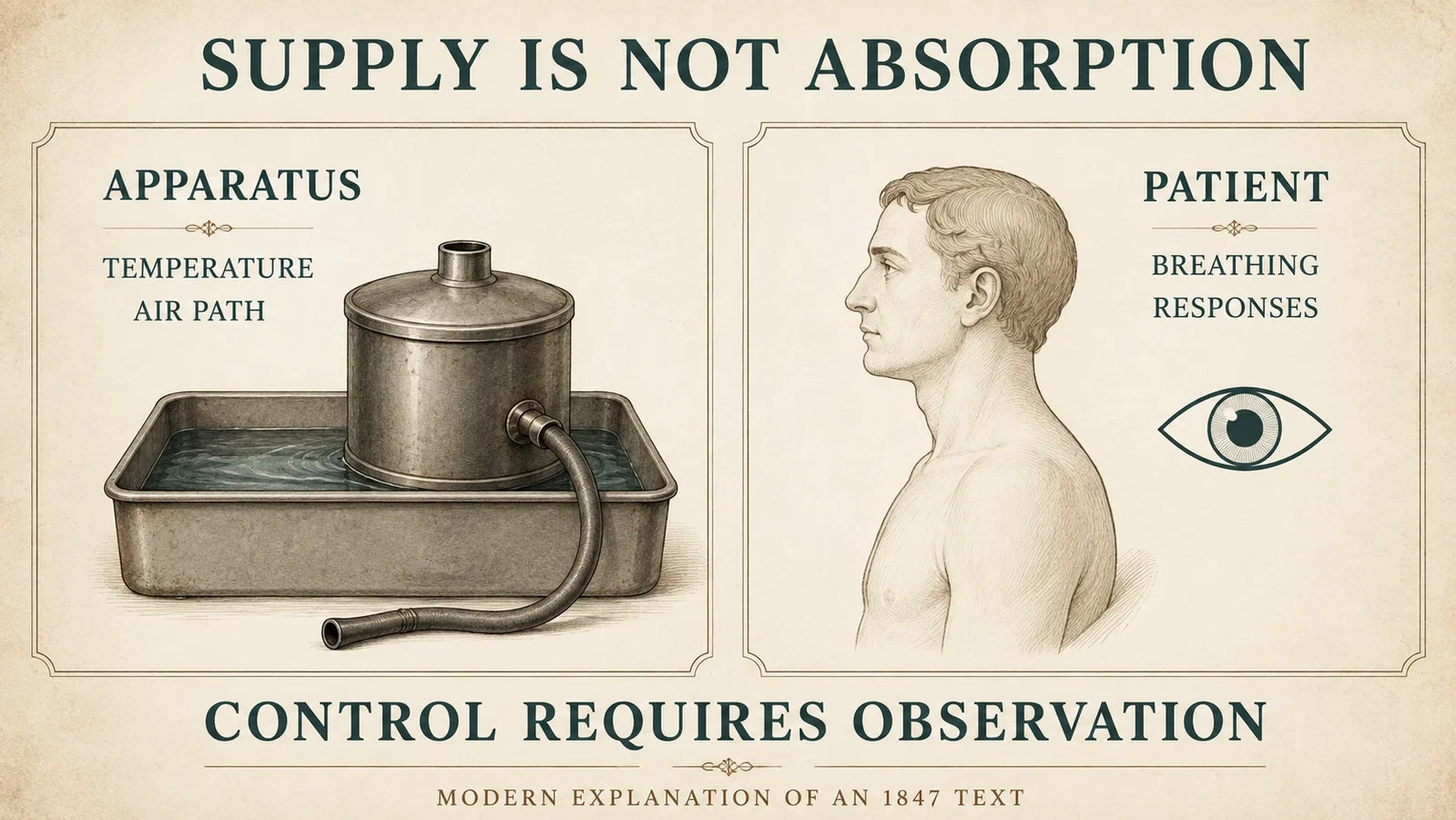
Observation depended partly on knowing what had been supplied. Snow wrote that symptoms alone might not identify a degree of effect; vapour strength, the duration of inhalation and the depth of breathing also informed the judgement.[1, pp 14–15]
The inhaler illustrated in the book was a later modification that Snow said had been in use for the preceding three months, not the first January prototype. A metal ether chamber sat in a water bath, with an internal air passage and a flexible tube leading to a facepiece.[1, pp 16–20]
The water addressed a physical problem. Evaporation cooled the apparatus, and cooling could alter the supply of vapour. Thermal regulation was therefore part of the attempt to make administration more controllable.[1, pp 20,29] The device also had a lineage: Snow acknowledged Julius Jeffreys's spiral arrangement and Sibson's facepiece, both adapted.[1, pp 19,22–23] This was modification and integration, not solitary invention of every component.
A movable valve admitted air at the facepiece. Its setting, however, offered only a rough estimate of dilution, influenced by breathing. Another observation exposed an even more tangible limit: some ether that appeared to have been used had actually splashed into the flexible tube because of an irregular internal passage. It had not all been inhaled.[1, pp 23,85–86]
The tables require similar care. Snow's January 23 contribution to the Medical Times divided a total mixture into ether vapour and air. In the later book, a table instead reported vapour added to a fixed volume of air, following further experiments. A number in one table cannot be treated as the same kind of percentage in the other.[2; 1, pp 25–26,29]
The historical temperatures were Fahrenheit. More importantly, neither the table nor the volume of liquid disappearing from an apparatus measured the amount absorbed by a particular patient.[1, pp 2,25–26,85–86] Those are distinctions worth preserving; reproducing the numerical tables here as present-day administration instructions would not be.
Reading the right 1847 book
The work is On the Inhalation of the Vapour of Ether in Surgical Operations, published in London by John Churchill in 1847. Its preface explicitly limits the discussion to surgical practice rather than extending it to midwifery and other medical uses.[1, title, preface v–vi] It should not be silently replaced by Snow's later chloroform book.
The preface is dated September. The Michigan State University John Snow Archive places the book in October and explains the bibliographic evidence behind that editorial dating.[3] Since the underlying October journal receipt notice was not directly read for this article, the public date remains 1847 rather than an invented day of publication.
The original images read here come from Wellcome's copy, with Medical Society of London provenance.[4] Wood Library-Museum catalogues a different copy as Snow's own, with a later presentation and an inserted letter.[5] That description was read as a catalogue record; the handwriting and physical objects were not authenticated here. The distinction matters because access to one scan is not access to every copy's annotations.
What emerges from the book is more interesting than a claim that precise anaesthetic dosing had suddenly been completed. Snow connected the changing patient, a controllable supply of vapour and the eventual surgical result. Each required its own observations. None could simply stand in for the others.
The unfinished case belongs in that story. It marks the point where an account of an effect had to wait for evidence of an outcome.
Sources and reading limits
Read: Snow's 1847 book (Wellcome copy) at the pages cited, including the five degrees (pp. 1-2, 9), the inhaler (pp. 14-29), the case lists and outcome summary (pp. 71-79) and the appendix (pp. 85-87); Snow's table in the Medical Times of 23 January 1847; selected passages of the MSU John Snow Archive transcription; the Wellcome and Wood Library-Museum catalogue entries.
Not covered: every page of the book and every listed case; the October 1847 journal notice behind the MSU dating; the Wood Library-Museum copy itself, its inscription and letter; Snow's later chloroform book.
- Snow J. On the Inhalation of the Vapour of Ether in Surgical Operations. London: John Churchill; 1847. Internet Archive.
- Snow J. Table of the quantity of vapour of ether in 100 cubic inches of air, saturated with it at various temperatures. Medical Times.1847 Jan 23; 15:325. Original journal-page photocopy.
- John Snow Archive and Research Companion, MSU: book transcription and editorial dating.
- Wellcome catalogue.
- Wood Library-Museum catalogue · Archived copy.
Continue exploring
Related reading connects shared questions and contexts; it does not by itself establish historical influence.
- 1853: The Queen's Chloroform, Relief Without an End to Debate
- 1846: The Ether Dome, a Breakthrough Without a Perfect Moment
- 1846: Holmes Gives an Old Word a New Task
- 1847: Simpson Separates Labour Pain from Uterine Action
- 1853: Wood and Pravaz, Similar Instruments for Different Questions
- 1868: Andrews Adds Oxygen to Nitrous Oxide
- 1878: Macewen's Oral Tracheal Tube
- 1894: Cushing and Codman Put Anesthesia on the Record
- 1920: Guedel Divides Ether's Third Stage into Four Strata
Anesthesia Epochs · The Source Room · About & Editorial Method
Sources and reading limits are stated above. Illustrations are labelled as original source images or AI-made. Historical accounts are educational; they are not current treatment instructions.
Continue these reading routes
Stop 2 of 7 · Back to route · From Ether to Balanced Anesthesia
Previous · 1846: The Ether Dome, a Breakthrough Without a Perfect Moment
Next · 1934: Lundy Uses and Observes Thiopental at the Mayo Clinic
Snow followed the effects of inhaled ether. Lundy’s cases ask what the clinician could observe as an intravenous anesthetic took effect.
Stop 1 of 7 · Back to route · Making Anesthesia Safer: From Observation to Continuous Monitoring
Next · 1894: Cushing and Codman Put Anesthesia on the Record
Snow recorded changing signs at the bedside. Cushing and Codman put observations alongside times and events so another reader could revisit them.