In 1868 Andrews added free oxygen to nitrous oxide in the hope of longer anaesthesia without asphyxia, and left the best proportion as an expectation rather than a tested recipe.
Reading Library · Anesthesia Epochs · 中文版
Watch the companion film
1868: Andrews and Nitrous Oxide–Oxygen · Watch on YouTube
The familiar proportion comes near the end of the paper, and it comes as an expectation. Edmund Andrews thought the best oxygen fraction would turn out to be one-fifth by volume. Andrews did not announce that a controlled comparison had established an optimum.[1, p 660]
That distinction changes how we read the 1868 report. Later historical shorthand can make the oxygen mixture sound like a finished recipe: a named doctor, a date, a ratio, a safer anesthetic. The original is less settled and more revealing. It contains different mixtures, incomplete anesthesia, an imperfect inhaler, brief procedures, reports from other practitioners and a promise to continue investigating.
The Anesthesia History Association's November calendar summarizes the publication as a proposal for an 80:20 nitrous oxide–oxygen premix. Read as a proposal, that is compatible with Andrews's closing discussion. Read as the regimen successfully tested throughout the paper, it is not.[1, p 660;4]
A proposed optimum is not the same as an observed result
Andrews published The Oxygen Mixture, a New Anæsthetic Combination in the November 1868 Chicago Medical Examiner. The original running heads and bibliographic record establish the month; the first day supplied in database metadata does not establish an exact historical publication day. The author line identifies the Chicago Medical College.[1, p 656;2]
The Wood Library-Museum places the Chicago proposal in its 1868 timeline. This locates a publication in anesthesia history. It does not settle the priority of every earlier use, demonstrate a preferred mixture, or tell us how quickly practice changed.[3]
What Andrews had actually tried differed from the fraction Andrews ultimately favored. The animal accounts included mixtures with approximately one-quarter oxygen. Several human accounts specified one-third oxygen. The one-fifth fraction appeared as Andrews's judgment about what future work would show.[1, pp 657–660]
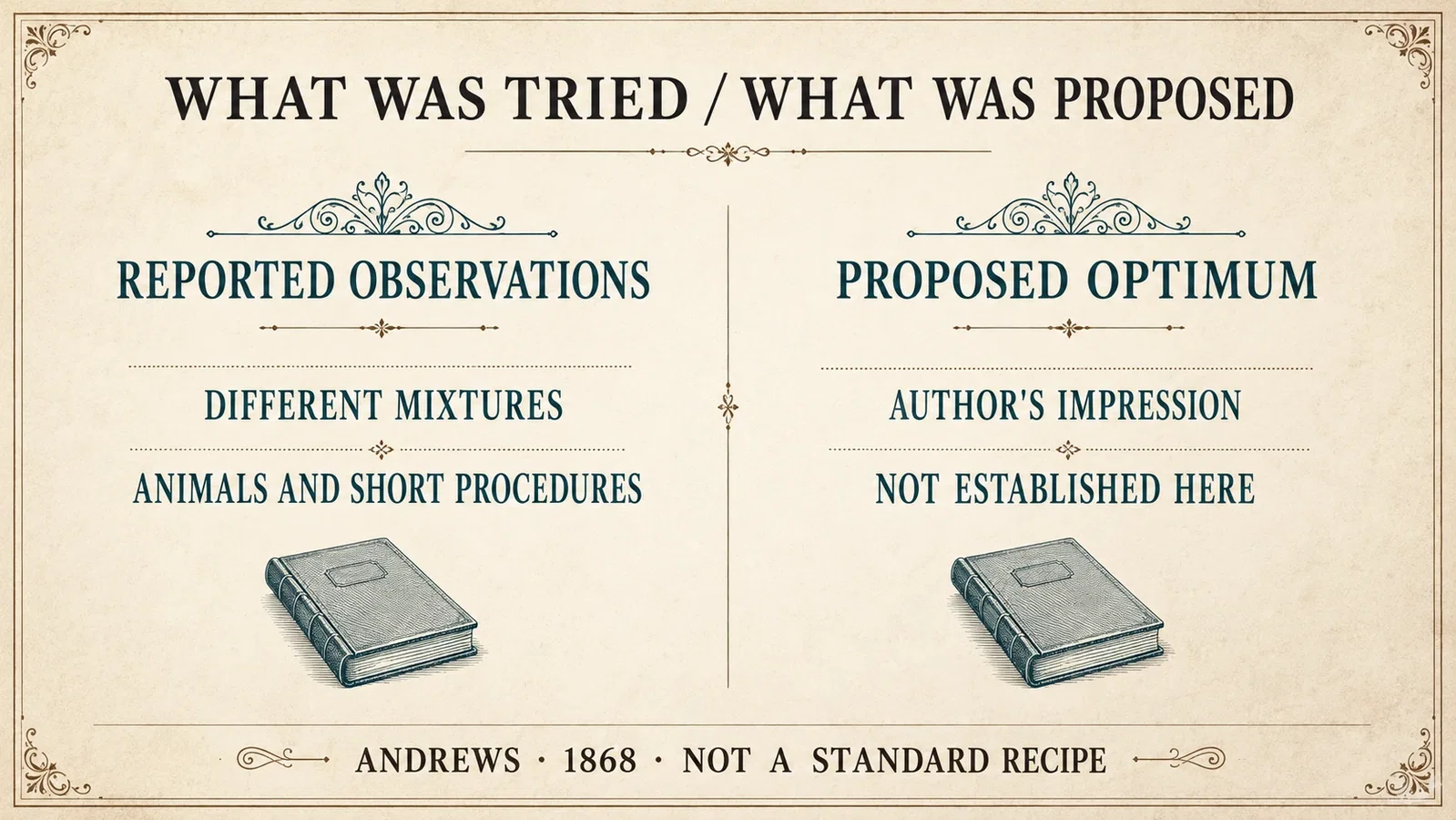
These fractions belong to the historical conditions under discussion. They are not recommendations for present-day anesthesia. More importantly for this story, they should not be collapsed into one standardized intervention that the original investigation never consistently used.
Why add oxygen at all?
The opening problem was duration. Andrews admired the speed with which dental nitrous oxide could act and wear off. Andrews wanted something with those advantages that could serve more prolonged surgical operations. But continuing pure nitrous oxide could produce a purple face, disturbed breathing and eventually near cessation of respiration in Andrews's account.[1, p 656]
Andrews distinguished oxygen chemically combined within nitrous oxide from free oxygen available for blood oxygenation. The presence of oxygen in a chemical name did not make the gas a respiratory substitute. Adding free oxygen was Andrews's way of asking whether anesthetic action could be continued without the accompanying asphyxial danger.[1, p 656]
This is the distinction captured by the title of this essay. It is an editorial reading of the problem in the source, not a claim that Andrews alone discovered the difference between anesthesia and asphyxia. Nor does it turn Andrews's descriptions of color and breathing into modern measurements. There were no reported saturation values with which to quantify those observations.
Nine numbered experiments, several different kinds of evidence
The paper's numbering can mislead. Experiments 1 through 5 were animal exposures involving three rats, not five independent animals. The same rat appeared in the third, fourth and fifth experiments. Experiments 6 through 9 were four numbered human narratives. Additional experiences reported by colleagues were not accompanied by a complete denominator.[1, pp 657–660]
A rat exposed to pure nitrous oxide died. Another, exposed to an oxygen-containing mixture for half an hour, subsequently recovered. Yet the third rat did not become fully anesthetized with a mixture described as 25% oxygen; repeating the exposure gave a similar result. Andrews attributed that incomplete effect to dilution and the animal's lower susceptibility.[1, pp 657–658]
The contrast mattered to Andrews's argument. Oxygen was not simply an extra ingredient that left every other feature unchanged. The source itself raised a tension between maintaining the desired anesthetic effect and changing the composition of the inspired gas. But three animals could not establish a general concentration-response relation.
The same third rat later died during an ether exposure. Andrews used this observation when arguing for the mixture's probable safety. Without adequately controlled exposure conditions, however, that sequence cannot establish a clinical safety ranking. The outcome of one animal under different exposures is not a comparison of mortality risks in patients.[1, pp 658,660]
The human narratives were heterogeneous too. One involved manipulation of an ankylosed knee; another a tooth extraction witnessed by Andrews. The dental account did not separately state its exact fraction. An account of a nail procedure compared the patient's recovery with that patient's experiences under other agents at other times and during different procedures. The patient's recovery after the oxygen mixture still included delirium, although the author described it as shorter than before.[1, pp 658–659]
None of this makes the report worthless. It identifies the kind of report it was: an exploratory collection of observations, not nine uniformly enrolled patients or a controlled crossover trial.
The inhaler interrupted the argument
The eighth experiment reveals a problem that a neat mixture ratio can conceal. A 42-year-old woman had an ankylosed right hip and flexion contractures of both knees. Andrews intended to divide the hamstring tendons and attempt to release the hip adhesions. Gas came from a large elastic bag through an inhaler Andrews described as imperfect.[1, pp 658–659]
Air entered with the gas. Andrews associated that further dilution with slower and less complete anesthesia. After nine minutes of inhalation, the patient became unconscious. The operations lasted about three minutes. Andrews divided the hamstrings but abandoned the attempt to break the hip adhesions because they were too firm.[1, p 659]
Those times describe different things. Nine minutes was the account of reaching unconsciousness; approximately three minutes described the operations. Neither is proof of a long operation, and adding them does not produce an independently measured period of stable twelve-minute anesthesia.
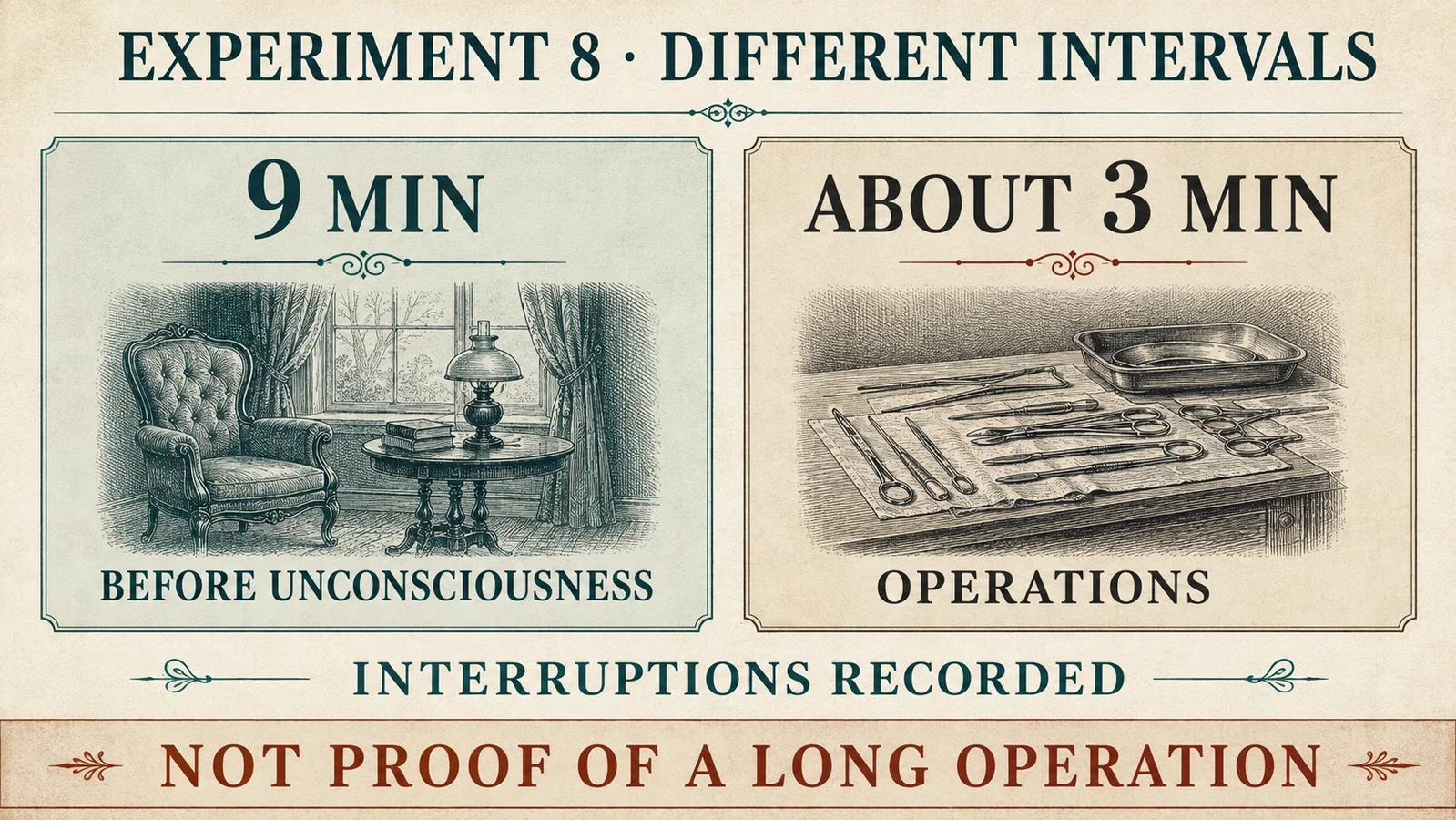
Twice during inhalation, pallor with faint duskiness led Andrews to suspend the gas briefly. The account also noted recovery without nausea. A faithful reading needs both facts. A favorable recovery detail cannot erase the appearance-driven interruptions, and those appearances cannot be retrospectively assigned an exact saturation or a definitive physiological diagnosis.[1, p 659]
The broader historical point is not a technical instruction about that inhaler. It is that a nominal mixture in a reservoir was only one part of delivery. The apparatus and entry of room air could change what the patient received. Andrews's report placed the composition problem and the delivery problem beside one another without resolving either for all patients or all operations.
The paper acknowledged a history before its author
Andrews recorded that Rogers, a Chicago dentist, reported using an oxygen-containing mixture for several years. This was not an unnoticed minor detail: it prevents us from using the 1868 paper as straightforward proof that Andrews alone made the first clinical use.[1, p 660]
The statement is available through Andrews's report. A separate contemporary Rogers publication has not been read for this article, and an exact starting year should not be reverse-engineered from the phrase describing several years. Other proposed or reported practices in the paper were qualified as indirect information, and an inquiry to one practitioner remained unanswered.[1, p 660]
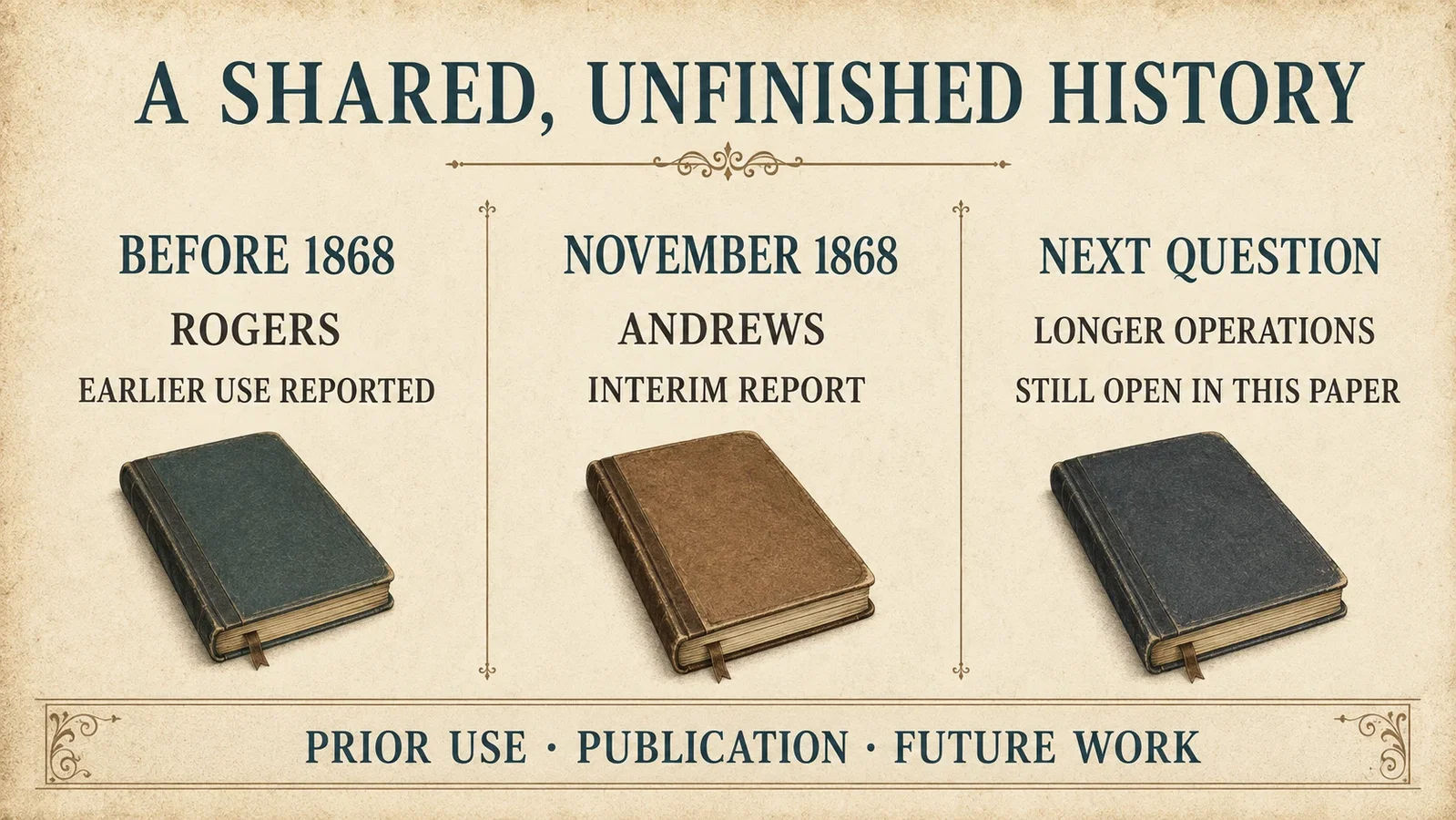
A distributed history does not diminish the publication's importance. It changes the nature of the credit: Andrews made an argument in print, described what Andrews and colleagues had observed, and exposed questions that a simple first-inventor label would hide.
An investigation that ended with more work
Andrews wrote with confidence about the mixture's promise. Andrews also explicitly said the experiments were insufficient to settle its value. At the end Andrews returned to the hope of anesthesia for the longest as well as the shortest operations and promised further investigation. That was a forecast, not an outcome already demonstrated by the cases printed above it.[1, pp 656,660–661]
The final page discussed the bulk of gas storage and transport as a practical inconvenience. Those passages show that a chemical proposal still had to become a workable method. They do not establish widespread uptake, validate a later apparatus, or justify reproducing the historical preparation and administration directions as present-day advice.[1, p 661]
The enduring question in this short paper is therefore larger than a ratio. Could anesthetic action, oxygen supply and actual delivery be considered together, without treating one as proof of the others? In 1868 Andrews offered observations and an unfinished answer. Keeping that unfinished quality visible is part of explaining what changed.
Sources and reading limits
Read: Andrews's paper in full (pp. 656–661); the Wood Library-Museum 1868 entry; the Anesthesia History Association November entry.
Not covered: any separate publication by Rogers; later apparatus. The "80:20" shorthand is treated as a proposal, not as the regimen tested in the paper.
- Andrews E. The Oxygen Mixture, a New Anæsthetic Combination. Chicago Medical Examiner. 1868 Nov;9(11):656–661. Original PMC scans.
- Europe PMC bibliographic record. PMID 37471821, PMC10004972. Month precision retained; first-of-month index fields are not exact historical dates.
- Wood Library-Museum of Anesthesiology. History of Anesthesia, 1868 entry · Archived copy.
- Anesthesia History Association. November, 1868 entry.
Continue exploring
Related reading connects shared questions and contexts; it does not by itself establish historical influence.
- 1800: Davy's Nitrous Oxide and Surgery in the Conditional
- 1844: Horace Wells, the Dentist Who Became the Patient
- 1847: Snow Makes Ether a Question of Observation and Control
Anesthesia Epochs · The Source Room · About & Editorial Method
Sources and reading limits are stated above. Illustrations are labelled as original source images or AI-made. Historical accounts are educational; they are not current treatment instructions.