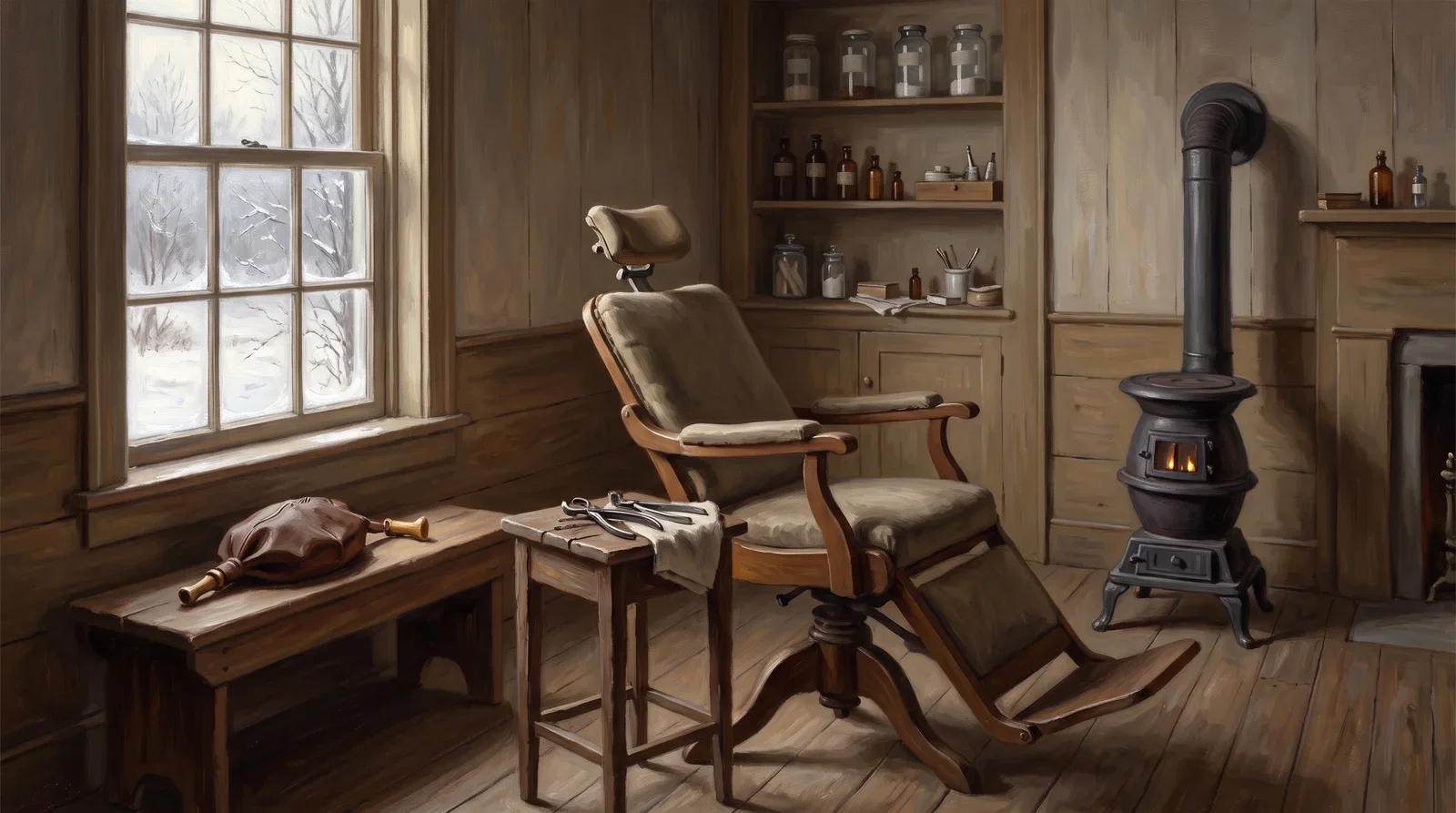
In Hartford in late 1844 the dentist Horace Wells became the patient: Colton gave him nitrous oxide, Riggs pulled his tooth, and Wells said he felt no pain.
Reading Library · Anesthesia Epochs · 中文版
Watch the companion film
1844: Wells and Nitrous Oxide · Watch on YouTube
On 27 March 1847, John M. Riggs swore to an account of an earlier tooth extraction. The patient had been another dentist, Horace Wells. Riggs recalled removing an upper molar after Wells received nitrous oxide at his own request. He had seen no evidence of suffering, and Wells had said afterward that he had suffered none.[1, p.21]
That is a small clinical story with an unusually important change of roles. The man proposing the experiment was also the person whose experience mattered. Wells did not extract his own tooth: Riggs operated, while Gardner Quincy Colton, in his later account, supplied and administered the gas.[1, pp.6,21; 2, p.5]
The familiar date is 11 December 1844. It is retained here as a conventional historical anchor, with a qualification that the sources themselves require. Accounts printed in Wells's 1847 pamphlet place the beginning in November. The day is not unanimously established by the early testimony.[1, pp.3,21; 2, p.5]
A result, and the person who reported it
Riggs's statement contains two kinds of evidence. He described what he observed during the extraction. He also recorded what Wells said about the experience after recovering. A person's outward behavior and subsequent report of pain can support each other, but they are not interchangeable measurements.[1, p.21]
Nothing in this record supplies a standardized pain score or proves a modern monitored state of anesthesia. Its importance is more direct: a tooth had been removed, and the patient reported that the expected suffering had not occurred.
That patient was not merely an audience for a medical idea. By accepting the proposed trial himself, Wells moved the question from observing someone else's reaction to reporting his own. The historical choice need not be celebrated as a method to imitate. Nor does an agreement described in a nineteenth-century account establish a modern consent process. This article gives no instructions for gas preparation, inhalation or extraction.
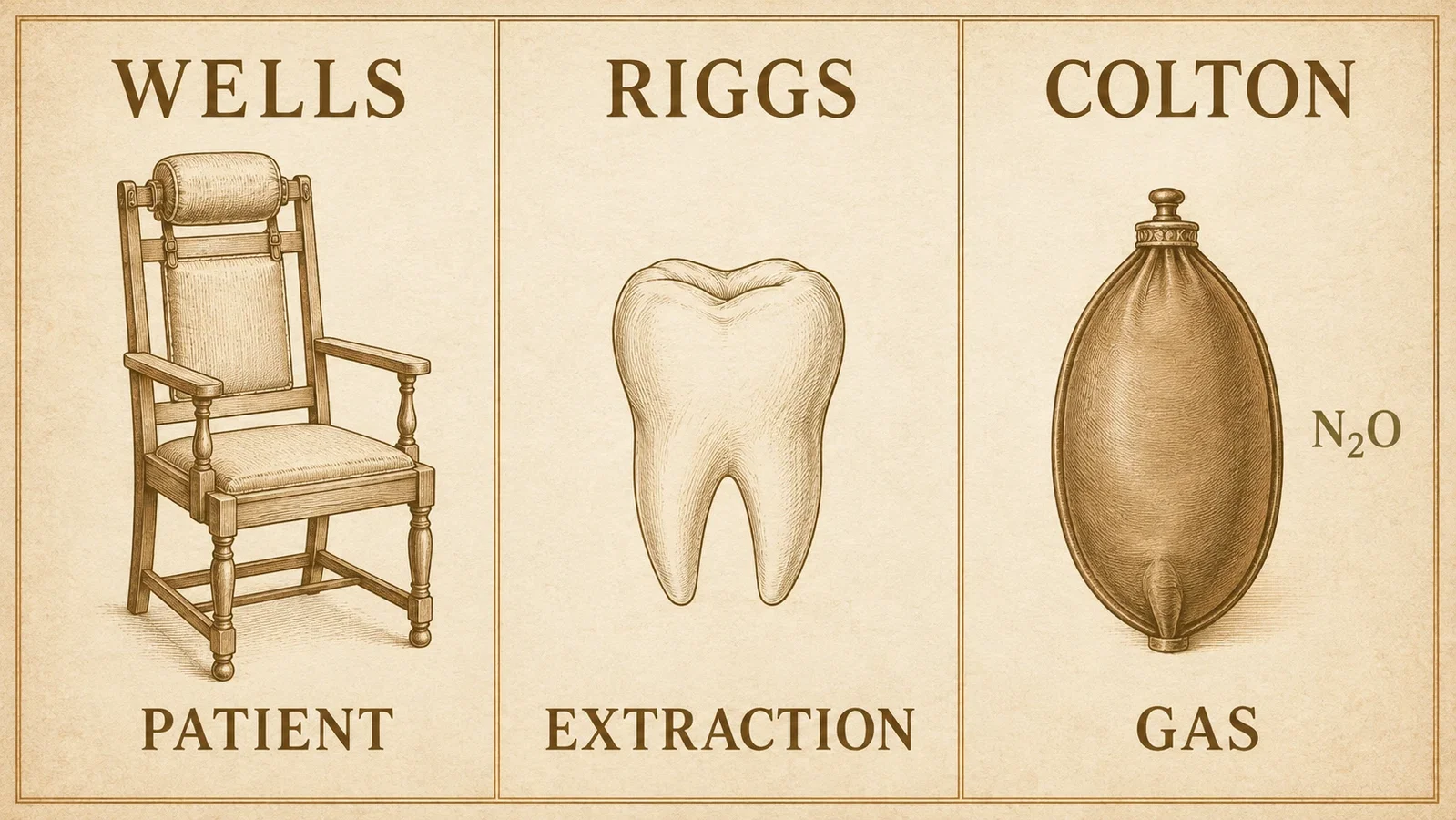
The division of work should remain legible. Riggs's 1847 statement does not name Colton as the administrator; Colton supplies that detail in his own 1886 narrative. Combining compatible parts of the accounts is reasonable when their different origins remain visible. Attributing every detail to the earlier affidavit is not.
The clue came from a different kind of room
Colton located the initial observation at a Hartford gas exhibition on the evening of 10 December 1844. In his recollection, a young man named Cooley ran against wooden benches while affected by nitrous oxide, injured his legs, and did not recognize the injury until afterward. Wells noticed the discrepancy between what had happened to the body and what the man had felt.[2, p.4]
Colton then remembered Wells asking whether a tooth might be removed without pain under the gas. They arranged to try the idea on Wells. The following morning, according to Colton, he brought gas to the dental office, gave it to Wells, and Riggs removed the tooth.[2, pp.4–5]
This is a participant's recollection published forty-two years after the event. It offers an explanation of how an exhibition became the occasion for a clinical question, but it is not a transcript made that evening. The precise dialogue should not be treated as though an observer had recorded every word in 1844.
An unnoticed injury at an exhibition was a clue, not proof that any operation could be performed safely. What changed was the purpose of the question. Wells was interested in whether an effect noticed during entertainment could alter the experience of a specific dental procedure.
His own account did not describe a perfect series
In 1847, Wells wrote that he had first tried the idea on himself and then used it for twelve or fifteen other people. The same page acknowledged one or two exceptions. Both parts belong in the account.[1, p.6]
The imprecise numbers cannot be made into a reliable success rate. There is no complete case table here identifying every patient, a uniform definition of success, or comparable follow-up. Quoting the favorable results while dropping the exceptions would make the evidence appear more complete than Wells himself presented it.
Other statements in the pamphlet broaden the personal record. F. C. Goodrich described beginning as a skeptic, watching the method used, then accepting it for the removal of his own large bicuspid tooth. He reported no pain and subsequently watched further operations.[1, pp.22–23]
That movement from spectator to patient provides something the first self-experiment could not: another person's experience. It still comes to the reader through testimony sworn in 1847 about earlier events. It is not a prospectively collected trial, and additional signatures do not silently change its design.
The case for taking the observation seriously can therefore remain substantial without becoming unlimited. There were favorable reports beyond Wells himself. There were also admitted exceptions, imprecise counts and retrospective collection of the evidence.
The calendar has more than one voice
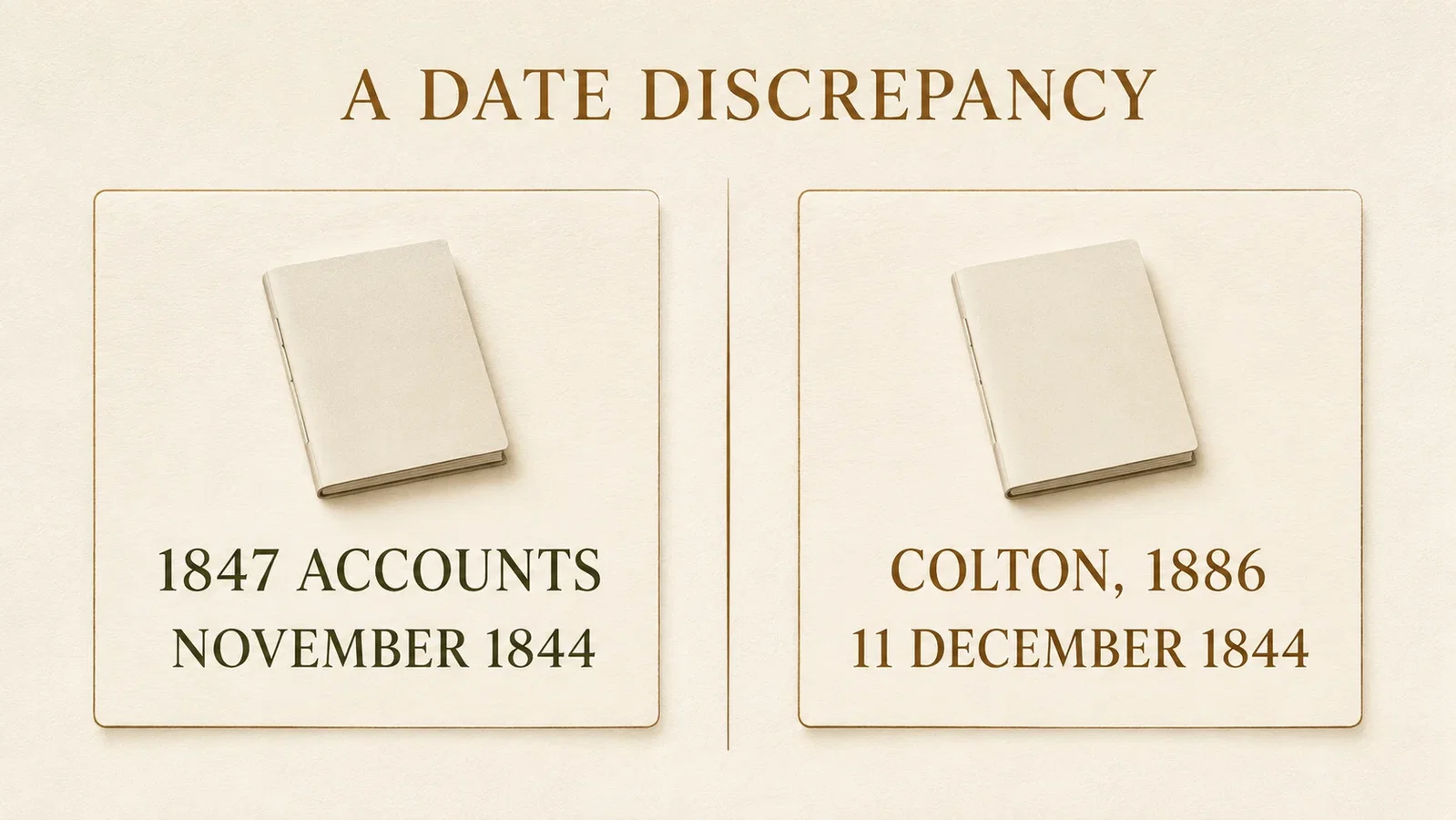
Wells dated the preface of his pamphlet 30 March 1847 and referred to making the discovery public in November 1844. Riggs's sworn statement placed their consultation at about the beginning of November, followed by the trial the next day. Mylo Lee, another patient whose testimony was included, likewise recalled treatment in November 1844.[1, pp.3,21–22]
Colton's later account explicitly supplied the sequence of 10 December for the exhibition and 11 December for the extraction. Subsequent professional and institutional histories adopted that familiar sequence.[2, pp.4–5; 3, p.74; 4]
The difference should neither disappear through silent correction nor be declared settled merely by choosing the earlier printed date. The original 1844 newspaper advertisement and the handwritten originals behind the printed affidavits are not covered here. This account names the texts it relies on and the point at which they disagree.
A source can support one part of a story without settling every part. The three men's roles and the report of a painless extraction can be described while the date retains its qualification. Historical precision sometimes means showing the limit of precision, not adding another digit.
What the signatures were doing
Wells's pamphlet was also an argument about credit. It assembled personal narrative, patient statements, witness accounts and endorsements to persuade readers of his contribution. These documents did different jobs.[1, pp.3,15–25]
At the end, physicians said they knew and had spoken with the named patients, expressed reliance on their accounts of the operations and their timing, and endorsed Wells's integrity. Isaac Toucey certified the professional position of the physicians, and Secretary Charles Wm. Bradley certified Toucey's office as governor. These are different kinds of endorsement. They do not show government approval of anesthesia or officials independently measuring the results of dental procedures.[1, pp.24–25]
The explanations surrounding the testimony also need limits. Wells discussed excited states and similarities between inhaled agents using the concepts available to him. Colton's much later pamphlet included an oxygen-based explanation and sweeping claims about safety. Reading those arguments does not require accepting them as physiology or validated clinical outcomes.[1, pp.5,12–13; 2, pp.10–14]
Wells also wrote that he wanted the discovery freely available and described trying to bring it before professional colleagues.[1, p.14] Moving from personal experience to wider conviction required more than an enthusiastic report: other people had to encounter the method, interpret its results and decide what the evidence could bear. His subsequent Boston demonstration belongs to the next episode, not a retrospective verdict that erases the Hartford experience.
No unrestricted title of sole inventor is needed to recognize what this article preserves. A dentist became the patient, another dentist performed the extraction, and the patient's answer made a possibility tangible. The admitted exceptions and imperfect historical record are part of that contribution's history, not details to remove before telling it.
Sources and reading limits
- Wells H. A History of the Discovery of the Application of Nitrous Oxide Gas, Ether, and Other Vapors, to Surgical Operations. Hartford: J. Gaylord Wells; 1847. Read in full (pp. 1–25, with the preface and testimony); citations use printed pagination. The handwritten originals behind the testimony are not covered.
- Colton GQ. Anaesthesia: Who Made and Developed This Great Discovery? A Statement. New York: A. G. Sherwood & Co.; 1886. Read in full (pp. 1–15). A participant's late recollection, not an 1844 transcript.
- Jacobsohn PH. Horace Wells: Discoverer of Anesthesia. Anesth Prog. 1995;42(3–4):73–75. PMID 8934966; PMC2148901. Read in full. Limited corroboration of the familiar Hartford sequence; errors elsewhere and unrestricted priority language are not adopted.
- Royal College of Anaesthetists. The History of Anaesthesia. The Hartford passage is cited.
Sources and reading limits are stated above. Illustrations are labelled as original source images or AI-made. Historical accounts are educational; they are not current treatment instructions.
Continue exploring
Related reading connects shared questions and contexts; it does not by itself establish historical influence.
- 1800: Davy's Nitrous Oxide and Surgery in the Conditional
- 1842: Crawford Long Operates Before Publishing
- 1845: Wells in Boston, One Demonstration and Three Kinds of Evidence
- 1846: The Ether Dome, a Breakthrough Without a Perfect Moment
- 1868: Andrews Adds Oxygen to Nitrous Oxide
- 1842: Clarke's Painless Tooth Extraction Under Ether, as Told in 1881
Anesthesia Epochs · The Source Room · About & Editorial Method