In his 1800 book on nitrous oxide, Humphry Davy recorded that the gas only briefly eased the pain of an inflamed gum, and wrote that it might probably be used in surgical operations without great blood loss, a proposal he did not test.
Reading Library · Anesthesia Epochs · 中文版
Watch the education video (for clinicians)
1800: Davy's Nitrous Oxide — A Proposal in the Conditional · Anesthesia Epochs Education Series
Watch the companion film
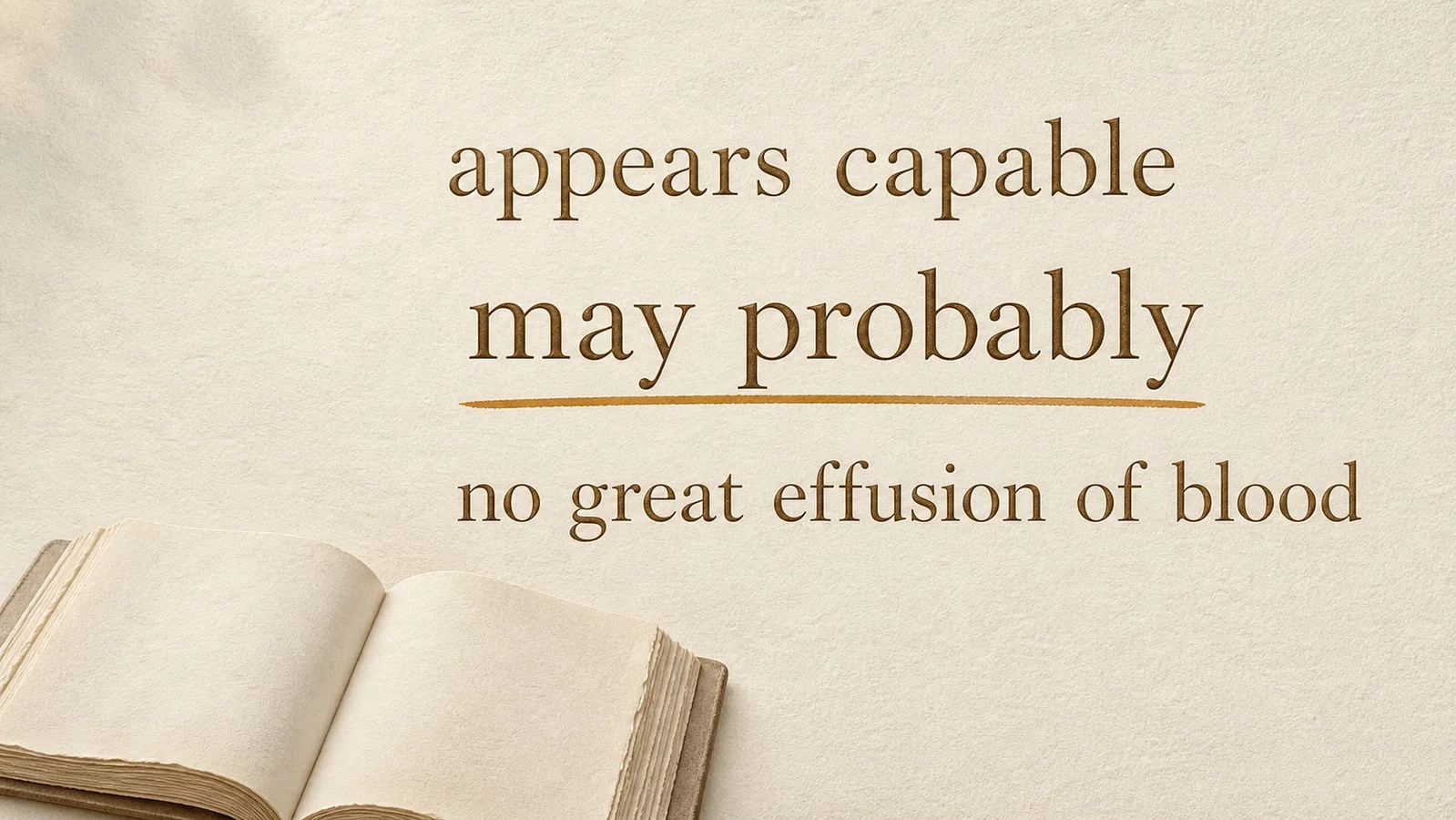
The most consequential words in Humphry Davy's suggestion about surgery may be the easiest to remove: “appears capable” and “may probably.” They mark the distance between what he thought nitrous oxide might do and what he had demonstrated it could accomplish in an operation.
The sentence appeared in 1800, on page 556 of Researches, Chemical and Philosophical. Davy suggested that the gas might be useful during certain surgical operations. He also specified a condition: there should be no great effusion of blood.[1, p.556]
Read without those qualifications, the passage can sound like an announcement that surgical anesthesia had arrived. Read in place, it does something different. It puts a possible application into print while leaving the task of establishing it unfinished. That was an important contribution without being a report of a successful operation.
A proposal on page 556, an observation on page 465
Here is the complete sentence from the public-domain original:
As nitrous oxide in its extensive operation appears capable of destroying physical pain, it may probably be used with advantage during surgical operations in which no great effusion of blood takes place.
The qualification about blood belongs to Davy's historical proposal. It is not a present-day eligibility rule, and the sentence is not accompanied by a surgical case or a tested method for reliably conducting an operation.[1, p.556; conclusion, pp.548–559]
Earlier in the book is an observation that helps explain the interest in pain. Davy described inflammation of his gum while a wisdom tooth was coming through. Pain interfered with rest and sustained activity. In his account, nitrous oxide diminished that pain temporarily; unpleasantness was briefly overtaken by pleasure. When his former state returned, so did the pain. On one occasion, he thought it might even have become worse.[1, pp.464–465]
The original expression is “cutting” a wisdom tooth. It describes eruption, not cutting out a tooth. There is no extraction in this passage. Changing it into a story about painless dentistry would replace an observation of existing pain with an unreported painful procedure and an invented successful outcome.[1, p.465]
Nor should the less triumphant ending disappear. Temporary relief followed by returning pain is what Davy recorded. It is not evidence of a lasting cure. The observation and the later surgical proposal belong together, but they are not the same kind of evidence.
Before publication: a body that observed, remembered and forgot
The publication year should not absorb the preceding investigation. Davy's book describes work in Bristol in 1799, including different trials on 11, 16 and 17 April. These dates refer to distinct experiences; they are not interchangeable versions of one “first experiment.”[1, pp.453–459; 2, pp.234–236]
The accounts concern changes in sensation, movement, feeling and recollection. After the fuller April experience, Davy described the importance of notes made immediately afterward: without them, some of what happened would have been difficult to recall. His body was the subject of inquiry, but memory and expectation also shaped what could subsequently be reported.[1, pp.458–459]
The introduction ends with a Bristol dateline, Dowry Square, Hotwells, 25 June 1800. The title page identifies J. Johnson in London as publisher and Biggs and Cottle in Bristol as printers. A dated introduction is not an independently established release day. Accordingly, this article uses 1800 for the published proposal and 1799 for the preceding investigations, without manufacturing a precise birthday for anesthesia.[1, title page and p.xvi; 4]
Thomas Beddoes is present in the introduction too. Davy acknowledged his conversation, advice and the institution that supported the work. The volume joins chemical investigation with work on respiration and accounts of human experience. Its historical setting is more substantial than a solitary flash of genius or a gathering remembered only for laughter.[1, introduction pp.xi–xvi; 2, pp.228–234]
Variation belongs in the evidence, not outside the story
The other participants' accounts resist a single uncomplicated description of the gas. Robert Southey reported pleasurable early experiences and a different, non-pleasurable experience after his health had worsened. A footnote then added that a subsequent trial had again been rather pleasurable. Coleridge described four experiences that were not identical.[1, pp.507–509, 516–518 and accompanying notes]
Peter Mark Roget's account makes the familiar name “laughing gas” a poor summary of every participant's experience. He described dizziness, altered bodily sensations and difficulty speaking, along with a temporary loss of awareness of where he was and who was nearby. Looking back, he recalled no pleasurable feeling at any stage. These are reported sensations, not instrument measurements or evidence that he had reached a demonstrated state of surgical anesthesia.[1, pp.509–511]
Roget also explained the difficulty of writing the account. The sensations were intense and unfamiliar, hard to compare with ordinary experience and difficult to describe afterward, rather like a dream. More than two months had passed since his experiment, and he acknowledged that details might have been forgotten. That interval belongs in the evidence. An exact experiment date does not appear in the letter and cannot be recovered from the interval alone. The date retained here is 1800, the publication year of the book that contains his account.[1, pp.511–512]
Miss Ryland supplied a particularly useful distinction. She reported losing the power of speech without losing recollection: she could still hear what was said in the room. Inability to speak cannot simply be translated into unconsciousness, much less into a demonstrated state suitable for surgery.[1, p.530]
Davy's conclusion recognized differences between individuals and between occasions in the same individual. It also included danger. Its opening discussed effects that could destroy life; its ending called for further facts and cautious investigation. The famous surgical sentence sits within that unfinished inquiry, not apart from it as a certified clinical result.[1, pp.548, 552–553, 558–559]
His explanatory vocabulary concerned blood, stimulation and excitability. Those passages tell us how he tried to understand the observations. They should not be silently upgraded into modern pharmacology. Likewise, the hazardous self-experiments described in the book provide no present-day safety assurance or instructions to reproduce their quantities, durations or gas handling.[1, pp.548–559]
A medical review is evidence of attention, not adoption
There is another tempting shortcut: an insight so far ahead of its time that medicine paid it no attention. The contemporary record does not support that blanket description of the book's reception.
In 1800, the Annals of Medicine devoted 32 pages to a review. It praised Davy's work and chose to give particular attention to the fourth Research because of its medical relevance. It recounted the episode of gum pain, including relief and return. Toward the end, it criticized some of the theoretical generalizations and called for further investigation.[2, pp.227–228, 240–241, 255–258]
This establishes medical discussion of the work. It does not establish that readers turned the surgical proposal into dependable clinical practice. A book can attract interest, its observations can be debated, and a proposed application can still remain untested. The review does not supply a series of operations performed under nitrous oxide.[2, pp.227–258]
F. F. Cartwright's 1950 historical article revisited Davy's contribution with strong arguments about priority and subsequent developments. It is valuable as an interpretation, not as an 1800 surgical record. Its broad explanations of social attitudes and later influence should not be used to fill every gap between a printed possibility and a working clinical method.[3, pp.571–578]
Leaving a useful question unfinished
At the end of Davy's volume, a short appendix signed by Beddoes asks for the preservation of accidental observations in medicine. It emphasizes accurate circumstances and the separation of fact from supposition, ending with a warning about fabricated medical reports. This is not a modern trial protocol. It nevertheless makes the recording problem explicit: an observation needs to survive in a form that others can examine.[1, appendix V, pp.577–580]
That gives us a way to value the 1800 proposal without inventing a painless operation. The relief was recorded, and so was the returning pain. A surgical possibility was proposed, and its uncertain language remained on the page.
Davy had moved from asking what the gas felt like to asking what it might be used to do. The second question was worth pursuing. Later achievements in anesthesia cannot answer it retroactively on behalf of the evidence available in 1800.
Sources and reading limits
- Davy H. Researches, Chemical and Philosophical; Chiefly Concerning Nitrous Oxide, or Dephlogisticated Nitrous Air, and Its Respiration. London: J. Johnson; 1800. Read: the full introduction, the opening of Research IV and Division I sections 1–3, the individual accounts cited above (including all four pages of Roget’s letter, pp. 509–512), the full conclusion, Beddoes’s appendix V and the errata, checked against the same-work transcription. Not the whole book. Roget’s letter gives no exact experiment date. In this scan, printed pages 433–448 are bound after 449–464; citations use printed page numbers.
- Anonymous. Review of Davy's Researches. Annals of Medicine, For the Year 1800. 1800;5:227–258. Read in full (32 pages). The reviewer is not named.
- Cartwright FF. Humphry Davy's contribution to anaesthesia. Proc R Soc Med. 1950;43(7):571–578. PMID 15440782; PMC2081366. Read in full. A later interpretation, not original clinical evidence; the private notebooks it quotes were not seen.
- Wellcome Collection. Researches… Humphry Davy, 1800. Catalogue record of another copy of the same book.
No gas-making, inhalation, dental-procedure or clinical drug-use instructions are provided.
Continue exploring
Related reading connects shared questions and contexts; it does not by itself establish historical influence.
- 1772–1774: Priestley's Nitrous Oxide, a Gas Before an Anesthetic
- 1793: Beddoes's Letters Propose a Place to Investigate
- 1794: Watt Designs an Apparatus for Breathing Medical Airs
Anesthesia Epochs · The Source Room · About & Editorial Method
Updated October 30, 2026. Sources and reading limits are stated above. Illustrations are labelled as original source images or AI-made. Historical accounts are educational; they are not current treatment instructions.