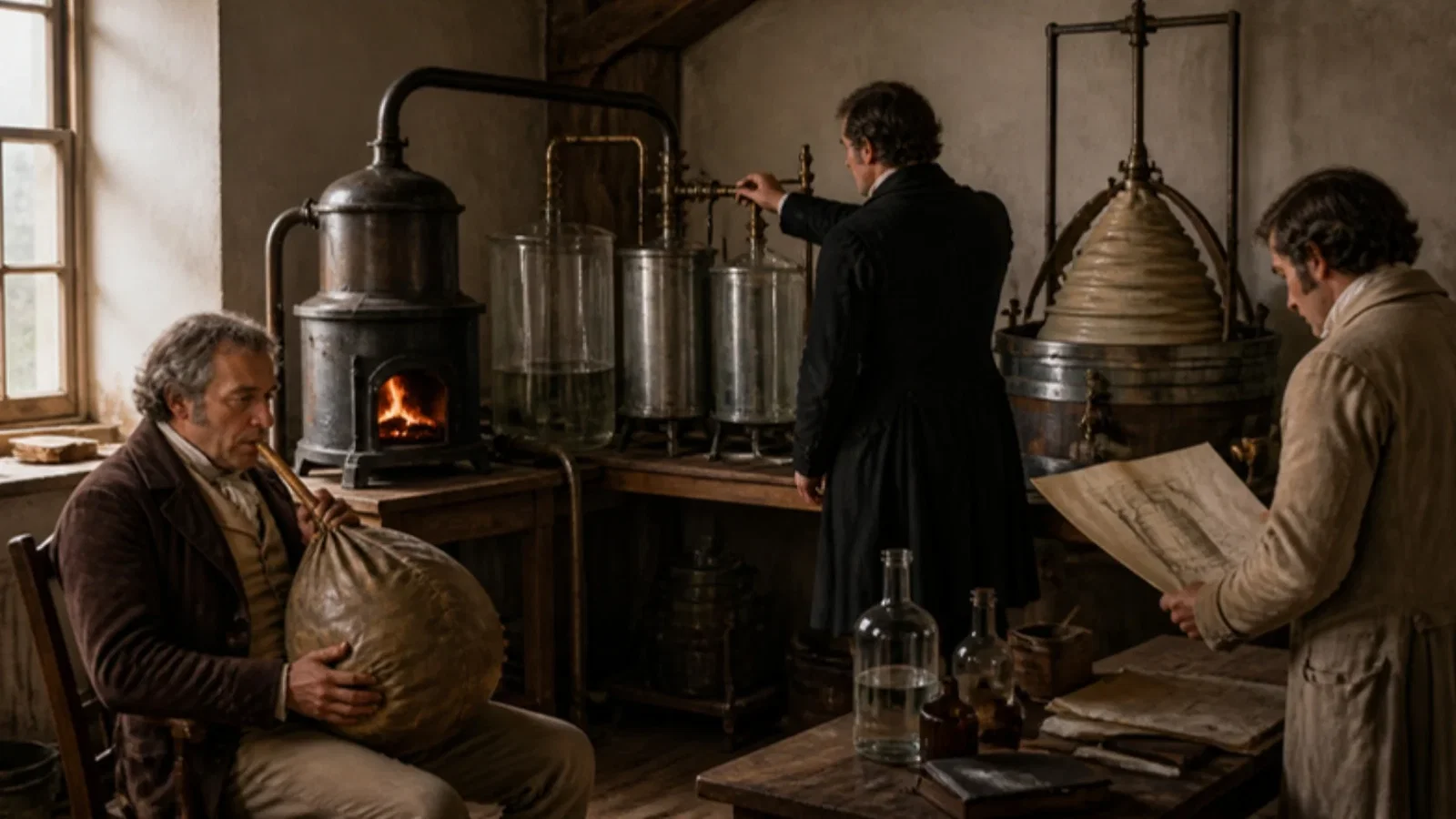
Watt sent Beddoes drawings of an apparatus that made a gas in a heated pot, washed and stored it, and passed it into bags for patients to breathe.
Reading Library · Anesthesia Epochs · 中文版
Watch the education video (for clinicians)
1794: Watt's Pneumatic Apparatus — Pot, Bellows, Bag · Anesthesia Epochs Education Series
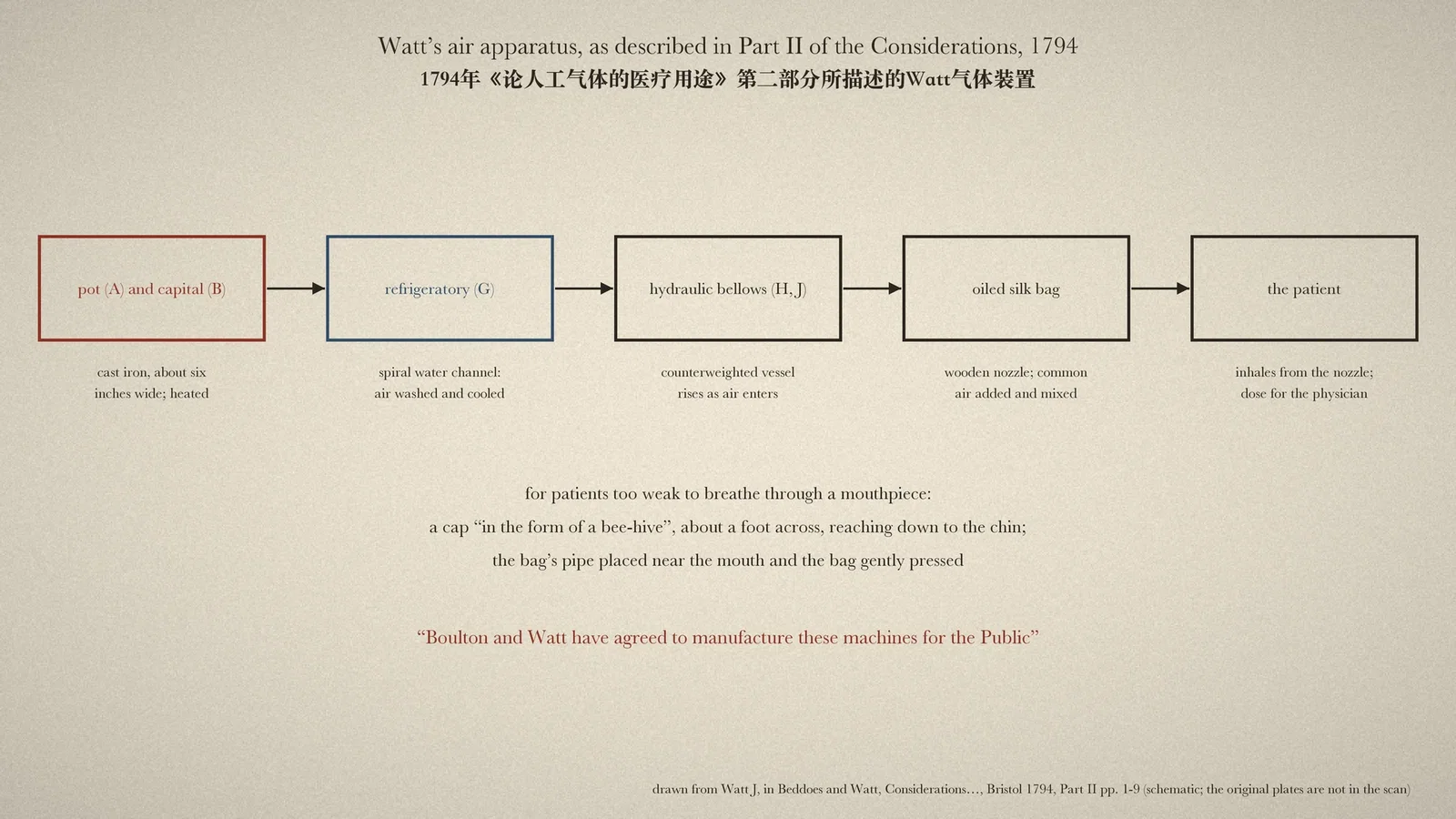
Before there could be anaesthetic machines, there had to be ways of making a gas, cleaning it, storing it and getting it into a patient's lungs in a measured way. One of the first printed designs for doing all of that came from the engineer James Watt, better known for the steam engine, who wrote it for the Bristol physician Thomas Beddoes for a project of "pneumatic medicine". This article reads Watt's own part of the book they published together in 1794. [1]
The book and the letter
Considerations on the Medicinal Use of Factitious Airs, and on the Manner of Obtaining Them in Large Quantities was printed at Bristol in 1794, "in two parts": Part I by Thomas Beddoes, M.D., Part II by James Watt, Esq. In a preface, Beddoes explains that at the close of 1792 three friends had offered to share the cost of building a pneumatic apparatus and paying someone to run it. [1]
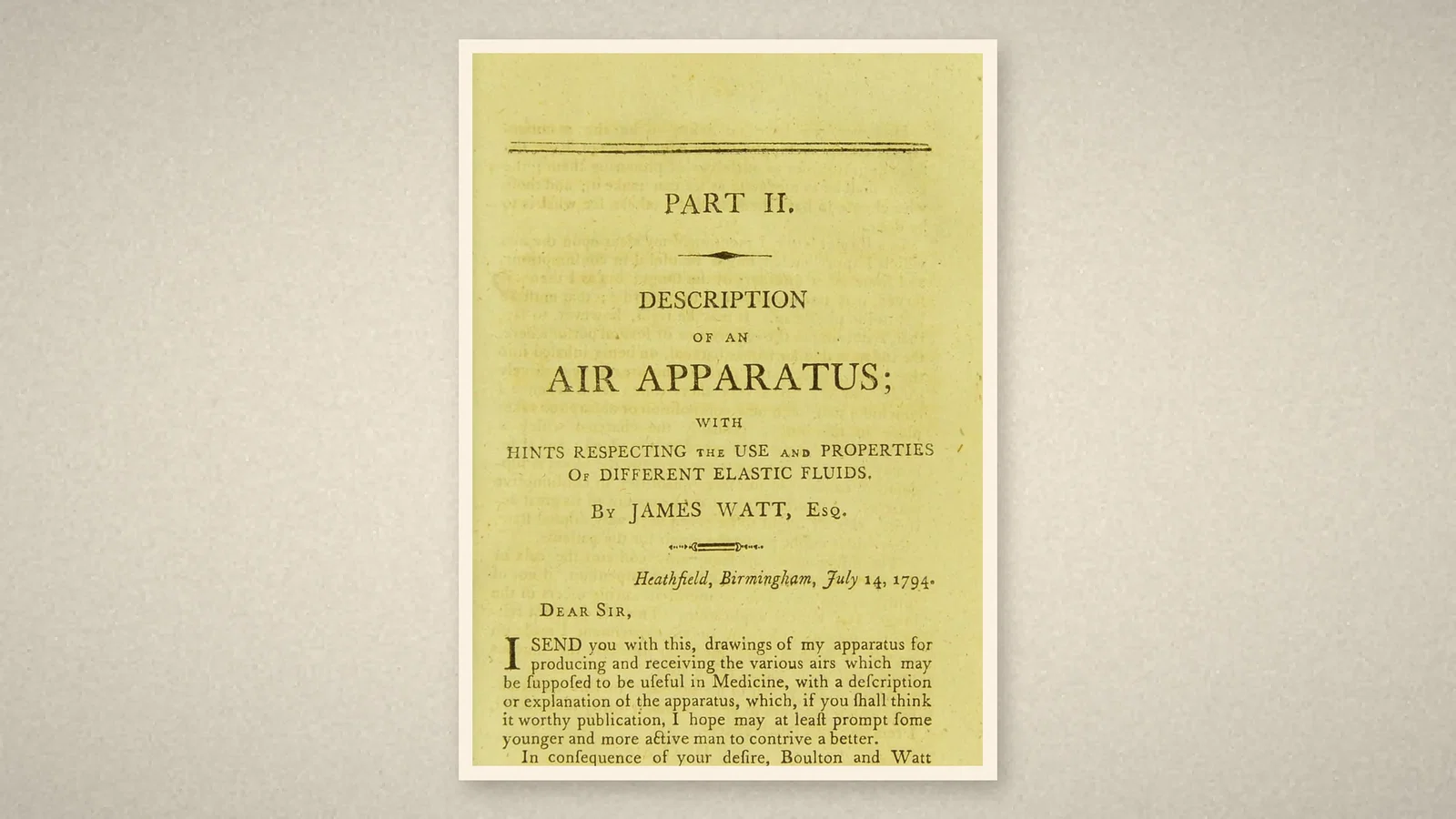
Part II is headed "Description of an Air Apparatus; with Hints respecting the Use and Properties of different Elastic Fluids", and opens with a letter dated "Heathfield, Birmingham, July 14, 1794": "I send you with this, drawings of my apparatus for producing and receiving the various airs which may be supposed to be useful in Medicine, with a description or explanation of the apparatus, which, if you shall think it worthy publication, I hope may at least prompt some younger and more active man to contrive a better." At Beddoes's request, Watt added, "Boulton and Watt have agreed to manufacture these machines for the Public", although a price could not yet be fixed while the workmen were "but bunglers" at some of the parts. Watt was careful about the limits of an engineer: "it is not my province to prescribe; that must be left to the physician." [1]
The apparatus
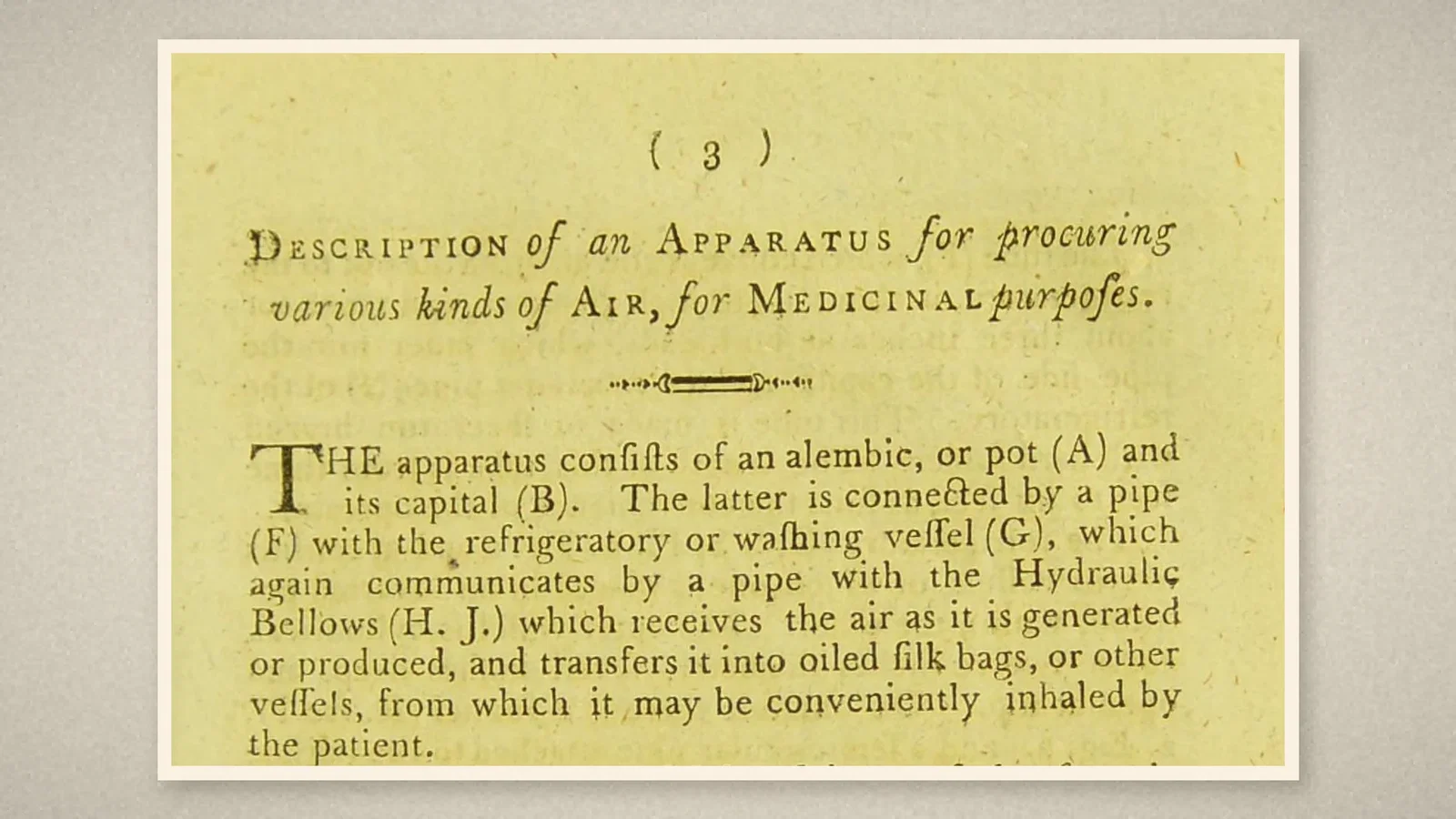
The description itself begins on page 3. "The apparatus consists of an alembic, or pot (A) and its capital (B). The latter is connected by a pipe (F) with the refrigeratory or washing vessel (G), which again communicates by a pipe with the Hydraulic Bellows (H. J.) which receives the air as it is generated or produced, and transfers it into oiled silk bags, or other vessels, from which it may be conveniently inhaled by the patient." [1]
The pot was soft cast iron, about six inches across at its widest, set in a furnace; water or other materials were fed in through a narrow tube controlled by a wire. In the refrigeratory the warm gas glided along a spiral channel under water, "depositing its heat", and passed on "quite cool" to the bellows, a vessel balanced by a counterweight that rose as the gas entered. When it was full, the wooden nozzle of an oiled silk bag was pushed into an outlet, the vessel was pressed down by hand, and the bag filled; a thumb over the nozzle sealed it. "The air in the bag may then have a proper proportion of atmospheric air added to it; and when thoroughly mixed, can be inhaled with great ease from the nozzle of the bag." [1]
Bags, smells and weak patients
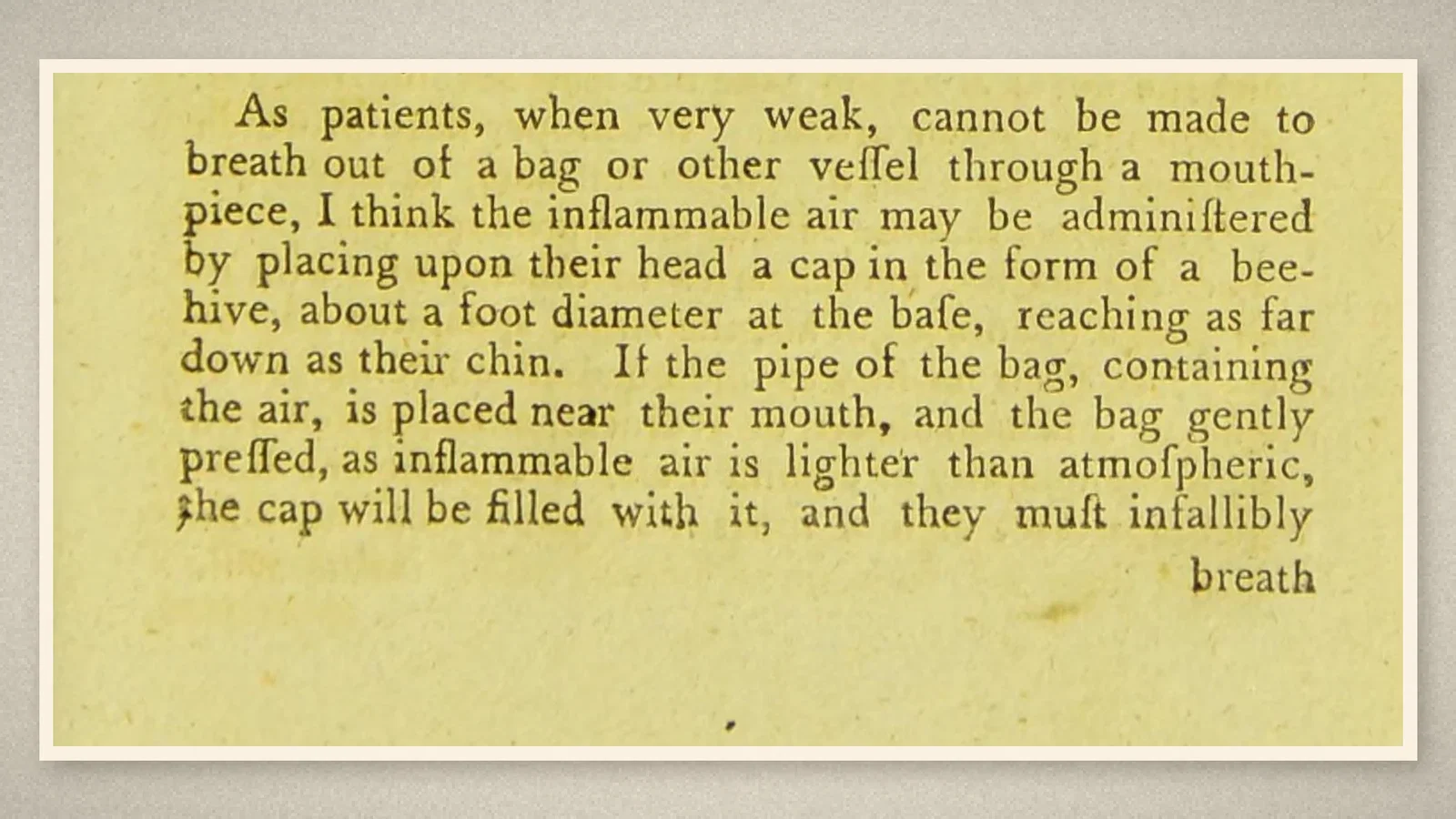
Watt paid close attention to the part the patient touched. Oiled silk had a disagreeable smell that might itself do harm, so Watt described removing it by rolling the silk in charcoal dust for days, washing it, and sealing the seams with japanners' gold size; green silk was to be avoided because it was coloured with verdigris, and "the yellow, or yellowish, is the best". For patients "when very weak", who "cannot be made to breath out of a bag or other vessel through a mouth-piece", Watt proposed a cap "in the form of a bee-hive, about a foot diameter at the base, reaching as far down as their chin": with the bag's pipe near the mouth and the bag gently pressed, a gas lighter than air would fill the cap, and the patient would breathe it "under no teazing constraint". [1]
Why an engineer took this up
Another letter printed in the same part, dated Birmingham, 17 June 1794, almost a month before the covering letter, explains Watt's motive in one sentence: having never made medicine a particular study, Watt would not have offered these crude ideas but for Beddoes's encouragement and "the hope that possibly some idea might be started, which may save other parents from the sorrow that has unfortunately fallen to my lot". The book says no more. [1]
What the record shows
The therapies Beddoes and Watt hoped for, chiefly in consumption, did not survive. The equipment logic did: generate the gas, wash and cool it, store it at low pressure, deliver it through a reservoir bag, dilute it with air before the patient breathes it, and think hard about the interface for a patient who cannot cooperate. Those are still the concerns of anaesthetic and oxygen equipment.
Sources and reading limits
Read: Part II of Considerations on the Medicinal Use of Factitious Airs (Bristol, 1794), Watt's covering letter, the description of the apparatus and its supplement, and later letters in the same part, in the University of Bristol copy; the title page and Beddoes's preface; the History of Anaesthesia Society timeline entry.
Not seen: the engraved plates of the apparatus, which are not in this scan, so the illustration here is a schematic drawn from the text; Part I beyond the preface; later editions and separate descriptions of the apparatus. The History of Anaesthesia Society timeline dates Watt's first equipment for Beddoes to the mid-1780s; the printed description is dated 1794. For the Pneumatic Institution, see 1793: Beddoes's Letters Propose a Place to Investigate. The therapeutic hopes are reported, not endorsed.
Three illustrations are page crops from the 1794 book; one is drawn from it.
- Beddoes T, Watt J. Considerations on the medicinal use of factitious airs, and on the manner of obtaining them in large quantities. In two parts. Bristol: Bulgin and Rosser, for J. Johnson and H. Murray; 1794. Part II, pp. 1-15. Internet Archive
- History of Anaesthesia Society. Timeline. HAS
Continue exploring
Related reading connects shared questions and contexts; it does not by itself establish historical influence.
- 1793: Beddoes's Letters Propose a Place to Investigate
- 1800: Davy's Nitrous Oxide and Surgery in the Conditional
Anesthesia Epochs · The Source Room · About & Editorial Method
Published November 2, 2026. Sources and reading limits are stated above. Illustrations are labelled as original source images or AI-made. Historical accounts are educational; they are not current treatment instructions.