Anesthesia Epochs
About this film
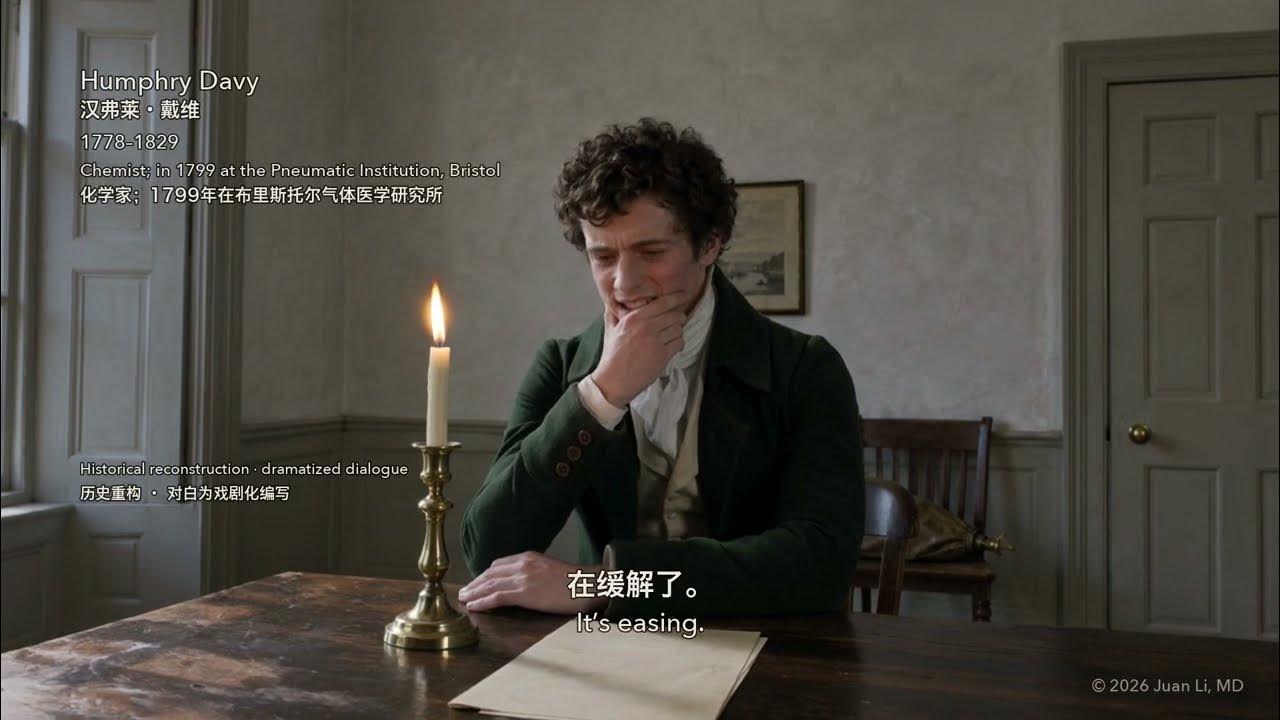
Bristol, 1799–1800. Humphry Davy investigated the effects of nitrous oxide and described temporary relief from the pain of an erupting wisdom tooth. The pain returned. His published suggestion that the gas might help in certain operations was carefully qualified, not a report of painless extraction or established surgical anesthesia. Following experiments, writing, and contemporary reception, this film asks what Davy's celebrated sentence actually claimed—and what would still have to be demonstrated.
Read the companion essay · 1800: Davy's Nitrous Oxide and Surgery in the Conditional
Scientific takeaway
Temporary pain relief can support a research proposal without demonstrating dependable surgical anesthesia.
Sources
- Davy H. Researches, Chemical and Philosophical; Chiefly Concerning Nitrous Oxide, or Dephlogisticated Nitrous Air, and Its Respiration. London: J Johnson; 1800. pp.464–465, 530, 556. Read printed p. 556
- [Review of Davy H. Researches, Chemical and Philosophical]. Annals of Medicine for the Year 1800. 1800;5:227–258. Read the cited edition
- Cartwright FF. Humphry Davy’s contribution to anaesthesia. Proc R Soc Med. 1950;43(7):571–578. doi: 10.1177/003591575004300721. Read the article
Notes on reconstruction
People, rooms, and some dialogue are reconstructed; the film distinguishes Davy's published qualifiers from dialogue written for the screen.
Read beyond the film
1800: Davy's Nitrous Oxide and Surgery in the Conditional
Explore the longer account, original references, reading limitations and connected stories.