On 16 October 1846 Morton gave ether at Massachusetts General Hospital while Warren operated on Edward Gilbert Abbott, and the records give differing accounts of the pain.
Reading Library · Anesthesia Epochs · 中文版
Watch the companion film
1846: Ether Dome · Watch on YouTube
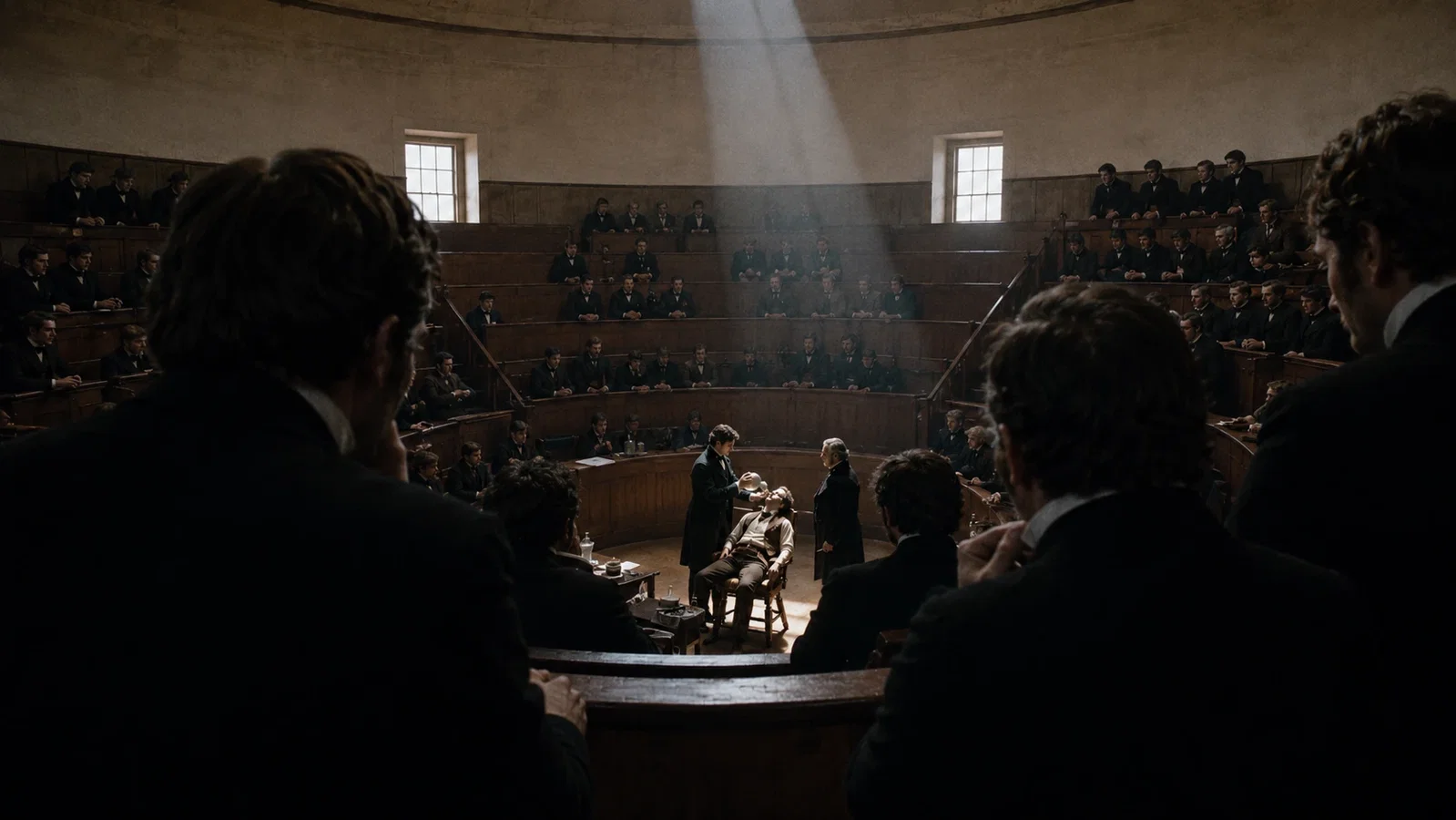
On October 16, 1846, a public operation at Massachusetts General Hospital in Boston became one of anesthesia's defining scenes. Morton administered the inhaled preparation, John Collins Warren operated, and Edward Gilbert Abbott was the patient. The contemporary record, however, is less tidy than the familiar image of a sleeping patient and an instantly transformed world.[1,2]
I. The patient who still had something to report
Henry Jacob Bigelow's paper, published on November 18, describes the October operation near the lower jaw. The patient muttered as if partly conscious and subsequently reported substantial, though reduced, pain. Bigelow suspected a defect in the inhalation process. That was his explanation, not a failure mechanism established by measurement.[1, printed p.309]
A retrospective account later pasted into Abbott's hospital records tells the experience differently: movement and vocalization appeared during the later part of the procedure, but the patient subsequently denied pain and described a scraping sensation. Firth's examination of the records brings this discrepancy into view. The same study identifies an attempted ligation of a vascular lesion, not the straightforward removal of a tumor; the mass remained at discharge.[2]
Neither version should be selected simply because it supplies the most satisfying anniversary story. The evidence does not support a motionless, unequivocally pain-free operation—and it should not be rewritten as an unequivocal absence of benefit either.
II. The next cases mattered
Bigelow's publication described a sequence, not a single triumphant scene. On October 17, George Hayward removed a fatty tumor from another patient's upper arm. Although she occasionally appeared uneasy, she later reported no pain and no knowledge of the operation.[1, pp.309–310]
On November 7, Hayward performed an above-knee amputation under the inhaled preparation. Bigelow recorded that the patient remembered no incision and became aware of remarks around the time the vessels were being secured. A further operation on the lower jaw, performed by Warren that day, again involved some return of consciousness during the procedure.[1, pp.314–315]
Keeping these patients and dates separate makes the development intelligible. Observers were comparing procedures and responses, trying to establish what the technique could achieve. October 16 began this influential public sequence. It does not need to borrow all the later results to remain important.
III. The promise and the danger shared the page
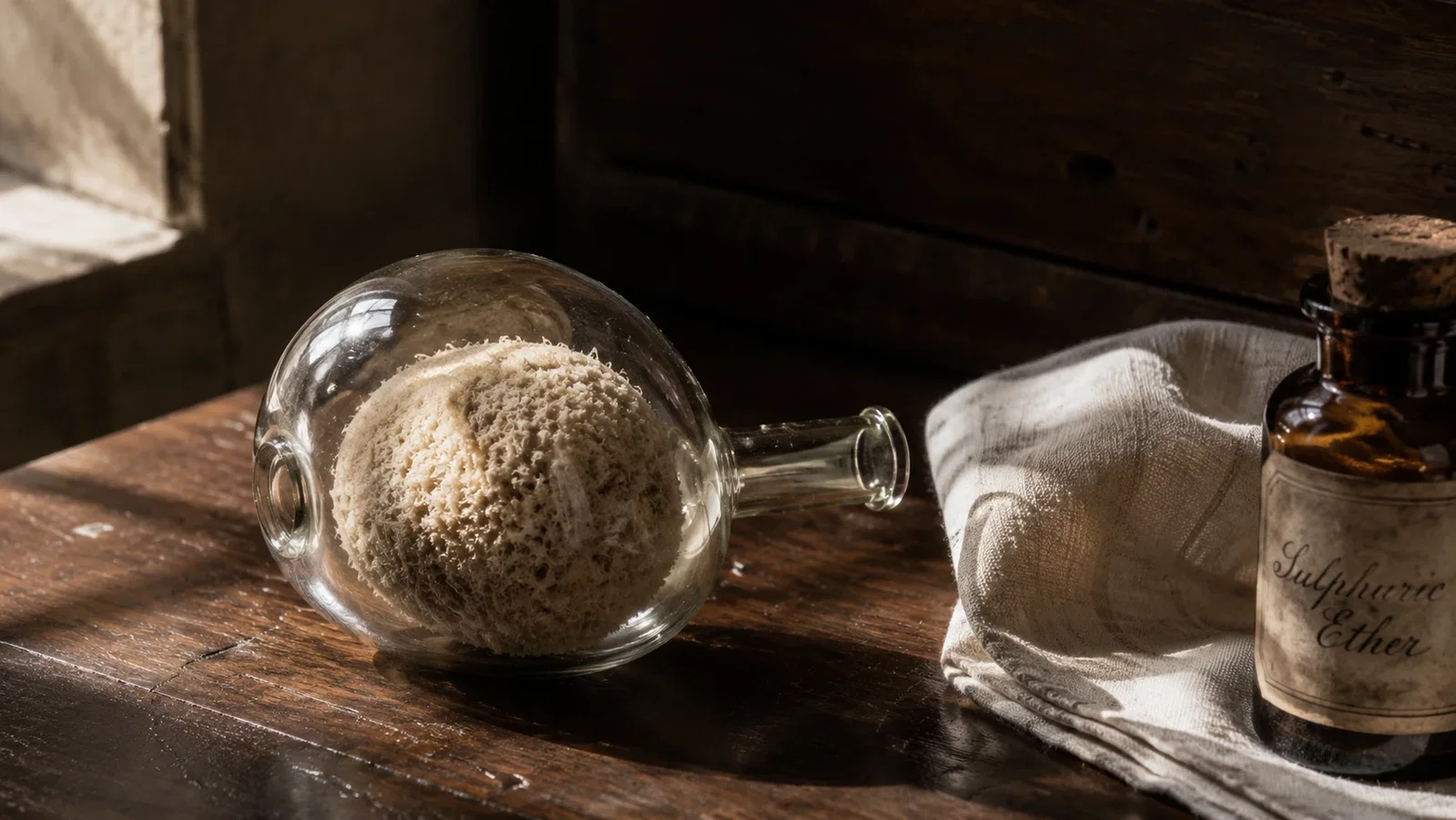
Bigelow described a two-necked glass globe, sponges providing an evaporating surface, and a valve diverting expired air. Those details are present in a contemporary account. They do not authenticate every component of a later replica or every arrangement depicted in a painting.[1, p.312]
The paper also reports unsuccessful inhalation, excitement, nausea and a prolonged administration followed by very slow breathing, a weakening pulse and delayed recovery.[1, pp.313–314] These observations belong to the landmark publication just as much as its successful operations. The obsolete resuscitation measures are not reproduced here as instructions, and historical experience is not presented as modern guidance.
Movement, facial expression and subsequent recollection did not always agree. Bigelow acknowledged changing his initial view that certain reactions could be assigned to reflex activity.[1, pp.313–315] The publication preserves an investigator revising an explanation, not merely announcing that every uncertainty had been solved.
IV. A record is more useful than an invented certainty
The sentence “Gentlemen, this is no humbug” is often attributed to Warren as though the field began with a perfect closing line. It is absent from the Bigelow text read here. That absence does not prove Warren never said it; it does mean the line should not be treated here as a verbatim record of the event.
Even the surviving editions require care. The archived nineteenth-century offprint retains the clinical account but omits the closing discussion of patents. A modern full transcription includes those paragraphs. Identical article titles do not guarantee identical coverage.[1, edition note]
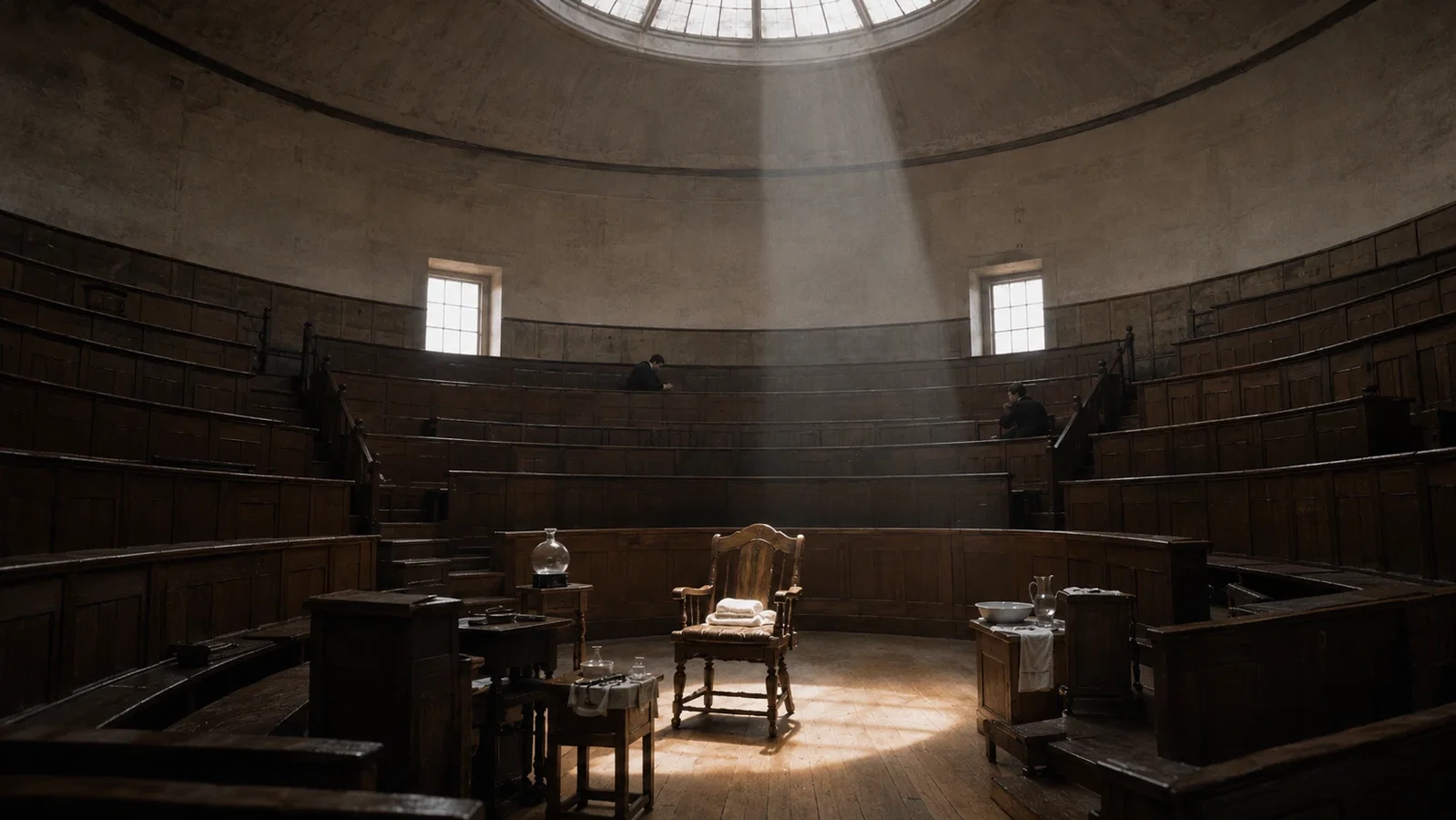
The Ether Dome matters because an influential series of observations became available for scrutiny and further work. It was not the absolute beginning of every form of anesthesia, nor did a single day create standardized dosing, monitoring, training and certification. Restoring uncertainty to the story does not diminish the achievement. It makes clear how much remained to be learned.
Sources and reading limits
[1] Bigelow HJ. Insensibility during Surgical Operations Produced by Inhalation. Boston Med Surg J. 1846;35:309–317. DOI. Read: the Wellcome/Yale offprint, printed pp.309–316 in full (this copy omits the closing patent discussion), and the complete Nickalls 2006 transcription, which is not an original journal scan.
[2] Firth PG. Ether Day Revisited: The Surgical Records of Edward Gilbert Abbott. Ann Surg Open. 2022;3(2):e166. DOI. Read: all eight pages, including the transcribed records. Not covered: the original MGH volume. Retrospective diagnoses and historical interpretations retain their limitations.
Visual interpretations
These illustrations explore the setting and ideas. Depicted people, actions, instruments and documents are reconstructions, not evidence of their exact historical appearance.
Continue exploring
Related reading connects shared questions and contexts; it does not by itself establish historical influence.
- 1845: Wells in Boston, One Demonstration and Three Kinds of Evidence
- 1846: Holmes Gives an Old Word a New Task
- 1846: Morton Extracts a Tooth for Eben Frost Under an Ether Preparation
- 1846: Patent 4,848 and the Claim to Relieve Surgical Pain
- c. 200: Hua Tuo's Mafeisan, a Recipe That Cannot Be Recovered
- 1561: Cordus's Account of Preparing Ether Reaches Print
- 1804: Hanaoka Removes a Breast Tumor Under Oral Anesthesia
- 1824: Hickman's Animal Experiments Toward Painless Surgery
- 1842: Crawford Long Operates Before Publishing
- 1844: Horace Wells, the Dentist Who Became the Patient
- 1847: Chloroform, from Self-Experiment to a Public Report
- 1847: Simpson Separates Labour Pain from Uterine Action
- 1847: Snow Makes Ether a Question of Observation and Control
- 1947: India's Anaesthesia Society Is Founded
Anesthesia Epochs · The Source Room · About & Editorial Method
Revised September 7, 2026. Sources and reading limits are stated above. Illustrations are labelled as original source images or AI-made. Historical accounts are educational; they are not current treatment instructions.
Continue these reading routes
Stop 4 of 4 · Back to route · Before the demonstration
Previous · 1845: Wells in Boston, One Demonstration and Three Kinds of Evidence
Stop 1 of 7 · Back to route · From Ether to Balanced Anesthesia
Next · 1847: Snow Makes Ether a Question of Observation and Control
Abbott’s recollection raises a practical question for Snow: what could the person giving ether observe and adjust during the operation?