In a letter dated 21 November 1846 Oliver Wendell Holmes Sr. proposed anaesthesia, a word already in Good's 1823 nosology, as the name for the state produced by ether.
Reading Library · Anesthesia Epochs · 中文版
Watch the companion film
1846: Naming Anesthesia · Watch on YouTube
The most revealing part of Nathan P. Rice's account is in the footnote.
On page 137 of his 1859 biography of William T. G. Morton, Rice presents the naming of anaesthesia as an accomplished event. His narrative says that the terms were immediately taken up. Below it, however, he prints a letter in which Oliver Wendell Holmes is still considering alternatives and recommending that someone else be consulted before the names are fixed. [3, p. 137]
The body text knows how the story ends. The letter does not.
That difference is a useful place to begin. Holmes's proposal matters, but its importance does not require us to turn a tentative suggestion into an instant professional consensus—or an existing word into a word that had never been used before.
The date belongs to a letter
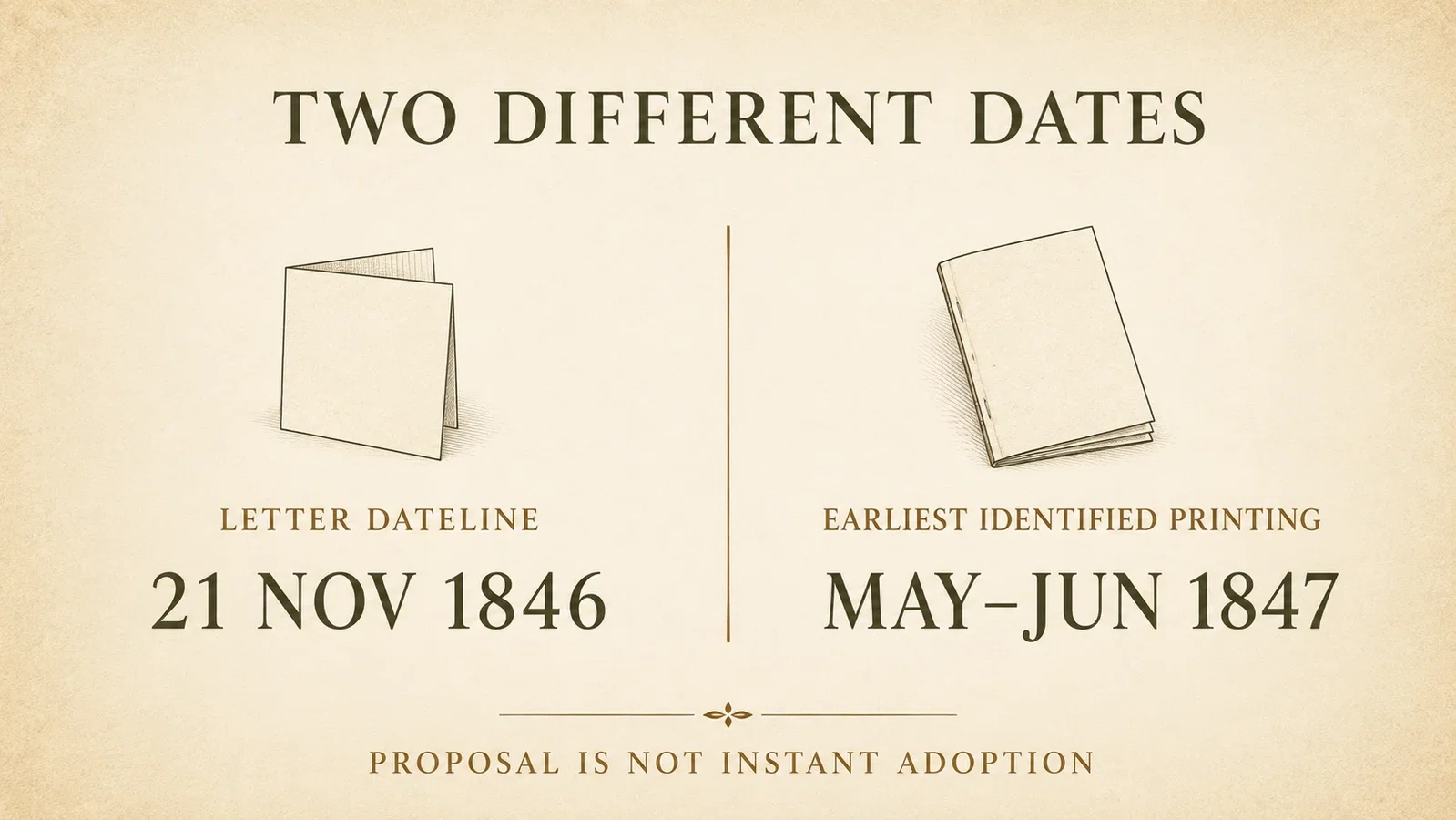
The letter printed by Rice is dated Boston, November 21, 1846. An earlier printed witness, on page 79 of Edward Warren's 1847 pamphlet, carries the same date. Both address Morton and propose anaesthesia for the state under discussion. They transmit a letter; neither page is the handwritten original. [1, p. 79; 3, p. 137]
The writer was Oliver Wendell Holmes Sr., the physician and author, not his son of the same name who later became a judge. The Anesthesia History Association's chronology also identifies the elder Holmes and gives November 21 for the proposal to name the state produced by inhaled ether. [4, pp. 38–40; 5]
Keeping that date on a timeline is reasonable. Giving it the wrong job is not. It does not date the first existence of the word, demonstrate publication on that day, or establish universal acceptance of the name.
A reference hidden in plain sight
Holmes supplied a source for his suggestion. Immediately after explaining anaesthesia as insensibility, especially in relation to touch, he directed Morton to page 259 of Good's nosology. [1, p. 79]
Open the 1823 Boston edition of John Mason Good's A Physiological System of Nosology, and the word is already there. Under the category describing complete insensibility to touch, the entry gives Anæsthesia, with abbreviated attributions to Linnaeus and Cullen. A simple form is restricted locally or generally to touch; a complicated form includes other senses. Numbness is among the English wording used to describe the former. [2, p. 259]
The nearby note makes the older vocabulary less tidy than a single modern definition might suggest. Good distinguishes writers who limited anaesthesia to touch from those who used it for a wider loss of sensation. These are Good's accounts of earlier classifications, not a claim that every earlier original has been independently inspected for this article. [2, p. 257]
Nor is this page a protocol for producing surgical anaesthesia. It belongs to a classification of disordered sensation. A shared word does not make every condition described in the old book clinically identical to the state produced by ether. [2, pp. 257–259]
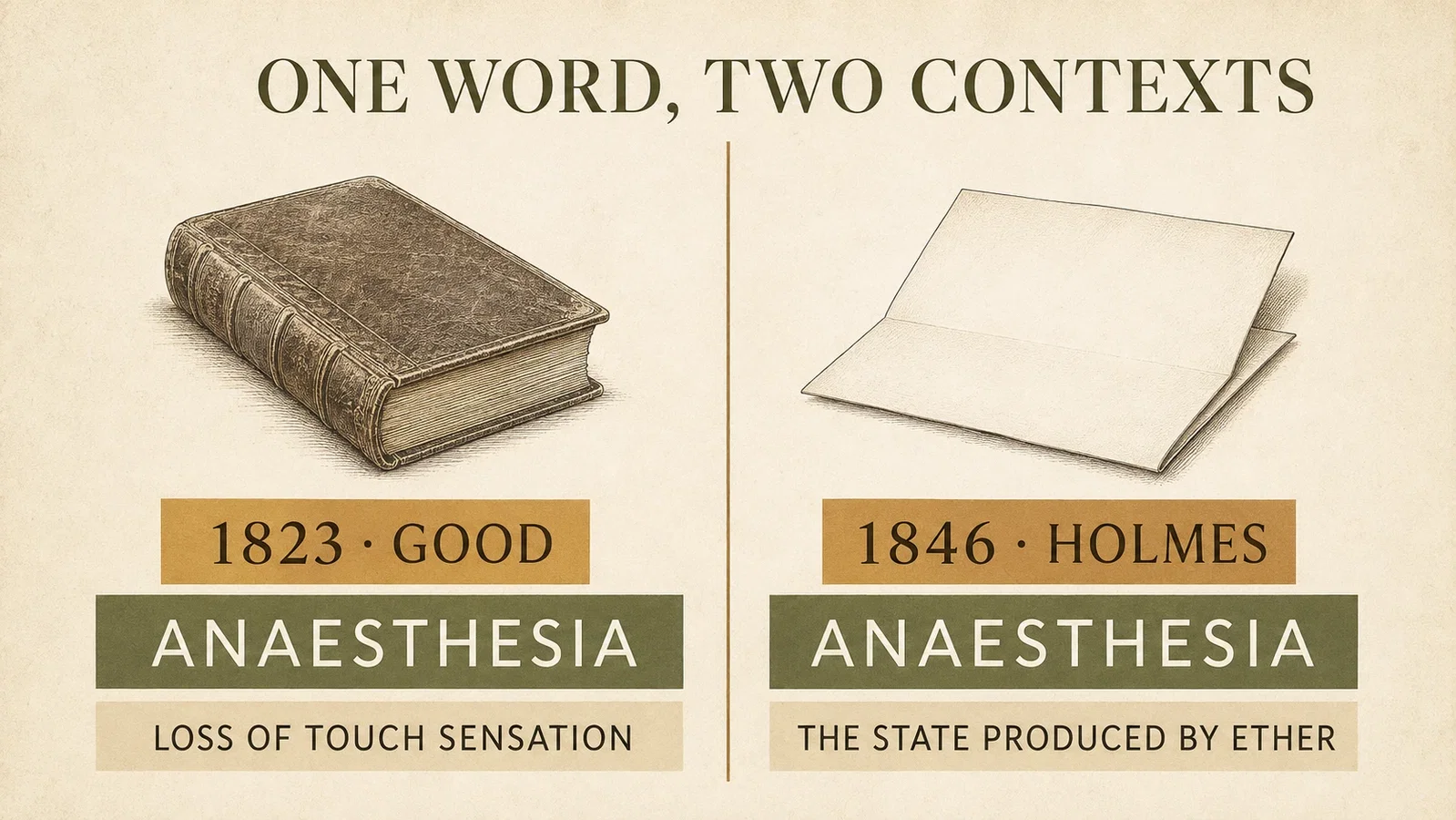
This gives Holmes a more precise role. He was not manufacturing an unused word from nothing. He was proposing a new application for one already present in medical language—and acknowledging that history in the letter itself.
Three naming problems, not one finished answer
At the opening, Holmes separates the state produced from the agent involved. He then considers how a noun, an adjective and a name for the means employed might fit together. [1, p. 79]
The noun is Anæsthesia; the adjective is Anæsthetic. For the means employed, the letter offers the less familiar anti-æsthetic agent. It entertains anæsthetic agent as another possibility, while leaving a question over its suitability. Both printed witnesses retain that hesitation. [1, p. 79; 3, p. 137]
A modern retelling can easily smooth this into the vocabulary we expect. Doing so would lose something: the letter is making distinctions and trying possibilities, not issuing a settled terminology standard. The prefix in anti-æsthetic should not silently become anti-anæsthetic either; that would change the printed term.
Holmes also considers several neuro- alternatives, finding them too anatomical for what he describes as a physiological change. This is an argument about an appropriate name, not experimental evidence for a modern mechanism of ether action. [1, p. 79]
His closing recommendation is practical and provisional. Morton should consult an accomplished scholar such as President Everett or Dr. Bigelow senior. Other words might prove more suitable. The proposal has direction without pretending that the discussion is over. [1, p. 79]
What survived in print
The 1847 witness requires some care with editions. The copy read here says second edition on its title page, ends at printed page 79 and has a preface dated May 30, 1847. Haridas's 2016 bibliographic study identifies this 79-page version as the second issue of the second edition, and places the earliest identified publication of the letter around May–June 1847. The preface date is not itself an exact release date. [1, title, preface and p. 79; 4, pp. 40–41, table 1]
Warren prints five body paragraphs; Rice prints four. The central proposal persists, but paragraphing, punctuation and some printed characters differ. Comparing these pages does not warrant certifying either as a perfectly faithful reproduction of Holmes's handwriting. [1, p. 79; 3, p. 137]
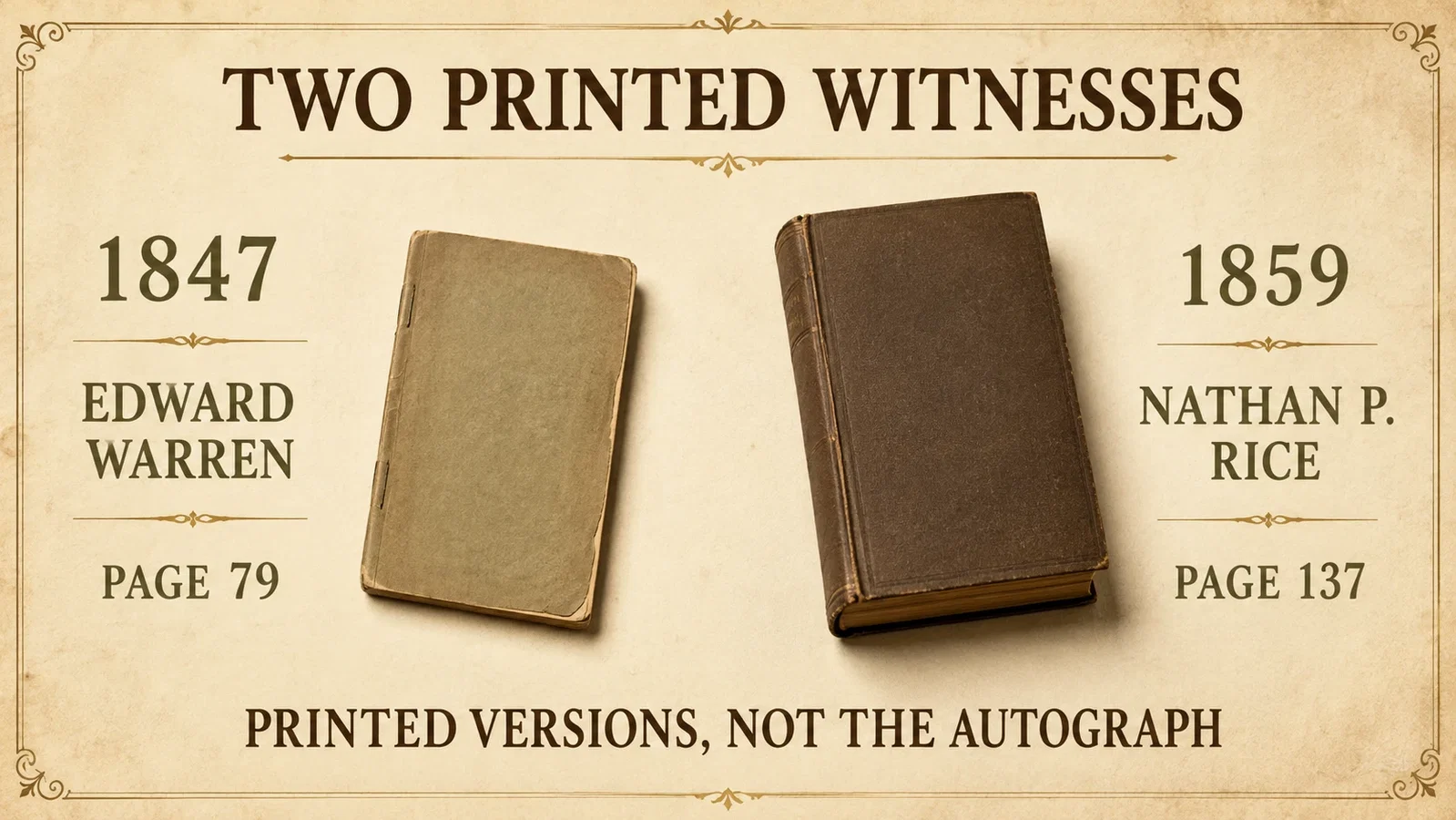
Haridas's study did not locate the original letter and suggested that it was probably lost with damaged Morton family papers. That remains a qualified finding of the 2016 study, not proof of certain destruction or the result of a new exhaustive search of every archive in 2026. [4, pp. 40–41]
The publications also have a position in the dispute around Morton. Warren explains in his preface why he has pressed the discoverer's case so forcefully. Rice's preface likewise presents the book as an effort to secure justice for an unrewarded discoverer. Edward Warren, the pamphlet author, must not be confused with surgeon John Collins Warren. [1, preface; 3, p. vi; 4, p. 40]
Their advocacy does not erase the letters they print. It does mean that a confident sentence about immediate adoption is not a neutral survey of medical usage. Rice's statement belongs to his later narrative, while the footnote preserves an earlier moment in which the terminology was still a proposal. [3, p. 137]
An old word, an explicit page reference, a few unresolved alternatives, and two printed witnesses: these are enough to tell the story without inventing an autograph or a worldwide change of vocabulary on one day. Holmes helped give a new state a usable name. The surviving texts let us see that act of naming still in progress.
Sources and reading limits
- Warren E. Some Account of the Letheon; Or, Who was the Discoverer? 2nd ed., 79-page issue. Boston: Dutton and Wentworth; 1847. Title, preface, p. 79. Internet Archive.
- Good JM. A Physiological System of Nosology; With a Corrected and Simplified Nomenclature. Boston: Wells and Lilly; 1823: 257–259. Internet Archive.
- Rice NP. Trials of a Public Benefactor, as Illustrated in the Discovery of Etherization. New York: Pudney and Russell; 1859: vi, 136–138. Internet Archive.
- Haridas RP. The etymology and use of the word ‘anaesthesia’: Oliver Wendell Holmes’ letter to W. T. G. Morton. Anaesth Intensive Care. 2016; 44 Suppl: 38–44. DOI: 10.1177/0310057X1604401S07. Author-uploaded full text.
- Anesthesia History Association. November chronology, 1846 November 21 entry. Accessed 2026-09-06.
Read: the pages cited above (Warren: title, preface and p. 79; Good: pp. 257–259; Rice: pp. vi and 136–138) and the text, table and references of Haridas's article.
Not covered: the rest of these books; the figures in Haridas's article; Holmes's handwritten letter, which has not been located.
Continue exploring
Related reading connects shared questions and contexts; it does not by itself establish historical influence.
- 1846: The Ether Dome, a Breakthrough Without a Perfect Moment
- 1845: Wells in Boston, One Demonstration and Three Kinds of Evidence
- 1847: Snow Makes Ether a Question of Observation and Control
- 1847: Simpson Separates Labour Pain from Uterine Action
- 1847: Chloroform, from Self-Experiment to a Public Report
- 1962: Ketamine Moves from Candidate Compound to Dissociative Anesthesia
Anesthesia Epochs · The Source Room · About & Editorial Method
Sources and reading limits are stated above. Illustrations are labelled as original source images or AI-made. Historical accounts are educational; they are not current treatment instructions.