Synthesis, human observation and a new name.
Reading Library · Anesthesia Epochs · 中文版
Watch the companion film
1962: Ketamine — A State to Name · Watch on YouTube
Historical anchor: 1962. Date details and source qualifications are explained below.
Ketamine’s early history contains three distinct dates. Historical accounts place its synthesis in 1962. A participant later dated the first human administration to August 3, 1964. The original human pharmacology paper appeared in 1965.[1,2,4,5] Separating these events helps explain how a chemical candidate became a clinical observation and then acquired a name.

The 1962 attribution comes from later historical writing, including the EMCDDA report.[2] A surviving primary document provides a firmer date for a different event: Calvin Stevens’s US patent was filed on June 29, 1962, and granted on May 31, 1966.[3] The filing date establishes part of the patent history. It does not identify the day on which synthesis first succeeded.
The location deserves similar care. EMCDDA describes synthesis at Parke-Davis laboratories. Domino’s 2010 account describes Stevens as a Wayne State organic chemistry professor and Parke-Davis consultant who made a series of derivatives in his own laboratory and supplied them for company screening.[2,4] The supported relationship is a collaboration. These accounts do not justify assigning the synthesis to a precisely identified company room.
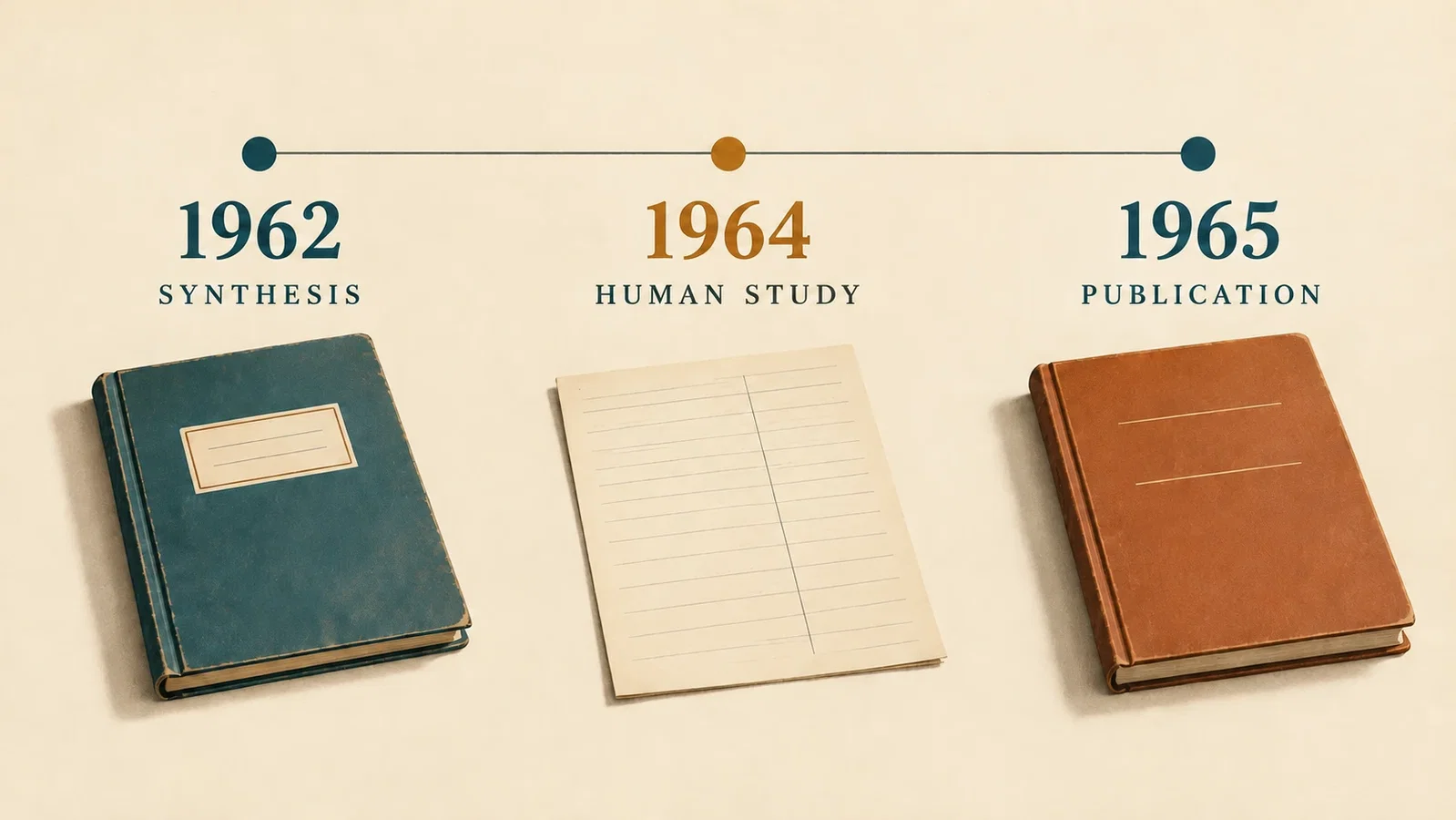
Domino’s 1984 reminiscence anticipated the twentieth anniversary of human administration on August 3. His 2010 account explicitly supplied the date August 3, 1964.[4,5] These are consistent recollections by the same participant, rather than independent testimony from two witnesses. The 1965 paper offers a different kind of evidence: the methods, observations and qualifications published after that early investigation.
Its authors, Domino, Chodoff and Corssen, described an initial phase I study of 20 male prisoners aged 25 to 48.[1] The article calls them volunteers. That description alone cannot settle all questions about voluntariness and consent in a prison research setting. Nor should the study be presented as an operative trial establishing general clinical benefit.
The observations made a familiar visual impression of anesthesia inadequate. Some subjects opened their eyes while losing contact with their surroundings. Analgesia accompanied a distinctive alteration of experience. The report also recorded increased blood pressure and heart rate, transient respiratory depression, and occasional need for manual support of the chin to maintain the airway.[1] A retained reflex was not a guarantee of an unaffected airway.
The authors’ recovery endpoint matters. They ended the observed period of coma when verbal communication returned, while explicitly noting that responses were still far from normal.[1] A reader who translates that endpoint into complete recovery changes the meaning of the result. Communication, pain responses and other observations need not return together.
The paper proposed the term dissociative anesthesia and called for further clinical study.[1] Naming gave investigators a way to discuss a recognizable state. It did not supply a complete molecular explanation or establish the evidence for every subsequent use of the drug. This early report is most informative when its promise and its unresolved questions remain visible together.
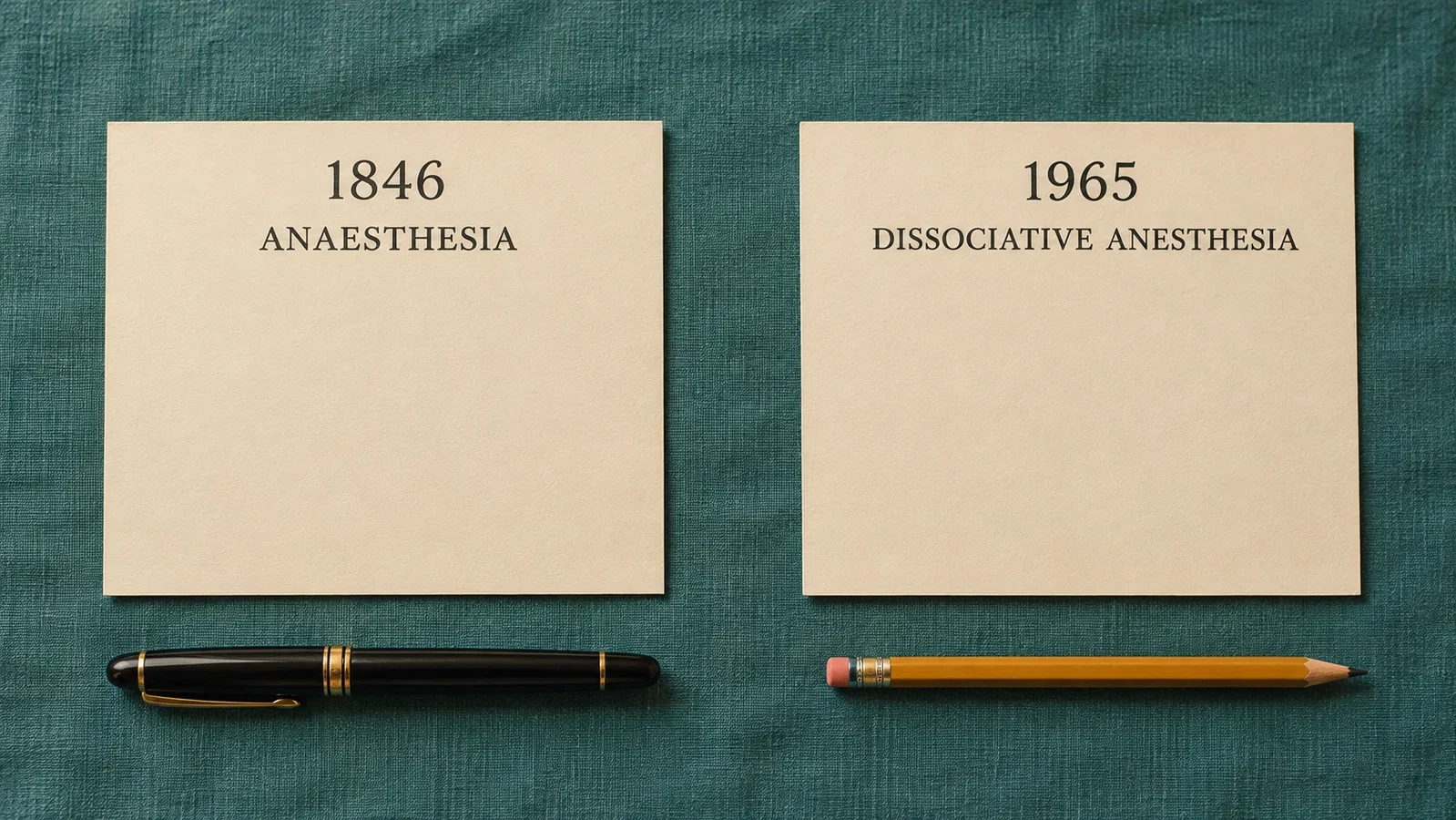
A specific comparison connects this article with Holmes’s naming letter. In its 1847 printing, the letter dated November 21, 1846 distinguished the state to be named from the agent producing it. The 1965 investigators proposed a more particular term for their observations.[1,6] Reading the texts together shows two occasions on which language was being fitted to experience. It does not establish that the later investigators took their naming proposal from Holmes.
The sequence from synthesis to human investigation to publication therefore needs more than a single discovery date. Each stage answers a different historical question. Keeping the original observations and their limits in view also prevents later knowledge from being assigned to investigators before they had it.
Reading and image note: The complete thirteen-page 1965 paper and the single-page 1984 reminiscence were read. Other sources were read only at the locations specified below. All four images are modern editorial interpretations, not photographs of Stevens’s laboratory, prison experiments or original measurements. Chemical preparation and clinical instructions are outside this historical account.
Sources and reading limits
- Domino EF, Chodoff P, Corssen G. Pharmacologic effects of CI-581, a new dissociative anesthetic, in man. Clin Pharmacol Ther. 1965;6:279–291. DOI. Full original, 13 pages.
- EMCDDA. Report on the risk assessment of ketamine. Luxembourg, 2002. Institutional repository copy. Copyright page and p31, historical introduction by L.A.G.J.M. van Aerts and J.W. van der Laan only.
- Stevens CL. Aminoketones and methods for their production. US3254124A. Filed June 29, 1962; granted May 31, 1966. Patent record and original. Header and claim 2 only.
- Domino EF. Taming the ketamine tiger. Anesthesiology. 2010;113:678–684. DOI. Selected pp678–680. Bibliographic pagination follows PMID20693870; the PDF’s first-page header differs.
- Domino EF. This Week’s Citation Classic. Current Contents. No.25, June 18, 1984, p306; essay dated May 11. Original one-page account.
- Warren E. Some Account of the Letheon; Or, Who was the Discoverer? 2nd ed. Boston, 1847. Appendix D, p79, printing of Holmes’s letter dated November 21, 1846. Original-edition scan · Library copy. Original p79 read for this comparison.
Continue exploring
Related reading connects shared questions and contexts; it does not by itself establish historical influence.
The Source Room · About & Editorial Method
Sources and reading limits are stated above. Illustrations are labelled as original source images or AI-made. Historical accounts are educational; they are not current treatment instructions.