
In March 1847 Simpson reported using ether in a difficult Edinburgh delivery and in later labours, separating the relief of pain from the action of the uterus while leaving safety an open question.
Reading Library · Anesthesia Epochs · 中文版
Watch the companion film
1847: Ether in Midwifery · Watch on YouTube
The strongest question in James Young Simpson's 1847 paper arrives at the end, and it begins with a condition.
If experience established that ether could safely relieve the pains of childbirth under appropriate management, Simpson argued, the profession might have to reverse its usual question. Instead of asking whether relief was justified, it would need to ask whether withholding it was justified.[1, p728]
That is a forceful argument. It is not a declaration that safety had already been proved.
Working backwards through the paper reveals why the distinction matters. There are patients' accounts, difficult deliveries, observations of uterine activity and questions about harm. They do not all point towards a single uncomplicated success story.
The condition was part of the argument
Before the ethical conclusion, Simpson called for cautious, accurate observations: the effects on uterine and abdominal action investigated, along with effects on the child, hemorrhage and other complications, contraindications, methods of administration and duration were all to be investigated.[1, p726]
At the same time, Simpson expressed considerable confidence in the relief already seen, wrote that no harm attributable to the agent had been observed, and regarded the cases as supporting its value in operative midwifery.[1, pp726–727]
These were judgments by the reporting physician. They were not the results of a controlled safety study. Most importantly, an assertion that the physician had not attributed harm to ether is not equivalent to a statement that every mother and infant had a good outcome.
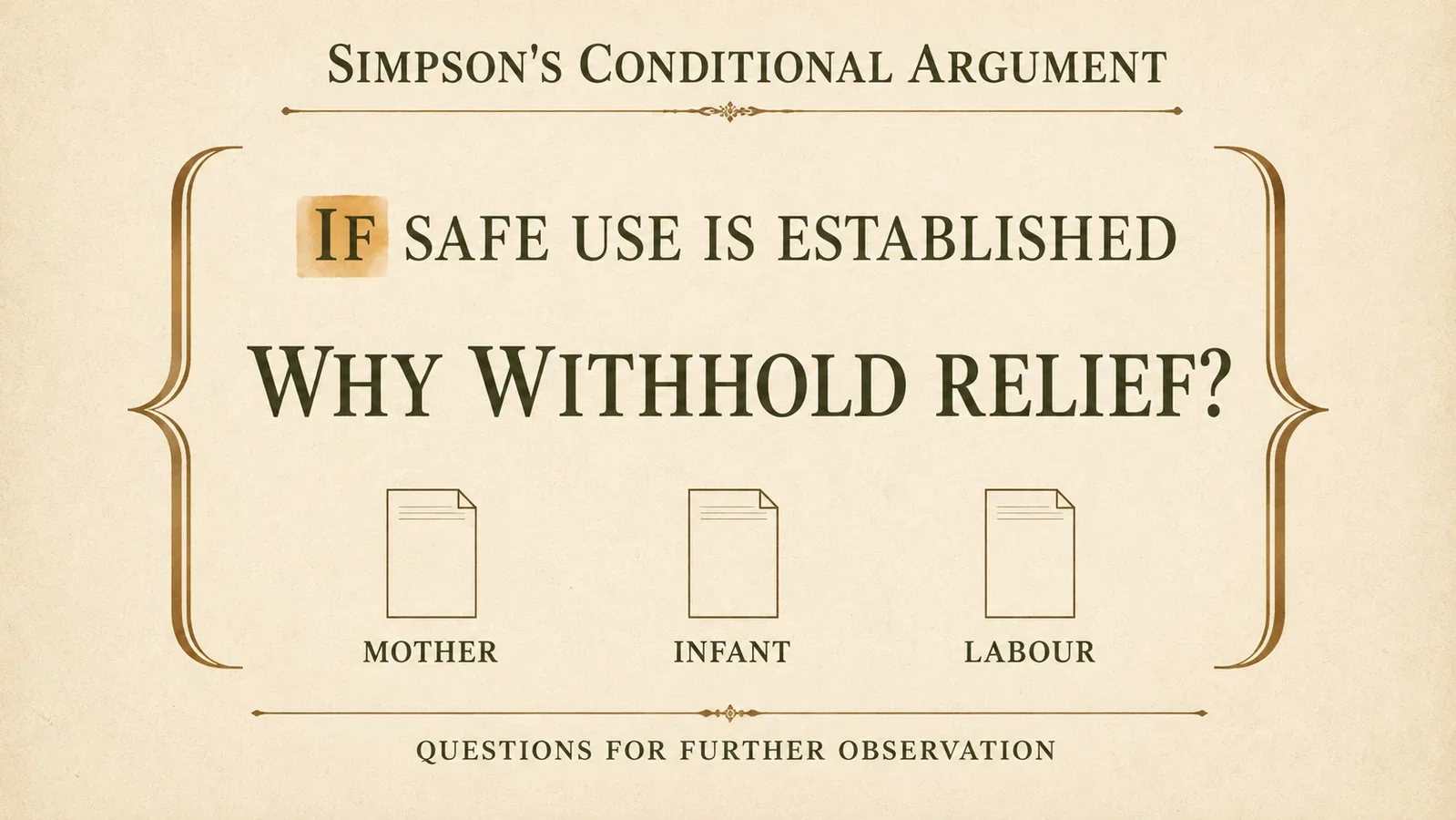
Keeping the condition in view makes the opening case harder, and more useful, to read.
One page, two very different accounts
On January 19, 1847, Simpson used ether during a difficult delivery in Edinburgh. The original report does not give the mother's name. The mother had a severely contracted pelvis and a deformed lumbar spine, and this was a second confinement.[1, p721; 2, p6]
The previous labour had ended with craniotomy after prolonged difficulty. For the January case, however, Simpson had planned turning and extraction. The previous operation must not be mistaken for the current one, nor should the forceps deliveries described later in the article be substituted for it.[1, pp721–723]
Assisted by Zeigler, Keith and Figg, Simpson administered ether and proceeded with the planned operation. Removing the head remained extremely difficult. The drug had not removed the mechanical obstruction.[1, p722]
The report then records that the infant gasped several times, but full respiration could not be established. That observation should not become a healthy-baby ending. Nor should it be compressed into a label that erases the reported gasps. The case alone does not establish either that ether caused the respiratory outcome or that it played no part.[1, p722]
On the same page, Simpson gives the mother's later account: no consciousness of pain during the procedure, and memories of sounds on waking. Simpson recorded favourable recovery the next day and on the fifth day, with a subsequent favourable report from Figg.[1, p722]
Those observations matter. They remain a reported experience and short-term recovery, not continuous measurement of awareness or a comprehensive assessment of safety. The mother's account cannot stand in for the infant's outcome.
The Wood Library-Museum holds a plaster cast of the head of the infant delivered that day; its title comes from a label on the base. It is an object linked to a difficult birth, not simply a trophy of painless progress, and the catalogue does not replace the original clinical account.[4]
Uterine action was a separate observation
The paper's later cases complicated the meaning of being etherized. Simpson described patients who appeared insensible; others who moved or complained but later recalled no suffering; others who remained aware while feeling much less distress; and some whose pain was only partly relieved.[1, pp725–726]
Behaviour, awareness, remembered pain and relief were not interchangeable descriptions.
Uterine contractions were another matter again. In the reported cases, they could continue while the patient's experience changed. That made it possible to ask whether relieving pain necessarily meant stopping the activity that advanced labour.[1, pp723–724]
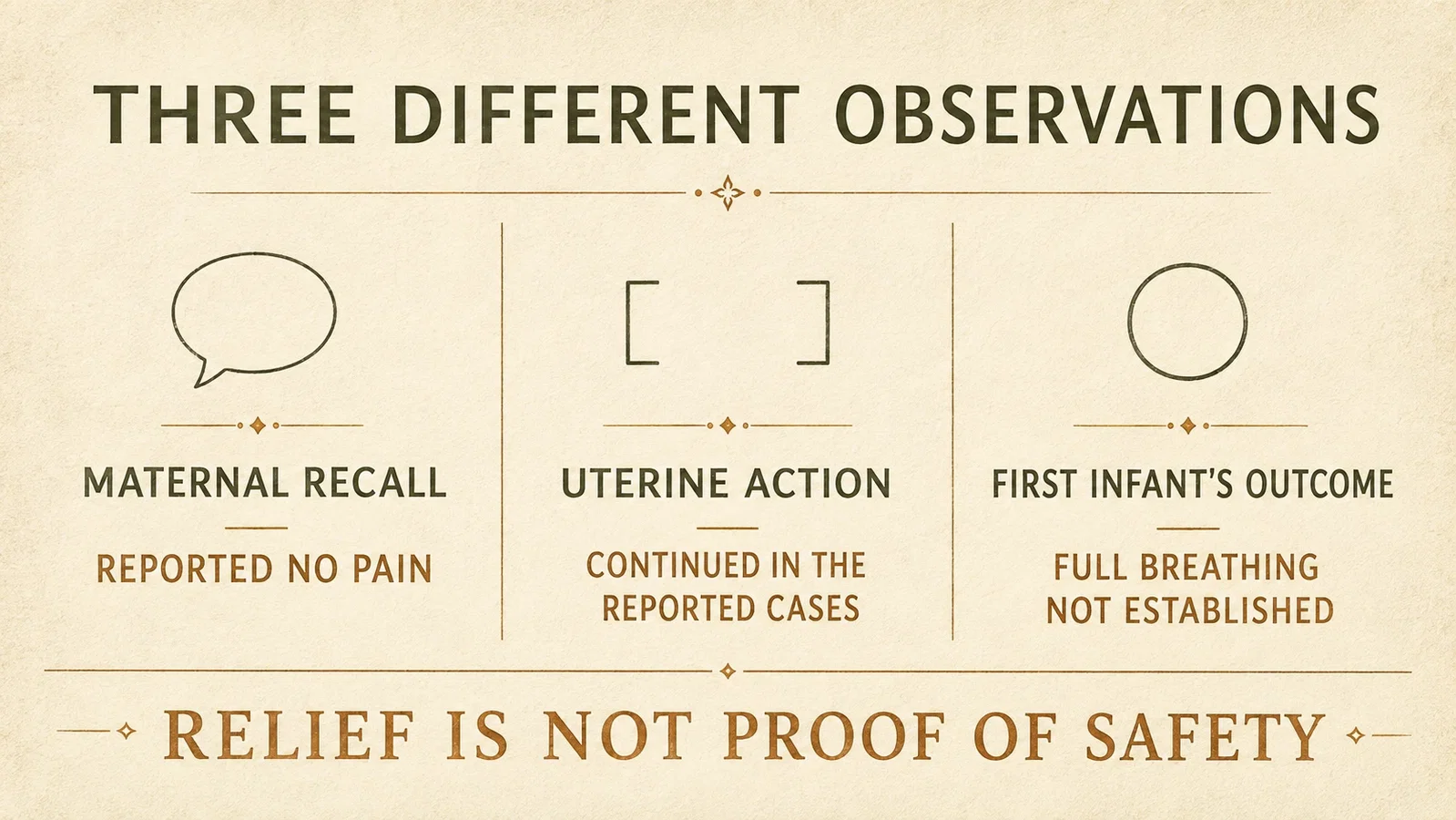
Simpson himself qualified the inference. More extensive investigation might find that ether interfered with uterine contractility in particular circumstances or at particular intensities. The 1848 retrospective report describes a few cases in which very deep etherization appeared to alter contraction strength, with recovery as the state became lighter.[1, p724; 2, p8]
Even a seemingly encouraging observation had competing explanations. After reporting an ether-and-ergot combination, Simpson asked whether the renewed contractions reflected ether, ergot, both, or coincidence, and had not enough facts to decide.[1, p724]
The historically important proposition was therefore limited: diminished suffering and continuing uterine action could coexist. It was not a timeless claim that ether was harmless to uterine function, and it is not a technique offered for present-day use.
Which 1847 story are we telling?
The original journal pages belong to the March 1847 issue, although the article closes with a February dateline. The same-year Wellcome offprint confirms the January case and preserves the conditional ending. Its title identifies the March journal issue; catalogue wording about a particular February publication day is not sufficient to erase that distinction.[1, pp721,728;3, title,pp3–4,11]
Another distinction concerns a name frequently attached to the story. The Australian Society of Anaesthetists' historical timeline places Jane Carstairs in the later chloroform episode. That name cannot simply be inserted as the named woman in this earlier, unnamed ether account. Simpson's 1848 report likewise separates the January ether experience from the first chloroform labour case in November.[2, pp6,10;5, PDF p15]
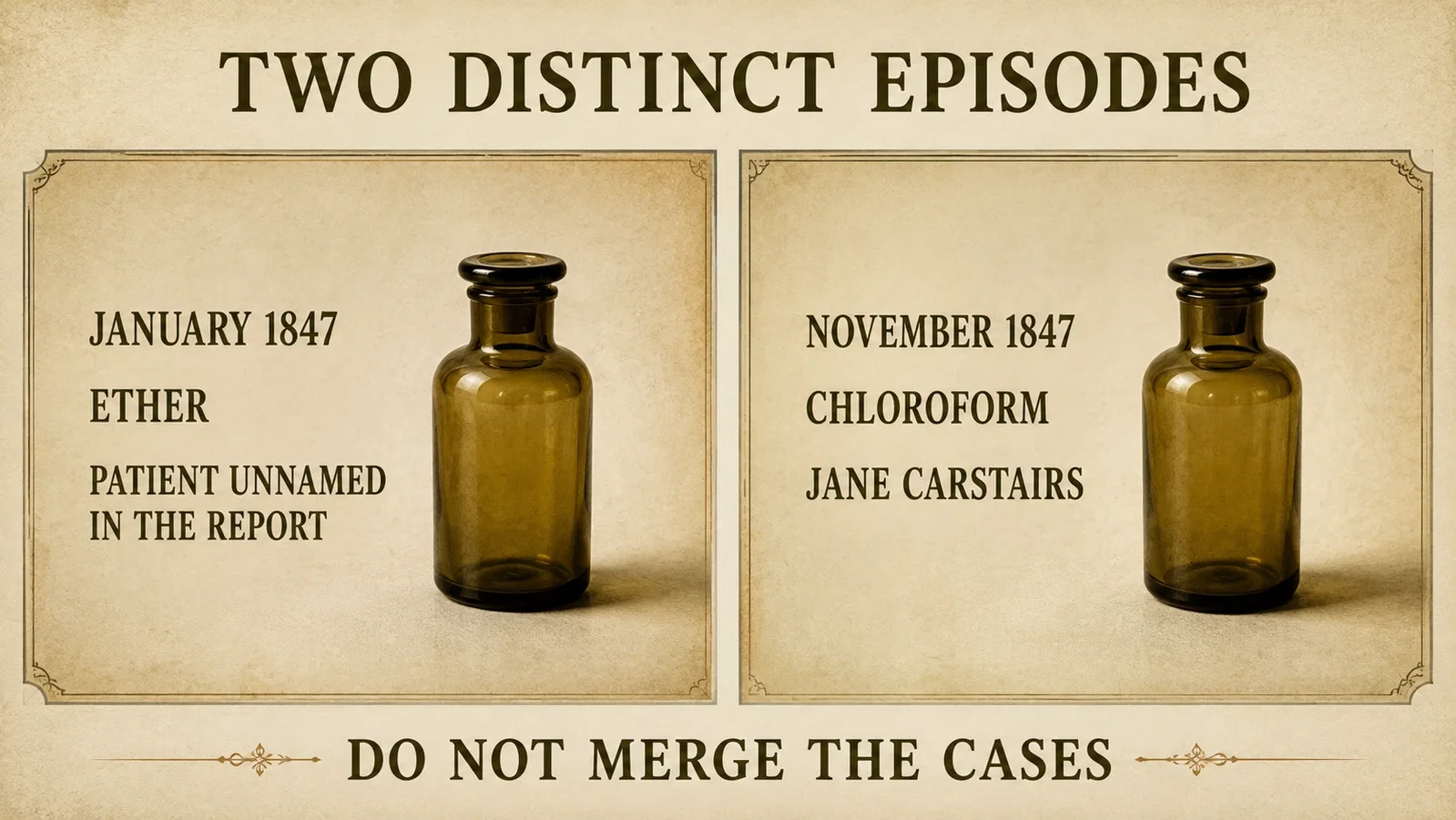
Nor does the word first settle every priority question. At the opening of the paper, Simpson wrote of being unaware of an earlier obstetric application. That establishes the limit of Simpson's stated knowledge, not a completed global search. Here, first means Simpson's first reported ether obstetric case in this account.[1, p721]
Once those distinctions are kept, the achievement does not disappear. It becomes more specific. Simpson took the suffering of labour seriously as something medicine might change, while trying to distinguish it from uterine action. The report also left evidence that relief, maternal recovery and an infant's fate were separate questions.
The ethical argument at the end gains precision when we return to it. A commitment to relieve pain and a duty to investigate harm belong together. The condition was not an inconvenient qualification added later. It was already on the page.
Sources and reading limits
Read: Simpson's March 1847 paper in the Monthly Journal of Medical Science, all eight pages; the same-year Edinburgh offprint (title, pp. 3-4, 11); Simpson's 1848 report Anaesthetic Midwifery, pp. 5-11; the Wood Library-Museum catalogue entry; the Australian Society of Anaesthetists timeline, p. 15, only for the Jane Carstairs entry.
Not covered: the rest of the 1848 report; the 1856 revised collection; any record of the mother's name; any worldwide priority question.
- Simpson JY. Notes on the Employment of the Inhalation of Sulphuric Ether in the Practice of Midwifery. Monthly Journal of Medical Science. 1847 March; new series no. IX:721–728. PMC indexes 1(9); older citations also use volume 7. Eight original journal pages.
- Simpson JY. Anaesthetic Midwifery: Report on its Early History and Progress. Edinburgh: Sutherland and Knox; 1848:5–11. Yale copy. Citations use the offprint's printed pagination.
- Simpson JY. Notes on the Inhalation of Sulphuric Ether in the Practice of Midwifery. Edinburgh: Sutherland and Knox; 1847:3–4,11 and title. Wellcome catalogue and scan. Same-year version control, not the 1856 revised collection.
- Wood Library-Museum of Anesthesiology. Simpson's 1st Obstetric Anesthetic · Archived copy. Accession 2005-08-01-1. Accessed September 6, 2026.
- Australian Society of Anaesthetists / HALMA. Timeline of Some Significant Events in the Evolution/History of Anaesthesia. 2024-Feb-29 file, PDF p15. Professional society timeline. Used narrowly for the identity distinction, not endorsement of every entry.
Continue exploring
Related reading connects shared questions and contexts; it does not by itself establish historical influence.
- 1847: Chloroform, from Self-Experiment to a Public Report
- 1847: Let the Woman in Labour Hold the Ether Sponge
- 1846: The Ether Dome, a Breakthrough Without a Perfect Moment
- 1846: Holmes Gives an Old Word a New Task
- 1847: Snow Makes Ether a Question of Observation and Control
- 1953: Virginia Apgar Gives the Newborn a Common Language
Anesthesia Epochs · The Source Room · About & Editorial Method
Sources and reading limits are stated above. Illustrations are labelled as original source images or AI-made. Historical accounts are educational; they are not current treatment instructions.