
An 1847 Boston pamphlet under Morton's name advised letting the woman in labour hold the ether sponge, because the raised hand drops once enough ether has been inhaled.
Reading Library · Anesthesia Epochs · 中文版
Watch the education video (for clinicians)
1847: Who Holds the Sponge — Morton's Ether Advice for Labour · Anesthesia Epochs Education Series
Patient-controlled analgesia rests on a simple safety idea: a patient who has had enough drug stops pressing the button. The timeline of the Australian Society of Anaesthetists traces the idea back to 1847, to William Morton's advice that a woman in labour should hold an ether sponge. This article reads that advice in the Boston pamphlet where it was printed, to see exactly what it says. [1][2]
The pamphlet
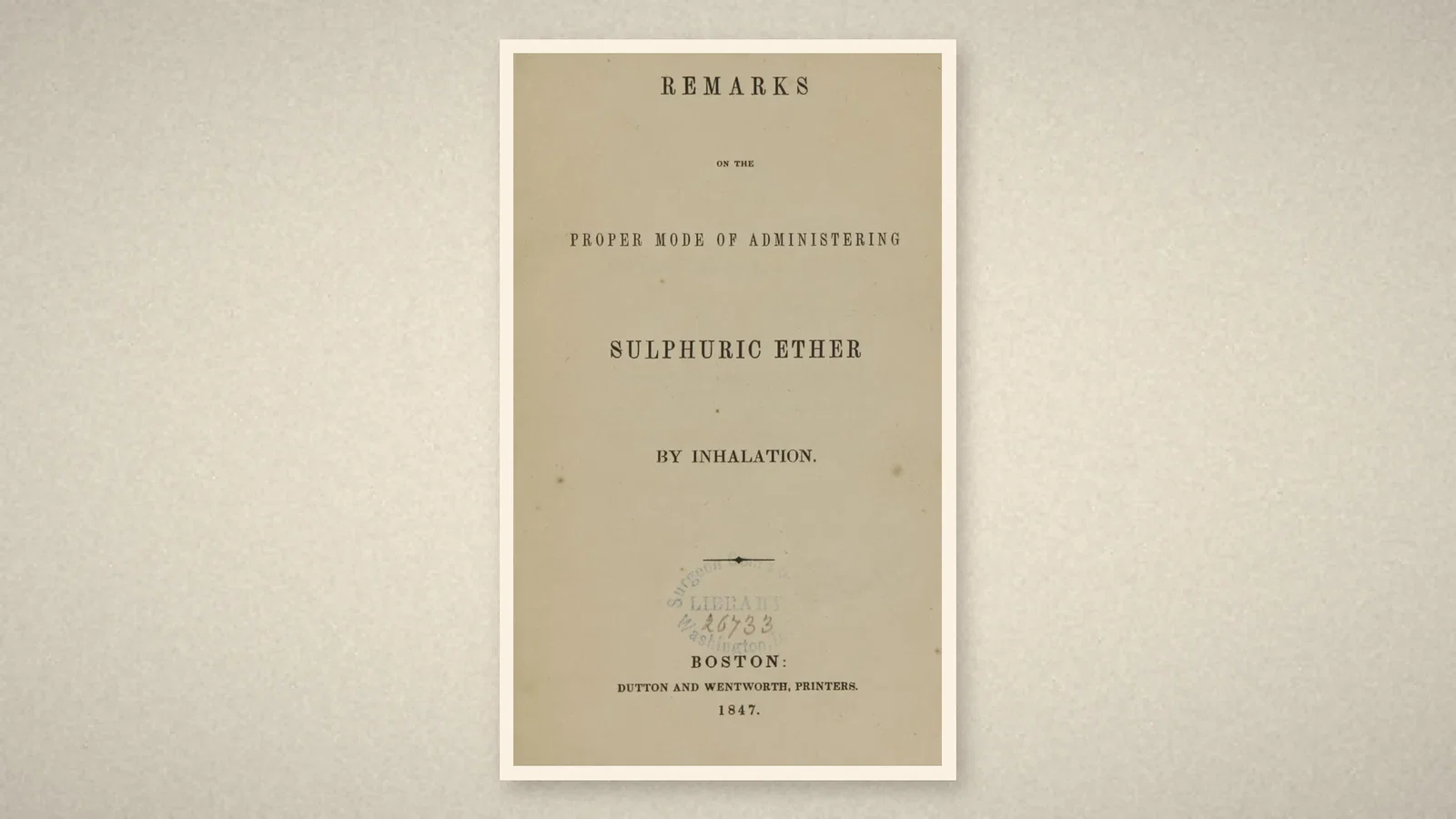
Remarks on the Proper Mode of Administering Sulphuric Ether by Inhalation was printed in Boston by Dutton and Wentworth in 1847. Its half-title reads "Morton on the inhalation of sulphuric ether", and the copyright was entered "by Wm. T. G. Morton". The author is not named on the title page, so this article describes it as published under Morton's name. [1]
The pamphlet prefers a sponge to an inhaling apparatus. With a sponge, ether is taken in "mixed with a larger proportion of atmospheric air", the sponge can be held at first a little away from the mouth so that the airway becomes used to the vapour, and it can be given more easily "where the patient is unwilling, or unable, to assist in the process". [1]
Ether in labour
The section on midwifery reports that ether, at first expected to be used only for difficult deliveries, had soon been given in natural labour and "was found to save the mother from suffering"; a footnote cites Professor Simpson of Edinburgh as having used it "forty or fifty times, with the most perfect safety and success". [1]
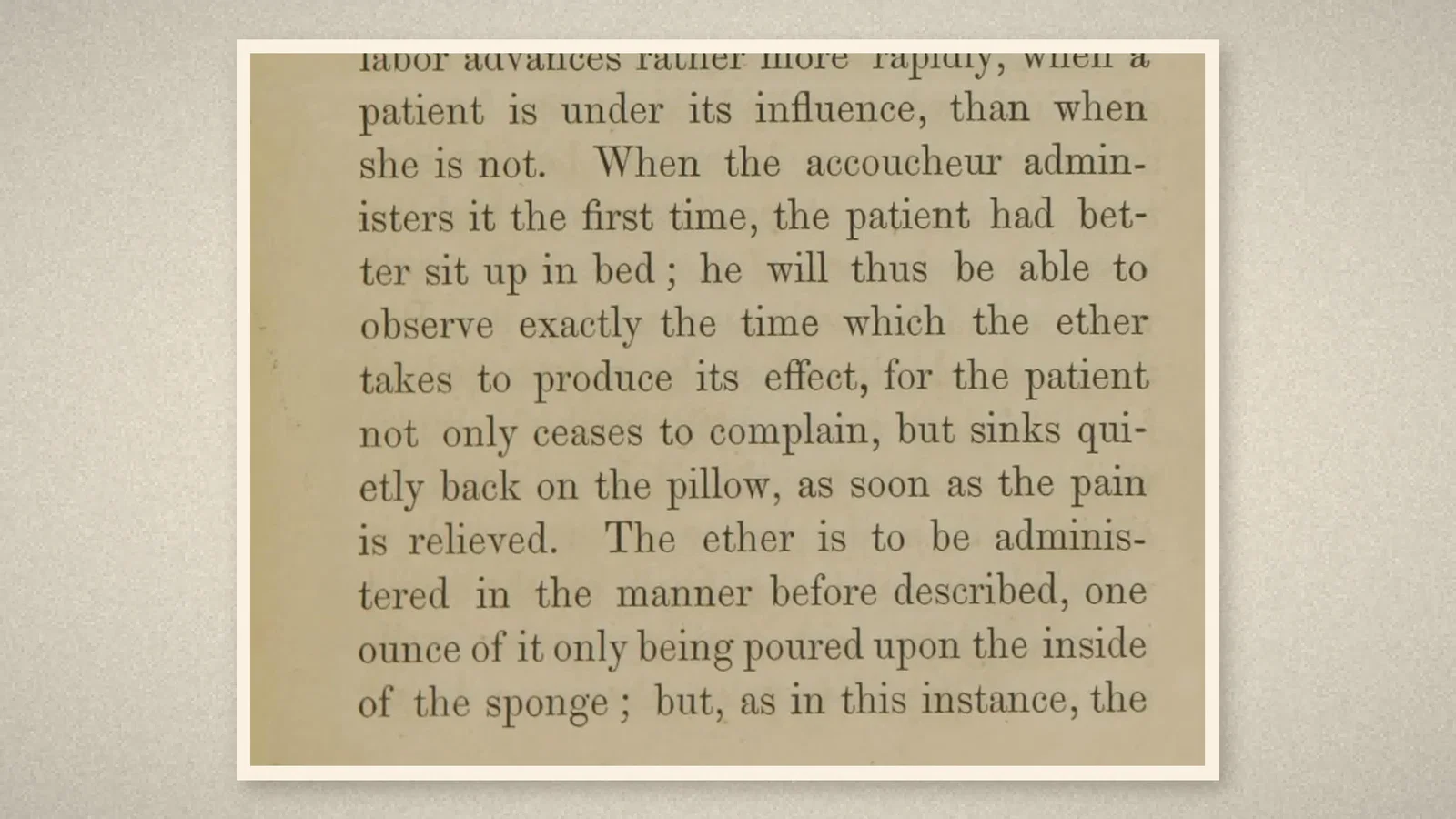
The advice is cautious about timing. In the early stage, and especially in first labours, the pamphlet suggests avoiding ether for the milder pains, partly because once a woman has felt its relief the woman may be unwilling to bear any pain without it; patients "should therefore be encouraged to bear the less severe pains with fortitude, while the worst ones should be relieved by ether". When the expulsive pains are under way, ether may be continued for most of them until the child is born. One ounce is poured into the sponge, and because here "cessation of pain is the indication to cease using the sponge", it is seldom applied for more than one to three minutes. [1]
The hand that drops
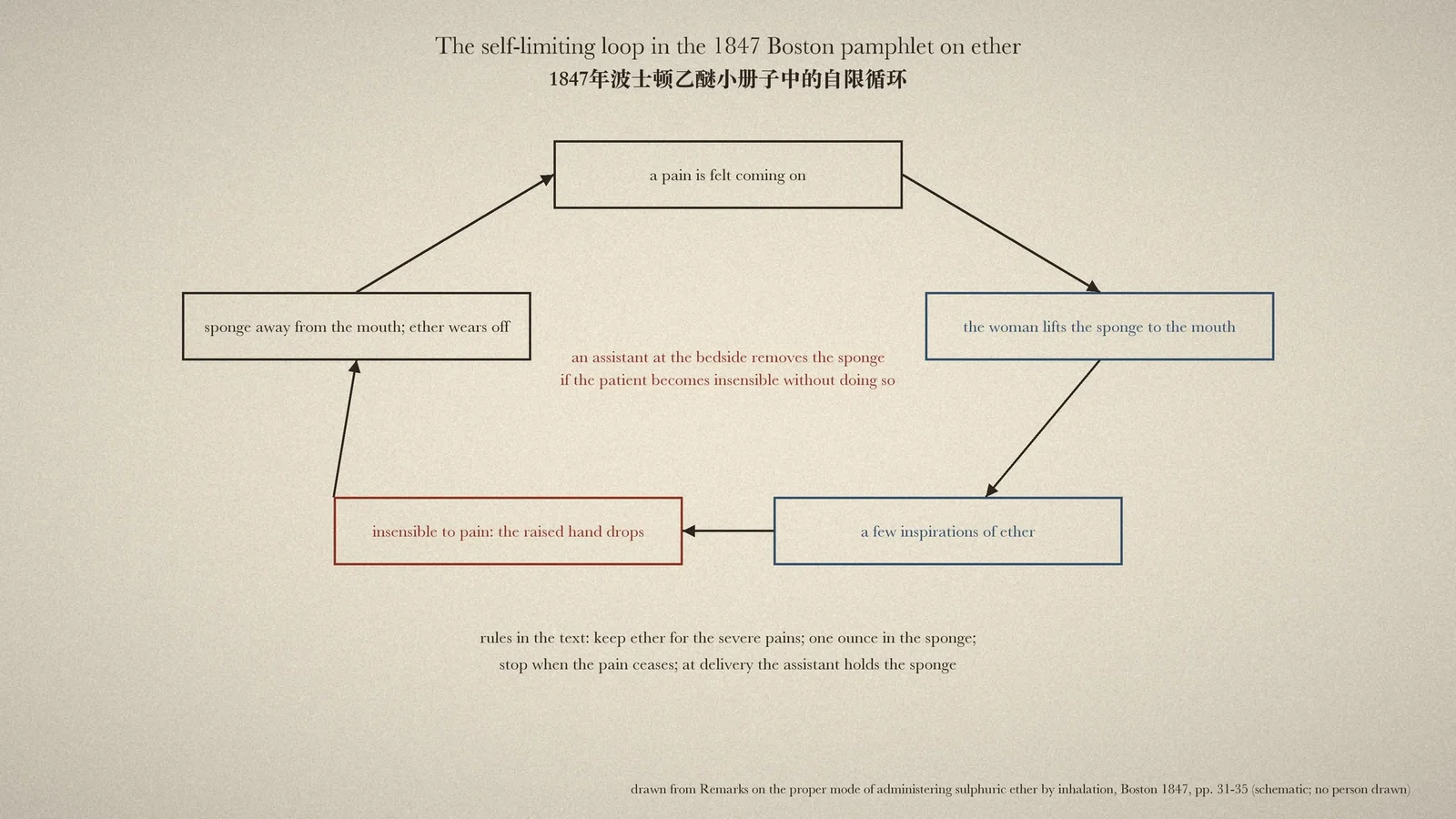
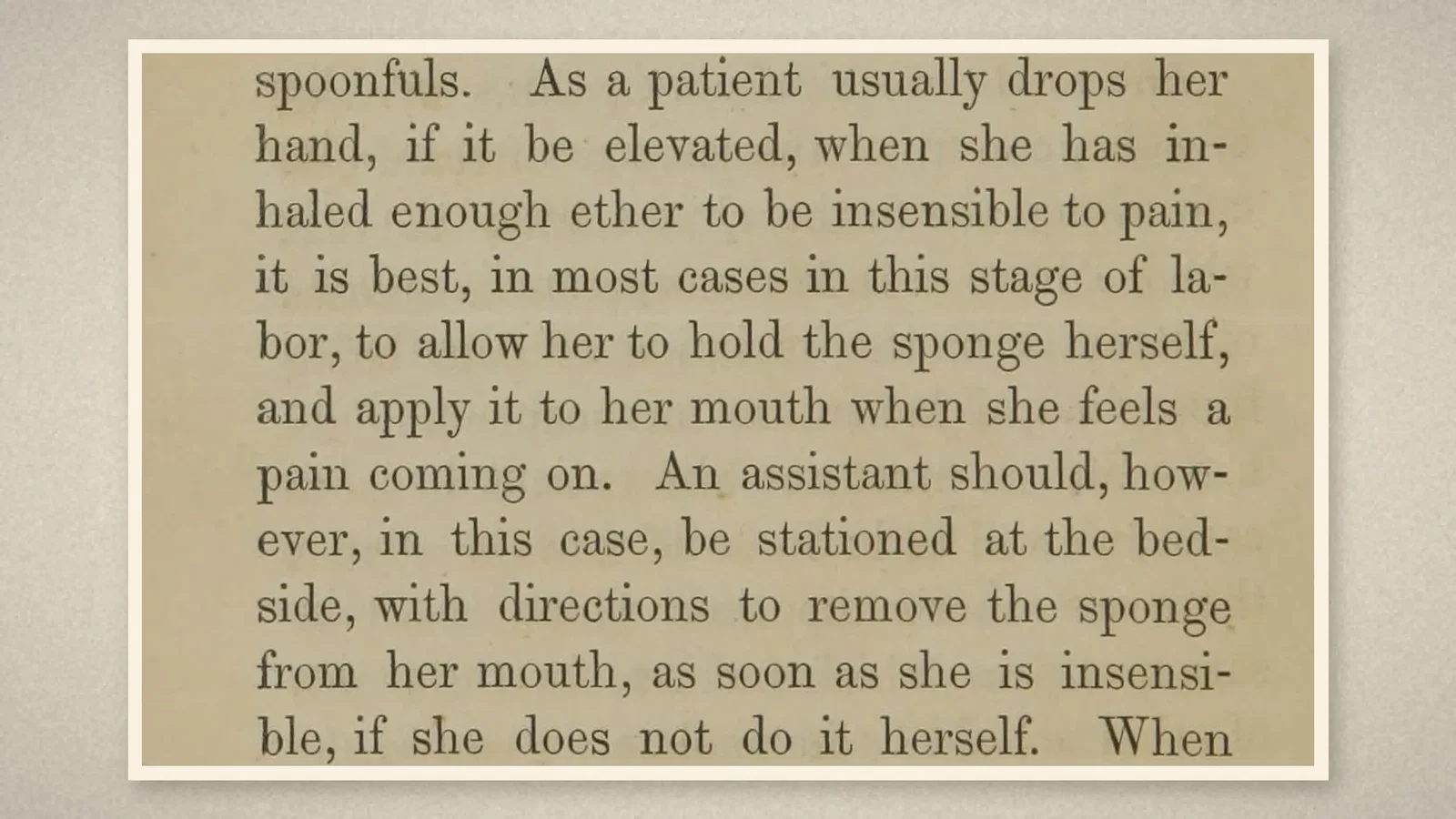
Then comes the passage the timeline refers to, on page 34. A patient who has inhaled enough ether to be insensible to pain usually lets a raised hand drop. For that reason, the pamphlet says, it is best in this stage of labour to let the woman hold the sponge and apply it to the mouth when a pain is felt coming on. An assistant should still be stationed at the bedside, with directions to take the sponge away as soon as the patient is insensible if the patient has not already done so. When the child's head is about to be born, the sponge is entrusted to the assistant. [1]
The logic is the one later built into patient-controlled devices: the patient decides when the drug is needed, and the drug's own effect stops further dosing. The pamphlet also adds the second layer that modern PCA keeps: someone watching, in case the first safeguard fails.
What the record shows
The 1847 advice is not a device and not a trial, and it concerns an inhaled anaesthetic rather than an opioid pump. But it states, in one paragraph, why a patient can be trusted to dose within limits, and why someone should still be watching.
Sources and reading limits
Read: the pamphlet Remarks on the Proper Mode of Administering Sulphuric Ether by Inhalation (Boston, 1847), the passage on the sponge and the section on midwifery (pp. 15-16, 30-35); the 2024 ASA timeline entries for 1847, 1967 and 1969.
Not covered: the reports of patient-controlled opioid analgesia that the timeline dates to 1967 (New York) and 1969 (Leeds); Simpson's own reports, cited in a footnote; any record of how widely the advice was followed. The pamphlet is unsigned on its title page. Ether in labour is reported as the pamphlet presents it, without endorsement. The article does not suggest that the authors used the term "patient-controlled analgesia".
Three illustrations are page crops from the 1847 pamphlet; one is drawn from it.
- [Morton WTG]. Remarks on the proper mode of administering sulphuric ether by inhalation. Boston: Dutton and Wentworth; 1847. pp. 15-16, 30-35. Internet Archive
- Australian Society of Anaesthetists. Anaesthesia history timeline. 2024. ASA
Continue exploring
Related reading connects shared questions and contexts; it does not by itself establish historical influence.
- 1847: Fanny Longfellow Gives Birth Under Ether
- 1847: Simpson Separates Labour Pain from Uterine Action
Anesthesia Epochs · The Source Room · About & Editorial Method
Published November 2, 2026. Sources and reading limits are stated above. Illustrations are labelled as original source images or AI-made. Historical accounts are educational; they are not current treatment instructions.