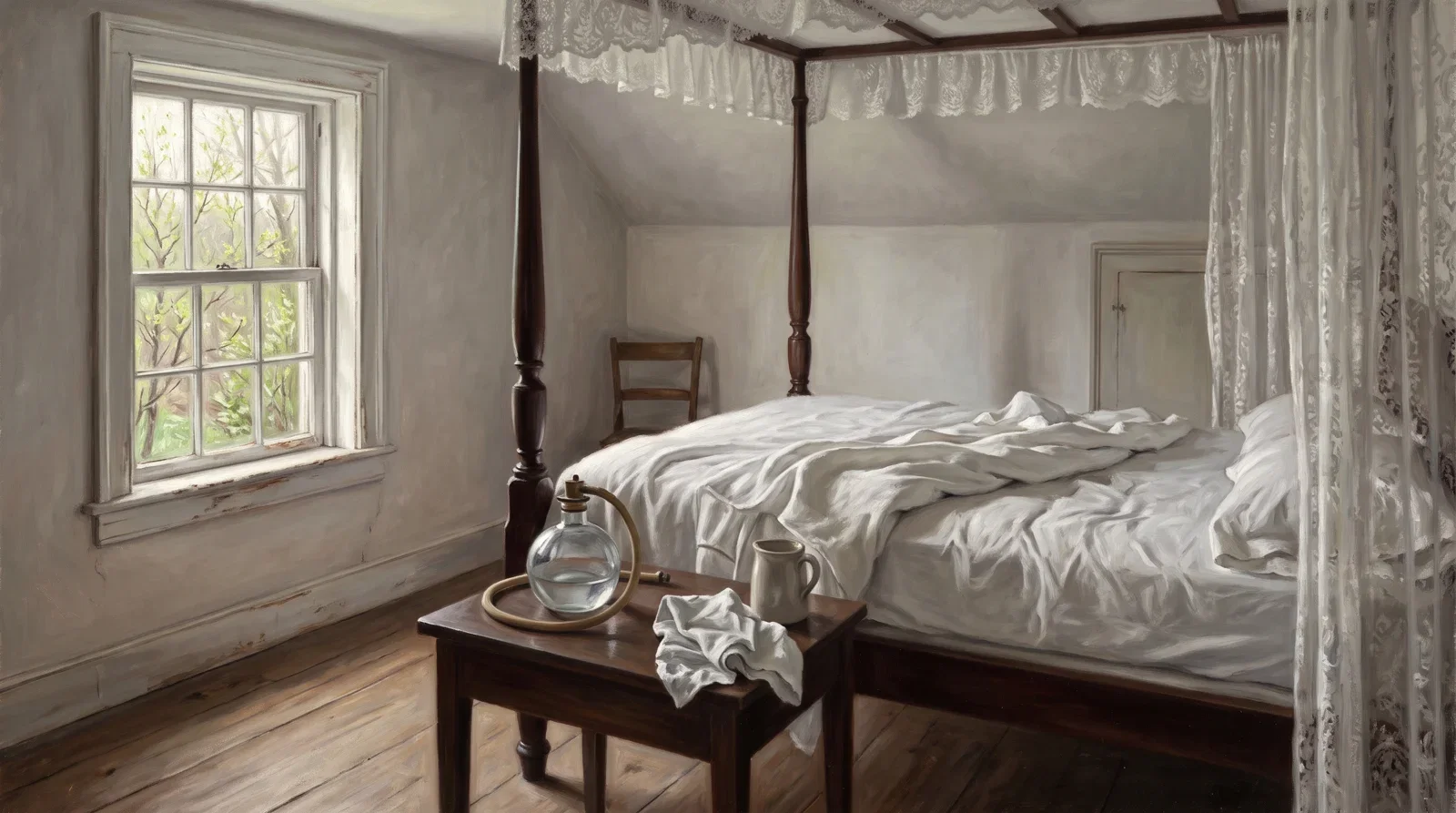
A dentist-physician gave ether during labour and reported it in five sentences; Fanny Longfellow wrote of never having got through a confinement so comfortably.
Reading Library · Anesthesia Epochs · 中文版
Watch the education video (for clinicians)
1847: Fanny Longfellow Gives Birth Under Ether — Keep's Pause · Anesthesia Epochs Education Series
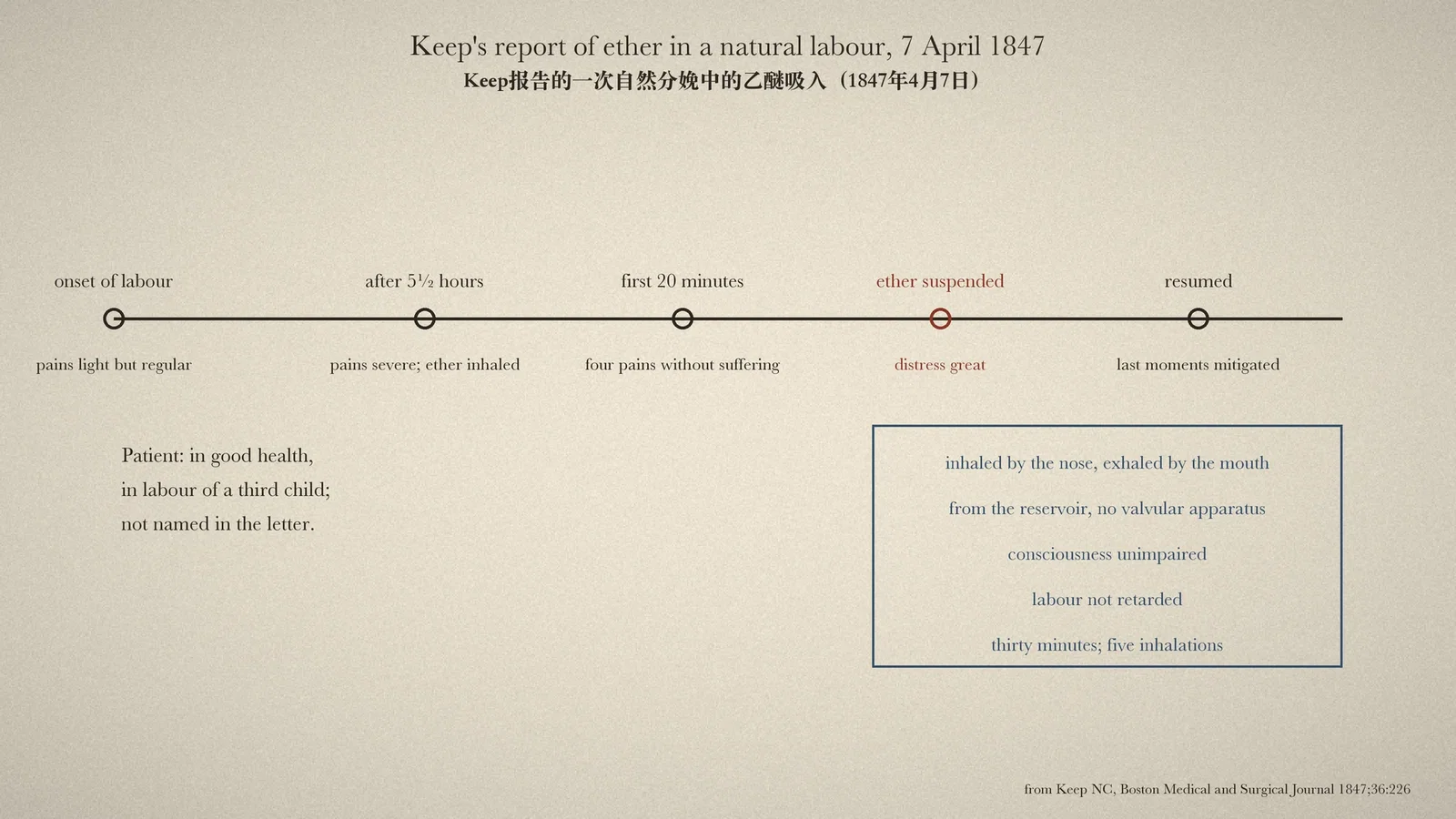
Two documents, written days apart and from opposite sides of the bed, record an early birth under ether in America. One is a medical report of five sentences, signed by the practitioner and naming no patient. The other is a private letter by the patient, who was the wife of the poet Henry Wadsworth Longfellow. Read together, they show what was done, how it felt, and how a later editor turned it into a "first". [1] [2]
The practitioner's report
On 10 April 1847 N. C. Keep, who elsewhere in the same volume signs as "M.D., D.D.S.", wrote to the editor of the Boston Medical and Surgical Journal. The letter is headed "The Letheon Administered in a Case of Labor". [1] "On the 7th inst.," Keep wrote, "I administered the vapor of ether in a case of natural labor." The patient was in good health and in labour with a third child. After five and a half hours the pains, until then light but regular, became severe, and the ether was given: inhaled through the nose and breathed out through the mouth, from the reservoir, without any valve. [1]
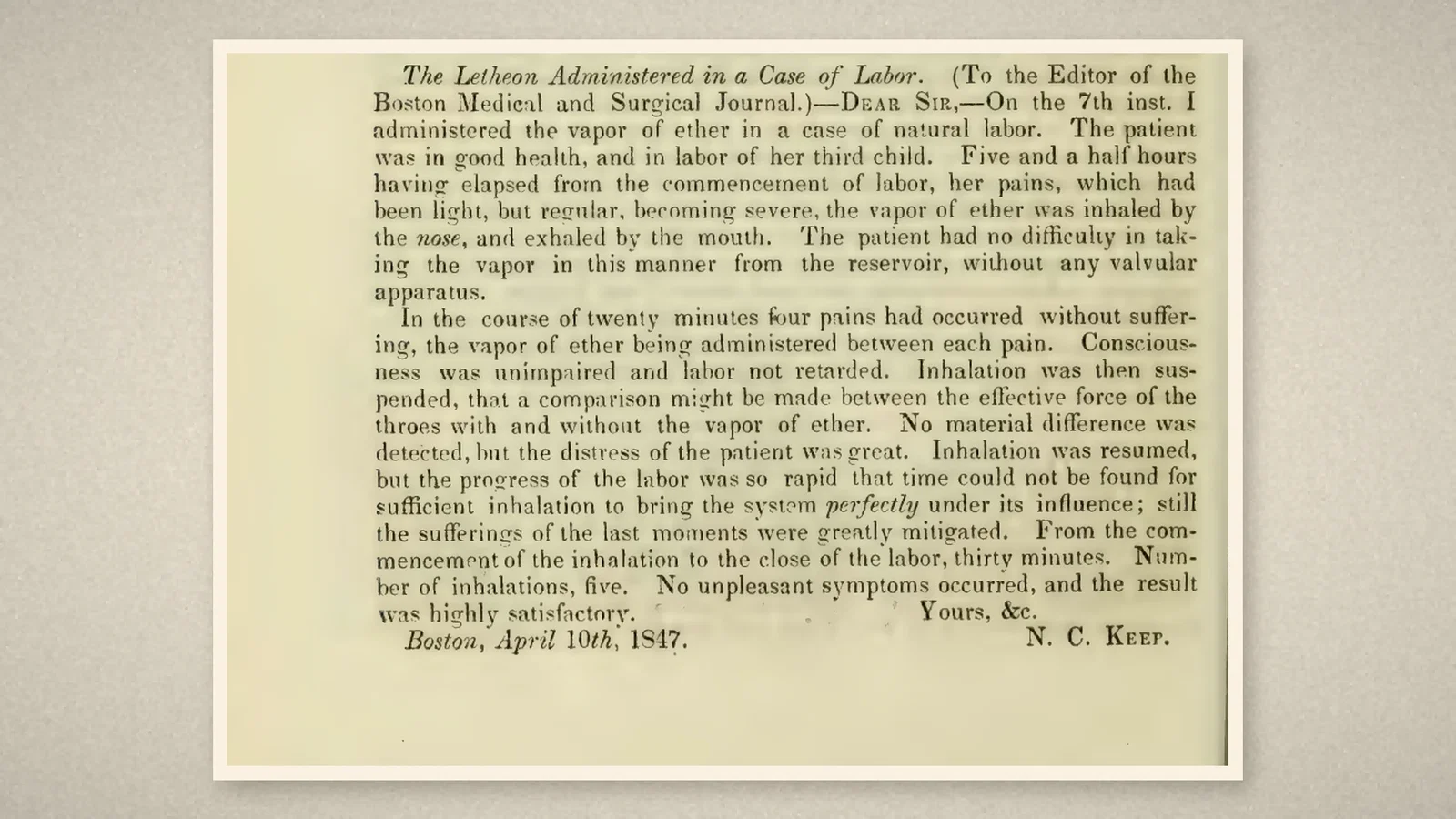
The report is careful in a way that is easy to miss. In twenty minutes four contractions passed "without suffering", ether being given between them; consciousness was unimpaired and labour not slowed. Then Keep stopped the ether on purpose, "that a comparison might be made between the effective force of the throes with and without the vapor of ether". No difference in the force was detected, "but the distress of the patient was great". The ether was resumed, but labour moved so fast that full effect was never reached; still, the suffering of the last moments was "greatly mitigated". From first inhalation to delivery took thirty minutes and five inhalations, with no unpleasant symptoms. [1] In one short letter Keep tested two of the questions that would dominate the obstetric debate: did ether weaken the contractions, and did it really remove the pain?
The patient's letter
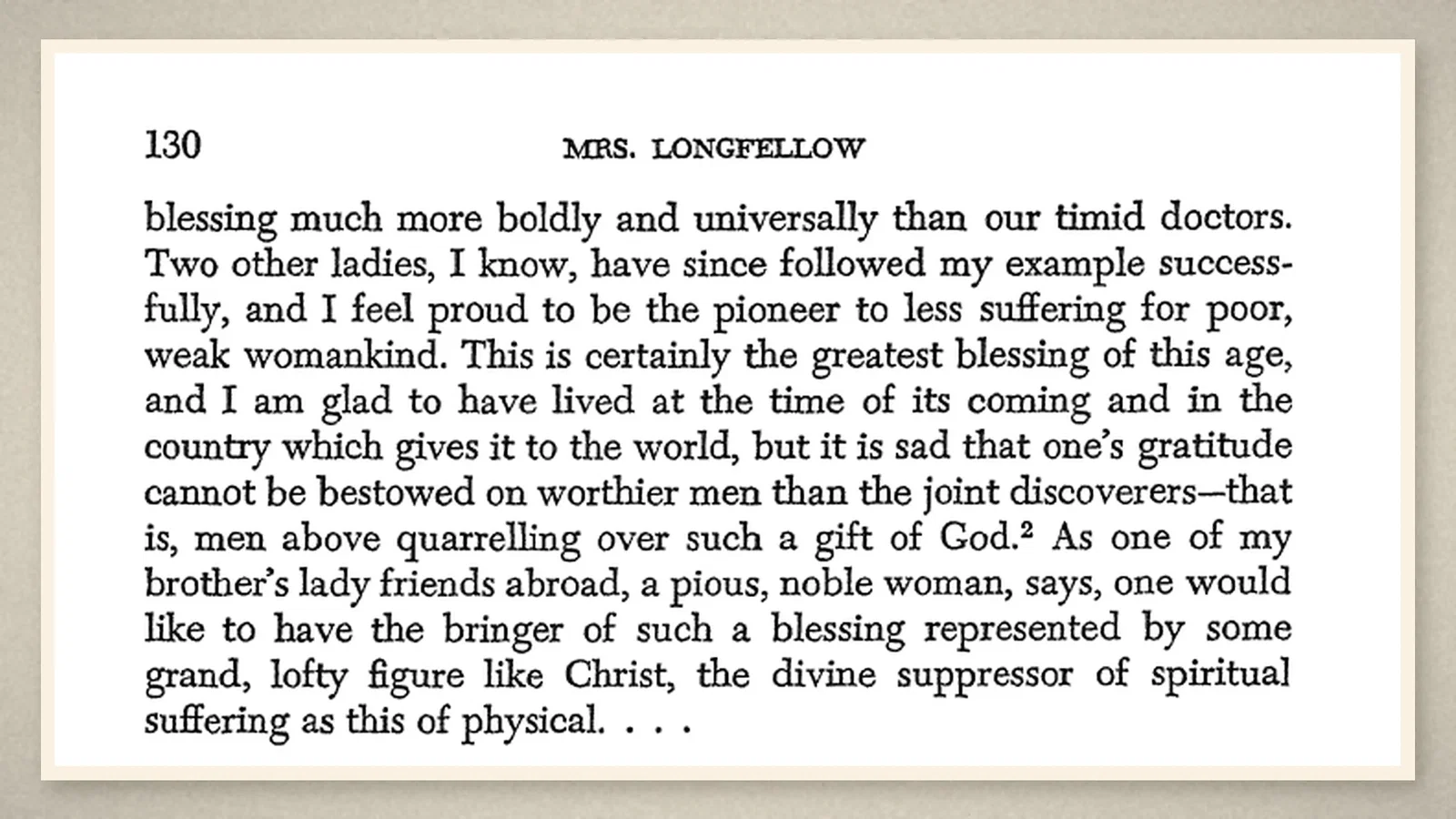
The 1956 edition of Fanny Appleton Longfellow's letters and journals, edited by Edward Wagenknecht, dates the birth of the Longfellows' daughter to 7 April 1847 and prints a letter from Cambridge, dated only "Friday", to Anne Longfellow Pierce. [2] It thanks the family for sympathy with "my new joy and etherial bravery" and says: "I never was better or got through a confinement so comfortably." [2]
The letter is also candid about the decision. "I am very sorry you all thought me so rash and naughty in trying the ether. Henry's faith gave me courage, and I had heard such a thing had succeeded abroad, where the surgeons extend this great blessing much more boldly and universally than our timid doctors." [2] Two other women, the letter adds, had since followed the example successfully, "and I feel proud to be the pioneer to less suffering for poor, weak womankind". Ether is "certainly the greatest blessing of this age", though it is sad, the writer adds, that gratitude cannot go to worthier men than the "joint discoverers", then quarrelling over the gift. [2]
How the two documents fit
Keep's letter names no one. The identification rests on the 1956 edition: the same date, the 7th of April 1847, a healthy mother with a third child, and the editor's note on the birth. [1] [2] Nothing in the pages read contradicts it, but it is an identification made by an editor, not by Keep.
Who said "first"
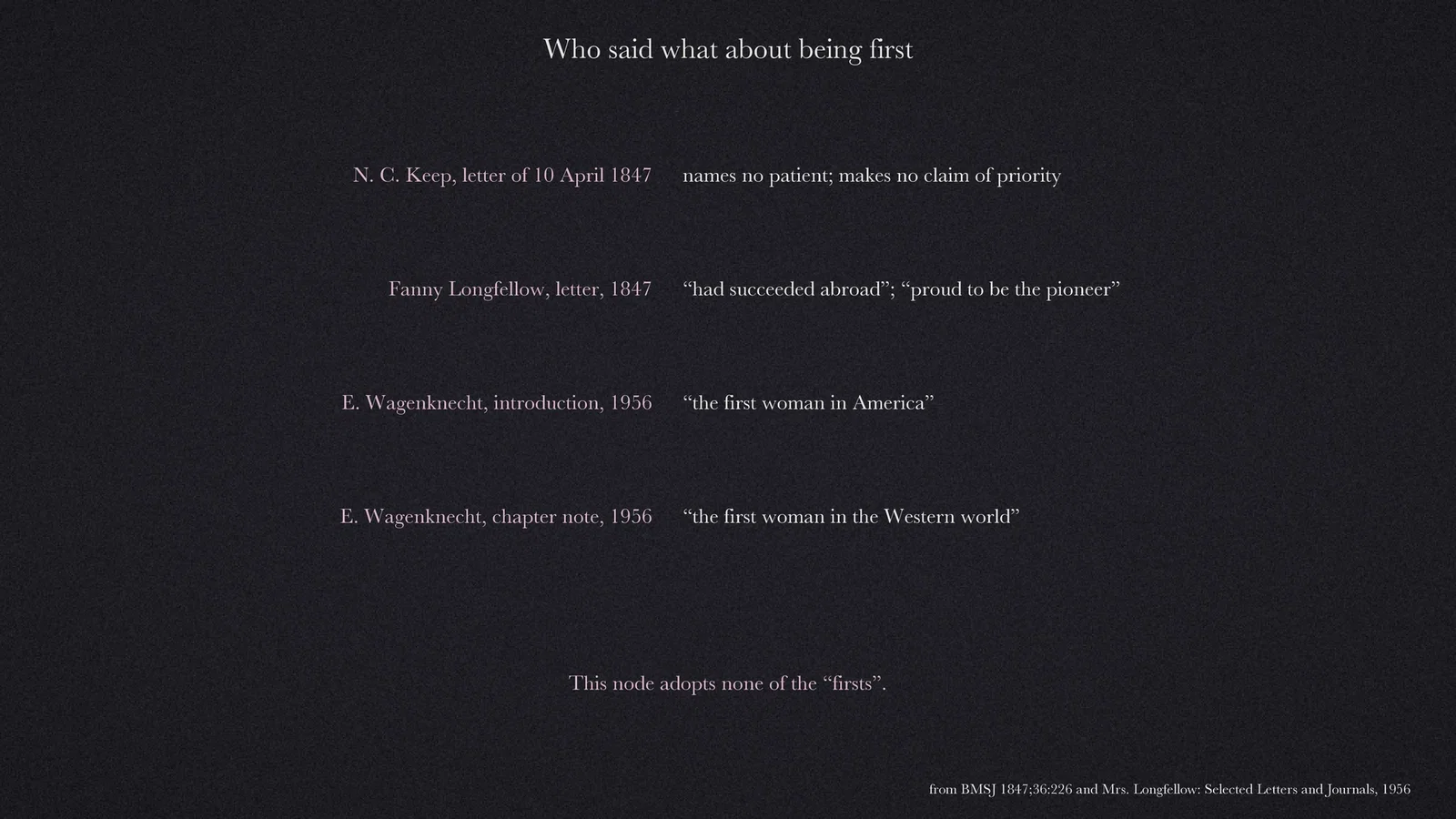
The claims of priority come from different places. Keep makes none. Fanny Longfellow's letter says the method "had succeeded abroad" and speaks of being a pioneer. The editor, writing more than a century later, calls Fanny Longfellow "the first woman in America to bear a child under anesthesia" in the introduction and "the first woman in the Western world" to give birth under ether in a chapter note; the second phrase sits awkwardly beside the letter's own reference to success abroad. [2] This article does not adopt either "first".
What the record shows
The episode gives obstetric anaesthesia two voices at its start: a practitioner who measured, interrupted and resumed, and a patient who chose against family worry, felt the difference, and wrote about it with pride. Both deserve to be read in their own words before any "first" is attached to them.
Sources and reading limits
Read: Keep's letter in the Boston Medical and Surgical Journal, vol. 36, p. 226; Fanny Longfellow's letter to Anne Longfellow Pierce with the editor's note and introduction in the 1956 edition (pp. 129-130).
Not covered: Henry Wadsworth Longfellow's journal for April 1847; the editor's biography of Longfellow, cited for the circumstances; histories of obstetric practice in Boston; responses by other Boston physicians. The patient is identified only through the 1956 edition. Keep's name is given as printed, N. C. Keep.
Two illustrations are page crops from the two sources; two are drawn from them.
- Keep NC. The Letheon administered in a case of labor. Boston Med Surg J. 1847;36:226. Internet Archive
- Wagenknecht E, editor. Mrs. Longfellow: selected letters and journals of Fanny Appleton Longfellow (1817-1861). New York: Longmans, Green; 1956:129-30. Internet Archive
Continue exploring
Related reading connects shared questions and contexts; it does not by itself establish historical influence.
- 1847: Simpson Separates Labour Pain from Uterine Action
- 1847: Chloroform, from Self-Experiment to a Public Report
- 1847: A Caesarean Section Under Ether at St Bartholomew's
Anesthesia Epochs · The Source Room · About & Editorial Method
Published November 2, 2026. Sources and reading limits are stated above. Illustrations are labelled as original source images or AI-made. Historical accounts are educational; they are not current treatment instructions.