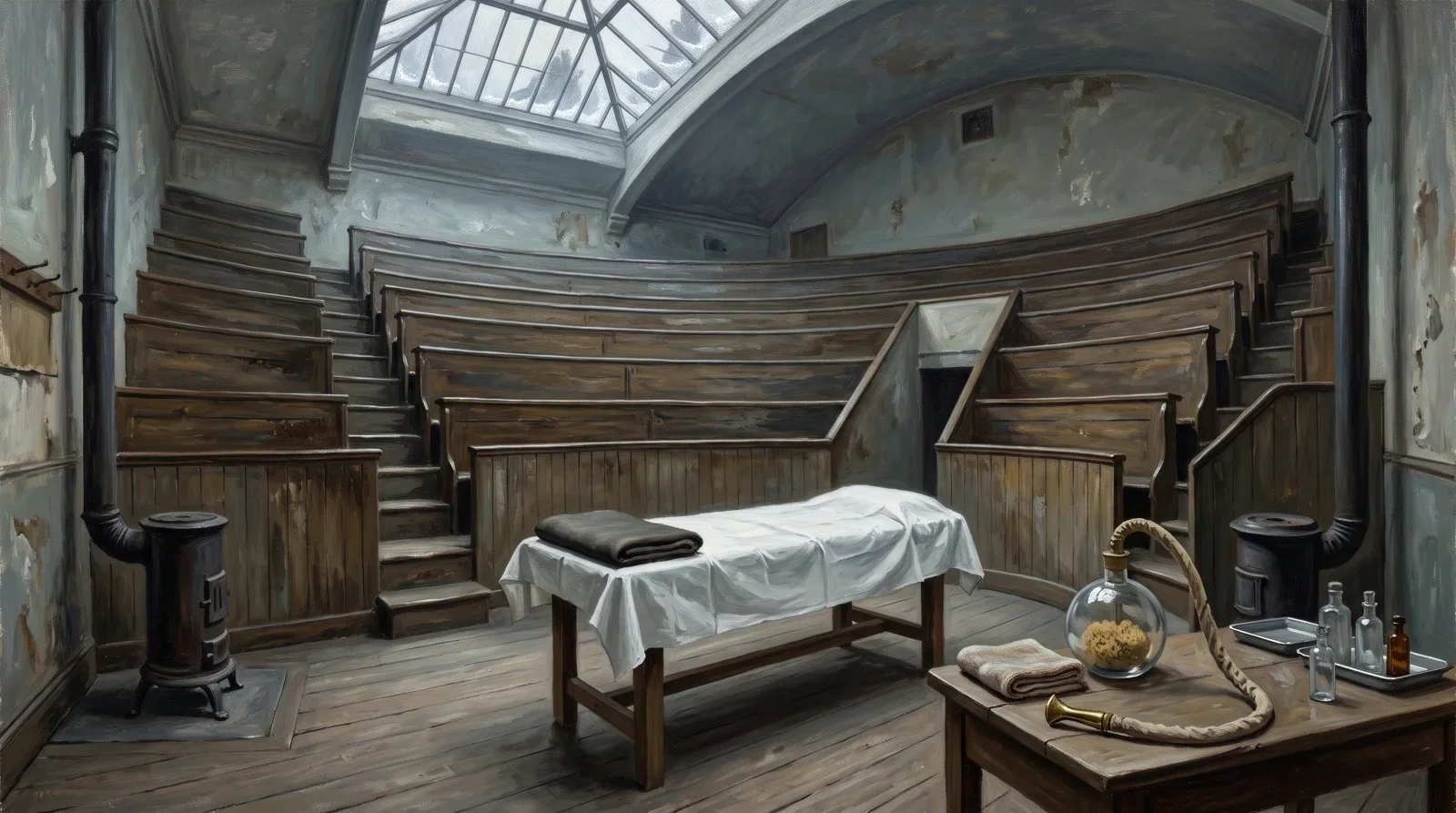
On 25 January 1847 Skey performed a caesarean section at St Bartholomew's while Tracy gave ether; the child lived, the mother died, and the ether never took full effect.
Reading Library · Anesthesia Epochs · 中文版
Watch the education video (for clinicians)
1847: Caesarean Section Under Ether — St Bartholomew's, London · Anesthesia Epochs Education Series
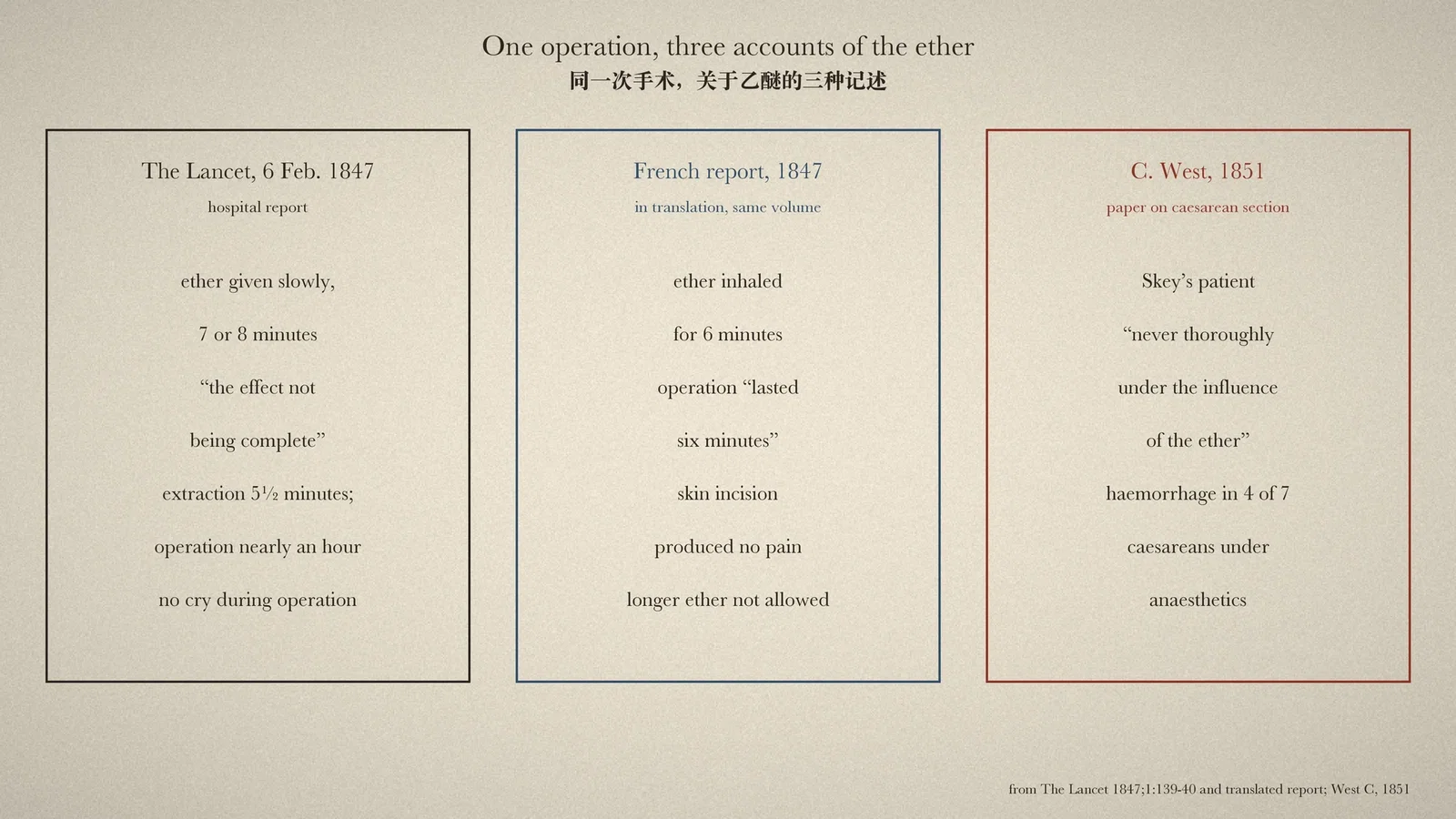
Ether had been in use in London for only a few weeks when it was taken into one of the most dangerous operations in obstetrics. On 25 January 1847 Mr. Skey performed a caesarean section at St Bartholomew's Hospital while Mr. Tracy gave ether. The Lancet printed a long hospital report twelve days later. [1] Read alongside a French summary in the same volume and a later comment by Charles West, it shows how quickly a hard case could be retold as an easy one. [1] [2]
The patient and the decision
The patient, Sarah Bartlett, had first consulted Mr. Jolin, a surgeon of Clerkenwell, in October. The report describes a woman "four feet one inch in height only", in the thirty-eighth year, whose pelvis measured "only one inch and one-third" from front to back: no child could pass, and "no resource remained but the Caesarian section". Jolin consulted Skey, the patient was admitted to St Bartholomew's, and the obstetric physicians Dr. Rigby, Dr. Protheroe Smith and Dr. Ferguson agreed. [1]
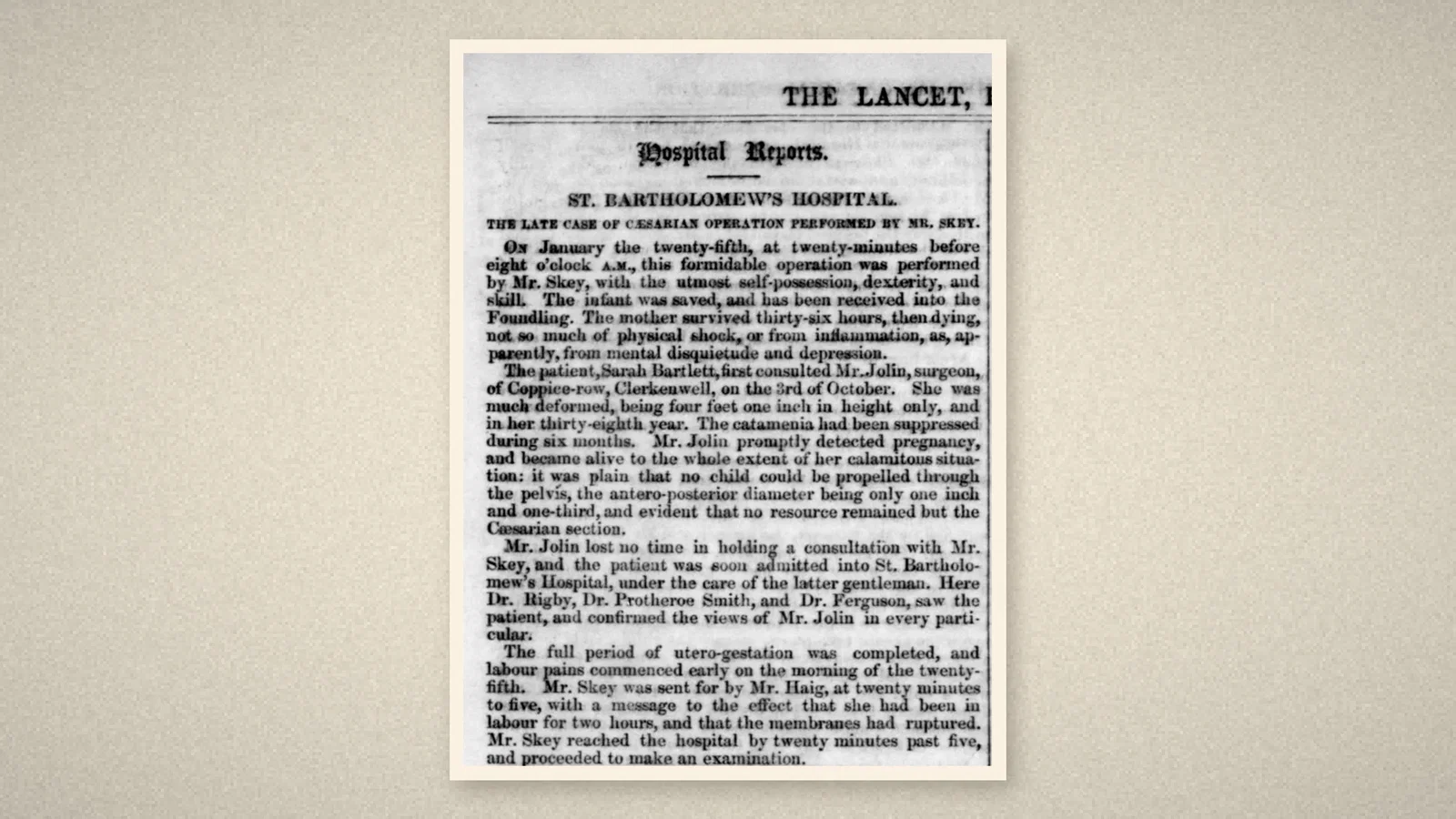
The morning of the operation
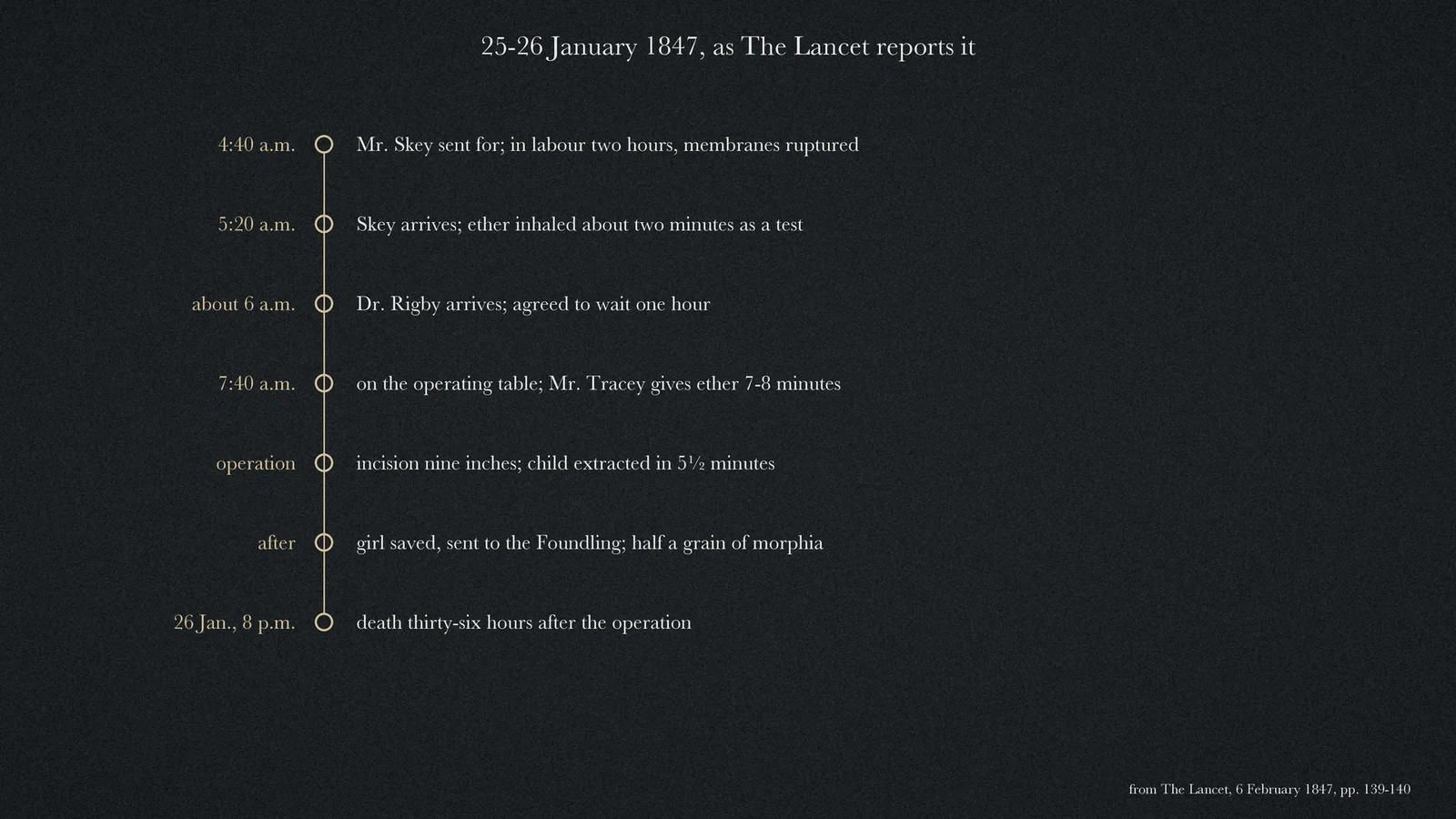
Labour began early on 25 January. Skey was sent for at twenty minutes to five and arrived at twenty past. The pains were strong and two minutes apart. As a test, ether was inhaled for about two minutes; Skey "fancied the interval between the pains lengthened immediately after the inhalation", though this was observed only once. Dr. Rigby came about six, and it was agreed to wait an hour. [1]
At twenty minutes to eight the patient was carried down to the operating table. "Mr. Tracey administered the ether slowly for seven or eight minutes, the effect not being complete." [1] (The report spells the name Tracey; elsewhere in the volume it is Tracy.) Skey opened the abdomen through a nine-inch incision, opened the uterus, delivered the child and removed the placenta. The extraction "occupied five minutes and a half; the whole operation, nearly an hour". [1] The child, a healthy girl, cried in a warm bath and was later received into the Foundling. "During the operation," the report says, the patient "uttered no cry, and only expressed a wish to get to bed." [1]
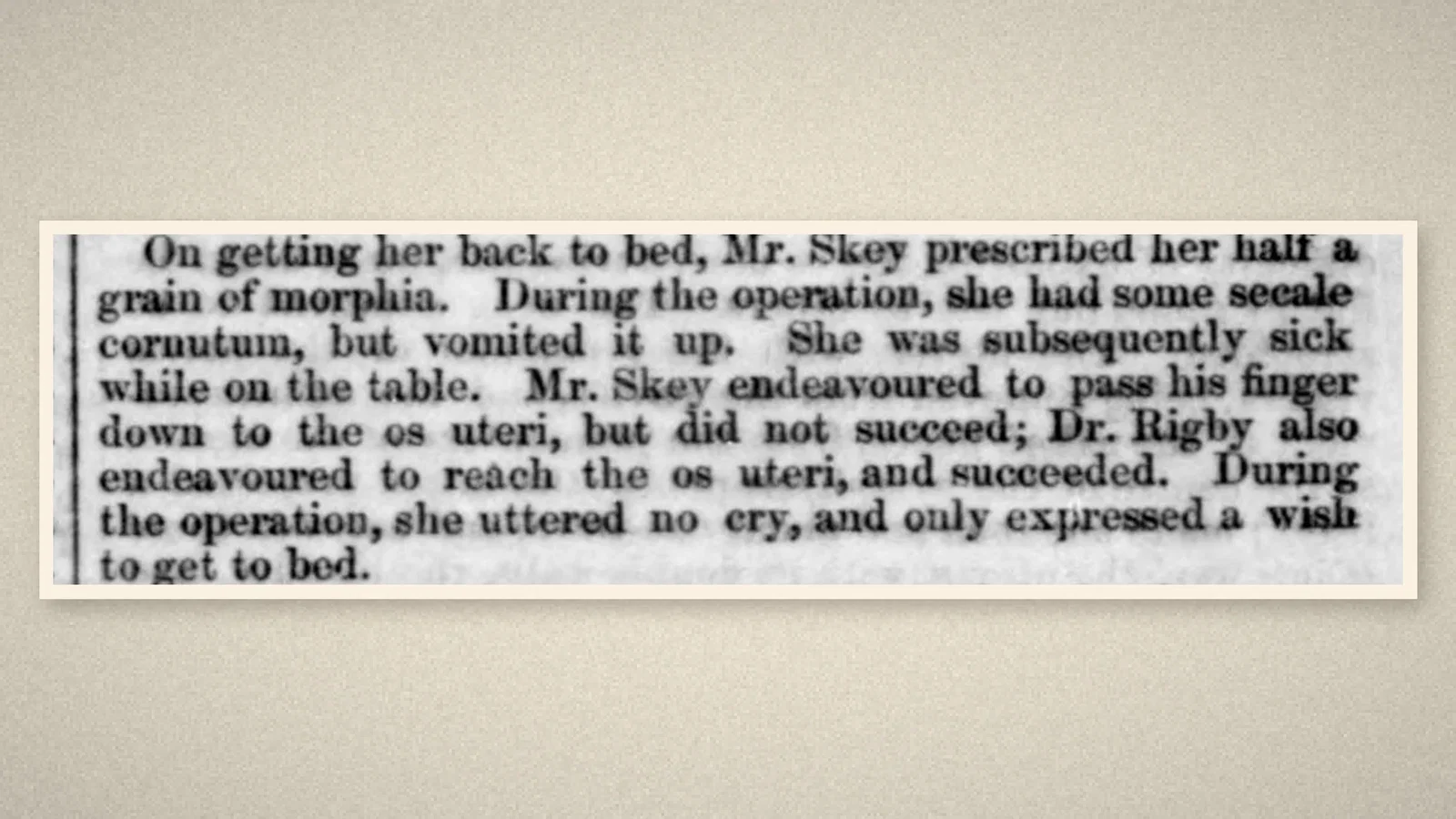
The recovery failed. Half a grain of morphia was given on return to bed and repeated through the day for severe, continuous pain. The next day the pulse rose to 150 and then 160, and the patient died at eight in the evening, thirty-six hours after the operation, in great pain. [1]
The same case, retold
The same volume of The Lancet printed, in translation, a French obstetric report that reviewed early uses of ether in childbirth. Its summary of the London case is very different: Skey operated "after making the woman inhale ether during six minutes"; the operation "lasted six minutes"; "the incision of the skin produced no pain"; and longer ether was avoided "lest it might possibly interfere with the contractions of the uterus". [1] The six minutes may reflect the time to extract the child, not the whole operation, but the summary leaves out both the incomplete effect and the death.
Four years later Charles West, reviewing the dangers of caesarean section, counted serious haemorrhage in four of seven caesarean sections done under anaesthetics, and noted that Skey's patient "was never thoroughly under the influence of the ether". [2]
The anaesthetist
Tracy, who gave the ether, is a recurring figure in the volume. An earlier report describes Tracy giving the vapour with an apparatus of Tracy's own invention for an operation by Skey on a boy's ruptured urethra, and an obstetrician later thanked "Mr. Tracy, of St. Bartholomew's Hospital", who had used the apparatus "in several hundreds of surgical cases". [1] In 1946 Charles Noon wrote to the St Bartholomew's Hospital Journal quoting Tracy's pamphlet on the apparatus, whose preface is dated 25 March 1847: as soon as the news from America arrived, "Mr. Skey requested me to extract some teeth" from patients under ether. Noon names the two men as S. J. Tracy and Frederick Carpenter Skey and concludes that ether was used at the hospital in 1846. [3]
What the record shows
The St Bartholomew's case shows ether arriving in obstetrics through a desperate operation rather than an ordinary labour. The careful hospital report records an incomplete anaesthetic, a long operation, a surviving child and a mother who died. Within weeks a summary abroad had shortened it to six painless minutes. Whether it was the first caesarean section under ether is not something the sources read here establish, and this article does not claim it.
Sources and reading limits
Read: the Lancet hospital report of 6 February 1847 (pp. 139-140); the translated French report and the notices of Tracy in the same volume; the passage on anaesthetics in West's 1851 paper; Noon's 1946 letter.
Not covered: Tracy's pamphlet itself, known only through Noon; any account written by Skey; hospital records; reports in other journals. The report's remarks about the patient's private circumstances are not repeated here.
Two illustrations are crops of the Lancet page; two are drawn from the sources.
- St. Bartholomew's Hospital. The late case of Caesarian operation performed by Mr. Skey. Lancet. 1847;1:139-40. Internet Archive
- West C. Account of a case in which the caesarean section was performed: with remarks on the peculiar sources of danger attendant on the operation. London; 1851. Internet Archive
- Noon C. [Letter on the centenary of anaesthesia at St Bartholomew's]. St Bartholomew's Hospital Journal. 1946;50(8). Internet Archive
Continue exploring
Related reading connects shared questions and contexts; it does not by itself establish historical influence.
- 1847: Fanny Longfellow Gives Birth Under Ether
- 1847: Simpson Separates Labour Pain from Uterine Action
Anesthesia Epochs · The Source Room · About & Editorial Method
Published November 2, 2026. Sources and reading limits are stated above. Illustrations are labelled as original source images or AI-made. Historical accounts are educational; they are not current treatment instructions.