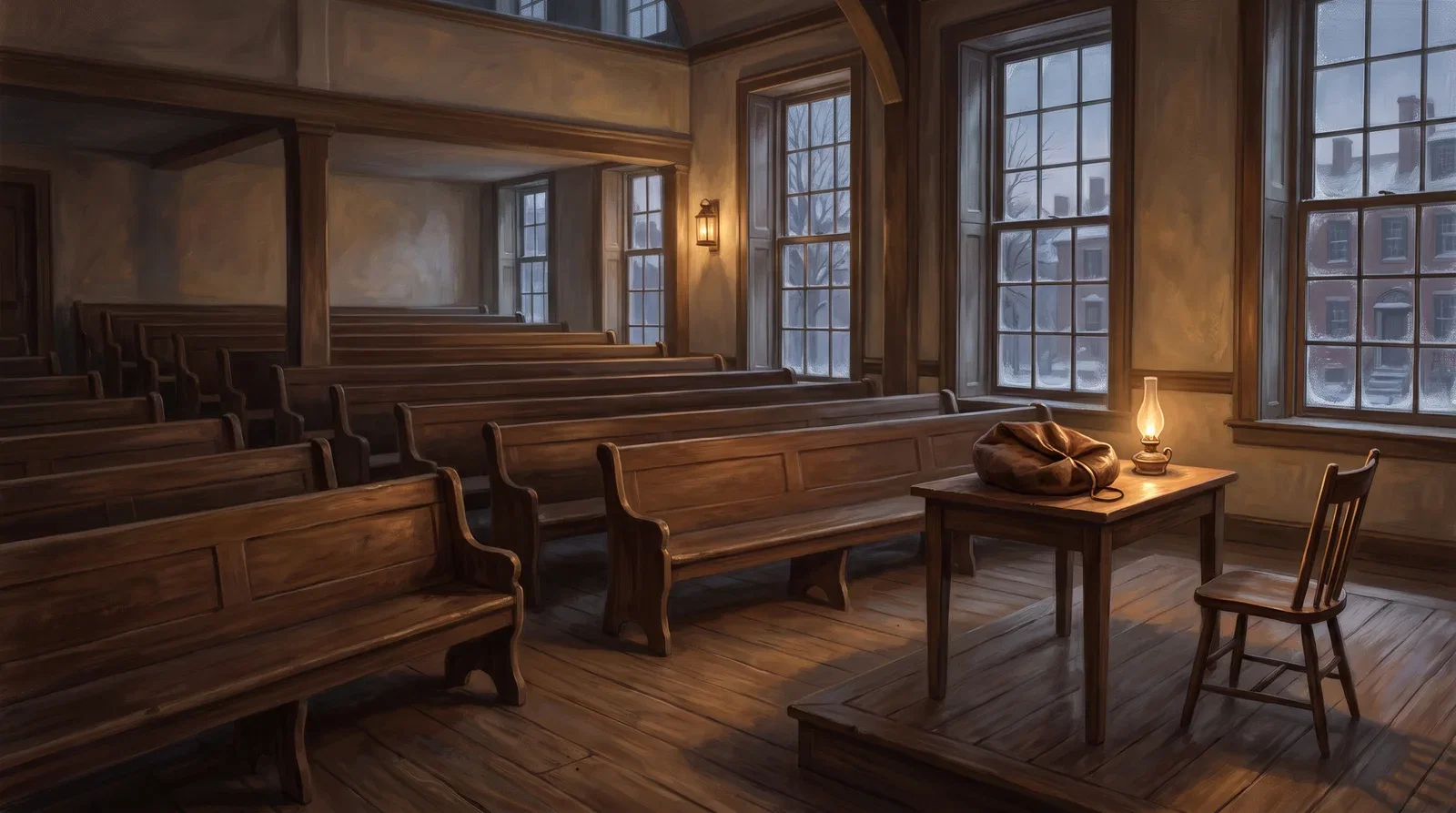
In January 1845 Wells gave nitrous oxide in Boston while a tooth was pulled; the patient reported some pain, and observers called it an imposition.
Reading Library · Anesthesia Epochs · 中文版
Watch the companion film
1845: Wells in Boston · Watch on YouTube
Daniel T. Curtis had seen enough to describe an operation, but not enough to claim knowledge of another person's pain.
In a statement printed in 1847, Curtis recalled accompanying Horace Wells to a hall in Boston's Washington Street. He witnessed the administration of gas and the removal of a tooth. He could not say whether the patient experienced pain. He had seen no manifestation of it, yet some people present considered the demonstration an imposition.[1,p17]
That restraint is a useful place to begin the familiar story of Wells's unsuccessful Boston demonstration. What an observer saw, what a patient was reported to have felt, and what an audience concluded are three different forms of evidence. The surviving accounts do not require us to compress them into one verdict.
Start with the letter, not the legend
Wells described the episode in a letter dated 7 December 1846, identified in a later reprint as published in the Hartford Courant on 9 December. The complete three-page version used here appeared in a professional dental-anesthesia journal in 1960. It preserves a retrospective account, not an 1845 case chart or the original newspaper page.[2,pp12–14]
The account does not say simply that the patient felt nothing. Wells reported some pain, although less than usually accompanied extraction. This is his transmission of the patient's response, not a separately surviving statement in the patient's own hand. There is no numerical pain scale to recover from it.[2,p13]
Wells also explained the disappointing result: the gas bag had been withdrawn too early. An explanation by the person conducting a demonstration is evidence of what he thought had happened. It is not, by itself, a tested account of the mechanism. We cannot supply missing concentrations, timings or measurements and then present the reconstruction as a known technical error.[2,p13]
His 1847 pamphlet likewise acknowledged incomplete success and a report of some pain.[1,p7] These admissions should not disappear when the story is retold sympathetically. They also do not establish the opposite extreme—that nitrous oxide had provided no relief whatsoever. The letter records a qualified experience and an unconvincing public result, not a controlled comparison between the gas and no treatment.
The audience had first been invited to listen
Before the extraction, Wells had tried to introduce an idea to medical practitioners and students. Warren invited him to address his class. A proposed opportunity involving an amputation did not proceed: the letter says the patient declined surgery; the later pamphlet says it was postponed. Neither is a report of an amputation attempted unsuccessfully under nitrous oxide.[1,pp6–7;2,pp12–13]
Two former students, Thomas William Kennedy and P. B. Mignault, signed a statement on 23 March 1847. They recalled moving to an adjoining room after Warren's lecture to hear Wells speak. Wells then invited them to attend an operation in the evening, which they stated they witnessed. Cincinnatus A. Taft's printed statement follows the same distinction.[1,pp15–16]
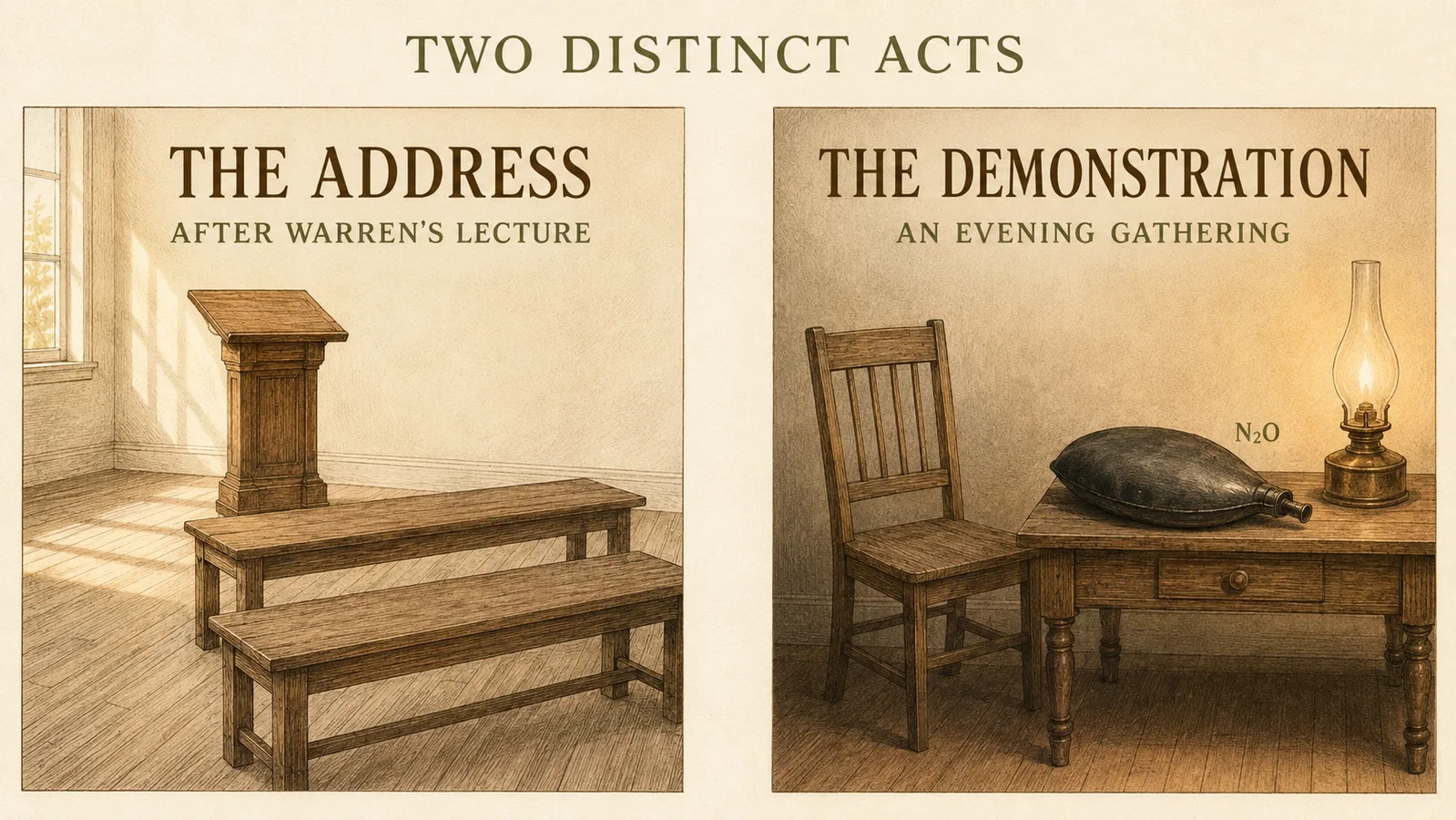
The phrase about an adjoining room belongs to the address. It does not locate the evening extraction. Joining those sentences too neatly produces an architectural detail the witnesses did not provide.
A second shortcut concerns Warren's institutional affiliation. The statements identify him with Massachusetts General Hospital, but that identification is not a venue description. His own certificate on the following page confirms that the named men attended his lectures in 1844–45. It does not certify a painless extraction, or his presence at that extraction.[1,pp15–16]
Signed testimony can answer a precise historical question without answering every question beside it. Attendance, location and clinical effect need separate support.
A city and a month, not a borrowed landmark
This account uses January 1845. Haridas's 2013 historical investigation considered 21 statements and five newspaper notices; these were not 21 eyewitnesses. It did not establish an exact day or hall. Late January remains a reconstruction, and Washington Street depends on Curtis's recollection. The available evidence does not securely place the extraction in MGH's surgical amphitheater, now known as the Ether Dome. That is a limit on identification, not proof that the location was impossible.[1,p17;3,proofpp2,5–9]
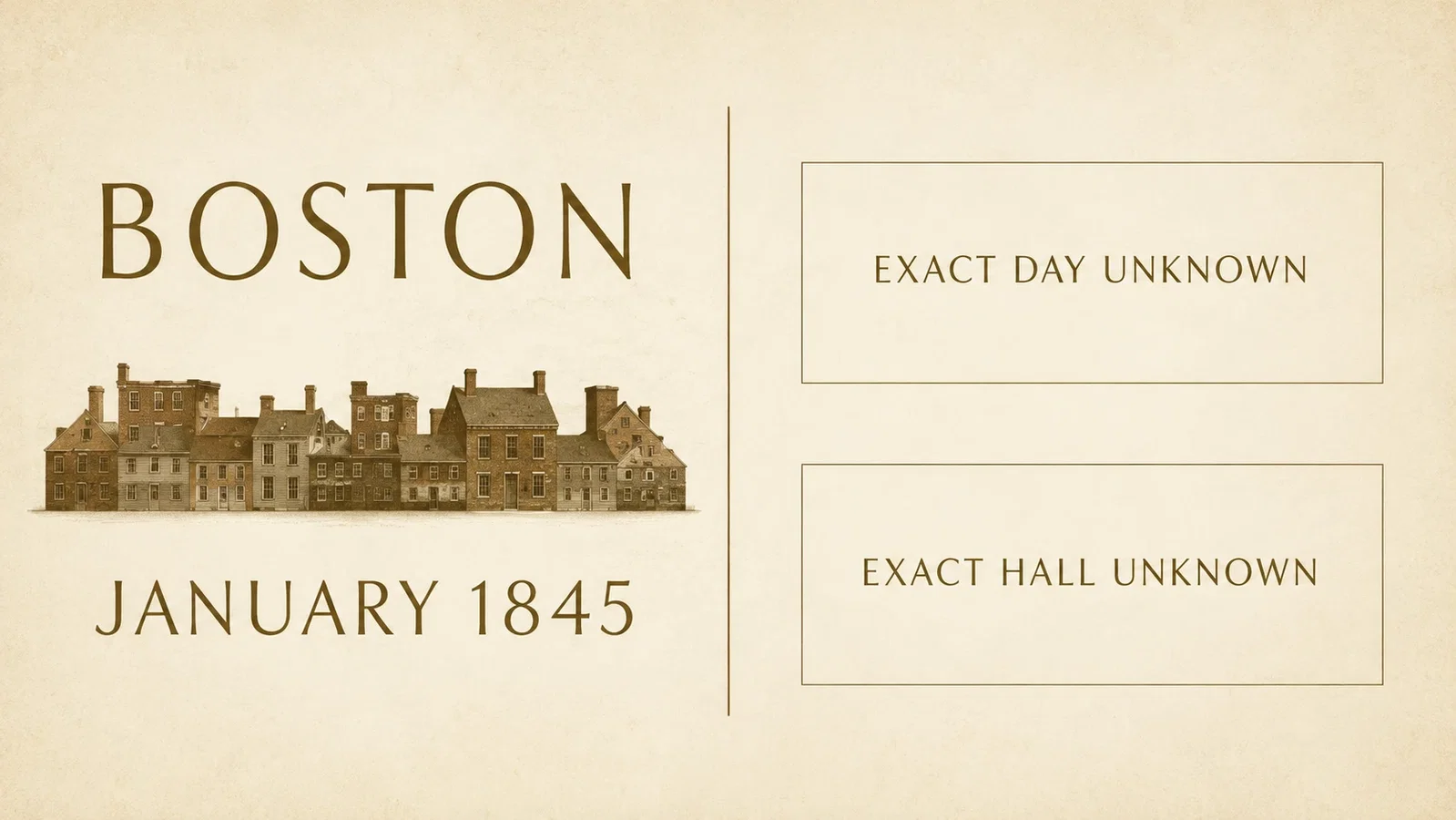
The earlier documents are not internally tidy: several 1847 accounts place the visit in 1844. Those discrepancies remain visible rather than being silently corrected to the later reconstruction.[1,pp6,15–17;3,proofpp5–9] We do not need a fully furnished, precisely dated room to understand the evidentiary problem. More confident scenery would make the picture easier to recognize, not necessarily more accurate.
Three questions on the same page
Return to Curtis. His statement distinguishes seeing no manifestation of pain from knowing whether pain occurred. It also distinguishes his own limited conclusion from the reactions of other people in the room.[1,p17]
Place that alongside Wells's letter and the differences become useful. Curtis reports his observation and its limit. Wells transmits a qualified pain report. Several observers, in Wells's account, dismiss the event. None of these sentences is a substitute for the others.[1,p17;2,pp13–14]
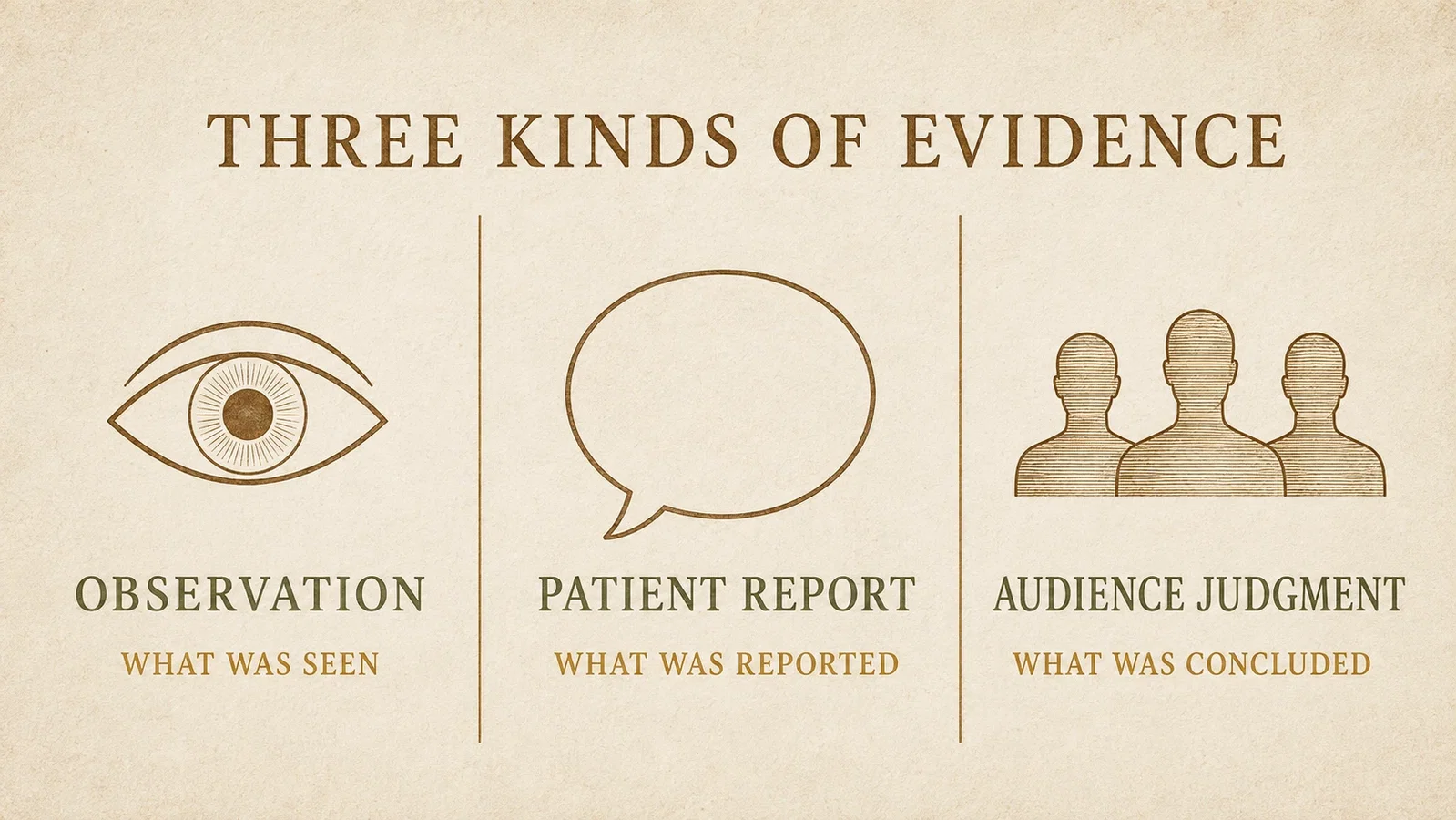
We should neither average the accounts into an invented pain score nor select whichever line gives the most satisfying dramatic ending. An observer's confidence, a patient's reported experience and an audience's trust can diverge. Preserving that divergence is more informative than writing a single seamless script.
The timing of the documents matters as well. The letter was written in 1846; the printed sworn statements followed in 1847. They look back on an earlier event, in material concerned with Wells's contribution and claim to recognition. Oaths identify a form of testimony. They do not transform recollection into prospective clinical data.[1,pp15–17;2,pp12–14]
What ended that evening
Wells wrote that there was no second patient available for another attempt. Several spectators called the affair a deception, and he went home the next morning.[2,p14] These details describe the end of his opportunity to demonstrate the method on that occasion. They do not describe a unanimous verdict by medicine as a whole.
This is where the word “failure” needs an object. The tooth was removed. The patient was reported to have felt some pain. A number of observers were not persuaded. The demonstration did not establish a dependable, universally painless method; it also did not prove that the agent could never relieve pain.
The significance of Boston lies partly in the difficulty of making one person's experience intelligible to other people. A new proposal needed more than an operation to be completed: its results had to survive questions about what happened and how anyone knew. This episode supplied disagreement rather than a settled answer.
Wells's Hartford experience need not be erased by Boston, and Boston need not be rewritten as a hidden perfect success to preserve his contribution. The unresolved details belong in the story. So does the difference between what a patient may have experienced and what a room of observers was prepared to believe.
Sources and reading limits
- Wells H. A History of the Discovery of the Application of Nitrous Oxide Gas, Ether, and Other Vapors, to Surgical Operations. Hartford: J. Gaylord Wells; 1847. Read: pp. 6–7 and 15–17; citations use printed pages. The handwritten affidavits behind the printed text are not covered.
- Archer WH, Wells H. The History of General Anesthesia (Part I): Published in the Hartford (Conn.) Courant, Dec. 9, 1846. J Am Dent Soc Anesthesiol. 1960;7(2):12–14. PMID 19598843; PMC2067500. Read in full; a 1960 reprint of the 1846 letter, not a facsimile of the original newspaper.
- Haridas RP. Horace Wells' Demonstration of Nitrous Oxide in Boston. Anesthesiology. 2013;119(5):1014–1022. DOI 10.1097/ALN.0b013e3182a771ea; PMID 23962967. Read in full (author proof; citations use proof pages). Its figures and underlying originals are not covered.
Sources and reading limits are stated above. Illustrations are labelled as original source images or AI-made. Historical accounts are educational; they are not current treatment instructions.
Continue exploring
Related reading connects shared questions and contexts; it does not by itself establish historical influence.
- 1800: Davy's Nitrous Oxide and Surgery in the Conditional
- 1844: Horace Wells, the Dentist Who Became the Patient
- 1846: Holmes Gives an Old Word a New Task
- 1846: The Ether Dome, a Breakthrough Without a Perfect Moment
Anesthesia Epochs · The Source Room · About & Editorial Method
Continue this reading route
Stop 3 of 4 · Back to route · Before the demonstration
Previous · 1842: Crawford Long Operates Before Publishing
Next · 1846: The Ether Dome, a Breakthrough Without a Perfect Moment
Compare the divided accounts of Wells’s demonstration with the records of Abbott’s operation and the cases that followed.