
Crawford Long removed two small tumours from James Venable under ether in 1842, the second not quite painlessly, but published the cases only in December 1849.
Reading Library · Anesthesia Epochs · 中文版
Watch the companion film
1842: Crawford Long and Ether · Watch on YouTube
The paper did not begin with a triumphant operation. It began with something its author had read.
Crawford Williamson Long recalled encountering a notice about Morton's “letheon” in the December 1846 Medical Examiner. He believed he had something important to add: ether itself could prevent surgical pain, and he had already used it for that purpose several years earlier. He said he began writing, was interrupted by his country practice, then waited while other claims emerged.[1, pp.309–310]
By the time his account appeared in the Southern Medical and Surgical Journal, it was December 1849. The operation at its center was dated 30 March 1842.[1, pp.309,312]
That interval shapes the evidence. We encounter the earlier event through a later argument, supported by patients' and witnesses' recollections and accompanied by an editor's decisions about what to print. Recognizing this does not make the operation disappear. It helps distinguish what happened in a practice from what subsequently entered the public record.
A discovery claim is also a case history
Long practiced in Jefferson, Georgia. His patient, James M. Venable, had consulted him repeatedly about two small tumors near the back of his neck. He kept postponing their removal because he feared the pain. Long's account makes that hesitation part of the clinical problem, not an incidental detail about a timid patient.[1, pp.311–313]
The proposed way around it came from a quite different setting. Long placed an evening gathering in December 1841 or January 1842. Friends wanted nitrous oxide, but he lacked the apparatus to prepare or preserve it. He offered ether instead. Later, he recalled discovering bruises without remembering when he had received them, and asking companions about falls or blows sustained while under its influence. They reported that the incidents had not hurt at the time.[1, pp.310–311]
This was ether, not an interchangeable version of laughing gas. Nor were these gatherings controlled investigations of safety. Long's belief that the substance was safe belongs to his historical explanation; it is not advice to recreate the experience.
Venable was already familiar with recreational ether use. Long proposed that one tumor might be removed without pain while he was under its influence. According to the report, Venable agreed, and the operation took place that evening. The lesion was encysted and about half an inch across. The description does not establish malignant disease or justify retelling the procedure as major cancer surgery.[1, pp.311–313]
Long reported no evidence of suffering during the removal. Venable afterward said that he had felt no pain and initially doubted that the operation was finished until the removed tumor was shown to him. Observation and patient report support different parts of that account. Neither should be silently converted into a modern pain score, a measured depth of anesthesia or a success rate across patients.[1, pp.311–314]
The second operation belongs in the story
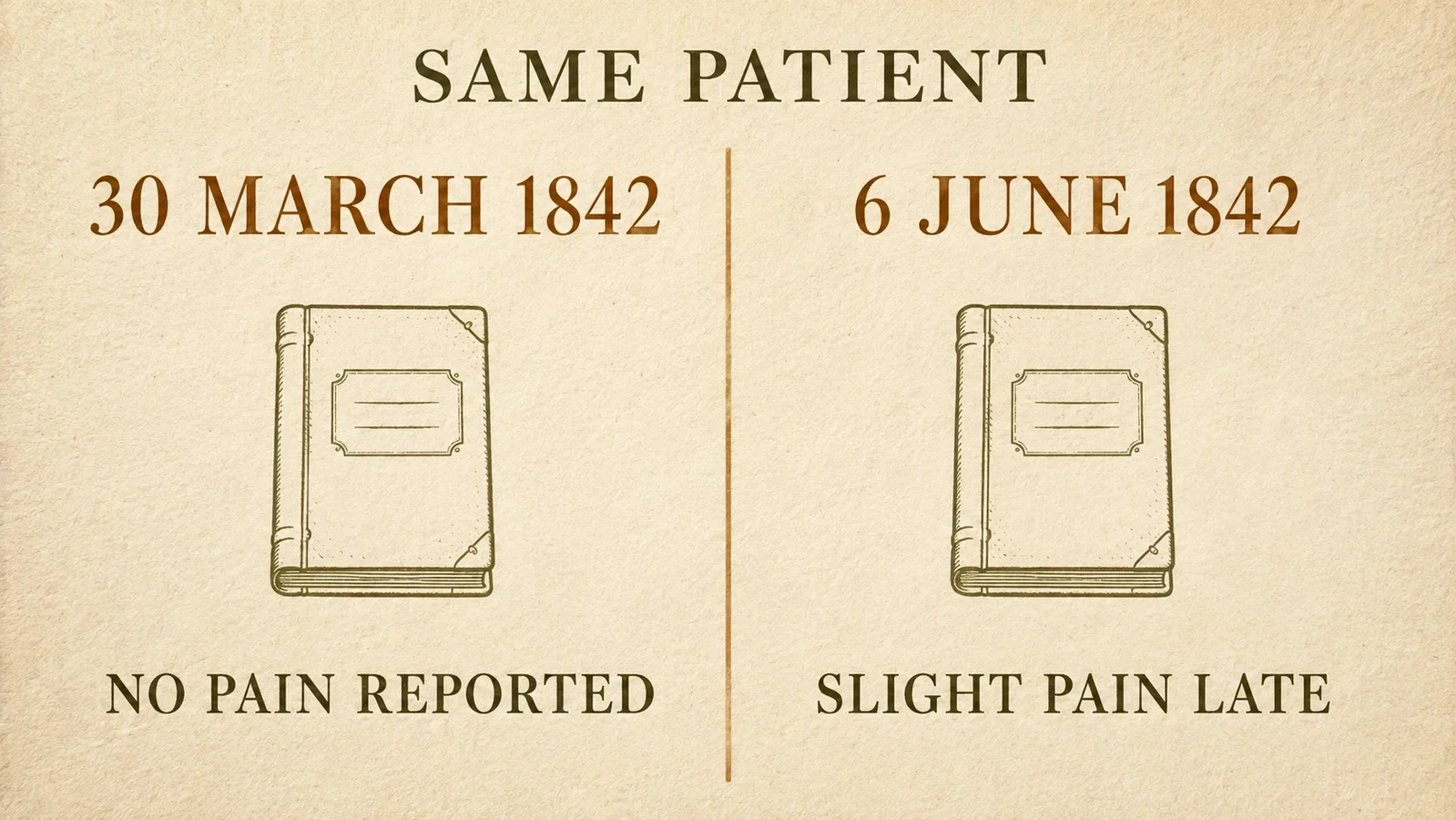
On 6 June 1842, Long removed Venable's other tumor. This took longer because its cyst had adhesions to surrounding tissue. Near the end, when the last attachment was separated, the patient showed slight suffering and subsequently acknowledged a little pain.[1, p.312]
The two accounts describe the interruption of ether exposure with different precision. Long wrote that inhalation had stopped before the first incision. Venable said that he stopped before the operation was finished. A careful narrative can preserve both statements without pretending that their timing is identical. They agree on the feature most relevant here: the second procedure was not entirely painless.[1, pp.312–313]
That qualification matters. Long connected this experience with concerns about how long the effect lasted. In his closing discussion he explained that, before January 1847, he had used ether in only one dental extraction, partly because he believed its usefulness depended on sustaining its effects.[1, p.317]
This is evidence of a practitioner working through the limits of an observation, not a ready-made set of modern instructions. The first operation could be important without establishing that ether had already become a dependable solution for every procedure. Including the second prevents a memorable success from swallowing the rest of the record.
What the witnesses actually dated
The report contains two printed certificates. Venable's was sworn on 23 July 1849. Andrew J. Thurmond's statement was dated 21 August of the same year. Neither is a document signed on the day of the first operation.[1, pp.313–314]
Venable remembered the first removal as occurring in the early spring of 1842, after school had finished for the day. He placed the second a month or two later. The exact date of 30 March comes from Long's narrative; the patient's certificate corroborates a broader period and the experience itself. Giving both statements the same day-level precision would make the evidence look more uniform than it is.[1, pp.312–314]
Thurmond described witnessing the first operation, recognizing the smell of ether, observing no sign of suffering and hearing Venable say that the removal had not hurt. He anchored the year in his attendance at the academy and his brother's tenure there. For the second procedure, however, he reported what Venable subsequently told him. He was not claiming to have watched both.[1, p.314]
The original editorial note says that Long supplied additional certificates, most of which were omitted. It also appeals to his professional standing and character. That combination reveals something about the journal's evidentiary conventions: documentary support mattered, but so did an editor's assurance that the author was trustworthy. An assurance of character is not the same thing as an independent clinical investigation.[1, pp.312–316]
Retrospective testimony can be informative without becoming contemporaneous documentation. Likewise, two accounts may corroborate each other without every sentence in them having the same source, timing or degree of firsthand knowledge.
Patients did not enter this archive on equal terms
The article continues beyond Venable. Long described a third experiment on 3 July 1842, amputating a diseased toe from an enslaved boy. He identified the boy through the woman who enslaved him and referred to her account of what he said on returning home. The publication does not provide the boy's own signed statement.[1, pp.314–315]
Two later cases supplied comparisons within individuals. In one, Long removed three tumors but used ether for only the second removal. In another, he amputated two fingers from an enslaved boy, using ether for one procedure and not the other. He described contrasting experiences of pain.[1, pp.315–316]
These comparisons show his attempt to separate a drug effect from imagination or unusual tolerance. They were not randomized trials. The enslaved patients must not be rewritten as freely recruited volunteers, and the record does not establish that they had an autonomous opportunity to refuse. Accounts passing through an enslaver cannot simply stand in for an unrestricted patient's voice.
An account of anesthesia's benefits can acknowledge this unequal setting. It need not conceal it to preserve the importance of relieving pain. The historical record asks us to consider not only what an intervention appeared to do, but whose experience could be spoken, signed, selected and published.
Publication was a separate event
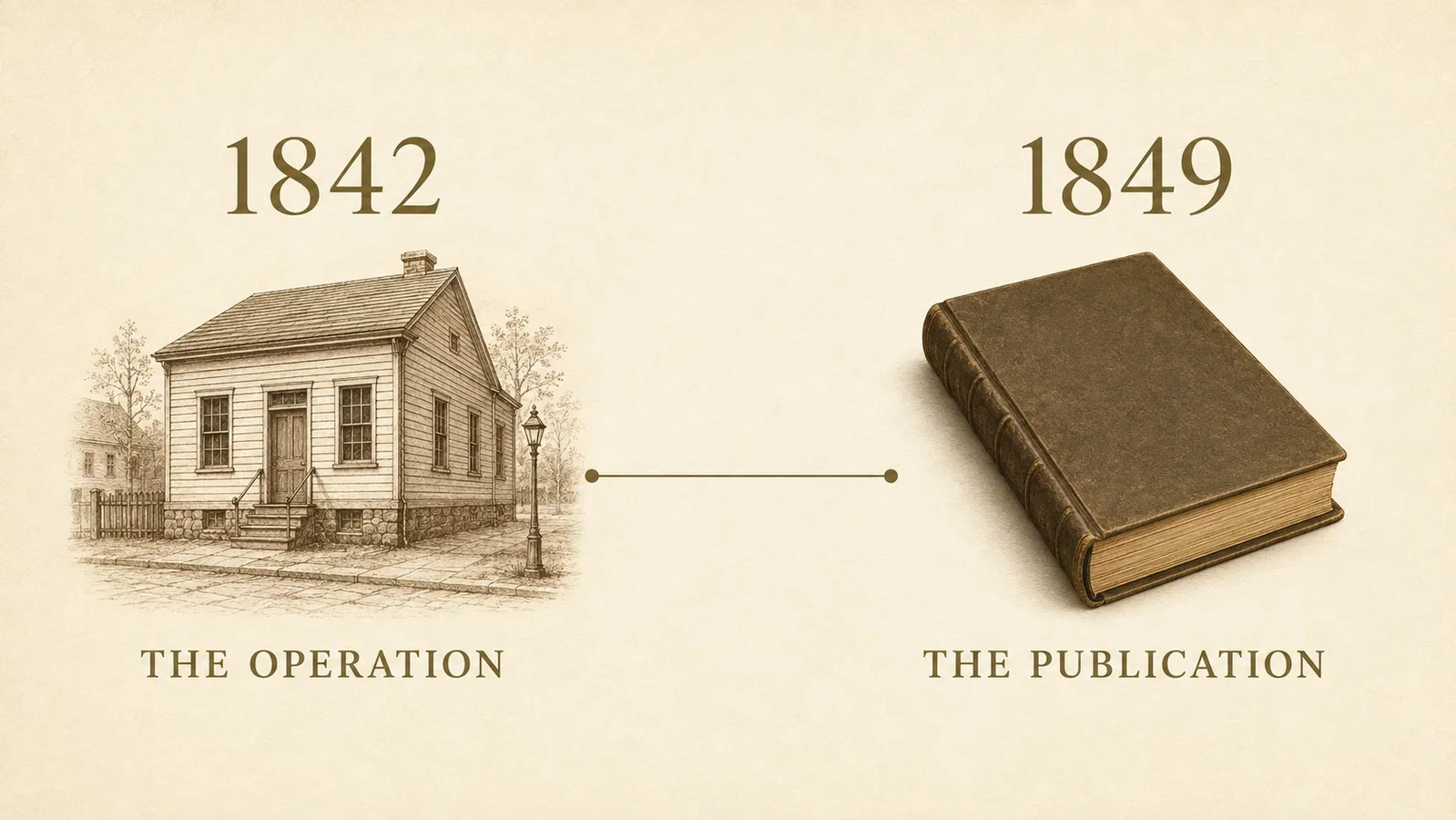
Long offered several reasons for the delay. He wanted enough experience to persuade himself that ether, rather than imagination or an unusual insensitivity to pain, accounted for the results. A young country practitioner saw relatively few surgical cases. He also described interrupted writing, waiting to learn the dates attached to competing claims, and postponement that he himself characterized as negligence.[1, pp.309–310,315–317]
These explanations should remain attributed. They do not prove a single tidy personality story about perfect modesty, fear of competition or indifference to recognition. His account is more complicated: cautious inquiry and admitted delay sit beside an explicit claim to priority.
He also acknowledged that his experience was largely with small tumors and amputations of fingers or toes, rather than the major operation he had hoped to observe. The cases did not establish universal safety or effectiveness in severe surgery. At the end, he left the profession to decide whether delayed presentation forfeited his claim.[1, pp.316–317]
Later commentators separated these questions in different ways. The 1942 dental-journal editorial accompanying the reprint accepted Long's early use but judged his contribution to wider dissemination harshly. That was a later historical argument, not an eyewitness report, not Long speaking about himself and not a verdict that must be inherited uncritically.[2, pp.329–331]
Even the reprints have histories

There is a practical reason to say which version has been read. Boland's later biography reproduces the account with additional certificates, including statements dated 1853 and 1854. It places the original editorial notes afterward and omits a closing paragraph present in the 1942 reprint. Useful historical compilation is not necessarily an unchanged copy of the 1849 publication.[3, pp.35–49; 1, pp.312–317]
An archive's catalog is another layer. The Smithsonian guide identifies photographic copies and negatives of letters, while noting that the locations of original letters were unknown. Reading the guide does not amount to inspecting or authenticating every underlying letter.[4, pp.1,4–5]
The account presented here therefore does not award an unrestricted title of first inventor of all anesthesia. It retains a narrower, substantial contribution: Long reported using ether to change what an operation felt like for a patient who feared it, recorded a less complete result in a second procedure, and eventually placed the experiences and supporting testimony before readers.
An operation can precede its publication. A claim to early use can differ from a contribution to widespread adoption. Keeping those distinctions visible gives Long's story more substance than either a victory inscription or a dismissal.
Sources and reading limits
- Long CW. An Account of the First Use of Sulphuric Ether by Inhalation as an Anaesthetic in Surgical Operations. Southern Medical and Surgical Journal. 1849;new series 5(12):705–713. Read: the complete 1942 reprint, J Am Coll Dent. 1942;9(3):309–317; citations use the reprint’s page numbers. The 1849 original issue is not covered.
- W.J.G. Anesthesia Centenary. J Am Coll Dent. 1942;9(3):329–331. Read in full. A later opinion, not another primary witness.
- Boland FK. The First Anesthetic: The Story of Crawford Long. University of Georgia Press; 1950, 2009 paperback. Read: the front matter and pp. 31–49.
- Harding RS, Angle G. Guide to the Crawford W. Long Collection, NMAH.AC.0120. Smithsonian National Museum of American History; 1984 processing attribution. Read in full. A finding aid, not the original letters themselves.
Sources and reading limits are stated above. Illustrations are labelled as original source images or AI-made. Historical accounts are educational; they are not current treatment instructions.
Continue exploring
Related reading connects shared questions and contexts; it does not by itself establish historical influence.
- 1804: Hanaoka Removes a Breast Tumor Under Oral Anesthesia
- 1824: Hickman's Animal Experiments Toward Painless Surgery
- 1844: Horace Wells, the Dentist Who Became the Patient
- 1846: The Ether Dome, a Breakthrough Without a Perfect Moment
- 1842: Clarke's Painless Tooth Extraction Under Ether, as Told in 1881
Anesthesia Epochs · The Source Room · About & Editorial Method
Continue this reading route
Stop 2 of 4 · Back to route · Before the demonstration
Previous · 1804: Hanaoka Removes a Breast Tumor Under Oral Anesthesia
Next · 1845: Wells in Boston, One Demonstration and Three Kinds of Evidence
Long’s delayed publication leads to a different kind of evidence in Boston: what witnesses reported seeing and what the patient later said.