In 1804 Hanaoka Seishu gave a woman named Kan the oral preparation Mafutsusan and removed a mass from her left breast; his case record also follows her decision beforehand and the weeks of care until she went home.
Reading Library · Anesthesia Epochs · 中文版
Watch the companion film
1804: Hanaoka’s Oral Anesthesia · Watch on YouTube
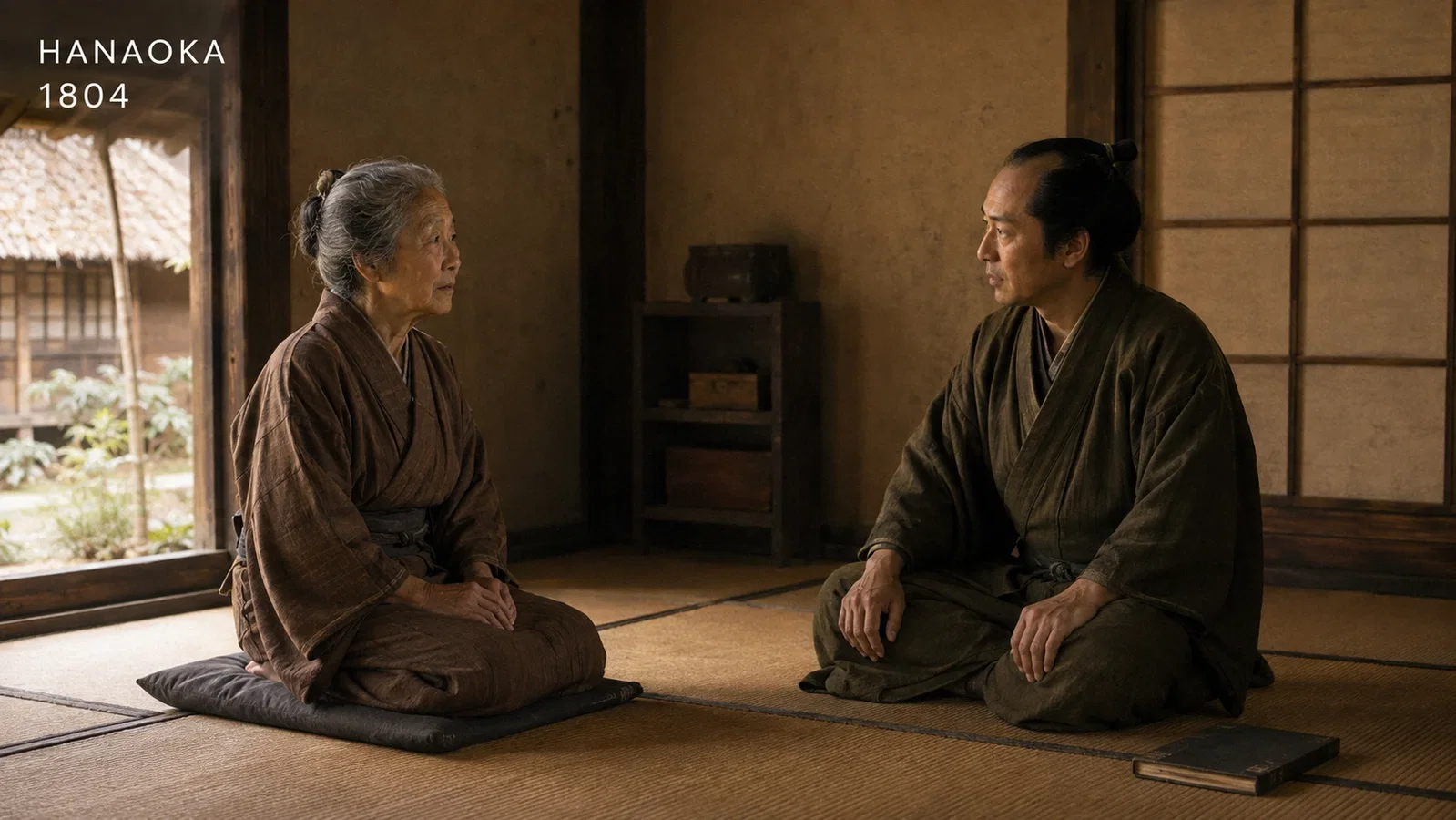
What does it mean to say that an operation succeeded?
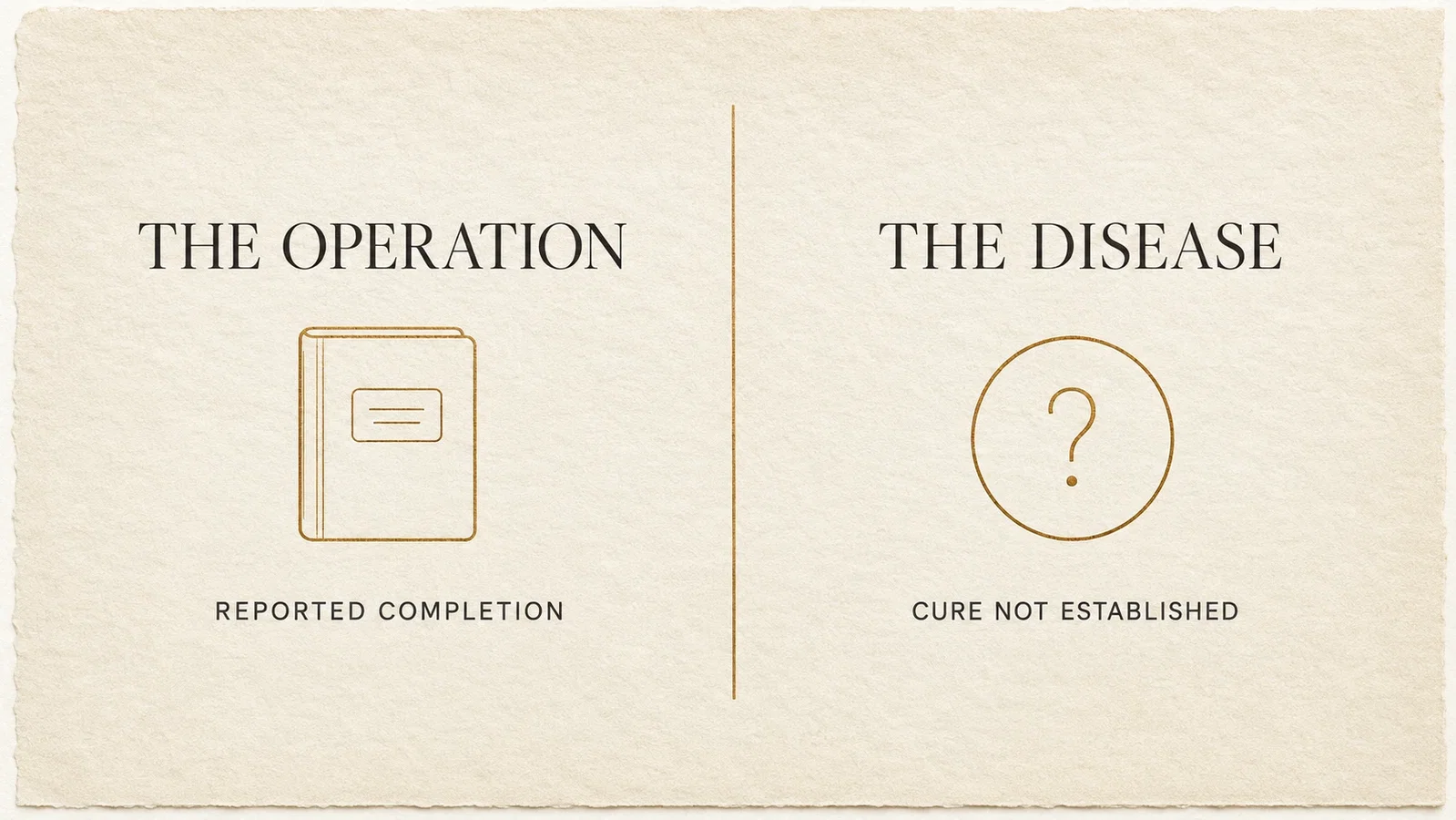
For Hanaoka Seishu's breast operation in 1804, there are several possible answers. A mass was removed. The patient regained awareness. Her wound was reported to heal, and she returned home. None of those statements, separately or together, establishes that her cancer was cured.[1,copy pp.7–8]
That distinction does not diminish the place of the operation in anesthesia history. The Japanese Society of Anesthesiologists recognizes it as the first known successful case of general anesthesia. But the surviving account offers more than a priority claim. It follows a patient before the intervention and stays with her after the most dramatic moment has passed.[4]
The woman was called Kan, identified in the record as the mother of Aiya Rihei. Rather than treating her simply as the recipient of a famous drug, it is worth asking what the report says about the course of her care.[1,copy pp.1–8]
A date recovered, not every uncertainty removed
The year itself required historical investigation. Older accounts placed the operation in 1805. In a 1973 paper, Akitomo Matsuki reported information from a temple death register showing that Kan had already died before that supposed operation date. Read alongside the case and patient register, it supported 1804 instead.[2,pp.193–195]
The smaller discrepancy remained: the case gives the thirteenth day of the tenth month, while the register gives a term interpreted as the sixteenth. Matsuki offered an explanation involving a later entry after intensive care, but explicitly called for further evidence. It is not a documented three-day nursing scene.[2,p.195]
This article therefore anchors the event to 1804 and identifies the case's Bunka 1 tenth-month thirteenth day as an old-calendar date. The English abstract's October 13 is not accompanied by a demonstrated calendar conversion. The temple register is known here only through the paper's transcription.[2,pp.194–197;8]
The decision took time
The case describes a woman with a left-breast mass and records her age as sixty, without giving us grounds to manufacture an exact modern age from historical counting. She came from Gojo, seeking treatment from Hanaoka.[1,copy pp.1–2;5]
Her determination matters in the account. The physician discusses the difficulty of the disease and earlier medical writers' unfavorable assessments. Kan presses him to attempt treatment, having seen a female sibling suffer from the condition. At the end, the writer contrasts her persistence with the fear of other people who had heard about an aggressive intervention and left.[1,copy pp.3–5,8]
These are not words recovered from an independent patient interview. They reach us through a physician's case narrative, carried in a later copy. Still, the report gives the patient an active part in the decision. She is not merely an unnamed body around which an inventor's story unfolds. Recognizing that role does not turn the conversation into documentation of today's informed-consent standards.[1,copy pp.5,8]
Nor does the narrative move immediately from her request to surgery. It describes treatment for leg symptoms, twenty days at home before her return, and further respiratory symptoms followed by more than twenty days in lodging. Preparation occupies time and attention before the account reaches administration of the anesthetic.[1,copy p.6]
A swallowed preparation and a changed operation
The case names the preparation Mafutsusan, written 麻沸散. Tsusensan is another familiar name. The actual case page and the professional society's history support using Mafutsusan here; a similar name is not evidence that Hanaoka recovered Hua Tuo's lost formula.[1,copy p.6;3,pp.355–356;4]
After the patient took the preparation, the account describes altered awareness, insensibility to pain and the operation that followed. The mass was separated and removed. Bleeding and attempts to control it remain in the description, as do closure and care of the wound.[1,copy pp.6–7]
This is evidence of an operation described under anesthesia, not a modern anesthetic chart. Historical language cannot supply continuous oxygenation or blood-pressure measurements absent from this case, nor does it establish a precisely measured depth of anesthesia. The case's old treatments are not translated here into instructions for present-day practice.[1,copy pp.6–8]
The oral route also had practical limits. The Japanese Society of Anesthesiologists notes slow induction and difficulty controlling anesthetic depth. The importance of an early operative achievement should not be confused with proof of a predictable, readily adjustable or risk-free technique.[4]
The patient was still there when the breakthrough was over
Awareness gradually returned after the operation. In the case writer's rendering, Kan was surprised by the missing mass and did not know how the treatment had been carried out. The report then makes a quieter distinction: removing the mass had not finished the patient's recovery.[1,copy pp.7–8]
Her wound still needed to heal, and her strength had not returned. Hanaoka describes continuing daily review. More than twenty days later, the narrative reports healing and a return to her hometown.[1,copy p.8]
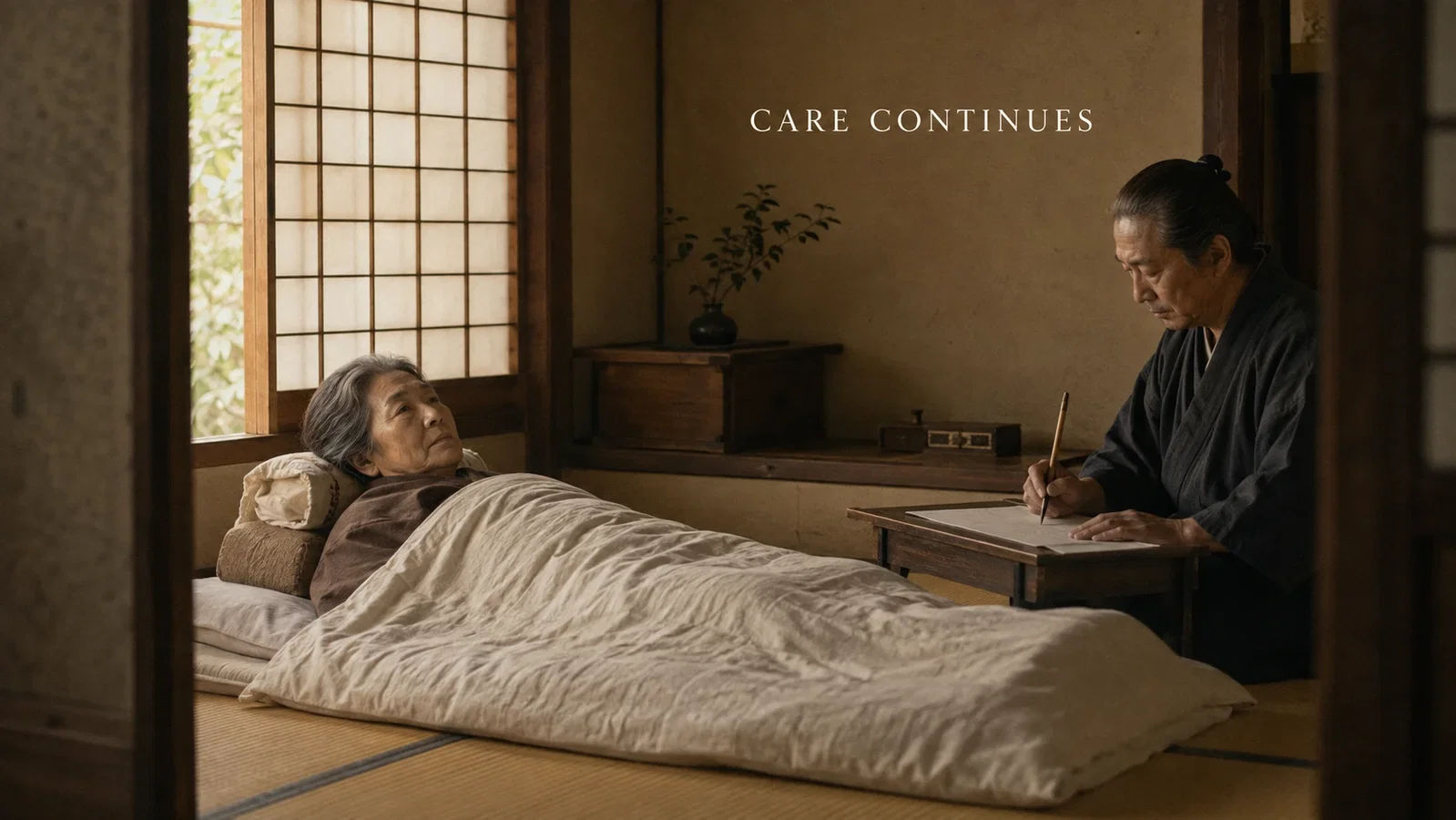
We cannot reconstruct the effectiveness of every treatment from this description. We can, however, notice what the narrative includes. The patient remains someone to be watched and cared for after the mass has been removed and consciousness has returned. The report has a period of convalescence, not merely a moment of technical triumph.
Longer-term conclusions require a different kind of evidence. Matsuki's date paper reports Kan's death in the following year. That information neither establishes her cause of death nor turns the case into a measure of cancer-treatment efficacy.[2,pp.194–195]
Likewise, a historical account of a breast mass does not supply modern histology, stage or a standardized breast-conserving procedure. We can describe what was reportedly removed without assigning the operation all the specifications of a present-day surgical label.[1,copy pp.2,7–8]
The record also has a history
There is another reason to read precisely. The case text used here is a family-held later handwritten copy presented by the Hanaoka Seishu Literature Preservation Society, on Wakayama Medical Society manuscript paper. It is not an authenticated 1804 autograph, and modern explanatory notes are not part of the original clinical narrative.[1]
The status of a separate Tenri manuscript has itself been debated. Matsuki's 2005 historical review questions its autograph status; a preservation-society essay discusses the possibility of an autograph draft. Those interpretations should remain attributed, not become an authentication verdict issued by this site.[3,p.375;6]
Modern preservation adds another layer. The Shunrinken historical-site area is now in Kinokawa, where municipal interpretation identifies Hanaoka's residence, practice and teaching setting while distinguishing preserved and reconstructed structures. A modern display can help visitors imagine a past setting without becoming original evidence for everything shown there.[7]
None of this requires replacing the operation with a story about disputed manuscripts. It requires keeping the kinds of evidence separate. The transmitted case supports a clinical sequence; later research helps examine its dating and transmission; institutional histories explain its commemorated place. They do not all answer the same question.
Hanaoka's achievement remains substantial without an unverified family-sacrifice story or a promise of cancer cure. An oral preparation changed what could happen during an operation. The case also preserved something less easily captured in a first-in-the-world caption: a patient's request beforehand, and the continuing work of care after she woke.
Sources and reading limits
- Hanaoka Seishu Literature Preservation Society. Installment 8: the Nyugan Chikenroku. Read: the main text, the eight later-copy pages, the eight parallel reading pages and the modern notes. Not an authenticated autograph; the surgical diagrams mentioned on the page were not seen. Copy-page references above refer to the eight-page copy.
- Matsuki A. The Correct Date of the First General Anesthesia by S. Hanaoka. Nihon Ishigaku Zasshi.1973;19(2):193–197. Read in full.
- Matsuki A. A Brief History of the Biographical Study of Seishu Hanaoka. Nihon Ishigaku Zasshi.2005;51(3):355–384. PMID 16450478. Read in full.
- Japanese Society of Anesthesiologists. History of anesthesia in Japan. Read: the opening paragraphs on Hanaoka.
- Wakayama Medical University. Hanaoka's breast-cancer surgery. An institutional retrospective, not an efficacy study.
- Takashima H, Hanaoka Seishu Literature Preservation Society. Installment 9: manuscript transmission. Read: the essay and footnotes.
- Kinokawa City. Seishu no Sato and Shunrinken. Describes the modern historical-site area, not an authenticated operating room.
- Takashima H, Hanaoka Seishu Literature Preservation Society. Installment 14: the case and its dating. Read: the essay and footnotes.
Medical history, not instructions for preparing an anesthetic, administering anesthesia or treating cancer.
Continue exploring
Related reading connects shared questions and contexts; it does not by itself establish historical influence.
- c. 200: Hua Tuo's Mafeisan, a Recipe That Cannot Be Recovered
- 1842: Crawford Long Operates Before Publishing
- 1846: The Ether Dome, a Breakthrough Without a Perfect Moment
- 1954: Japan's Anesthesia Society Is Founded and Holds Its Opening Meeting
Anesthesia Epochs · The Source Room · About & Editorial Method
Sources and reading limits are stated above. Illustrations are labelled as original source images or AI-made. Historical accounts are educational; they are not current treatment instructions.
Continue this reading route
Stop 1 of 4 · Back to route · Before the demonstration
Next · 1842: Crawford Long Operates Before Publishing
Compare the date of Hanaoka’s operation with the date on the surviving account. Long’s case raises a related question about the years between operating and publishing.