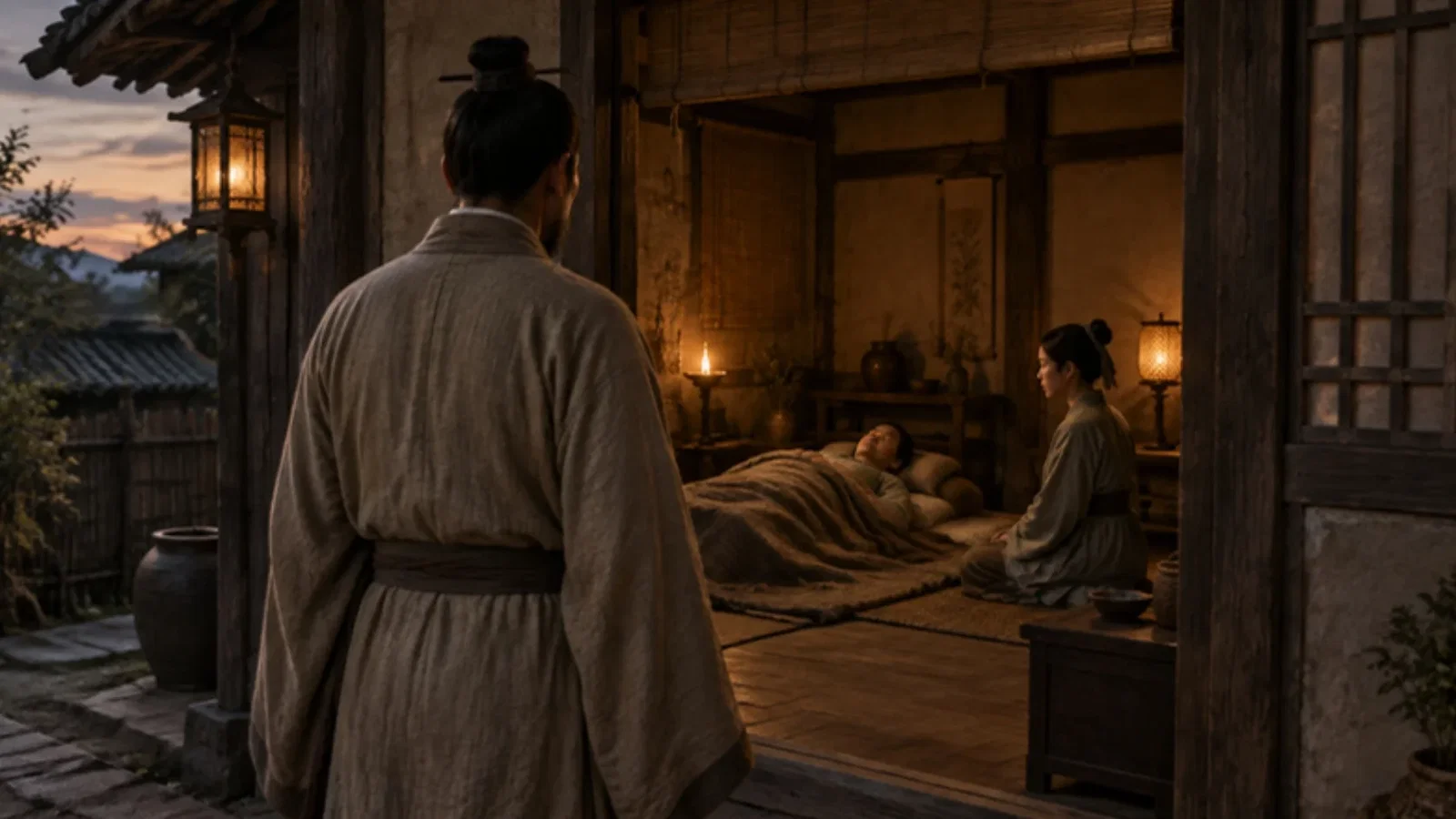
Two histories, the Records of the Three Kingdoms and the History of the Later Han, say that Hua Tuo's patients drank mafeisan and lost awareness before surgery, but neither records its ingredients, a dated operation or a checkable outcome.
Reading Library · Anesthesia Epochs · 中文版
Watch the companion film
c. 200: Mafeisan · Watch on YouTube
Historical anchor: 200. Approximate placement; see the essay for the date range and evidence.
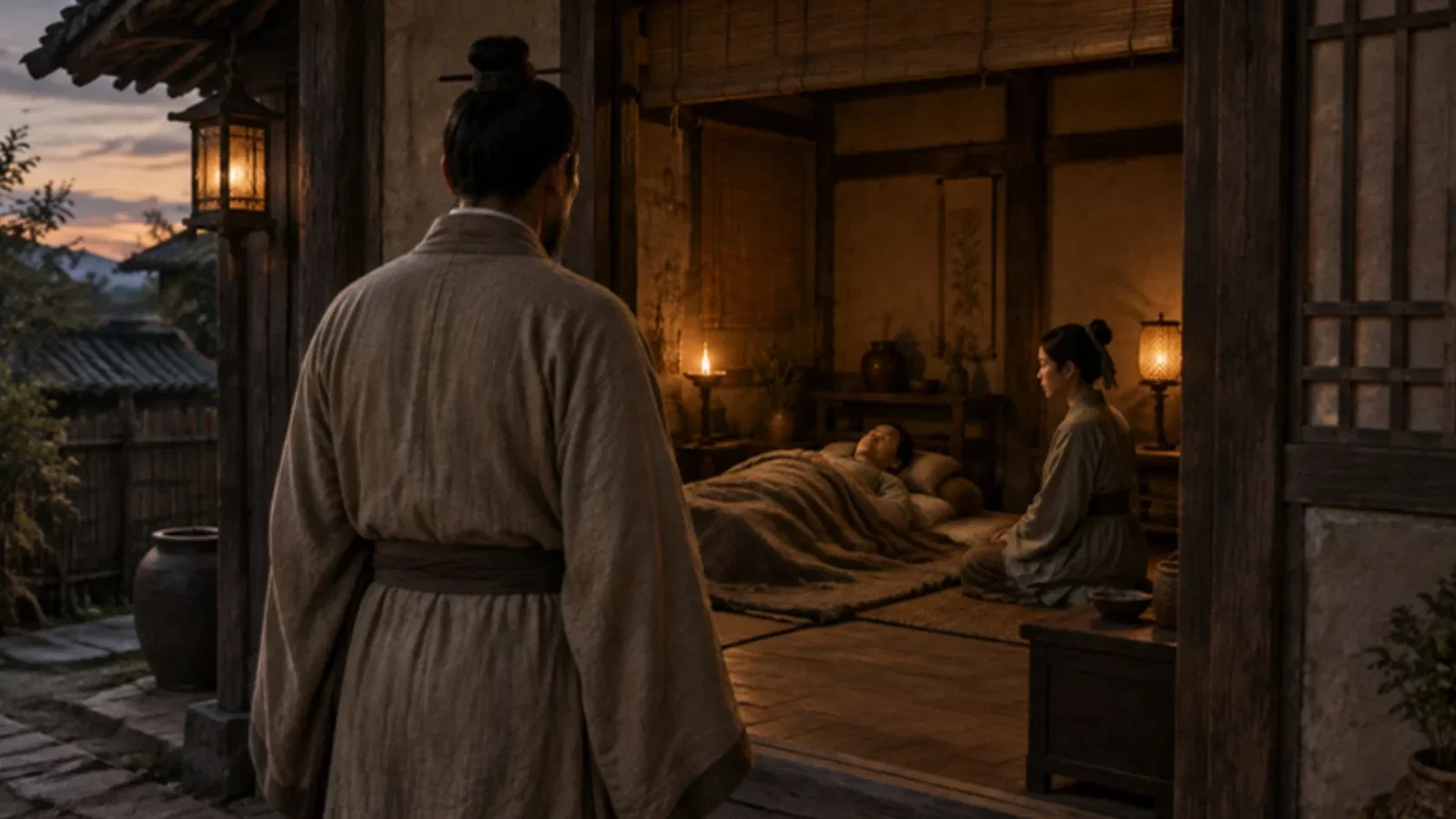
The best starting point for Hua Tuo's anesthesia story is not a reconstructed operating room. It is a pair of passages whose wording differs. Both connect a drug-induced loss of awareness with surgery. Neither, by itself, establishes a verified first case of general anesthesia.[1,2]
I. Two texts, not one interchangeable quotation
In Hua Tuo's biography in chapter 29 of the Records of the Three Kingdoms, Chen Shou writes:
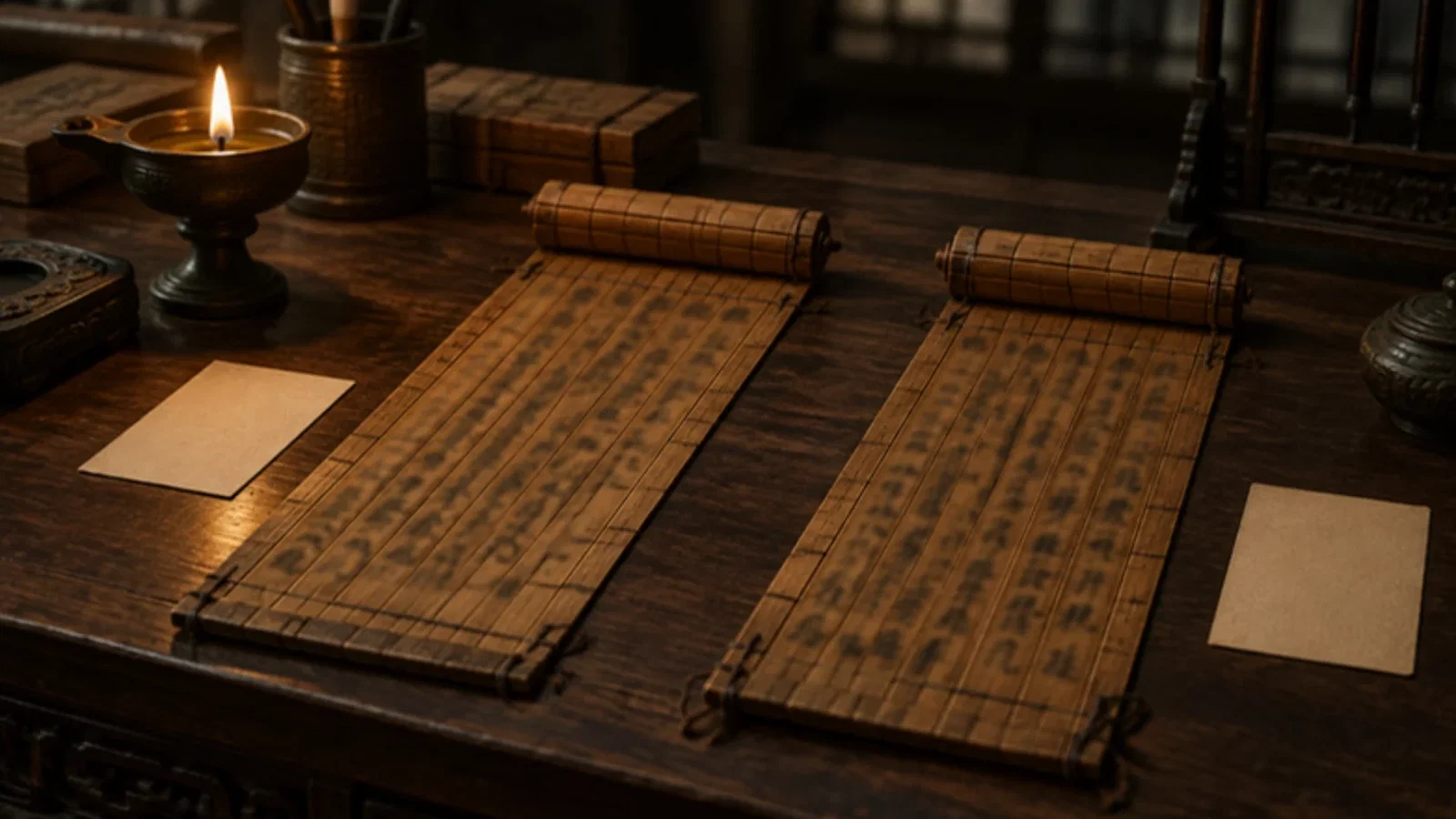
若病結積在內,針藥所不能及,當須刳割者,便飲其麻沸散,須臾便如醉死無所知,因破取。[1]
In our translation: when an internal condition lay beyond the reach of needles and medicines and required cutting, the patient would drink mafeisan; soon appearing as if dead drunk and knowing nothing, the patient would then undergo an incision and removal. The account continues with treatment of the intestines, suturing and recovery. These are the biography's descriptions, not outcomes independently confirmed from a clinical record.[1]
Fan Ye's History of the Later Han, chapter 82b, gives a related account that explicitly mentions taking mafeisan with wine, followed by cutting into the abdomen or back to remove accumulated disease.[2] That is the source of the wine-and-abdomen quotation; it should not be attributed to Chen Shou. Reading the two passages separately corrects the attribution without pretending that their relationship supplies two independent observations. A modern historical article also prints and distinguishes them.[3]
II. What the accounts establish—and what they leave open
The passages matter because they describe altering a patient's awareness before an otherwise painful intervention. They do not provide the date of a particular operation, a complete prescription, a case count, or an assessment of anesthetic depth and safety that can be checked by modern criteria.[1,2]
This article therefore uses approximately 200 CE as an editorial position for the late Eastern Han setting, not as the date of a documented operation.
The biographies also contain extraordinary and supernatural stories. Their concise surgical passages cannot be authenticated merely by calling the surrounding history restrained. Nor can a transmitted description of insensibility, written after Hua Tuo's lifetime, settle whether every procedure occurred as described. The distinction is between evidence for an account and evidence sufficient to reconstruct an event.
III. An unknown formula should remain unknown
The historical passages read here contain no ingredient list. Yuan and colleagues discuss whether the anatomical, surgical and pharmaceutical conditions of the period could have allowed such a preparation; their 2020 article does not report the recovery of Hua Tuo's prescription. Brand and Zhao likewise treat the proposed inclusion of cannabis as speculation.[3,4]
A plant's known effects on the nervous system do not establish that Hua Tuo used it. Conversely, a simplified comparison of modern receptor mechanisms cannot determine the efficacy or safety of an unidentified ancient compound. This article therefore does not rank supposed ingredients or assemble henbane, cannabis, aconite and wine into a plausible-looking recipe. That would turn a gap in the evidence into a pharmaceutical claim.
IV. A burned scroll is not a complete explanation
The biographies describe Hua Tuo offering a scroll to a prison official before his death. When the official declined, Hua Tuo burned it. They do not identify the scroll as a mafeisan prescription. They also name Wu Pu and Fan A as men who learned from him.[1,2]
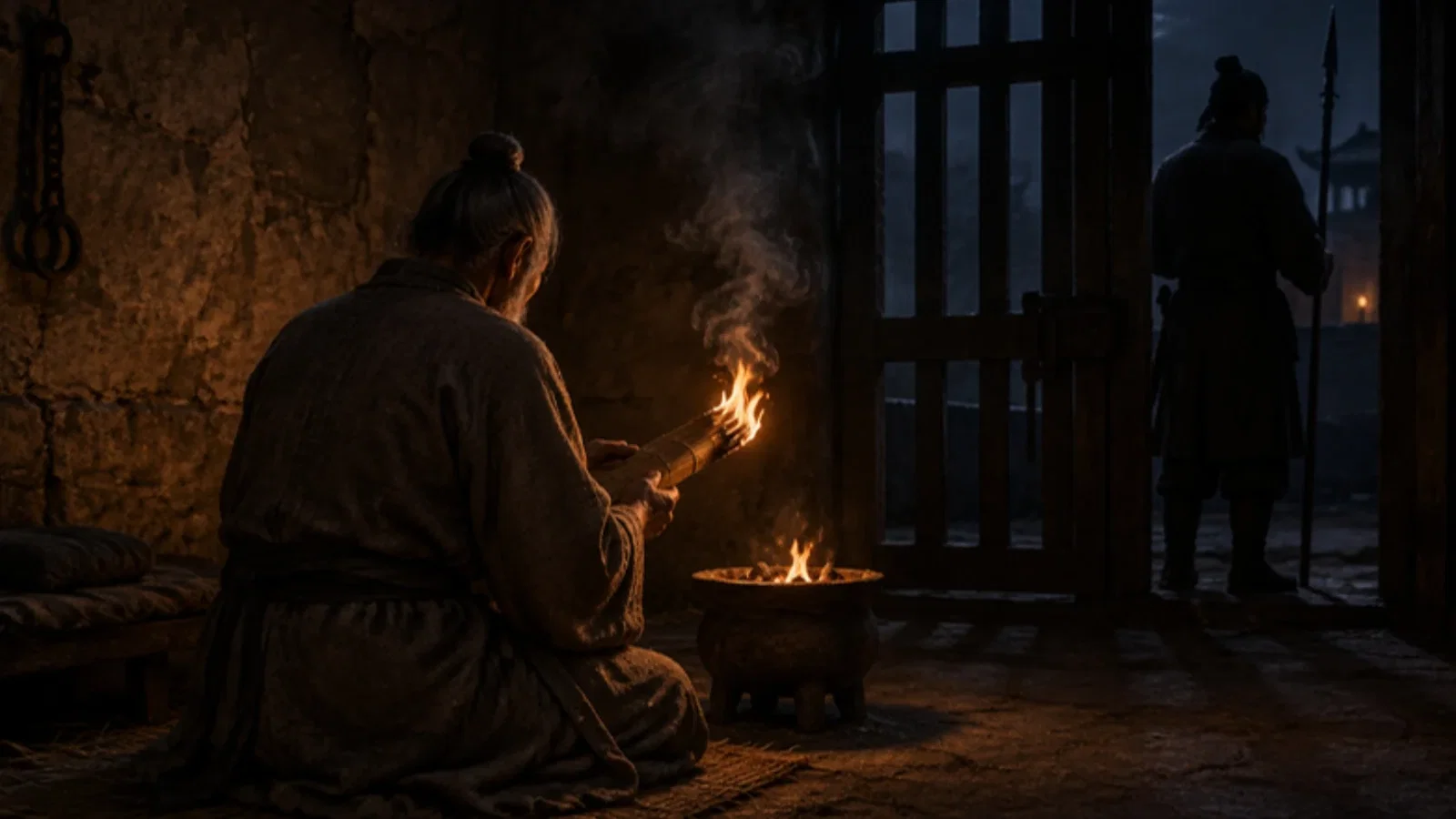
Those details do not establish uninterrupted transmission of mafeisan. But they do prevent an equally confident opposite story: that Hua Tuo's death demonstrably destroyed every part of his knowledge and ended all subsequent Chinese development in pain relief. The sources do not give us that causal chain.
Hua Tuo's place in this history does not depend on winning a priority contest with Boston. It rests on a consequential historical record: an account that connects taking a preparation, becoming unaware and undergoing surgery. We can preserve that account's significance while acknowledging that its formula and results cannot presently be reconstructed from the evidence read here.
Image note: all four images are AI-generated editorial illustrations. They are not portraits, authenticated objects, ingredients or surgical scenes.
Sources and reading limits
[1] Chen Shou. Records of the Three Kingdoms, chapter 29, Hua Tuo biography. Chinese Text Project · Alternative transcription, checked against the complete Wikisource transcription. These are electronic witnesses to transmitted texts, not independent clinical sources. English rendering above is our translation.
[2] Fan Ye. History of the Later Han, chapter 82b, Hua Tuo section. Chinese Text Project · Alternative transcription, checked against Wikisource.
[3] Yuan H, Zhou D, Yin L. Taking Mafei Powder (麻沸散) as an Example to Explore the Evidence of the Existence of Ancient Anesthesia. Chin Med Cult. 2020;3(2):83–86. DOI:10.4103/CMAC.CMAC_11_20. University-hosted issue PDF; all four article pages read. Historical plausibility arguments are not treated as recovery of a prescription.
[4] Brand EJ, Zhao Z. Cannabis in Chinese Medicine: Are Some Traditional Indications Referenced in Ancient Literature Related to Cannabinoids? Front Pharmacol. 2017;8:108. DOI:10.3389/fphar.2017.00108. Publisher full text. Read: the methods, relevant pain/mafeisan passages and conclusion, not every section.
Updated September 7, 2026. Sources and reading limits are stated above. Illustrations are labelled as original source images or AI-made. Historical accounts are educational; they are not current treatment instructions.
Continue exploring
Related reading connects shared questions and contexts; it does not by itself establish historical influence.
- c. 1550 BCE: The Ebers Papyrus and an Uncertain Plant Name
- c. 1250: The Soporific Sponge, a Recipe Not a Proven Anesthetic
- 1804: Hanaoka Removes a Breast Tumor Under Oral Anesthesia
- 1846: The Ether Dome, a Breakthrough Without a Perfect Moment
Anesthesia Epochs · The Source Room · About & Editorial Method