Recipes for a soporific sponge or drink, a tradition that surgical texts carry into the thirteenth century, promise sleep through an operation, but the surviving texts record prescriptions and routes, not patients or outcomes.
Reading Library · Anesthesia Epochs · 中文版
Watch the companion film
13th Century: Soporific Sponge · Watch on YouTube
Historical anchor: 1250. Approximate placement; see the essay for the date range and evidence.
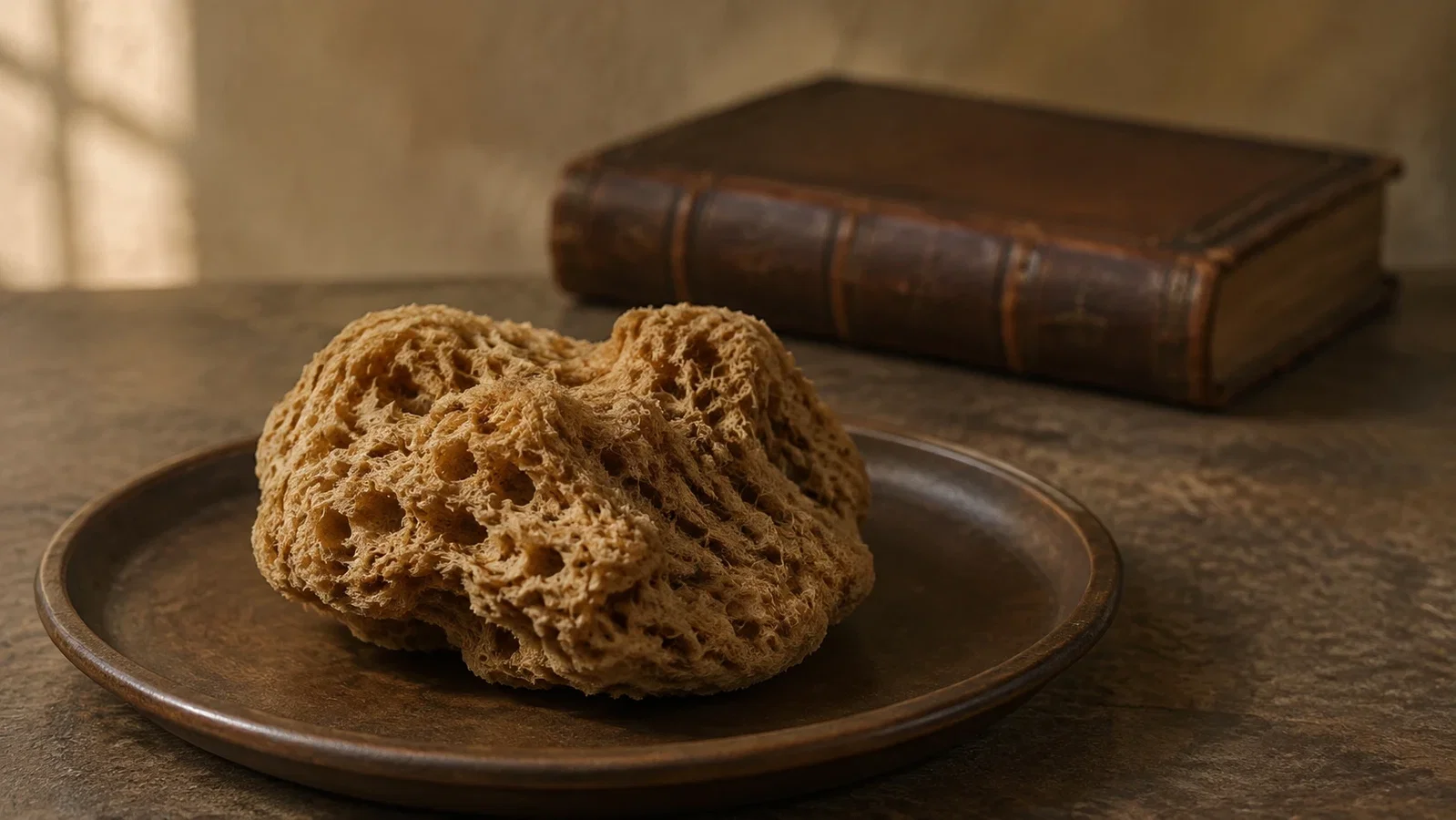
A sponge as a historical clue. This retrospective illustration is not an excavated artifact, validated anesthetic apparatus or demonstration of administration.[1,2]
The patient in the recipe falls asleep promptly. Between that promise and the patient's actual experience lies a record we have not been given.
The soporific sponge invites a complete story: a medieval surgeon induces sleep, operates, then wakes the patient. Reading a particular text complicates that sequence. A written intention to lessen operative pain does not, by itself, establish adequate anesthetic depth or dependable recovery.[1–3]
What the thirteenth-century label means
In The Genesis of Surgical Anesthesia, Bergman describes a thirteenth-century sponge prescription associated with Theoderic within a tradition spanning several centuries. That makes the century a useful narrative anchor, not the date of a first successful operation.[2]
Luft's scholarly notes, drawing on Baur, trace the recipe tradition to the ninth century and compare a twelfth-century Antidotarium Nicolai version. This is a modern scholarly account of earlier witnesses, not this site's direct inspection of a ninth-century manuscript.[1]
The date of a tradition and the date of the text in front of us need not coincide.
A drink with directions for the nostrils
Recipe 5/71 in Luft's edition begins by calling the preparation a drink intended to ease operative pain through sleep. Its closing directions turn instead to nasal administration. The recipe does not itself specify a sponge or the precise means of nasal delivery. The notes explain its relationship to a Latin sponge recipe; the following Welsh recipe, 5/72, explicitly names a sponge in an instruction for waking the patient.[1]
Those details resist easy substitution. Selecting only the word drink could misrepresent the intended route. Equating nasal directions with modern inhalational anesthesia would supply a mechanism the wording cannot establish. Neither the waking instruction nor its confident tone proves reliable reversal.
No formulation, quantities or preparation instructions are reproduced here. These texts are not treatment advice.

Copying a text does not reproduce an outcome. The person and book pages are imagined, not an identified physician or an authenticated manuscript.[1,2]
Luft's 2020 edition uses Rawlinson B467 as the base for Book 5, with variants and supplied passages from other witnesses. That composite manuscript dates to the late fourteenth or early fifteenth century. A traceable critical text is not a thirteenth-century operative case record.[1]
Nine preparations are not nine anesthetics
Cavalloro and colleagues examine nine preparations attributed to Borgognoni at folios 4r/v of Lucca's Manuscript 1939. They date the codex to the fourteenth century and the prescription material to the late thirteenth or early fourteenth century.[4]
These are not nine identical sponge recipes, let alone nine patients. Table 1 includes different preparations and purposes, with oral and topical forms. The study connects the texts with research on plant constituents. That can generate pharmacological questions; its design does not turn the old compounds into clinically tested anesthetics.[4]
Our inference is limited: identifying an active constituent does not establish how much a historical preparation delivered, what state it produced or what harm accompanied it.
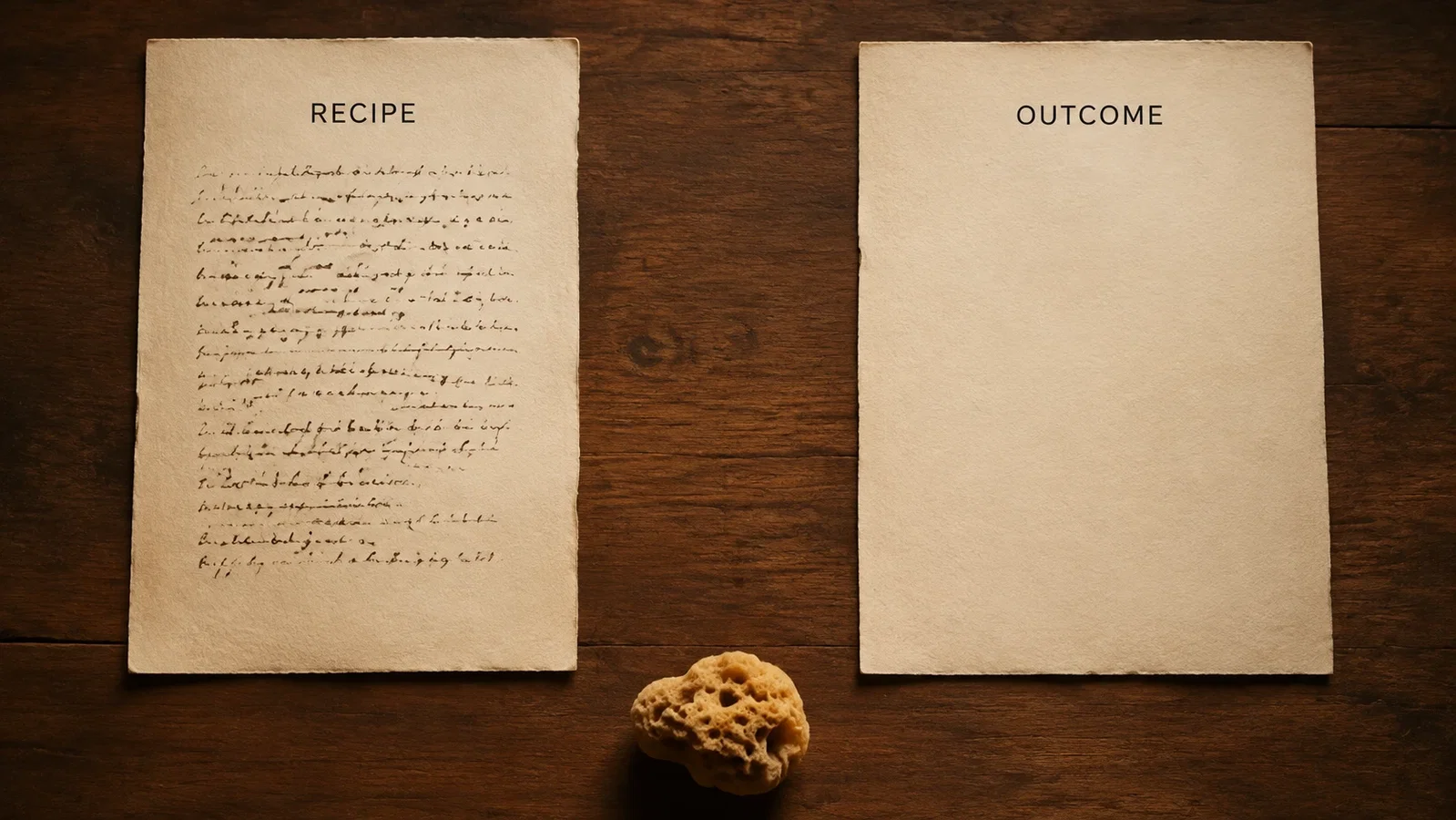
A prescription and an outcome record are different evidence. The blank sheet represents the limit of the recipes inspected here, not the absence of all historical outcomes.
Warnings belong in the story
Hunter's study of early-modern English sleep medicine discusses Giovanni da Vigo's works published in English in 1543. His report of others using an opium-containing sponge also carried a warning about danger. We have read this through Hunter, not independently inspected that 1543 edition.[3]
Hunter distinguishes English oral dwale from the continental sponge tradition. Her principal material is early-modern household recipes, not a medieval surgical cohort. Ordinary sleep, intended stupefaction and modern surgical anesthesia cannot be treated as interchangeable merely because a text uses the language of sleeping.[3]
Bergman's account also juxtaposes conflicting later reports of attempts to recreate soporific sponges. Those reports warrant scrutiny. They do not authorize a verdict that every historical formula worked, or that none could ever have had an effect.[2]
A place without an invented operation
The sponge does not need an imagined, peacefully anesthetized patient to earn its place in this history.
These writings show efforts to make relief from operative pain something that could be prepared, transmitted and explained. They also expose the distance between the certainty of a prescription and observation of what happened to a patient. Respect for that effort can coexist with uncertainty about its results.
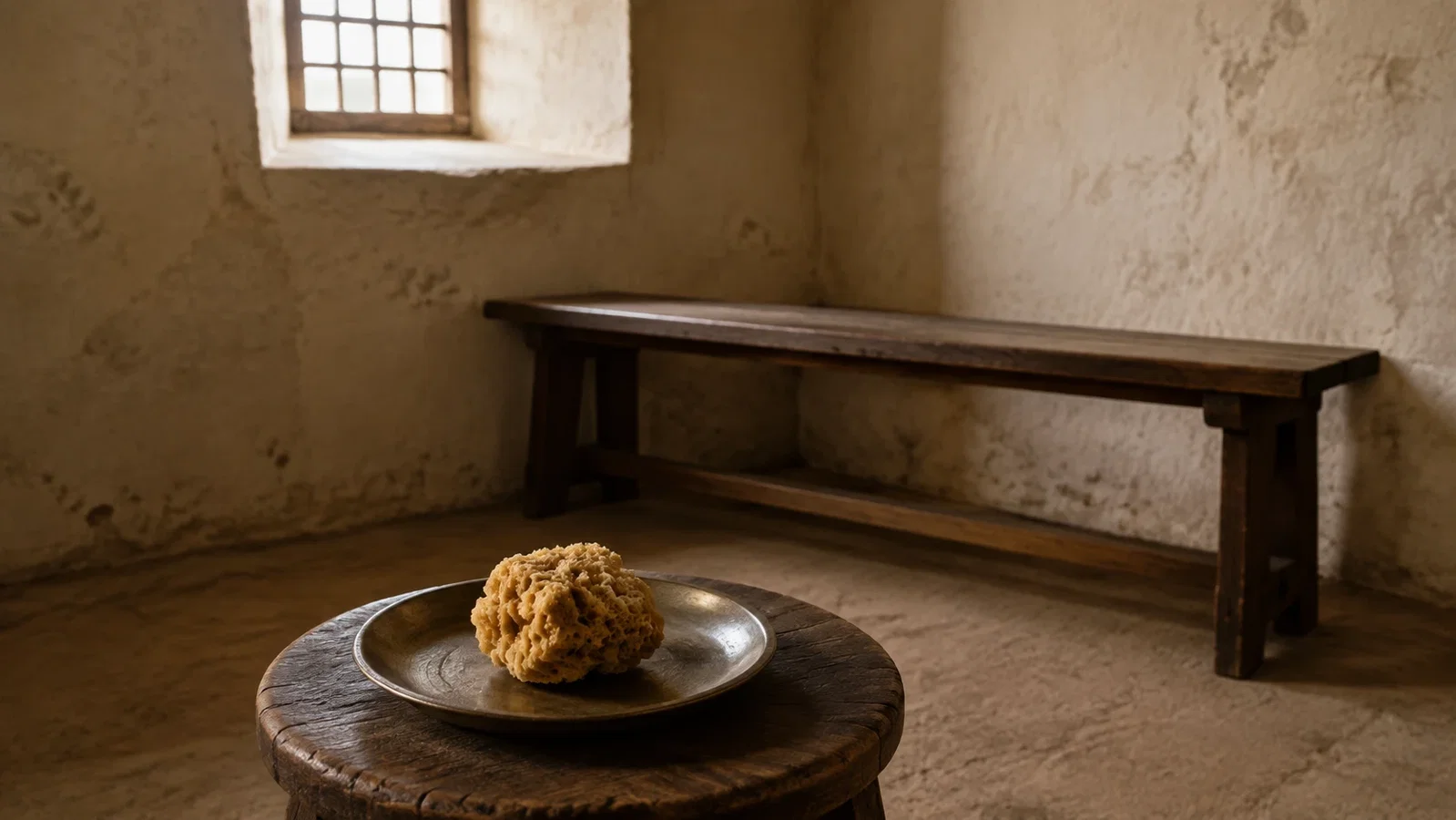
Leaving the unverified operation outside the frame. The room is an original atmospheric reconstruction, not an identified treatment site. No patient or administration is shown.
The sponge belongs in the picture. A patient guaranteed to feel no pain and then wake safely does not.
Sources and reading limits
- Luft D. Medieval Welsh Medical Texts: Volume One: The Recipes. Cardiff: University of Wales Press; 2020. Complete 624-page PDF; selected edition information and printed pages 12, 111–113, 154–155, 369–370 read. Critical text and translation, not a whole-book reading or independent Welsh collation.
- Bergman NA. The Genesis of Surgical Anesthesia · Archived copy. Wood Library-Museum of Anesthesiology; 1998. Title/copyright and complete sponge subsection, printed pages 18–19, read online.
- Hunter EK. ‘To Cause Sleepe Safe and Shure’. Social History of Medicine. 2022;35(2):473–493; advance access 23 October 2021. DOI:10.1093/shm/hkab064. Complete PDF/XML; selected pages and corresponding text checked. Not an independent reading of every cited early edition.
- Cavalloro V, et al. Teodorico Borgognoni’s Formulary for Thirteenth Century Anesthetic Preparations. Life. 2023;13:1913. DOI:10.3390/life13091913. Complete 15-page PDF/XML; relevant main-text sections, Table 1 and Figures 1/7 read. Not a reference-by-reference botanical pharmacology audit.
Historical discussion, not treatment advice. The year 1250 is only the midpoint of the thirteenth century used to place this article. Sources and reading limits are stated above. Illustrations are labelled as original source images or AI-made. Historical accounts are educational; they are not current treatment instructions.
Continue exploring
Related reading connects shared questions and contexts; it does not by itself establish historical influence.
- c. 1550 BCE: The Ebers Papyrus and an Uncertain Plant Name
- c. 200: Hua Tuo's Mafeisan, a Recipe That Cannot Be Recovered
- c. 1015: Cold in Avicenna's Canon, Relief Versus Safety
Anesthesia Epochs · The Source Room · About & Editorial Method